
Security and compliance are no longer just checkboxes for SaaS companies. They’re now core to customer trust and competitive differentiation.
If your product processes financial transactions, touches healthcare data, or hosts sensitive customer information, regulatory expectations are higher than ever. And because SaaS companies move fast and operate globally, governance and risk can’t be treated as a once-a-year audit exercise.
From ISO 27001 certification to GDPR compliance, maintaining regulatory readiness can become a serious drain on time and internal resources unless you have a trust management platform that helps you automate and scale your program.
That’s where modern Governance, Risk, and Compliance (GRC) tools come in. These platforms centralize controls, evidence, and workflows so you can reduce manual work, stay audit-ready, and keep your team focused on building and shipping.
Below, we’ll walk through five of the best GRC tools for SaaS companies in 2026 and break down how each one supports compliance at scale. As compliance is just one piece of a broader SaaS technology ecosystem, you may also want to review our breakdown of the essential software services for SaaS companies to understand how GRC fits into the larger operational stack.
Why GRC Tools Matter More Than Ever in 2026
For SaaS companies, governance, risk, and compliance (GRC) is now a day-to-day operating requirement, not a once-a-year audit project. As more software companies expand into regulated industries and international markets, expectations are rising for transparency, accountability, and demonstrable controls.
In the EU, the Digital Services Act (DSA) is already in effect and is raising the bar for how organizations prove oversight. At the same time, the EU AI Act is rolling out on a phased timeline, which makes 2026 a key year for teams that build, use, or sell AI capabilities into Europe to get prepared.
In the U.S., privacy compliance is getting harder, not easier. Instead of a single national standard, more states now have privacy laws in effect, with new rules and updates continuing to emerge. That pushes SaaS companies to manage overlapping requirements across product, legal, security, and go-to-market teams.
GRC is also tied directly to revenue. Enterprise buyers increasingly treat security posture and compliance maturity as a gating factor in procurement. If you cannot quickly demonstrate SOC 2 readiness, maintain clean evidence trails, and run a credible vendor risk program, deals slow down or shift to competitors who can prove it faster.
Modern GRC tools help you turn compliance into a repeatable system by centralizing controls and evidence, improving visibility across teams, and reducing the operational drag of audits and customer security reviews as you grow. If you want to explore in depth how GRC software strengthens compliance maturity and reduces operational risks, read our detailed guide on why GRC software is key to enhancing business compliance.
1. Vanta: Agentic Trust Platform
Best For: Automating Compliance for Scaling SaaS Companies
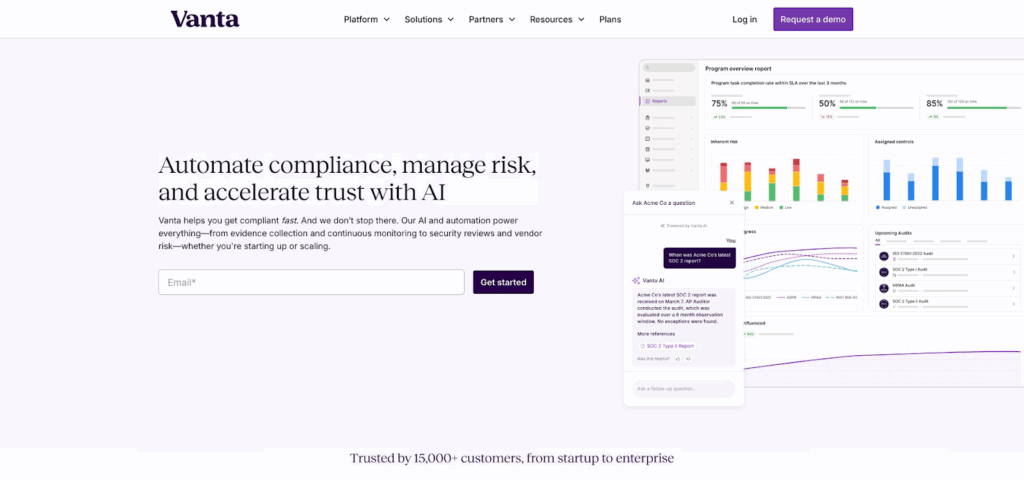
Vanta is an agentic trust platform, and its GRC software helps SaaS teams move from "getting compliant" to running compliance as an ongoing system. Founded in 2018 and headquartered in San Francisco, Vanta supports 16,000+ customers and is positioned for teams that need to scale across frameworks, stakeholders, and regions without scaling manual work at the same pace.
Vanta at a glance
- Founded: 2018
- HQ: San Francisco, CA
- Scale and recognition: 16,000+ customers; recognized as a Leader in the 2025 IDC Worldwide GRC Software MarketScape; a G2 Leader for Security Compliance for nine consecutive quarters with ~2,700 G2 reviews
- Vendor risk expansion: Acquired Riskey (2025) for continuous vendor risk monitoring
- Customer experience: 95.5 CSAT
What Vanta helps your team run day to day
Vanta’s core value is continuous compliance automation. It combines evidence collection and controls monitoring with adjacent GRC workflows, including risk management, policy management, issue management, access management, vulnerability management, and asset inventory. For SaaS organizations, that means you can centralize the work across engineering, IT, security, and legal, then keep it operating between audits.
Framework coverage (and how far it goes beyond SOC 2)
Vanta supports 35+ frameworks out of the box, including SOC 2, ISO 27001, HIPAA, GDPR, PCI DSS, HITRUST (via MyCSF integration), SOC 1, NIST 800-53, NIST 800-171, CMMC, FedRAMP, CCPA, ISO 42001, and more. It also supports custom frameworks when you need to layer in internal requirements.
Automation depth and integrations
For teams evaluating “how much work is actually automated,” Vanta’s approach centers on technical integrations and continuous monitoring:
- 400+ pre-built integrations across cloud, identity, HR, engineering, security, and productivity tooling
- Hourly automated test runs, with alerts when tests fail and workflows that push remediation into your existing task trackers
- Private Integrations for custom or in-house systems, plus an open API for extensibility
AI capabilities (where the platform reduces the most toil)
Vanta includes a Vanta AI Agent embedded across the platform. It’s designed to reduce time spent searching, mapping, and drafting by supporting workflows like agentic search across controls and documentation, evidence checks and collection, policy generation and bulk imports, control mapping, SLA tracking, issue management, and more.
Vanta also offers Questionnaire Automation (QAuto) for responding to inbound security questionnaires, with tier-based volume (for example, up to 25 questionnaires per year at Plus and up to 144 per year at Professional).
Vendor risk management and continuous monitoring
Vanta includes a full third-party risk management (TPRM) module that covers vendor inventory, risk tiering, questionnaires, a vendor portal, and AI-supported vendor security reviews. With the Riskey acquisition, Vanta also offers continuous external risk signal monitoring to help teams move from point-in-time vendor reviews to ongoing oversight.
Trust demonstration for faster security reviews
For SaaS companies selling into the enterprise, trust is part of the sales motion. Vanta’s Trust Center is built for that reality, with 6,000+ live public trust centers and features designed to reduce back-and-forth in procurement. It supports workflows like controlled access requests and NDA handling, integrates with systems like Salesforce and HubSpot, and can include an AI chatbot experience for buyers to self-serve answers.
Audit workflow and auditor collaboration
Vanta supports an end-to-end audit workflow, including compliance roadmaps, scoping support, SOC 2 system description generation, ISO Statement of Applicability (SoA) workflows, and auditor collaboration through an auditor portal and Auditor API. Teams can also work with Vanta’s vetted auditor network or bring their own auditor.
Pricing structure
Vanta offers four tiers: Essentials, Plus, Professional, and Enterprise. Pricing is based on factors including framework count, employee count, and selected modules. (Essentials includes one framework, and higher tiers expand capabilities like QAuto and risk management.) You can see more at vanta.com/pricing.
Ideal company profile
Vanta is a strong fit for cloud-native, growth-stage to enterprise SaaS companies (roughly 50 to 5,000+ employees) that need to pass SOC 2 and/or ISO 27001, maintain continuous compliance, demonstrate trust to buyers, and scale their program without a proportional increase in headcount.
Known limitations
Vanta is not positioned as a privacy consent platform. It does not natively offer cookie consent management (it partners with Osano). It offers EU AI Act support as a dedicated framework alongside ISO 42001. Privacy automation capabilities like DPIA and data inventory are noted as being on the roadmap. For analytics, it uses built-in reporting rather than integrating directly with BI tools like Power BI.
Customer proof points
Vanta is used by 16,000+ customers, including Snowflake, GitHub, Duolingo, Replit, Clay, and the Golden State Warriors.
Want to streamline your path to compliance? Vanta’s GRC software brings compliance automation, risk management, vendor risk, and trust demonstration into one platform so you can stay audit-ready as you scale.
2. OneTrust
Best For: Privacy and Data Governance at Enterprise Scale
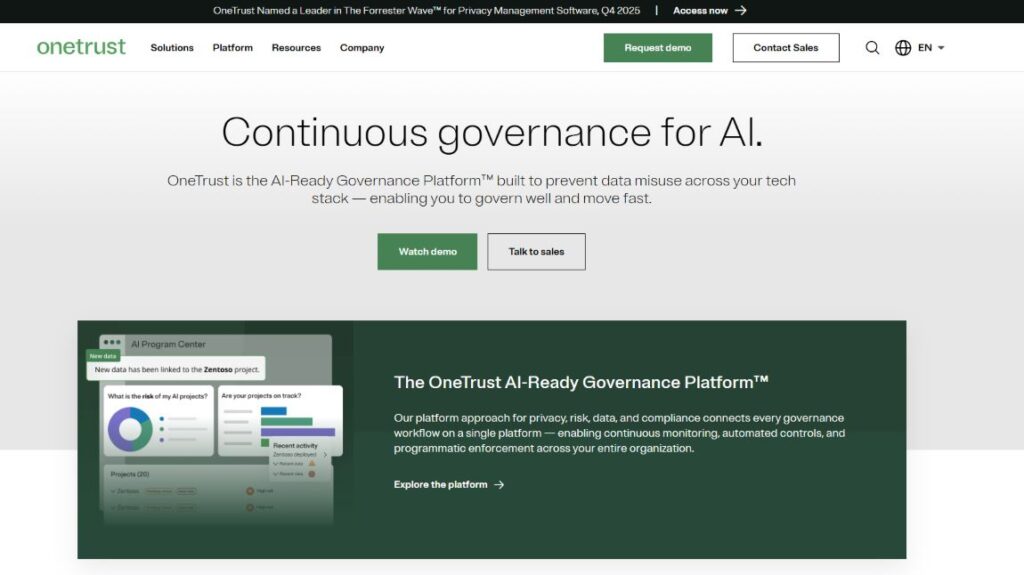
OneTrust is best known as an enterprise privacy platform, and that is where it tends to deliver the most value. For SaaS companies operating across multiple jurisdictions, it can bring structure to privacy operations like consent, data subject requests, and privacy impact work, alongside broader GRC needs.
It is also important for buyers that OneTrust’s compliance automation capabilities came through its acquisition of Tugboat Logic (2021), then were rebuilt as part of its broader platform. In practice, OneTrust is often the right choice when privacy is the primary driver, and compliance automation is part of a larger governance ecosystem.
Company snapshot
- Founded: 2016
- HQ: Atlanta, GA and London, UK
- Scale: ~3,500 employees; 14,000+ customers (with an important nuance that ~50 percent primarily use the cookie consent product)
- Enterprise footprint: Used by 75 percent of the Fortune 100
- Funding: $1.13B raised
- ARR estimate: $500–600M (2025 estimate)
Core GRC and privacy capabilities
OneTrust’s scope is broad, spanning multiple modules. On the GRC side, its Technology Risk & Compliance module supports core program building blocks like controls, policies, risk management, issue management, audit workflows, and reporting. On the privacy side, OneTrust is typically used for capabilities such as:
- Privacy impact assessments
- Cookie consent management
- Data governance workflows
- Vendor risk scoring and third-party risk workflows
- Incident response workflows
Reporting for Technology Risk & Compliance is powered by Power BI. OneTrust also added evidence evaluation and AI-recommended evidence-to-control mapping in Fall 2025.
Framework coverage
OneTrust supports major security and privacy frameworks including SOC 2, ISO 27001, HIPAA, GDPR, PCI DSS, and NIST, plus a wide range of global privacy requirements. The platform’s strength is breadth of governance and privacy coverage, although the automation depth for compliance evidence and controls is typically lighter than purpose-built compliance automation platforms.
Automation depth and integrations
OneTrust offers roughly 100 integrations overall, with about 22 focused specifically on tech risk and compliance. Compared to compliance automation platforms built around deep infrastructure testing, OneTrust’s compliance workflows generally require more manual setup and evidence work.
Notable automation and integration constraints cited in the research include:
- No continuous monitoring of internal controls, with more reliance on users to add evidence through workflows
- Limited out-of-the-box support for version control systems (GitHub, GitLab, Bitbucket)
- Fewer bi-directional ticketing options (Jira, Asana, ServiceNow, Zendesk)
- No policy document syncs with tools like Google Drive, Confluence, or SharePoint
- No MDM integrations
AI capabilities
OneTrust’s AI capabilities are strongest in specific areas, including AI-assisted evidence evaluation and control mapping (added Fall 2025). It also offers a Third-Party Risk Agent that can automate parts of vendor risk assessment using data from the Third-Party Exchange.
Vendor risk management
OneTrust includes a dedicated Third-Party Risk Management module, including questionnaires and vendor assessment workflows. A differentiator is the Third-Party Exchange, which provides a catalog of vendor security and privacy profiles that teams can use during due diligence.
Trust demonstration and external security reviews
OneTrust has a Trust Center, but it is more privacy-focused and is not positioned as a real-time, compliance-forward Trust Center that highlights passing controls and continuous monitoring. It also does not offer AI-powered questionnaire automation at the same level as dedicated compliance automation platforms designed to accelerate inbound security reviews.
Audit workflow and implementation considerations
OneTrust supports internal audit workflows and enterprise reporting. The trade-off is that deployments often require more configuration and services. Implementation services are cited as ranging from $5,000 for self-starter deployments to $100,000+ for complex implementations.
Pricing structure (high level)
OneTrust pricing is module-based and typically enterprise-oriented:
- Tech Risk & Compliance: priced based on admin users and asset inventory, cited in the $50K–$300K license range
- TPRM: priced based on vendor count and system users, cited in the $40K–$500K range
- Additional charges may apply for implementations and integrations
- Consent management, privacy, and data governance are priced as separate modules, and support is tiered (Essential vs Premier Success)
Ideal company profile
OneTrust is best suited for large enterprises (often 1,000+ employees) with mature governance programs, multi-jurisdiction privacy requirements, and the budget and internal resources to support a more involved implementation. It is a particularly strong fit when cookie consent, privacy operations, and data governance are central requirements.
Known limitations
Based on the research, the main limitations for SaaS teams using OneTrust primarily for security compliance automation include fewer and shallower compliance-focused integrations, lack of continuous monitoring for internal controls, and a more complex, services-heavy rollout compared to compliance automation platforms built for fast SOC 2 and ISO 27001 outcomes.
Customer proof points
OneTrust is widely adopted across large enterprises, including significant usage within the Fortune 100 (often driven by privacy and consent needs). The research also notes examples of companies that migrated away from OneTrust to other compliance automation platforms, including MapLight, Orderful, 3PlayMedia, Jivox, and iSoftpull, citing a need for easier implementation and stronger automation.
3. LogicGate Risk Cloud
Best For: Custom Workflows for Enterprise Risk and GRC Programs
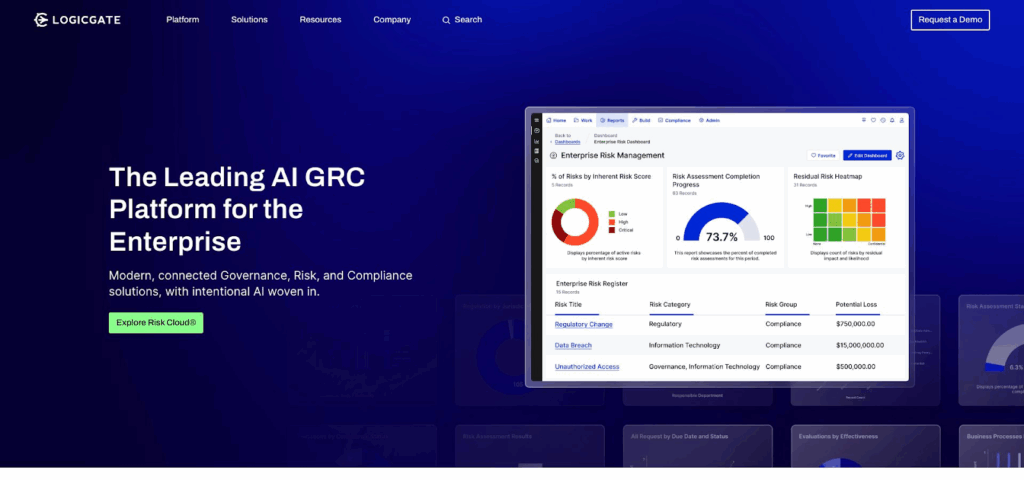
LogicGate Risk Cloud is a no-code GRC platform built for organizations that want to model complex risk and compliance workflows across multiple business units. It is often a better fit for mid-to-large enterprises with established GRC teams than for SaaS companies looking for the fastest path to a first SOC 2 or ISO 27001 audit.
Company snapshot
- Founded: 2015
- HQ: Chicago, IL
- Team and funding: ~300 employees; $156M raised (Series 5A, Sept 2024)
- Market validation: Named a Leader in The Forrester Wave GRC Platforms Q4 2023; Major Player in the 2025 IDC MarketScape for GRC
- Customer and review signals: “Hundreds” of customers (400+ per IDC report); G2 rating 4.6/5 with 180+ reviews
Core GRC capabilities
At its core, Risk Cloud is a workflow and data platform. LogicGate’s “Application Canvas” lets teams build and connect processes across a broad set of GRC domains. The platform includes 40+ interconnected applications, including:
- Enterprise Risk Management (ERM)
- Controls and compliance
- Third-party risk management (TPRM)
- Regulatory compliance management
- Internal audit management
- Operational resilience
- ESG management
- Data privacy management
- AI governance
LogicGate also offers Risk Cloud Quantify for risk quantification, and the platform is built on a graph database architecture that’s designed to link risks, controls, issues, and workflows across the organization.
Framework coverage
LogicGate supports 30+ frameworks with cross-framework mapping. The expert research also notes gaps in some regional and industry-specific frameworks, including Cyber Essentials (UK), Essential Eight (Australia), TISAX, CJIS, AWS FTR, and Microsoft SSPA. Framework content loading can be accelerated through premium support, which is a paid add-on.
Automation depth and integrations
Risk Cloud can automate evidence collection, but it is not primarily a “pre-built tests” compliance automation model. Instead, automation is often achieved through configuration, services, and workflow-based automations:
- 40+ pre-built integrations
- Automation via workflow “Jobs,” which typically require customization
- Merge.dev for standardized data pulls from systems
- Workato-based connectors for more complex integrations (noted as an additional cost)
- Open RESTful API and an SFTP connector for enterprise and legacy needs
For SaaS teams evaluating effort reduction, the key trade-off is that LogicGate generally involves more build and configuration work to reach a comparable level of automated control validation.
AI capabilities
LogicGate includes Spark AI, with AI embedded across the platform to support recommendations such as control mapping, record linking, and text generation. It also offers an AI governance application for managing AI-related compliance workflows. At the same time, the expert research notes that some G2 reviewers cite a slower innovation pace, with feedback that certain items have remained “on the roadmap for numerous years.”
Vendor risk management
LogicGate supports vendor risk workflows including onboarding, questionnaires, and a vendor portal for collaboration. The expert research notes limitations in automated vendor discovery and continuous external risk monitoring, which are important if your program aims to run vendor oversight continuously rather than as periodic assessments.
Trust demonstration
LogicGate is focused on internal GRC operations. It does not offer a dedicated Trust Center product for externally demonstrating security posture to prospects, and it does not offer a questionnaire automation product designed to accelerate inbound customer security questionnaires.
Audit workflow
LogicGate includes an Internal Audit Management application designed for audit planning, fieldwork, and reporting. The orientation is toward internal audit and broader enterprise assurance workflows, rather than optimizing external certification audits like SOC 2 with deep pre-built testing and continuous monitoring.
Pricing structure
LogicGate pricing is highly customized and depends on:
- Which applications you purchase (from 40+ available)
- Power User licenses (admins; standard and external users are free)
- Additional features such as Risk Cloud Quantify
- Implementation, professional services, and integration services
Online sources cited in the expert research indicate a range of $11,000 to $126,000 per year, with a median of $52,000, and implementation is likely an additional cost.
Ideal company profile
LogicGate is best suited for mid-to-large enterprises (500+ employees) with dedicated GRC teams, multiple business units, and the need to model enterprise-wide workflows across ERM, internal audit, resilience, regulatory exams, and AI governance.
Known limitations
For SaaS teams primarily evaluating compliance automation speed and automation depth, the main constraints are:
- Fewer integrations (40+ pre-built) compared to compliance automation platforms with broader SaaS ecosystems
- No automated testing model comparable to continuous control testing, with more reliance on customized workflows and services
- No Trust Center or questionnaire automation for external trust and sales enablement
- Paid add-ons for premium support and some integration approaches can increase total cost of ownership
Customer proof points
LogicGate lists customers including Zurich, Hyatt, Bill.com, United Community Bank, and Ciena. The expert research also notes strong support sentiment, with 98% of G2 reviewers satisfied with support quality, and recognition as a G2 leader for ERM for 22 consecutive quarters.
4. Centraleyes
Best For: Risk-Centric Compliance Across Many Frameworks (Especially in Regulated Industries)
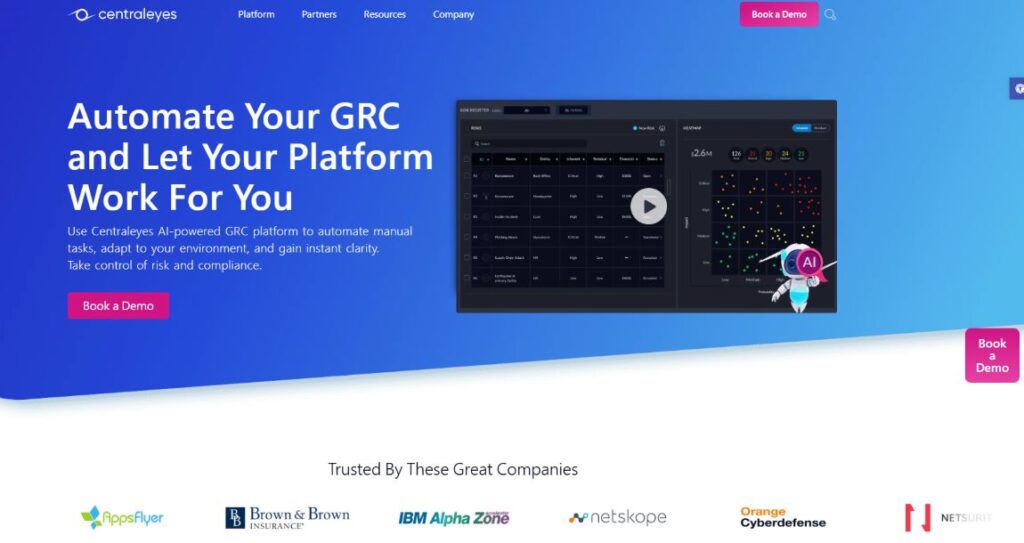
Centraleyes is best understood as a cyber risk and compliance management platform that emphasizes breadth of framework coverage and risk reporting. It can be a fit for regulated organizations that want to consolidate assessments across many standards and entities, but it is generally less aligned to the SaaS-native “deep integrations plus continuous control testing” model that many teams want for fast SOC 2 and ISO 27001 execution.
Company snapshot
- Founded: 2016 (originally CyGov)
- HQ: New York, NY (Israeli-founded)
- Funding: ~$2.8M (PitchBook)
- Revenue: <$5M (ZoomInfo)
- Go-to-market: Partner program for MSSPs and resellers
- Size: Small company, employee count not publicly confirmed
This context matters for buyers evaluating long-term product velocity and support depth relative to larger, more established platforms.
Core GRC and risk capabilities
Centraleyes centers on risk workflows and executive reporting. Key capabilities highlighted in the research include:
- 1st-party (internal) risk and compliance workflows, supported by smart questionnaires and data feeds
- 3rd-party vendor risk management for vendor assessment and categorization
- BoardView for executive-level risk reporting and decision support
- Dashboards and auto-generated reports
- Multi-tenant, no-code architecture designed for managing multiple entities
Framework coverage
Centraleyes’ standout feature is its framework library. It includes 180+ pre-loaded frameworks with cross-framework control mapping, plus support for custom frameworks. Examples cited include NIST CSF, NIST 800-53, ISO 27001, SOC 2, CMMC, PCI DSS, GLBA, CCPA, HIPAA, and FERPA.
Automation depth (what it automates, and what it doesn’t)
Centraleyes claims significant time reduction in data collection, including a “90% reduction in data collection time” based on its use of pre-loaded questionnaires and automated workflows. For many teams, the practical takeaway is that Centraleyes is strongest when your program is assessment-driven.
That said, the research notes that this is not the same as deep SaaS compliance automation through extensive infrastructure integrations and continuous automated testing.
AI capabilities
Centraleyes highlights an AI-powered Risk Register intended to quantify and prioritize risks. Beyond that, specific AI features like policy generation, evidence evaluation, and remediation guidance are not documented in the research with the same level of detail as some other platforms.
Integrations
Centraleyes supports integrations through data feeds, but the research notes a key gap for SaaS buyers: the count and depth of pre-built integrations for modern SaaS stacks (cloud providers, identity providers, HRIS, MDM, and security tooling) is not publicly documented at a level that makes it easy to evaluate evidence automation coverage up front.
Vendor risk management
Centraleyes includes a dedicated 3rd-party vendor risk module with centralized workflows for vendor assessment, categorization, prioritization, and questionnaires. This is positioned as one of the platform’s stronger areas.
Trust demonstration
For SaaS companies, trust demonstration is often part of the revenue engine. Centraleyes is not designed around that use case. The expert research indicates:
- No dedicated Trust Center for externally showcasing security posture
- No questionnaire automation product specifically aimed at responding to inbound customer security questionnaires
Audit workflow
Centraleyes can produce audit-ready outputs and reporting, but the research notes it is more oriented toward risk and compliance reporting than a full end-to-end external audit workflow with auditor portals, an auditor marketplace, or an auditor API integration.
Pricing structure
Pricing is subscription-based and customized based on factors like organization size, number of entities, and modules or frameworks. Pricing is not publicly available. A 30-day free trial is referenced in research, though it may be outdated.
Ideal company profile
Centraleyes is best suited for risk and compliance teams in regulated industries such as financial services, insurance, higher education, energy, and healthcare that need broad framework coverage, multi-entity visibility, and executive reporting. It may also fit MSSPs and consultancies delivering risk programs as a service.
Known limitations
Key limitations noted in the research include:
- Limited public detail on integration depth for SaaS evidence automation
- Smaller company profile, with relatively limited funding compared to larger GRC vendors
- Review feedback citing UI slowness, limited drill-down reporting, and an initial learning curve
- No Trust Center and no inbound questionnaire automation, which can matter for SaaS procurement cycles
- Not recognized in the 2025 IDC MarketScape for GRC
Customer proof points
Customer logos cited include IBM AlphaZone, Netskope, Orange, AppsFlyer, Brown & Brown, Florida State University, and the University of Oklahoma. The research also references a Neurosoft testimonial that highlights ease of use and automation, and a Capterra review noting that Centraleyes has frameworks and crosswalks for a wide range of needs.
5. Scrut Automation
Best For: Startups and First-Time Compliance Teams Prioritizing Price
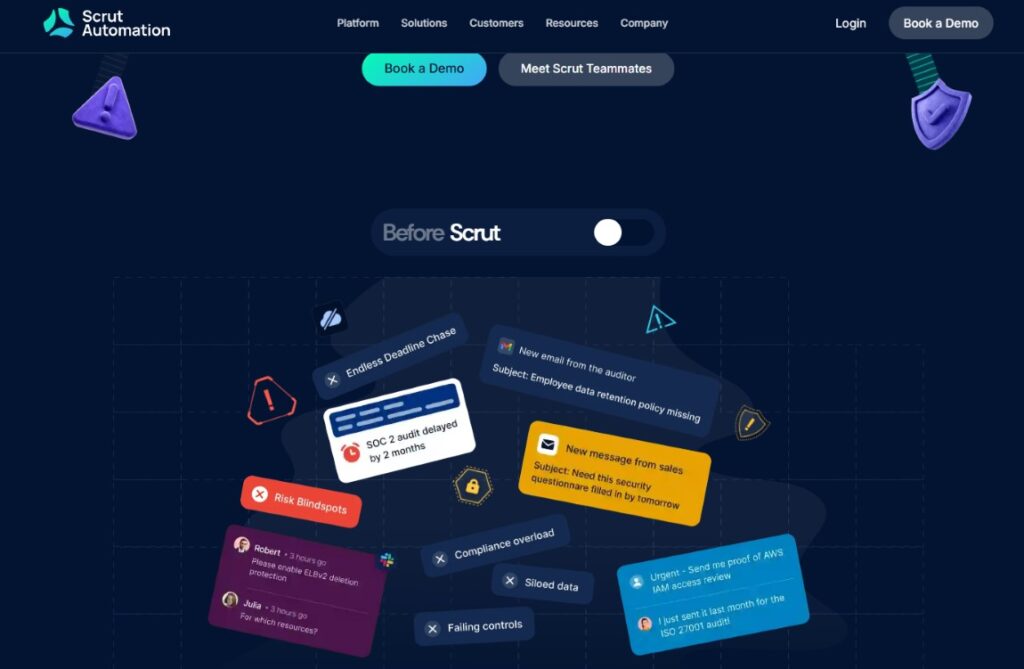
Scrut Automation is a compliance automation platform aimed at small to mid-sized companies that are building a program for the first time and want a more budget-friendly path to frameworks like SOC 2, ISO 27001, or HIPAA. It’s often evaluated when price is a primary constraint and a team is willing to trade some automation depth for a lower platform cost.
Company snapshot
- Founded: 2021
- HQ: Milpitas, CA (main office in Bengaluru, India)
- Scale: ~220 employees; ~1,700+ customers across 65 countries
- Funding: $20.5M raised (Series A, 2024, led by Lightspeed and MassMutual Ventures)
- Reviews: G2 rating 4.9/5 with 1,275+ reviews (with the caveat that some reviews may be incentivized)
- Market recognition: Absent from the 2025 IDC Worldwide GRC Software MarketScape
Core GRC capabilities
Scrut’s platform covers the core building blocks most teams need to run an audit project and maintain a baseline program:
- Controls and mapping: 1,400+ unified controls with cross-framework mapping
- Policy management: 90+ auditor-vetted templates and a ChatGPT-powered policy builder
- Audit workflow: Audit center with role-based auditor access, collaboration features, and findings management
- Program operations: Risk management (risk register, scoring, treatment plans), asset inventory, user access reviews, dashboards
- Security add-ons: Employee security training, continuous vulnerability scanning with Jira integration, and a built-in DAST tool
- Device coverage: Built-in MDM plus support for third-party MDM
Framework coverage
Scrut supports 60+ compliance frameworks. The expert research also notes it does not have pre-built support for HITRUST, which can be a deciding factor for healthcare and healthtech teams.
Automation depth and integrations
Scrut offers 70+ integrations and automated tests that run once daily. The research notes that the platform has fewer tests overall than more integration-heavy competitors, which can translate into more manual evidence work as you get closer to audit.
The expert findings also highlight a few practical constraints:
- Limited shadow IT discovery (SSO-based only)
- Customer-reported integration bugginess and a steeper learning curve than expected
AI capabilities
Scrut positions AI as a productivity layer across compliance tasks. Its AI teammate is described as supporting workflows like answering questions, creating tickets, assigning owners, tracking progress, suggesting code fixes, evaluating inherent risk, and helping with vendor reviews. It also offers AI-powered questionnaire automation with multi-format support and a centralized answer library.
At the same time, the expert research notes customer feedback that Scrut’s AI agents can be buggy or immature, and questionnaire automation accuracy benchmarks are not verified in the provided data.
Vendor risk management
Scrut includes vendor risk management with a vendor portal, SSO-based vendor discovery, risk tiering, onboarding/offboarding workflows, custom risk assessments, AI-assisted questionnaire review, and reporting. It’s functional for early programs, but the research positions it as less robust than platforms that offer deeper automation and continuous vendor monitoring.
Trust demonstration
Scrut offers a Trust Center with NDA support, CRM integrations, and revenue attribution. The research notes two limitations that matter for SaaS go-to-market teams:
- It lacks an AI chatbot for buyer self-service
- Customers have reported frequent Trust Center downtime, and it does not show proof of continuous monitoring
Audit workflow
Scrut provides an auditor-accessible audit center and offers in-house compliance experts for support. However, the expert research also includes customer-reported concerns, including SOC 2 efforts taking three times longer than expected and questions about audit reliability and accuracy.
Pricing structure
Scrut is generally priced lower than established competitors. The expert research includes example quotes such as:
- ~$14K for ISO 27001 for a ~50 FTE UK company (including audits)
- $12K/year for ~20 employees via AWS Marketplace
The key trade-off to evaluate is total cost of ownership. A lower subscription price can be offset if your team spends significantly more time on manual evidence collection, troubleshooting integrations, or managing audit readiness.
Ideal company profile
Scrut is best suited for small SaaS companies (roughly 10–200 employees) pursuing a first SOC 2 or ISO 27001, especially when budget is tight and the environment is simple enough that daily testing and lighter integrations still cover most requirements. It’s also noted as a strong fit in APAC and EMEA markets.
Known limitations
Based on the expert research, buyers should weigh:
- Fewer integrations (70+ vs. deeper ecosystems elsewhere), which can increase manual evidence collection
- Daily test runs, which may reduce responsiveness for teams aiming for near-real-time monitoring
- Customer-reported issues such as immature policy documentation, buggy AI agents, Trust Center downtime, and inconsistent support experiences
- Not included in the 2025 IDC MarketScape for GRC
Customer proof points
Scrut reports ~1,700+ customers across 65 countries and a large volume of positive G2 reviews. The expert research also notes examples of companies that migrated from Scrut to other platforms, including Dune Security, SensorUp, AI Squared, FileAI, and Josys, citing a need for more automation and platform maturity. A G2 reviewer also noted that the platform “does not show accurate checks at times.”
How to Select the Perfect GRC Platform for Your SaaS Organization?
There’s no one-size-fits-all GRC platform. The right choice depends on your compliance maturity, how regulated your customers are, and how much you want the platform to automate versus how much you’re willing to configure.
Use these questions to narrow the field:
- Are you trying to get audit-ready fast, or run continuous compliance at scale? If your priority is automation, continuous monitoring, and reducing audit effort as you grow, Vanta is designed for that operating model.
- Is privacy your primary problem to solve? If you run complex, multi-jurisdiction privacy programs and need deep privacy operations alongside GRC, OneTrust is typically the better fit.
- Do you need highly customized enterprise workflows beyond certification audits? If you have a mature GRC program and want to model complex risk hierarchies, internal audit, operational resilience, or AI governance, LogicGate is built for that level of configurability.
- Are you a smaller team optimizing for price while building your first program? Scrut can be a practical starting point for first-time compliance teams, especially when budget is the main constraint.
- Do you need broad framework coverage and risk reporting across multiple entities? Centraleyes can make sense for risk-centric organizations that prioritize framework breadth and executive reporting, though it is less SaaS-native for deep integration-led evidence automation.
Ultimately, the best platform is the one that reduces day-to-day compliance workload, fits your tech stack, and helps you demonstrate trust to auditors and enterprise buyers without slowing down the business.
Conclusion: What Lies Ahead?
Choosing the right GRC platform is a strategic decision for any SaaS company operating in a world where customer trust, procurement cycles, and audit readiness are tightly connected. The best tool is the one that matches how your team actually runs compliance, not just which frameworks you plan to check off this year.
In 2026, the direction of the market is clear: more automation, more continuous monitoring, more AI-assisted workflows, and higher expectations from enterprise buyers. The platforms in this guide reflect different strengths:
- Vanta is built for SaaS teams that want deep automation, continuous monitoring, and a mature trust management platform that scales across frameworks and customer requests.
- OneTrust is strongest when privacy operations and global regulatory requirements are the main driver, especially in large enterprises.
- LogicGate Risk Cloud fits organizations that need highly configurable enterprise workflows across ERM, internal audit, resilience, and broader GRC programs.
- Centraleyes stands out for breadth of framework coverage and risk reporting, particularly in risk-centric, regulated environments.
- Scrut Automation can be a practical starting point for first-time compliance teams prioritizing lower cost, with clear trade-offs in automation depth and platform maturity.
Whatever you choose, treat compliance as a system. Centralize ownership, document continuously, and invest in a platform that reduces manual work so your security and compliance program can keep pace with product and revenue growth.
%201.png)

%201.png)

%201.png)