
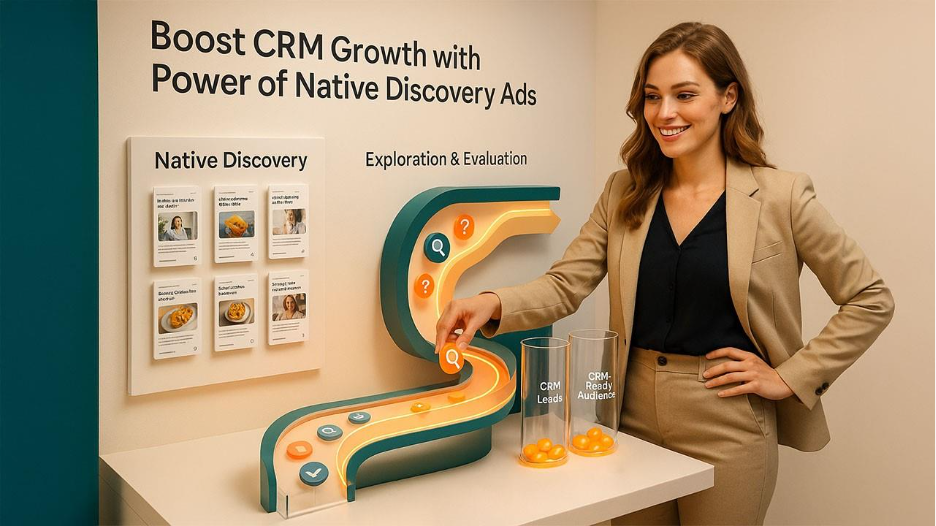

Social and search have done the heavy lifting for years. But if you look at how people actually buy now, those two channels are just two touchpoints in a messy web of scrolling, swiping, watching, and half-reading. That’s why so many funnels feel “almost there” – you’re visible in the obvious places, but you’re missing a whole layer of discovery that bridges strangers into CRM-ready leads.
That missing layer is native discovery ads.
Used well, they don’t replace social or search. They sit between them, capturing curious, “just looking” users and moving them into your owned database where your CRM can do the slow, steady work of conversion.
Why your funnel has a discovery gap
Most marketing plans are still built like the old linear funnel: awareness, consideration, decision. Reality looks nothing like that.
Google’s own research on the “messy middle” of buying decisions shows that people bounce between exploration and evaluation across many channels rather than marching neatly from trigger to purchase. When you layer on insights like BCG’s work on omnichannel touchpoints, the picture is clear: buyers make decisions across a swarm of small interactions, not a simple “saw ad → clicked → bought” story.
When you map that to your own channels:
- Social is great for quick awareness and retargeting, but it’s volatile and algorithm-dependent.
- Search (paid + organic) captures high intent, but mostly for people who already know what to type into the search bar.
- Email/CRM is powerful for nurturing, but only once someone is in your database.
There’s a big gap between “I’ve never heard of you” and “I’m actively searching for your category.” Native discovery ads live in that gap: in-feed placements that look and feel like editorial content, designed to be clicked by curious, mildly interested humans rather than only bottom-funnel buyers.
HubSpot’s guide to native advertising points out that native formats are built to blend with their environment so they’re harder to ignore than traditional display, especially when the content is genuinely useful. That “blend in, don’t interrupt” approach makes a native ideal for opening gentle, story-based conversations that your CRM can continue.
What native discovery ads actually do (beyond cheap clicks)
If you’ve only seen native via spammy widgets at the bottom of news sites, it’s easy to dismiss. But modern discovery campaigns on Taboola-style networks, Outbrain, or other platforms do three specific jobs your CRM will appreciate.
1. They manufacture mid-funnel intent
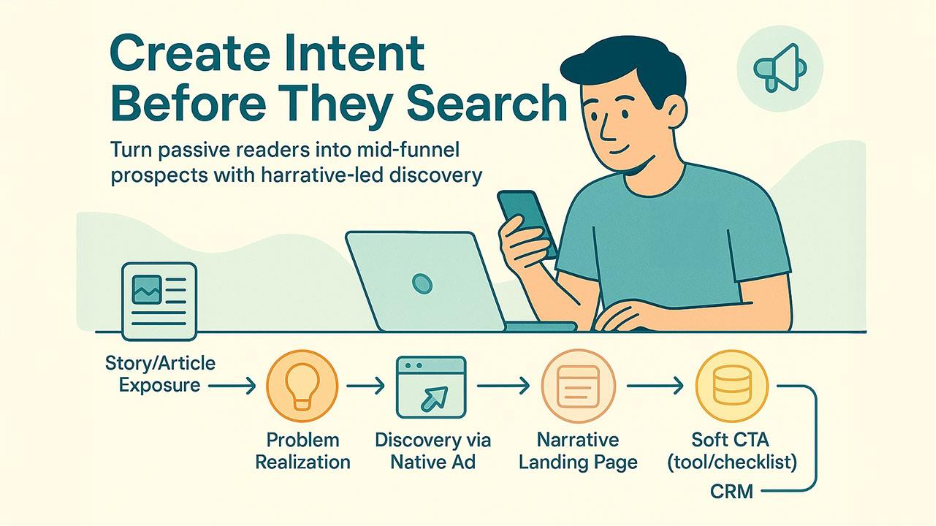
Search catches people who already know what they want. Native can create that intent by exposing new problems and solutions through stories, explainers, and comparisons. Success in E-commerce Ads and B2B lead generation both benefit from this approach—you're not waiting for high-intent searches; you're creating the intent itself.
Imagine a social media manager reading an article about evergreen content. They see a native ad about “Why your best posts never reach new audiences,” click, and land on a narrative piece. That article walks them through a subtle problem (over-reliance on algorithmic reach), shows mini-stories or data, and offers a soft CTA like a checklist or calculator.
By the time they opt in, they’re no longer a totally cold prospect. They’ve already absorbed your framing of the problem and solution, so when they land in your CRM, you can nurture them as someone who understands that issue, not just another generic contact.
2. They create diverse, trackable touchpoints
Work on omnichannel behavior shows that brands win when they orchestrate touchpoints, not when they over-optimize a single channel. Native placements give you extra chances to show up in those in-between moments – the late-night research scroll, the “I’m just reading industry news” moment, the commute browse – instead of relying only on social and search.
Because you control the landing page experience, every click can be tagged and routed into your CRM with:
- UTM parameters to distinguish networks, campaigns, and creatives
- Hidden form fields to capture source/medium with every form fill
- Custom events (scroll depth, CTA clicks, video views) pushed into the contact record
This turns “cheap clicks” into structured, attributable touchpoints. When you later review a contact, you can see the native article they first discovered you through, the content offer they grabbed, and every follow-up interaction inside one timeline.
3. They feed smarter CRM analytics
OutrightCRM already makes a strong case for putting customer data to work with analytical CRM tools. When “native discovery” becomes a distinct source inside your CRM, you suddenly get a new layer of insight:
- Which narratives convert best from “never heard of us” to MQL
- Which publishers or placements produce leads that move to opportunity, not just email signups
- Which topic clusters should shape future campaigns or even product messaging?
Instead of a fuzzy bucket called “paid,” you see specific paths like “native article → webinar → demo request,” and can invest in the stories that actually create a pipeline.
Plugging native traffic into your CRM (without creating chaos)
Buying native traffic is the easy part. Making it work with your CRM is where things tend to break. Here’s a pragmatic way to connect the dots.
Step 1: Decide what kind of lead you actually want
Native can drive:
- Newsletter subscribers
- Content upgrades (guides, templates, audit checklists)
- Free trials or demos
- Waitlist or interest forms
For mid-funnel audiences, jumping straight to “Book a demo” is usually too aggressive. A better pattern is “native → story-driven landing page → content offer → CRM nurture.”
Map each offer to a clear CRM segment (for example, “native-SEO-interest,” “native-CRM-integrations”) so you can send relevant email sequences instead of one generic drip.
Step 2: Standardize tracking before you launch
Before your first ad goes live:
- Lock in naming conventions for UTMs (source, medium, campaign, content).
- Map those fields into your CRM, so every contact carries their origin story.
- Build views or dashboards that group native separately from search and social.
If you’re already comparing tools and tactics around the best social CRM tools, treat native as another acquisition source that must report cleanly into the same reporting model, not a rogue campaign your team can’t fully track.
Step 3: Use your CRM’s “brain”, not just its address book
Most CRMs are capable of far more than basic email blasts. Use:
- Lead scoring to give extra points for high-intent behaviors (pricing page visits, comparison downloads, product-focused webinars).
- Behavior-based workflows to split native leads into different streams depending on what they do after the first article.
- Attribution reports to see which discovery topics contribute to pipeline and revenue, not just list growth.
The more structured your CRM data, the faster you’ll see which networks, creatives, and narratives are actually worth keeping.
How to test Taboola-style networks without torching your budget
The other trap with native discovery is treating it as a one-network, one-shot experiment. You pour everything into a single platform, run one set of creatives, and walk away when it doesn’t instantly print revenue.
Instead, treat native as a controlled test bench.
1. Start with one narrative, not 20 random headlines
Pick a core story that sits naturally between your SEO and CRM:
Example: “How multi-touch attribution actually looks inside a real CRM” for an audience already reading SEO, analytics, or MarTech content.
Build three or four variations of that same narrative (different hooks, angles, or formats) and point them to one focused landing experience. That way, you’re testing how audiences respond to a coherent story, not spraying unrelated clickbait to a dozen thin pages.
2. Diversify networks smartly
Taboola and similar platforms are obvious discovery choices, but you don’t have to commit to just one. When you’re evaluating traffic sources, a comparison piece like Alternatives to Taboola Advertising can help you shortlist networks that match your budget, formats, and geo focus instead of guessing on spend.
When you do test more than one network:
- Keep the offer and landing page constant so you’re comparing traffic quality, not different offers.
- Use consistent UTM structures so your CRM can report on “Network A vs. Network B” performance at the lead and opportunity level.
3. Bring SEO and link-building into the picture
Native doesn’t live in a vacuum. The content you promote can also attract links and organic traffic over time if it’s genuinely useful. OutrightCRM’s guide on building a strong backlink profile stresses quality and relevance over volume, and discovery content is often link-worthy if it feels like an editorial piece rather than a thin ad.
That’s where the “missing layer” idea comes together:
- SEO brings in long-tail searchers who already know what to type into Google.
- Native discovery brings in readers who recognize the problem but haven’t named the solution yet.
- CRM keeps both groups warm and moves them toward sales conversations at their own pace.
When these three channels share topics, tracking, and feedback, you stop thinking in isolated campaigns and start thinking in connected stories.
Wrapping it up
If your brand already invests in social content, SEO, and CRM, you’re closer than you think. You don’t need a completely new acquisition strategy; you need a discovery layer that sits between feed and search, translating casual curiosity into CRM-ready leads.
Native discovery ads can be that missing layer – if you design them as part of the journey, not as a one-off traffic trick. Use them to tell better stories, add more meaningful touchpoints, and give your CRM the data it needs to focus on the people who are actually leaning in.
%201.png)

%201.png)

%201.png)