

If you’re in the flooring business, you know how time-consuming takeoffs and estimating can be. Measuring each room, calculating required materials, and accounting for transitions can be an overwhelming and complex task. That's where the best flooring estimating software comes in—and more specifically, where AI Estimating Tools are revolutionizing the industry.
With AI-powered tools like Beam AI, you can streamline takeoffs, reduce mistakes, and get back hours of your bid cycle you didn’t know you were missing. The best part? It fits right into your workflow as the outputs can plug in directly to the estimating process you already use.
Why Traditional Estimating Can Be a Pain
Let’s be honest: manual flooring takeoffs are slow. You’re spending hours with a PDF or printed blueprint, a tape measure, a calculator, and maybe a few highlighters. By the time you finish, you’re exhausted, and there’s still a good chance something got miscounted, maybe that extra closet you forgot or a tricky transition.
And in today’s fast-moving construction world, every hour you spend on manual takeoffs is an hour you could’ve spent refining your bid, talking to clients, or snagging the next project. That’s why more contractors are turning to smart solutions that do heavy lifting for them. (Learn more about AI-powered flooring takeoffs).
The Hidden Costs of Getting It Wrong
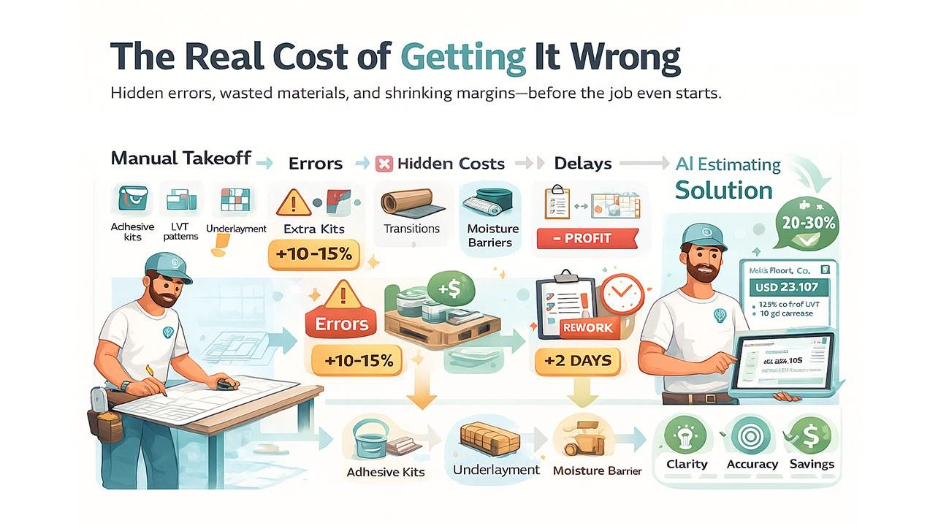
Many flooring contractors are reluctant to provide their clients with the true "pain" associated with manual takeoffs, which is both the time wasted making them and the mistakes that may occur in regard to takeoffs.
Calculating the materials incorrectly can result in a contractor having to pay for shipping and pallet costs that were not included in the contractor's original budget. If a supplier sells specific kit sizes (for example, 15-gallon kits), you might purchase far beyond the number of kits necessary. A contractor orders 21 gallons of adhesive, but your supplier only sells in 15-gallon kits? Guess who's eating that cost.
Another area where mistakes occur is during the installation process. If you fail to calculate or provide pattern matching luxury vinyl tile, you may face an additional 10% to 15% material cost due to a miscalculation of how much material to order. If you fail to provide the transition piece between rooms, then you will have to scramble to find appropriate reducer or T-moldings while their crew is idle. And when plan revisions come through mid-project, knowing how to effectively manage changes in construction plans becomes critical to keeping your estimates accurate and your margins intact.
There are several costs that nobody wants to discuss, such as, underlayment for carpet jobs, moisture barriers for basement installations, and unplanned floor preparation that was absent in the original plan. The more money spent on repairing subfloors, the more it adds to the overall project budget for advanced flooring.
One of the most frustrating things about not including these details in your estimate is that you will have to deal with three bad options. You can either absorb the cost and reduce your margin, go back to the client, and ask them to pay you more money while risking the working relationship, or cut corners and compromise with the quality of your work.
These are some of the reasons why contractors are starting to move towards automated solutions. A big part of the reason isn’t only to improve their productivity but also to help them capture the details that could turn profitable jobs into cost-prohibitive jobs.
What Makes Beam AI Different
Beam AI is like having a super-efficient estimating teammate who never misses detail. Here’s what makes it stand out:
- Simple plan upload: PDFs, blueprints, finish schedules, Beam AI reads them all.
- Comprehensive scope handling: Carpet, vinyl, hardwood, tile, underlayment, transitions, baseboards: you name it, Beam AI can handle it. You can even tweak the takeoff to match project-specific requirements.
- AI-powered takeoffs: Once you upload, the AI extracts all the quantities you need, neatly organized, and ready to go. No more counting squares or guessing.
- Quick turnaround: Your takeoff comes back in 24–72 hours, QA-checked, and ready in Excel, PDF, or a viewable link, whatever works best for you.
Contractors who use Beam AI often save up to 90% of the time they used to spend on takeoffs. Imagine reclaiming days’ worth of work every month!
Why Contractors Love It

- You can move faster. With AI handling the heavy lifting, you can take on more bids without scrambling to hire extra help.
- It promises ±1% of your in-house takeoff accuracy. Beam AI takeoff outputs are QA-verified, implying zero to no review of rework for estimators.
- Revisions aren’t a pain anymore when plans change or addenda rolls in. Beam AI handles up to 10 addenda versions and lets you update takeoffs quickly instead of redoing everything from scratch.
Who Should Consider AI Flooring Takeoffs
Beam AI works best for flooring subcontractors and GCs who handle multiple materials and complex layouts. It’s perfect for those who are looking to:
- Scale bid volume without adding headcount.
- Eliminate errors and rework.
- Quickly respond to plan changes or last-minute addenda.
If you’re juggling carpet, tile, wood, vinyl, and transitions all in one project, Beam AI can make your life a lot easier.
Takeaway: Work Smarter, Not Harder
As competition in the flooring industry continues to grow, the ability to estimate faster and more accurately is no longer a nice-to-have—it’s a necessity. AI Estimating Tools like Beam AI help contractors stay competitive by reducing risk, improving bid confidence, and protecting profit margins.
By removing guesswork from takeoffs and capturing every detail upfront, you can focus less on correcting mistakes and more on delivering high-quality work. The result is a smoother estimating process, stronger client trust, and a business that’s better equipped to scale in today’s fast-moving construction landscape.
%201.png)

%201.png)

%201.png)