



Digital technology has transformed the way we work, learn, and evaluate ourselves. From fitness trackers to productivity apps, people rely on online tools to better understand their abilities and optimize performance. One area that has seen rapid modernization is cognitive assessment — particularly IQ testing.
Today, Online IQ Testing as Product has evolved beyond simple entertainment quizzes. These tools increasingly reflect technological progress: adaptive logic, data-driven scoring, and user-centered design. These tools attract people who want quick yet meaningful insight into how their minds work in a complex, information-heavy world.
Why Cognitive Assessment Matters in the Era of Information Technologies
Modern technology, more than ever, rewards very specific mental skills. The abilities for logical reasoning, pattern recognition, speed of learning, and problem-solving have ceased to be the privilege of academic circles; they are now a core competency for professionals dealing with data, code, automation, and digital systems.
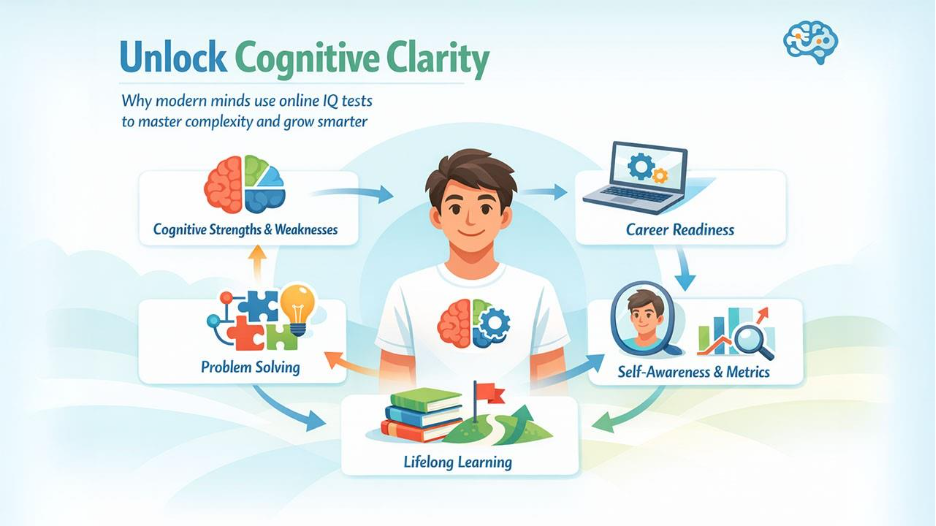
Key reasons people turn to online IQ tests today.
- To gain a better understanding of their cognitive strengths and weaknesses.
- Assess readiness for technically demanding careers
- To assess the problem-solving skill in a structured manner
- To support lifelong learning and self-improvement
- Comparing personal perception against objective metrics
With technology speeding up, self-awareness is becoming a competitive advantage. IQ Testing in Modern Workflows has become essential for professionals who need to understand how they process complexity and adapt to rapidly changing digital environments.
How Online IQ Testing Has Evolved
Traditional IQ assessment was once limited to controlled environments, paper-based tasks, and long sessions with specialists. Technology has reshaped this model completely.
Core technological improvements in modern IQ tests
| Aspect | Traditional Tests | Modern Online Tests |
| Accessibility | In-person only | Available anywhere |
| Speed | Hours or days | Minutes |
| Feedback | Delayed | Instant |
| Adaptability | Fixed questions | Logic-based variation |
| User experience | Formal | User-friendly |
Online platforms now combine structured logic tasks with intuitive interfaces, making cognitive testing more accessible to a wider audience without removing analytical depth.
Introducing MyIQ in a Digital-First World
Among the latest cognitive platforms, MyIQ Online IQ Test appears to be one of the services specifically geared towards individuals living within a technology-driven world. This service views the testing of IQ not as a clinical process and procedure for identification and classification into specific categories, but rather as a utility for the purpose of self-discovery on the basis of how users interact with technology on a day-to-day basis.
The platform provides a simplified test experience with emphasis on clarity, logic, and tangibility of results. The test-takers are involved in logical reasoning problems with structured challenges to evaluate their competence in pattern recognition, analytical intelligence, and problem-solving ability.
A real-world view of the situation is provided, in detail, by this post on the support.google website: MyIQ. Such organic discourse illuminates the way in which digital communities interpret and psychologically function with cognitive feedback, which proves to be a key component of contemporary tech devices.
What Makes MyIQ Technologically Relevant
From the technological side, MyIQ embodies the following principles, characteristic to successful platforms:
1. User-Centered
The design of the interface is straightforward and clutter-free, focusing more on simplicity and clarity rather than being entertaining. This is similar to the trend exhibited by productivity and analytics software.
2. Logic over Memorization
The test is more about reasoning than trivia and learned knowledge, more aligned with how intelligence is applied in a tech-driven world.
3. Analytical Feedback -Immediate
Fast results match modern expectations shaped by real-time dashboards and instant metrics.
4. Scalable Accessibility
Users can take a test irrespective of their location, device, and timing, and this is one of the primary elements of online platforms.
Who Benefits Most From Online IQ Testing?
Even though IQ test systems are largely linked with students, current systems are highly popular with a much wider audience.
Typical user profiles include:
- Technologists considering the cognitive fit for technology jobs
- Entrepreneurs and Founders that are interested in strategic thinking and planning
- Students studying skill sets other than grades
- Remote employees working to optimize learning efficiency
- Curious people who focused upon personal development
In a world of algorithms and automation technology, understanding how you think matters just as much as understanding what you do and how you do it.
Limits and Responsible Use of IQ Tests
One needs to keep in mind that online IQ tests must be used as information tools and nothing else. Intelligence is a multi-dimensional construct, and it cannot be quantified by a single score when it comes to creativity, emotional intelligence, and experience.
Best Practices for Interpretation:
- Based on Achieved Outcomes, not a label
- Apply intelligence quotient insight with real-world results
- Do not make comparisons
- Rather than emphasizing their ranking, focus on expansion
Technology is most powerful when used in the service of awareness rather than the constriction of identity—and cognitive tools must be used with the same approach.
Conclusion: Intelligence Meets Technology
Understanding cognitive capabilities becomes increasingly relevant as digital systems grow more complex. Online IQ testing represents a natural point where psychology and technology merge, offering structured insight into a format that modern users expect.
MyIQ fits into this space as a modern, technology-aligned platform that makes cognitive assessment accessible without unnecessary barriers. In a world driven by information, logic, and speed, such tools can be a valuable means for better understanding how the mind actually functions within modern systems.
In the end, technology doesn’t replace intelligence — it reveals how effectively we use it.
%201.png)

%201.png)

%201.png)