
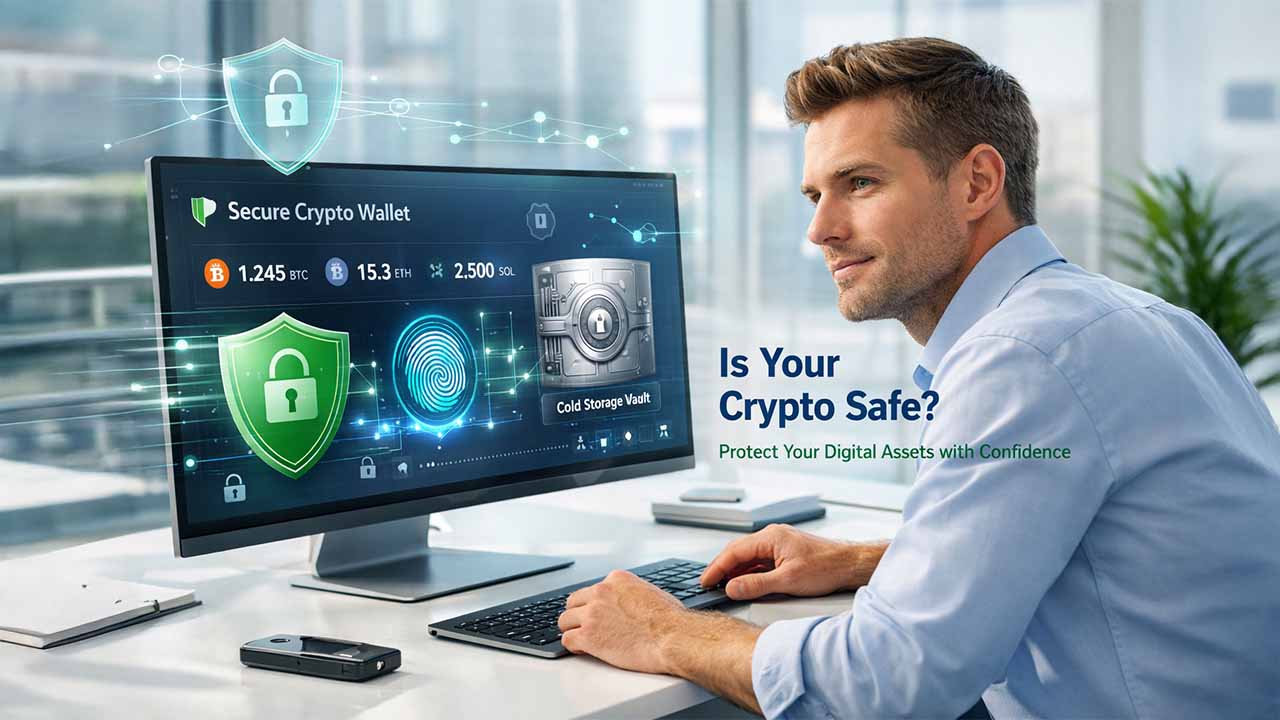

eCryptoBit.com has managed to get a clientele of over 1.2 million active wallets as of Q2 2025 and hence is to be considered as a well-noticeable option in the crypto storage space. If you've also been considering storing your digital assets on the eCryptoBit.com platform, you may be looking forward to seeing whether this indeed keeps your crypto secure.
eCryptoBit.com wallets strike a strong balance in security, but everything comes with its tradeoffs. The end-to-end encryption of the platform, biometric login options, and multi-factor authentication keep users secure. You can store more than 100 different digital assets and choose either custodial or non-custodial wallet types according to your needs.
The service also offers an integrated cold storage service to protect larger balances by keeping your funds offline and out of the reach of hacks or other online threats. Major pitfalls of this platform include limited third-party security audits and questions over its transparency.
Are eCryptoBit.com Wallets safe?
The security of a wallet can be measured by how well the platform protects your private keys and controls access to your funds. eCryptoBit.com has a multi-layered approach to security, addressing the most common threats facing crypto users today. Similar platforms like Crypto30x.com and Gemini have also established themselves in the market with robust security frameworks, making it essential to compare features across providers.
How eCryptoBit.com handles private keys
A difference in key management is really about ownership versus access when it comes to cryptocurrency. eCryptoBit.com will handle this in a couple of ways, depending on which wallet type you choose.
In non-custodial wallets, your private keys are encrypted on your device and do not get transferred to the server of eCryptoBit. You retain custody of your assets but have the option to back up your wallet with a 24-word mnemonic seed generated offline. The hardware supports hardware wallets such as Trezor and Ledger Nano X.
eCryptoBit uses sharded vaults with multi-signature approval for custodial wallets. Multi-signature simply means that a transaction needs to be approved by several different private keys. You can choose from many security levels:
Security Audits and Encryption Standards
It implements military-grade encryption combined with adaptive authentication, to which security demands are automatically increased according to the risk profile of a particular transaction. Its security structure incorporates strong encryption, multi-approvals on any transaction, activity monitoring to spot abnormal behavior, and expert rewards for ultimately contributing to finding and fixing security loopholes. These measures directly address how cryptocurrencies affect cybersecurity by implementing layers of protection against both traditional and crypto-specific threats.
Types of Wallets Explained: Custodial and Non-Custodial
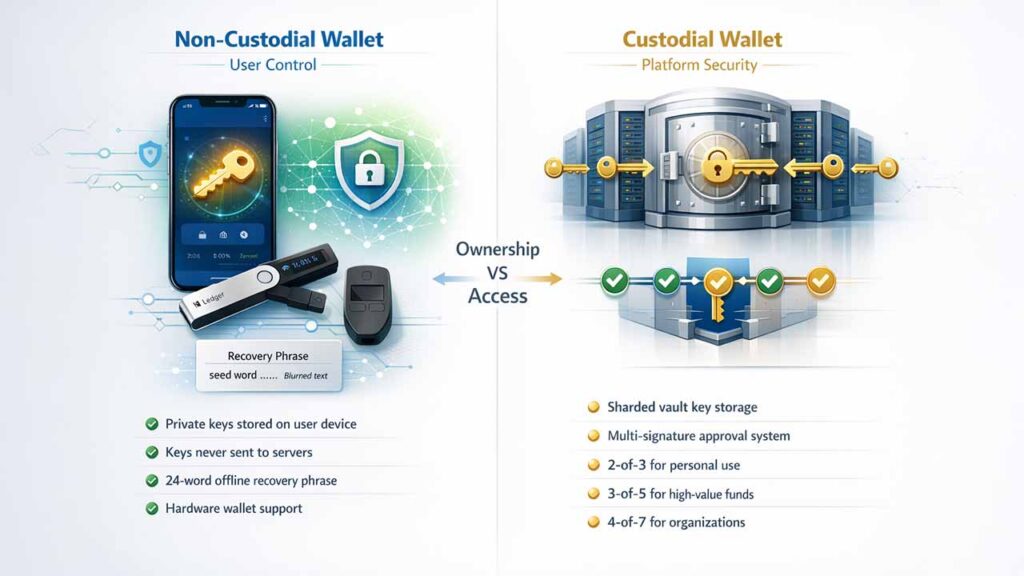
eCryptoBit.com provides a service for storing cryptocurrency through two approaches: the choice depends on how much control you want over your assets.
What is a Custodial Wallet?
By using the custodial wallet at eCryptoBit.com, they will have your private keys and will manage the crypto assets on your behalf. Access to your funds is done through a simple username/password, just like with online banking. The complicated cryptographic security is done by the platform, freeing you up to buy, sell, or trade.
This enables convenience and recognizable account recovery options for its customers. Custodial wallets also interact seamlessly with eCryptoBit's trading and staking functionalities. The downside is that you're trusting eCryptoBit.com to keep your assets secure. For businesses wondering how to get their customers to use crypto, custodial wallets present a familiar, user-friendly entry point that reduces technical barriers.
Benefits and Risks of Non-Custodial Wallets
With non-custodial wallets, the complete control of your private keys and cryptocurrency rests with you. This model provides advanced levels of privacy, direct connection to decentralized Apps, and safety from hacks on exchanges or some business failures.
The responsibility comes with some level of risk. Lose your seed phrase, and your cryptocurrency is gone forever. Customer support will not be able to recover lost funds from a non-custodial wallet.
Which one is safer for a beginner?
For beginning cryptocurrency users, custodial wallets have usually been an easier and much safer entry point. They eliminate the particular technical complexity involved in managing private keys, while offering recovery options that are more familiar to them.
Experienced users often adopt a hybrid strategy whereby they maintain custodial wallets for active trading and smaller quantities while shifting the larger portions of their holdings to non-custodial storage for ultimate security.
Security Matters
Strong security features are what make a big difference between securing your assets and leaving yourself vulnerable to unauthorized access and exploitation.
Multi-factor Authentication and End-to-End Encryption
eCryptoBit.com: Your data will be covered by end-to-end encryption. This means that information is protected both while being stored and during transmission. This protection is amplified by multi-factor authentication, entailing verification in three dimensions: something you know (password), something you have (hardware token), and something you are (biometric data).
Cold Storage and Biometric Login
eCryptoBit.com stores the majority of its cryptocurrencies in cold storage, or completely offline and away from threats based online. Biometric authentication is also used through fingerprint scanners with false acceptance rates as low as 0.001%.
Behavioral Alerts and Transaction Limits
Account monitoring happens through behavioral analysis systems, which learn your typical usage patterns. In the case of something happening out of the ordinary, the system will fire off immediate alerts. Transaction limits prevent huge unauthorized transfers in cases when your account may be compromised.
Backup and Recovery Options
You then receive a 24-word seed phrase master key to restore it. The platform does grant options for a manual backup and encrypted cloud backup; it's just highly recommended that you store physical copies of your seed phrase in multiple secure locations.
What else can you do with eCryptoBit.com Wallets?
eCryptoBit.com wallets serve not only for secure storage but also as an operational base for cryptocurrency.
Access DeFi & Manage NFTs
The wallet connects directly to decentralized finance protocols for token swapping on exchanges like Uniswap and PancakeSwap. You can stake the likes of ETH, SOL, and DOT, among others, plus yield farm and liquidity pool.
For NFT collectors, eCryptoBit.com offers full management through its in-built marketplace, where they can buy, sell, and trade their digital collectibles.
Multi-Chain Support That Actually Works
It currently supports multi-chain networks such as Ethereum Mainnet and Layer 2 solutions, Binance Smart Chain, Polygon, Avalanche, Solana, and ZK-rollups. Network changes are one tap away.
Clean Designs and Customization
It's an interface all about simplicity, cleanliness of screens, and clarity of icons. You can customize your dashboard by reshuffling asset tiles around and pinning the tokens you use the most. More than 20 languages are supported on the platform, with options for both dark and light display modes.
Conclusion: Are eCryptoBit.com Wallets Safe?
eCryptoBit.com wallets are a secure means of storing your cryptocurrency, but they work even better when you learn where their strong and weak points are. The security foundation is pretty great, with end-to-end encryption, multi-factor authentication, and cold storage. Unique to eCryptoBit.com is offering custodial and non-custodial wallets. Most of the users have been quite successful with a hybrid application: custodial wallets for active trade and non-custodial storage for holding over a longer period of time.
It's more than just a bare storage solution with integrations such as DeFi, support for NFTs, and multi-chain capabilities; however, it still has limited third-party security audits, which means there is less independent verification than what some competitors can boast.
For the majority of users, eCryptoBit.com wallets offer a practical balance of security versus functionality. Whether these wallets are right for you really depends on your specific needs and experience level with cryptocurrency.
FAQs for eCryptoBit.com Wallets
Q. Is eCryptoBit.com Wallet Safe to Store Cryptocurrencies?
A. Indeed, all eCryptoBit.com wallets boast a number of security features, including end-to-end encryption, Biometric login, and multi-factor authentication. They provide both custodial and non-custodial options, cold storage for large balances, and support for more than 100 digital assets.
Q. What kind of wallets does eCryptoBit.com offer?
A. eCryptoBit.com provides wallet types of Custodial and Non-custodial. The former are those maintained by the platform, with easier account recovery, while in the case of non-custodial wallets, full control over private keys belongs to the owner.
Q. How does eCryptoBit.com protect users' private keys?
A. Whereas, for non-custodial wallets, Private Keys get encrypted locally on the user device-in custodial options, keys get stored in sharded vaults with multi-signature approval layers. The capability for offline key storage through hardware wallets is also supported by the platform.
Q. What Other Services Does eCryptoBit.com Wallet Offer?
A. eCryptoBit.com wallets provide a whole host of features for their customers, including integrations with DeFi and NFT, multi-chain support for networks such as Ethereum, Binance Smart Chain, and Solana, and developer tools to build on Web3.
Q. How Does eCryptoBit.com Recover Wallets?
A. It provides a 24-word seed phrase, which is useful for wallet restoration. It uses both manual and encrypted cloud backups and recommends users physically store copies at multiple secure locations.
%201.png)

%201.png)

%201.png)