
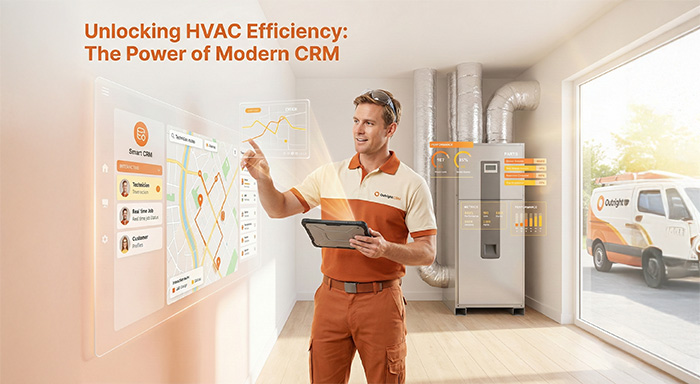

The heating, ventilation, and air conditioning industry is going through a real tech transformation. Five years ago, most small HVAC shops tracked jobs in notebooks or Excel sheets, while dispatchers coordinated technician visits through phone calls and paper schedules. Things have changed completely now. Customers expect instant responses, online booking, and transparent pricing, just like they get from Amazon or Uber. Competition keeps getting tougher, margins are shrinking, and holding onto skilled specialists gets harder every day.
That's where specialized CRM systems for HVAC businesses come in. They don't just store customer contacts — these are complete tools that automate sales, job scheduling, invoicing, and customer communication. The power of CRM software lies in its ability to centralize operations, reduce errors, and improve customer satisfaction. According to numerous reports, HVAC companies that have implemented CRM can see a 27% increase in repeat orders within the first year. Makes sense: the system reminds customers about scheduled maintenance, keeps track of every visit, and lets technicians see on-site what equipment a particular customer has installed.
This article looks at the top CRM solutions for HVAC companies, their main capabilities, and selection criteria. This article explores what matters during implementation and how to find the right balance between functionality and ease of use.
Selection Methodology: How They Choose Platforms for Review
The platforms featured in this review were selected based on a consistent set of evaluation criteria focused on real-world usability, reliability, and relevance for service businesses. Each solution was assessed not in isolation, but in the context of how HVAC companies actually use software in day-to-day operations.
- User reviews and ratings. Verified customer feedback from Capterra, G2, and Software Advice was analyzed. These platforms aggregate reviews from actual users of HVAC software — primarily business owners, office managers, and dispatchers — who work with these systems on a daily basis.
- Industry discussions and professional communities. Practical, experience-driven conversations on HVAC-focused forums such as HVAC-Talk and ContractorTalk were analyzed, focusing on posts where professionals discussed real operational outcomes, system limitations, onboarding challenges, and reasons for switching platforms.
- Field service–specific functionality. Priority was given to platforms built for field operations, including job scheduling and dispatching, technician mobile apps, inventory tracking, estimating, and integration with accounting systems.
- Vendor reputation and product maturity. Evaluation went beyond company age or brand visibility and focused on operational reliability: product stability, update consistency, and how vendors handle known issues after deployment.
- Geographic focus and data considerations. The final selection emphasizes North American and European vendors.
Overview of Leading CRM Systems for HVAC Businesses
FieldComplete
FieldComplete was built specifically for service companies working in the field, positioning itself as a practical field service management software solution. The platform covers the full cycle — from the first customer call to closing out the invoice. Dispatchers see a map with technicians marked in real time and can reassign tasks in seconds.
The mobile component for technicians provides access to complete job information: photos of the HVAC system, service history, contact details. On-site, specialists create quotes right in the app, customers sign on a tablet, and accounting gets the data immediately. Integration with QuickBooks and Xero simplifies financial tracking. Automatic reminders about seasonal maintenance through HVAC software increase the share of planned work, which is more profitable than emergency calls.
ServiceTitan
ServiceTitan is one of the best-known players in the American market among medium and large HVAC companies. The Glendale, California company raised over $500 million in funding. The platform focuses on maximizing revenue through built-in sales tools.
The system analyzes historical data and suggests optimal service packages to technicians. Integration with financing platforms like GreenSky lets customers arrange payment plans right on-site. The analytics module shows a detailed sales funnel: call conversion rates, average tickets by neighborhood, technician effectiveness.
Field Promax
Field Promax is a cloud-based field service management platform built for HVAC companies that want to organize operations without complex enterprise software. The system combines CRM tools with scheduling, dispatching, invoicing, and service management, allowing businesses to manage the workflow from the first customer call to the final invoice.
Technicians use the mobile app to access job details, customer information, and service history while on site. They can capture photos, collect digital signatures, and generate invoices immediately after completing work. Integration with QuickBooks helps synchronize financial data and reduce manual bookkeeping.
Field Promax also supports estimating and recurring maintenance scheduling. Automated reminders notify customers about upcoming service visits, helping HVAC companies maintain consistent communication and encourage repeat service appointments.
Jobber
Jobber comes from Edmonton, Canada, and positions itself as a simpler solution for small businesses. The interface is intuitive — you can train a new employee in an hour. The system covers basic needs: scheduling, invoicing, online payments, communication.
Automatic review requests after jobs help collect positive comments and publish them on Google My Business. For HVAC crews with 5-15 specialists, the functionality is usually enough. Pricing is transparent, with no hidden fees.
Housecall Pro
Housecall Pro, a field service management tool, focuses on mobility. The mobile app here isn't a simplified web platform version but a complete working tool. Technicians accept card payments through the built-in terminal (Square, Stripe), photograph completed work, and send customers video explanations.
Automatic notifications to customers when specialists head out, with photos and arrival times, reduce follow-up calls. The system supports different pricing models and offers a library of typical tasks with recommended prices for transitioning to flat rate.
mHelpDesk
mHelpDesk has been around since 2008 and belongs to HomeAdvisor, which provides access to a massive base of potential customers. The functionality is standard: scheduling, CRM, invoices, mobile app.
Tight integration with HomeAdvisor Leads automatically loads customer requests into the system with all details. Pricing starts at $169/month for five users. For companies using lead generation through online platforms, this integration can pay off through faster processing.
Sera
Sera positions itself as an all-in-one solution with a focus on marketing automation. Beyond standard field service management software functions, it has developed email and SMS campaign tools, database segmentation, and A/B testing.
You can set up automatic email sequences: a week after installation — usage tips, a month later — smart thermostat offer, six months out — maintenance reminder. The system tracks opens and clicks, adjusting communication. Cost is above average, and setup takes time.
Workiz
Workiz is an Israeli development that's popular in the US. It focuses on work speed and minimizing clicks. Many processes are automated: the system recognizes numbers, pulls up customer cards, shows history. Dispatchers drag tasks onto technicians on the map — done.
Two-way sync with Google Calendar and Outlook instantly reflects schedule changes. Convenient for specialists who manage their time through familiar apps.
Key Features of CRM for HVAC Companies
For CRM software for HVAC to actually help rather than create extra burden, you need to understand the critical features for the industry. Not all universal CRMs like Salesforce or HubSpot fit HVAC contractors.
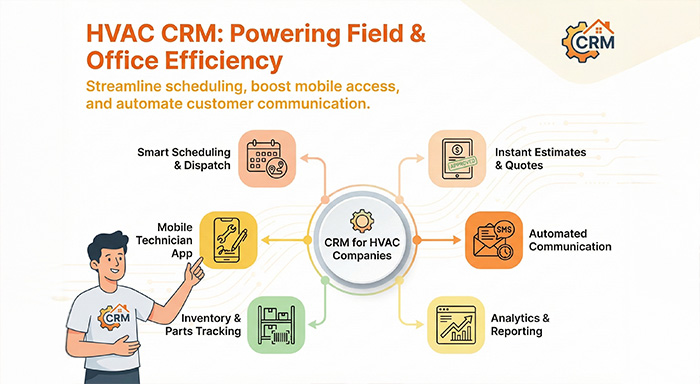
- Schedule and dispatch management is the heart of any field service system. You need visualization of technician workload, quick task reassignment, travel time consideration. Modern systems use route optimization algorithms that save up to 15-20% on fuel.
- Mobile access for technicians replaces paper work orders. Specialists need access to equipment diagrams, service history, and parts inventory. After the job, they fill out reports, collect signatures, take payments — all through the app. This speeds up the invoicing cycle.
- Inventory management is critical for HVAC. The system tracks which parts are in the warehouse and in trucks. When a specialist uses a filter or compressor, they scan the barcode, cost gets added to the customer bill, and stock adjusts automatically.
- Estimates and quotes are needed for quick proposal creation on-site. Technicians select the job type from the catalog, add materials, the system calculates cost with markup. Customers approve with electronic signatures, work moves to execution without office calls.
- Communication automation reduces call center load. The system sends booking confirmations, pre-visit reminders, technician arrival notifications, and post-job review requests.
- Analytics and reports should answer questions: which lead sources work best, what does one customer cost, what's the estimate-to-job conversion rate, what's the average ticket by service. CRM for HVAC companies shows this through clear dashboards.
How to Choose the Right CRM for Your HVAC Company
The choice depends on business size, work specifics, and budget. A company with 2-3 technicians needs a simpler solution than a regional player with a hundred employees.
- Company size and growth plans. Some systems work great for small businesses but don't scale. If you're planning growth, pick a platform with API for integrations. Powerful enterprise solutions might be too complex for a small team.
- Work specifics. Commercial projects (office buildings, shopping centers) need contract management tools with regular visits and detailed reports. For the residential segment, speed of processing one-off orders matters more.
- Integrations with existing tools. If you use QuickBooks, seamless sync is important. Integration with CallRail or other call tracking lets you monitor ad effectiveness.
- Total cost of ownership includes not just the subscription but also setup, staff training, integrations, and support. Calculate TCO for at least the first year.
- Technician convenience. The fanciest system won't work if technicians refuse to use it. The mobile app needs to be intuitive, work offline, and not lag on budget smartphones. Get technicians involved in testing during selection.
- Support and training are critically important. Technical support availability, documentation, and training materials need to be up to standard. Some vendors run regular webinars with best practices.
Conclusions
As you can see from the article, the CRM HVAC market is full of offers from various suppliers. The platforms differ in price, features, terms of use and the size of the enterprises for which they were created. There is no universal solution that would be equally suitable for all HVAC companies.
In order not to "jump" from one system to another, it is worth to study the websites of companies offering CRM software for HVAC in detail. Carefully read the websites of suppliers, read reviews about them, talk to their support, if possible, use a free demo version to test the system under real working conditions. Only after this does migration make sense. The process is not fast, but it helps to prevent costly mistakes.
In 2026, manual workflows slow teams down and make consistent customer service harder to maintain. For most service businesses today, a CRM for HVAC companies is a basic working tool, not an optional upgrade. A properly selected CRM HVAC system helps structure daily operations and supports growth.
%201.png)

%201.png)

%201.png)