
Not long ago, AI in game development mostly meant making enemies a bit smarter or tweaking NPC behavior trees. Now it’s everywhere. Ubisoft, for example, uses AI to spot bugs during playtests, saving hours of manual work. Indie teams turn to AI to generate concept art, placeholder assets, or even dialogue, long before their game is fully built. Even animation cleanups and facial expressions can be partially handled by AI, which used to take entire teams weeks to finish.
What makes this shift interesting is not the technology itself, but the scale and speed of adoption. Tasks that once felt like bottlenecks can now happen in the background, letting developers focus on the fun, creative stuff. That’s why studios, big or small, are rethinking how they structure teams and plan projects.
AI in game development is no longer an experimental feature. It’s already shaping game production, creative decisions, and even what players expect from modern games. Knowing where it helps, where it struggles, and how people are actually using it today is becoming as important as knowing your engine or your rendering tricks.
Early Development Gets a Speed Boost
Concept art used to eat up weeks of an artist's time. Character designs, environment sketches, level layouts — all of it required careful manual work. Midjourney changed that equation pretty dramatically. So did Stable Diffusion and Ludo.ai. Studios now prototype visual ideas in hours instead of days.
The data backs this up. Developers note that artificial intelligence reduces time spent on repetitive tasks, giving them more opportunities for real creative problem-solving. Kevuru Games is a good example of a AAA game studio figuring out how to combine traditional artist skills with AI-generated assets. All of their 3D models and textures meet AAA quality standards, as humans still do the final polishing, but with tight budgets and deadlines, some things can be optimized by using AI. This is especially useful for preparing test designs so that the artists know where to move next. This can save hundreds of hours of reworking designs.
Artists aren't getting replaced here. Research from a16z shows 70% of developers either use or plan to use AI for 3D asset creation, but every single output needs human review and adjustment. Activision used AI-generated content in Call of Duty: Black Ops 6, though players spotted some wonky visuals that sparked debates about quality control.
3D Production Pipeline Gets Disrupted
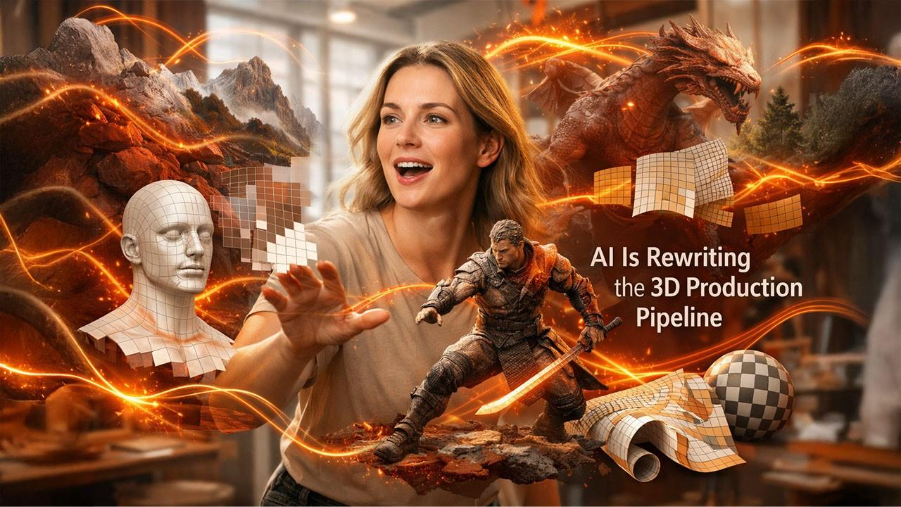
Traditional 3D art has seven standard stages: blocking out shapes, sculpting details, retopology for game-ready meshes, UV mapping, texture baking, painting textures, then animation. AI tools now touch almost every step.
Meshy and Leonardo Artificial Intelligence can spit out basic 3D models from text prompts or reference images. Microsoft dropped their Muse model early in 2025 — it can watch gameplay footage from something like Bleeding Edge and generate new variations right in the engine editor. Tasks that took a week now finish in an afternoon.
Procedural generation is where things get really interesting. No Man's Sky has been using algorithms to build planets and ecosystems for years, but new AI models push way past those limits. The Oasis mod for Minecraft doesn't use a traditional game engine at all. The AI literally predicts each frame in real-time, building the world as you play. That project launched late in 2024 and it's honestly kind of wild to watch.
Procedural Content Goes From Good to Absurd
Roguelikes have used procedural generation since Rogue came out in 1980. Generative AI has taken that concept much further.
Monaco 2 dropped in April 2025 with procedurally generated heist maps that change after your first playthrough. Guard patrol routes shift. Loot spawns in different spots. Every run feels genuinely different, which does wonders for replayability.
AI Dungeon took text adventures in a completely new direction. Classic games like Zork had predefined paths and responses. AI Dungeon uses GPT models to handle basically anything a player types. Want to create a cyberpunk detective story? Go for it. Medieval fantasy with talking animals? Sure. The AI learns from each interaction and generates responses that actually make sense in context, complete with detailed descriptions and plot twists that weren't programmed in advance.
NPCs Finally Feel Alive
Anyone who played Skyrim remembers NPCs repeating the same three lines until you wanted to throw your controller. Large language models and companies like Inworld AI fixed that problem.
NVIDIA showed off Covert Protocol at GDC 2024. The demo put players in a detective role where every NPC could hold actual conversations. Not scripted dialogue trees — real back-and-forth exchanges that adapted to what the player said and did. Each playthrough felt legitimately unique.
Mount & Blade II: Bannerlord got even more interesting with Inworld AI mods. NPCs remember past conversations. They shift their loyalty based on player choices. Characters develop personalities beyond their initial programming.
Programming and QA Get Serious Upgrades
GitHub Copilot and ChatGPT became standard tools for programmers pretty fast. They generate boilerplate code, catch bugs, suggest better architecture. Basic stuff, but it saves hours.
Testing saw bigger changes. AI agents can stress-test systems, hunt for bugs, simulate thousands of player behaviors, and spot balance issues that would take human testers weeks to find. Google Cloud's data shows 47% of developers now use AI for playtesting and gameplay balance.
QA departments used to need armies of testers manually playing through levels looking for edge cases and exploits. An AI agent can run through thousands of scenarios overnight, finding the weird stuff that breaks games — collision bugs, economy exploits, softlock conditions. Studios catch problems in alpha that used to slip through to release.
Localization Costs Drop, Audio Gets Weird
45% of studios use AI for translation and localization now. Projects that cost hundreds of thousands of dollars and took months can finish in weeks. The catch? Human editors still need to fix cultural references, jokes, and idioms. Machine translation misses too much nuance.
Audio production changed even faster. Voice synthesis tech means studios can generate NPC dialogue without booking studio time. NVIDIA demonstrated Audio2Face in a preview build of World of Jade Dynasty — their massively multiplayer game has characters that hold full voice conversations instead of cycling through pre-recorded lines.
Tools like Tone generate adaptive soundtracks that respond to gameplay. Music shifts from calm to tense when entering dangerous areas, swells during victories, mellows during exploration. Dynamic audio that actually fits the moment.
Full AI-Generated Games Exist (Sort Of)
Can AI build entire games by itself? Yes, but don't get too excited yet.
The Girl Does Not Exist is a simple puzzle game where every asset came from AI generation. Infinite Craft lets players combine elements to create new ones, using AI algorithms to determine what's possible based on inputs. Each session plays differently.
Status from Wishroll hit fourth place in the App Store's Lifestyle category. The game drops players into fictional lives — pop stars, athletes, fantasy characters, whatever. Inworld's AI handles relationship development with virtual celebrities and creates unique milestone moments for each player.
AAA titles made entirely by AI aren't happening yet. Jensen Huang from NVIDIA thinks we're 5-10 years out from fully AI-generated games. Right now in 2025, AI assists development but doesn't run the whole show.
Real Problems Still Need Solving
Implementation of AI in game development has actual drawbacks. According to a16z research, quality and accuracy remain the biggest issues. AI-generated content needs significant manual cleanup before it ships.
Legal issues still worry developers and society. Copyright and licensing for AI-created content sits in murky legal territory. Who owns a Midjourney texture? What about GitHub Copilot code? Nobody really knows yet.
Technical limitations cause headaches too. Cloud-based AI that isn't optimized for production environments creates 800-1200ms response delays. That kills immersion instantly. Logitech G built their Intelligent Streaming Agent using local processing specifically because standard cloud APIs introduced 1-2 second delays that made the assistant feel disconnected from gameplay.
There's a weird split in adoption rates. 58% of artists use AI compared to 85% of executives. Artists worry about job security and creative integrity getting undermined. Management sees efficiency gains and cost savings. That gap tells you something about how different parts of the industry view this technology and the current state of AI in game development.
What's Coming Next
The future of AI in game development looks transformative. We're likely to see AI-native studios emerge — companies built from day one around AI tools handling design, development, and live operations.
Studios are already experimenting with runtime AI — model-driven NPCs, content generation happening in real time during gameplay. These technologies could enable entirely new genres that weren't possible before.
Large gaming companies need AI to stay competitive. Production costs keep climbing and development timelines keep stretching. AI tools help manage that pressure. Small studios get something even more valuable — the ability to punch above their weight and compete with industry giants on tighter budgets.
VR integration with AI will create some seriously immersive experiences. NPCs that hold full voice conversations. Metaverse environments that evolve whether users are logged in or not. Worlds that feel genuinely alive instead of static and scripted.
The Human Element Remains Critical
AI isn’t replacing game developers. It’s becoming their most powerful tool. Kevin Huang from GIANTY put it perfectly: “AI is a multiplier, not a replacement.”
What’s changing isn’t creativity — it’s scale. A single designer can now prototype worlds that once took full teams. Writers can test branching narratives in days, not months. Artists can explore visual directions without committing weeks to a single concept. The barrier isn’t talent anymore — it’s imagination and taste.
Studios that cling to rigid, old-school pipelines will fall behind. The future belongs to hybrid creators: people who think like artists, build like engineers, and treat AI as a collaborator rather than a shortcut.
Looking ahead, games won’t just be played — they’ll be co-created. NPCs will remember you across sessions. Worlds will evolve while you’re offline. Stories will bend around player behavior instead of forcing players down scripted paths. Small teams will ship experiences that feel impossibly large, personal, and alive.
The real shift isn’t technical. It’s philosophical. Games are moving from static products to living systems — and AI is the force accelerating that transformation. The studios that win won’t be the ones who automate the most, but the ones who use AI to amplify what humans do best: curiosity, emotion, and the instinct to build worlds worth escaping into.
%201.png)

%201.png)

%201.png)