
Digital products in 2026 are no longer judged by visual appeal alone. The market has matured, users have become more demanding, and competition has intensified across nearly every digital category — from SaaS and fintech platforms to AI-driven tools and enterprise systems. Today, digital product design sits at the intersection of business strategy, technology, and user psychology.
What separates fast-growing digital products from those that stall is not feature volume, but design maturity — the ability to create scalable, consistent, and user-centered experiences that evolve with the product and its audience.
Instead of treating design as a final visual layer, many product-led companies now approach it as a core part of their operational strategy. This shift is especially visible in how mature teams structure UX decisions, invest in design systems, and align interface logic with business goals. Publicly available case studies from studios working deeply with complex products — such as this digital product design agency — illustrate how early UX structure and system thinking often determine whether a product can scale without constant redesigns later on.
Why Digital Product Design Became a Strategic Asset

Design used to be perceived as a supporting function — something applied after development. That mindset is obsolete.
In 2026, digital product design directly influences:
- Customer acquisition and retention
- Product-market fit
- Monetization efficiency
- Development velocity
- Brand trust and perception
Well-designed products reduce friction, shorten onboarding time, and create intuitive flows that guide users toward value. Poor design, even with strong engineering, increases churn and support costs.
Design as a Business Multiplier
Companies that invest early in product design benefit from:
- Lower cost of change — fewer redesigns post-launch
- Faster scaling — reusable design systems and components
- Clear differentiation — especially in crowded markets
- Stronger user loyalty — driven by usability, not marketing promises
Design is no longer about “making it pretty.” It’s about making it work at scale.
Core Principles of Digital Product Design in 2026
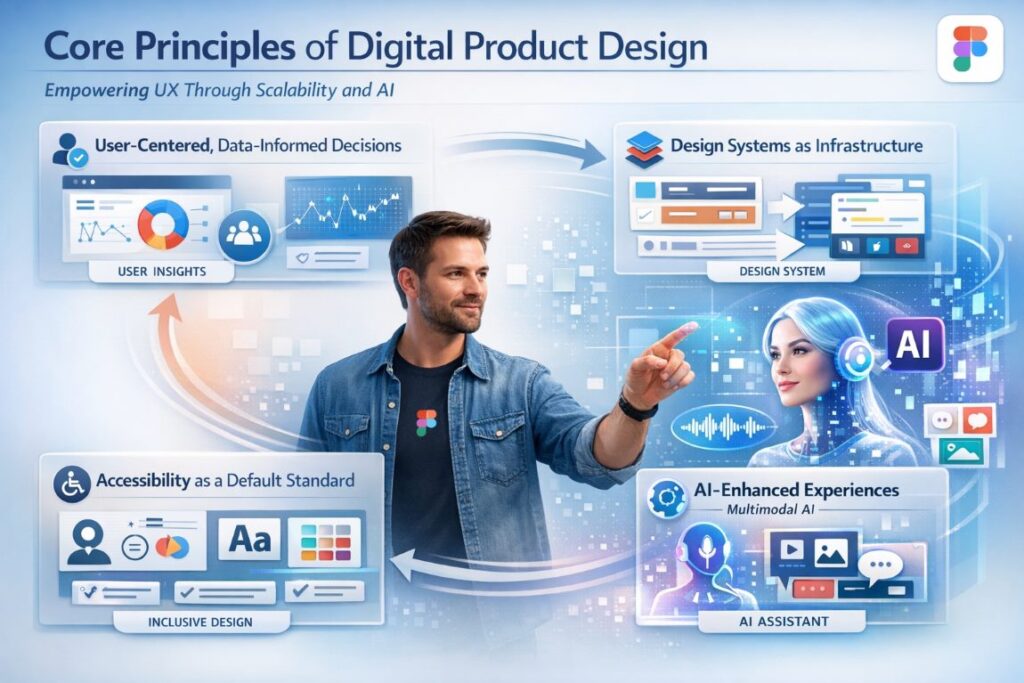
Successful digital products share a common design philosophy. Below are the principles shaping modern product design today.
1. User-Centered, Data-Informed Decisions
Design decisions must balance qualitative insights (user interviews, usability testing) with quantitative data (behavior analytics, funnels, heatmaps).
Key practices include:
- Continuous user research, not one-time discovery
- Validation through rapid prototyping
- Iterative UX improvements based on real usage
Design without data is guesswork. Data without design insight is noise.
2. Design Systems as Infrastructure
In 2026, design systems are no longer optional — they are foundational infrastructure.
A mature design system enables:
- Consistent UI across platforms and devices
- Faster feature development
- Easier collaboration between designers and developers
- Predictable UX as products grow in complexity
Without a design system, scaling a digital product becomes chaotic and expensive.
3. Accessibility as a Default Standard
Accessibility has shifted from “nice-to-have” to non-negotiable.
Modern product design must account for:
- WCAG compliance
- Keyboard navigation
- Screen reader compatibility
- Color contrast and typography readability
Accessible design improves usability for everyone, not only users with disabilities.
4. AI-Enhanced User Experiences
AI is deeply embedded in digital products, and leveraging multimodal AI can enhance user interactions across text, images, and more.
In 2026, design challenges include:
- Explaining AI decisions transparently
- Designing trust around automation
- Balancing control vs. autonomy
- Preventing cognitive overload
Great AI products are not defined by algorithms alone, but by how humans interact with them.
UX Maturity Levels: Where Most Products Fail
Many digital products stall because they never move beyond early UX maturity.
| UX Level | Characteristics | Business Impact |
|---|---|---|
| Initial | Fragmented UI, inconsistent flows | High churn, slow growth |
| Structured | Defined UX patterns, partial system | Moderate scalability |
| Mature | Full design system, validated UX | Sustainable growth |
| Optimized | Continuous UX optimization | Competitive advantage |
Most failed products don’t lack features — they lack UX maturity.
The Hidden Cost of Poor Product Design
Underinvesting in design leads to long-term costs that are often invisible at first.
Common consequences include:
- Increased customer support load
- Slower onboarding and activation
- Feature underutilization
- Repeated redesign cycles
- Development bottlenecks
Over time, these issues compound and directly impact revenue.
Why Specialized Product Design Teams Matter
As products become more complex, in-house teams often struggle to balance delivery speed with design quality. This is why companies increasingly collaborate with specialized design partners.
A dedicated product design agency brings:
- Cross-industry experience
- Proven UX frameworks
- Independent product thinking
- Deep research and validation processes
- Strong alignment between design and business goals
External teams often identify structural UX issues that internal teams overlook due to product familiarity.
Digital Product Design vs. UI Design: A Critical Distinction
One of the most common misconceptions is equating product design with UI design.
| Aspect | UI Design | Digital Product Design |
|---|---|---|
| Focus | Visual interface | End-to-end experience |
| Scope | Screens and components | User journeys & systems |
| Timeline | Short-term | Long-term product evolution |
| Impact | Aesthetic clarity | Business scalability |
Digital product design encompasses UI, but also strategy, research, system thinking, and long-term scalability.
Design for Scalability: Thinking Beyond MVP
Launching an MVP is easy. Scaling it is not.
Designing for scalability requires:
- Flexible information architecture
- Modular components
- Clear UX rules and constraints
- Anticipation of future user roles and use cases For teams aiming to optimize product planning and design, modern tools can provide actionable insights and faster workflows. Using an AI software for design teams helps prioritize features, enhance collaboration, and ensure your hero product resonates with customers. These tools enable teams to make data-driven decisions that improve both the design process and landing page conversions.
Products designed only for launch often collapse under real-world usage.
The Role of UX in Retention and Growth
Retention is the true test of product success.
Strong UX drives retention by:
- Reducing cognitive load
- Creating predictable interactions
- Making value immediately visible
- Supporting users through complex actions
In 2026, growth loops are increasingly UX-driven, not marketing-driven.
Key UX Metrics Product Teams Track in 2026
Modern design teams align UX improvements with measurable outcomes.
Common UX-related metrics include:
- Time to first value (TTFV)
- Task completion rate
- Feature adoption rate
- User error frequency
- Retention by cohort
Design decisions are evaluated by impact, not opinion.
What the Future Holds for Digital Product Design
Looking ahead, several trends will continue shaping the discipline:
- Deeper AI-human collaboration
- Greater personalization without sacrificing privacy
- More ethical and transparent design practices
- Increased convergence of UX, product, and growth teams
Designers will increasingly act as product strategists, not just executors.
Final Thoughts
Digital product design in 2026 is about building systems, not screens. Products that succeed are those designed with intention, empathy, and scalability from the start.
As competition increases and user expectations rise, companies that treat design as a strategic function — supported by experienced product design partners — will outperform those who view it as a finishing touch.
The future belongs to products that are not only functional, but thoughtfully designed to grow with their users.
%201.png)

%201.png)

%201.png)