

When choosing the best web scrapping tools people often ask one question which is “Can they deliver structured and data without constant human oversight?” Years have been spent helping teams extract web data for CRM enrichment, pricing intelligence, and competitive monitoring.
The tools that win are not always the fastest. They stay unblocked, handle JavaScript rendering gracefully, and integrate cleanly with your downstream systems.
This roundup covers eleven tools across frameworks, unblocker APIs, browser automation, no-code platforms, and specialized endpoints. You will get concrete recommendations by use case and stack patterns you can adapt to your own pipelines.
What "Best" Means for Web Scraping Today
Reliability beats raw speed every time you evaluate web scraping tools. A scraper that fetches ten thousand pages per minute means nothing if half those requests get blocked or return garbage data. The hidden costs of failed requests, retries, engineering time, and CRM cleanup add up fast.
Modern anti-bot systems have become sophisticated. They inspect TLS handshakes using JA3 and JA4 fingerprinting, analyze behavioral patterns, and deploy machine learning models to distinguish humans from bots.
Naive HTTP clients get filtered even when they are technically fast. The best stacks pair resilient fetching with parsers and validators that deliver clean, deduplicated records directly into your pipelines.
What This Guide Covers
Here the focus is on crawlers, unblocker APIs, browser automation tools, managed platforms, and specialized endpoints for search and knowledge graphs. All recommendations assume a lawful collection of publicly available information. You will not find guidance on credential stuffing, accessing non-public data, or bypassing authentication barriers.
Who This Roundup Serves
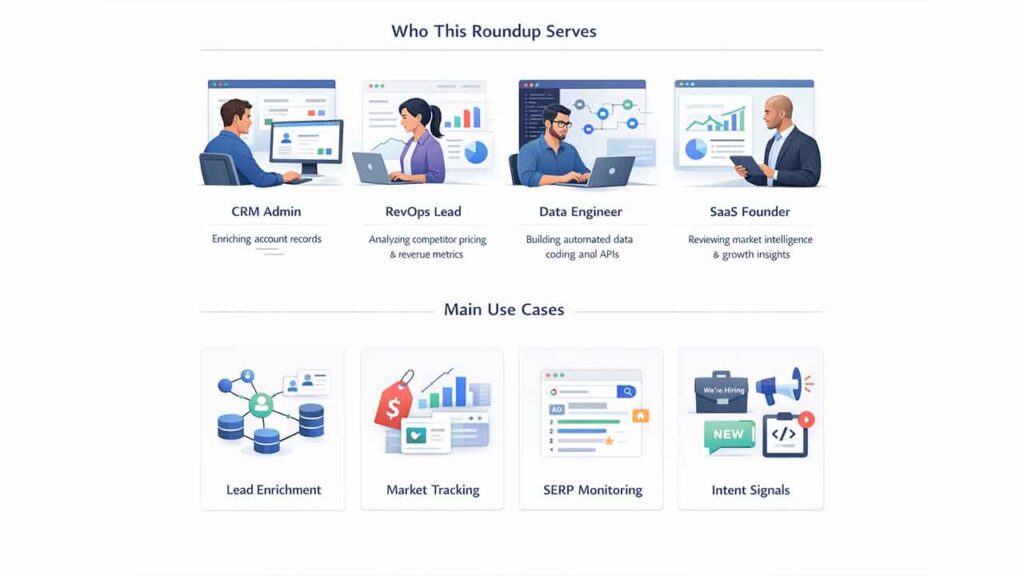
This guide targets teams with real delivery deadlines who need production-grade web data. If you're a CRM admin enriching account records, a RevOps lead tracking competitor pricing, a data engineer looking to build pipelines, or a SaaS founder who aims to capture market intelligence, you'll find actionable recommendations here.
Main Use Cases
- Lead enrichment: Augment firmographics, technology signals, and contact data to improve routing, scoring, and personalization. Effective data visualization for CRM enables teams to transform these enriched records into actionable dashboards that surface buying signals and account health metrics.
- Market tracking: Monitor pricing, inventory, promotions, and content changes across competitors.
- SERP monitoring: Track rankings, ads, featured snippets, and People Also Ask data for better SEO strategy.
- Intent signals: Track hiring pages, product announcements, technical blogs, and changelogs for expansion or churn indicators.
Constraints Real Teams Face
Most of the time, teams are unable to maintain private proxy fleets or tune TLS signatures constantly. Data that is recorded in the system database needs to be normalized and deduplicated. Compliance review and observability are non-negotiable, and every recommendation here accounts for these realities.
How to Pick Best Tools
Methodology matters when recommending tools that teams will depend on. Each option has been tested against three target types: a static HTML list page, a JavaScript-heavy single-page application (SPA) with infinite scroll, and a WAF-protected property with aggressive bot controls.
Evaluation Criteria
- Success rate, measured as the percentage of requests returning valid payloads
- Time to first usable data from initial setup
- Resilience to TLS fingerprinting and dynamic anti-bot challenges
- CAPTCHA handling capabilities and error reporting
- API quality, documentation, and SDK support
- Cost per ten thousand pages, including any rendering surcharges
Compliance Framework
The Robots Exclusion Protocol became an IETF standard with RFC 9309 in September 2022, so robots.txt parsing should be treated as a protocol requirement. U.S. courts, including in hiQ Labs v. LinkedIn, have held that scraping those pages that are publicly accessible without bypassing access controls have lower chances to violate the Computer Fraud and Abuse Act (CFAA). Always align your scraping programs with applicable law and your organization's risk tolerance.
Quick Picks by Use Case
Use these quick picks to match tools to your main use case before you compare feature lists. Your choice depends on technical capacity, target difficulty, and budget constraints.
No-Code vs. Code-First
Pick no-code tools like Octoparse or ParseHub when you need speed to value and non-developer ownership. It is recommended to choose code-first options such as Scrapy with Playwright when you are in need of custom logic, version control, and quality gates.
WAF-Heavy Targets
Use unblocker APIs with residential IP rotation and dynamic TLS fingerprinting for Cloudflare, Akamai or DataDome-protected sites. Scrape.do and Zyte API shines the most here. For precise geotargeting needs, Bright Data and Oxylabs offer expansive IP pools.
1: Scrape.do
Scrape.do is capable of solving the most difficult problem in web scraping: bypassing enterprise WAFs at scale. A single API endpoint unifies rotating residential and mobile proxies, dynamic TLS fingerprinting, CAPTCHA handling, automatic retries, and optional headless rendering.
What Makes It Different
The platform centralizes unblocking, proxy rotation, and rendering behind one call. This eliminates the need to maintain proxy fleets and headless browsers yourself.
Dynamic TLS fingerprinting and browser profile mimicry raise pass rates against sophisticated bot managers. Success-based billing limits waste from blocked attempts.
When to Use It
For teams dealing with Cloudflare, Akamai, or other enterprise WAFs, a specialized unblocker that combines large proxy pools, smart retries, and optional rendering is often the most reliable option. When you face persistent bot challenges or need optional headless rendering without building an in-house proxy fleet, run fetches through the Scrape.do API. You can combine rotating residential and mobile IPs, dynamic TLS fingerprints, automatic retries, and a single-call render option for higher success rates. To pass through metadata for observability, plus the output into Scrapy or Beautiful Soup.
2: Scrapingdog
Scrapingdog is designed for developers who want a reliable scraping API without spending time managing proxies, headless browsers, or anti-bot systems. A single API handles JavaScript rendering, automatic proxy rotation, CAPTCHA solving, retries, and geotargeting, making it easy to scrape websites at scale.
What Makes It Different
Unlike many scraping platforms that charge extra credits for JavaScript rendering or premium proxies, Scrapingdog keeps its pricing simple with most core scraping features included by default. It also offers dedicated APIs for Google Search, Google Maps, Google Shopping, Google Hotels, LinkedIn, and Google AI Mode, allowing developers to receive structured data instead of raw HTML.
When to Use It
If you're building SEO tools, AI applications, price monitoring systems, lead generation software, or large-scale data pipelines, Scrapingdog is a practical choice. It works well for teams that want a production-ready scraping solution without maintaining their own proxy network, browser infrastructure, or anti-bot logic.
3: Scrapy
For those teams who want full code ownership, Scrapy remains the gold standard Python framework. Its event-driven is built on the Twisted async networking library which supports high-throughput crawling with the help of backpressure control and middleware that is pluggable.
Scrapy shines for deterministic crawls with domain-specific rules, link extraction, and robust item validation. However, it struggles with heavy client-side rendering and dynamic challenges. It is suggested to pair it with Playwright and an unblocker for JavaScript-heavy or WAF-protected targets.
4: Playwright
For JavaScript-heavy flows, Playwright is the go-to browser automation library. It provides support to Chromium, Firefox, and WebKit with first-class SDKs in JavaScript, Python, Java, and .NET.
Use Playwright when crucial data renders client side or when workflows need interactions like scrolling and clicking. Wait explicitly for those selectors who guarantee data readiness and assist with blocking noisy third-party domains to cut down unnecessary network chatter.
Avoid Playwright for simple static pages where an HTTP client plus parser is cheaper.
5: Apify
Apify's managed orchestration removes operational overhead for long-running jobs. Actors are serverless scraping programs with built-in scheduling, managed storage for datasets, and webhook integrations.
The platform fits teams wanting to avoid running servers and cron jobs. Marketplace Actors accelerate prototyping for common targets. Webhooks make it simple to push results to CRMs, queues, or warehouses with idempotent upserts.
6: Zyte API
Zyte API provides managed unblocking with per-site tuning and browser mimicry.
It manages ban recovery and swap identities at scale by integrating via proxy mode or direct API at the same time keeping your existing crawler code intact.
The dashboard provides visibility into block-rate spikes. It allows you to adjust policies quickly. Cost scales with traffic and unblock difficulty, so model per-ten-thousand-page costs including render rate before committing.
7: Bright Data Web Scraper API
Bright Data offers enterprise scales along with over 150 million proxy IPs across 195 countries. Geotargeting down to ZIP code or ASN helps in replicating local results for availability use cases and pricing.
Residential traffic is powerful but costly. Prefer datacenter IPs when WAF posture permits and render only when necessary to control CPU-time charges.
Flexible delivery options support both near real time and batch architectures.
8: Oxylabs Web Scraper API
Oxylabs excels for product and SEO data with sources that are predefined such as google_search and amazon_product. Systematic and structured parsing options help lower parsing lift for common targets.
The prebuilt sources eliminate the need for guesswork and accelerate time-to-data for search and marketplace use cases. Push-pull modes work well for both event-driven and batch workflows. Benchmark success rate and field completeness against your schema.
9: Octoparse
For non-developers, Octoparse provides no-code extraction with cloud parallelism. Cloud runners effectively manage scheduling without any operations overhead. The visual builder cuts time-to-first data for pilots and lightweight pipelines.
Conduct version tasks and test against staging targets wherever there is a possibility. Selectors can be brittle on complex UIs, so define alerting on run failures and low field-fill rates to capture data loss that goes unnoticed.
10: ParseHub
ParseHub handles dynamic actions like clicks, AJAX requests, and pagination with the help of visual interfaces. It is solid for semi-structured sites and quick recurring jobs with API access for light automation.
Complex, heavily scripted sites can be slow. Plan for selector maintenance as layouts evolve. Be prepared to add headless rendering or an unblocker for WAF-protected targets.
11: ScrapingBee
What Makes It Different
ScrapingBee combines rotating proxies, full headless Chrome rendering, and AI-powered data extraction. Describe the data you want in plain English - no CSS selectors needed. For teams scraping sites with inconsistent markup or frequent redesigns, this cuts engineering overhead considerably.
When to Use It
Use ScrapingBee when your team needs reliable JavaScript rendering and proxy rotation without owning the infrastructure. It fits CRM enrichment, competitive pricing, and SERP monitoring well.
12: ZenRows
ZenRows is a scraping API that combines rotating proxies, JavaScript rendering, CAPTCHA bypass and advanced request handling in a single interface. It helps extract data from modern, protected websites without the need to manage infrastructure.
Web scraping is simple and scalable for both small and large data extraction needs.
What Makes It Different
ZenRows brings together proxy management, browser automation, and smart request handling into one API. Built-in retries, header management, and optimized request flows reduce engineering overhead.
It focuses on reliability and ease of use, enabling teams to scale scraping workflows without maintaining custom proxy or browser setups.
When to Use It
Use ZenRows when you need a simple yet powerful solution for JavaScript-heavy or protected websites. It fits use cases like lead generation, price monitoring, and competitive intelligence where consistent data access and scalability are critical.
13: Diffbot
Diffbot eliminates the need for hand-written parsing rules through AI extraction and a web-scale Knowledge Graph. DQL queries allow for entity discovery and enrichment for account-based marketing and firmographic use cases.
To avoid stale or outdated data flow inti CRM systems, make sure to verify field lineage and timestamps. Combine Knowledge Graph results with your own crawls to bridge gaps or verify critical attributes.
14: SerpApi
SerpApi is a purpose-built platform for search results with structured JSON outputs and built-in CAPTCHA handling. Location spoofing precision provides great support to local SEO and price intelligence comparisons.
Full-browser execution lifts success on modern search engine results pages. Normalize JSON results into a canonical schema covering organic results, ads, and People Also Ask boxes. Feed insights into SEO dashboards and alert on rank deltas.
How to Assemble Your Stack
A resilient scraping stack combines a crawler, an unblocker, and specialized APIs so each part handles what it does best. Three patterns cover most production use cases.
1: Scrapy Plus Unblocker
Scrapy schedules URLs, calls an unblocker API, conditionally enables rendering for JavaScript-heavy pages, parses responses, validates data, and upserts to your CRM or data warehouse. This pattern gives you high control and strong observability.
2: Managed Platform
Apify Actors orchestrate targets on schedule using Zyte, Bright Data, or Oxylabs for fetching. Results emit to datasets, webhooks trigger transformation services, and clean data lands in your CRM. This minimizes operational burden.
3: API-First
Use SerpApi, Diffbot, or Bright Data scrapers for specific domains. It is recommended to skip parser development entirely. Make sure that output schemas align with your internal models, monitor coverage, and freshness.
Implementation Playbook
A focused two-week sprint is enough to launch a production-ready web scraping pipeline. Keep days one and two to focus on target auditing and compliance review. Days three and four prototype your fetch layer using either Playwright or a managed API.
Days five through seven define schemas, validators, and storage. Implement dedupe keys and store provenance fields.
Days eight through ten add retry policies with capped backoff and basic observability metrics. On days eleven and twelve, run backfills and QA. After that, finalize scheduling and CRM sync in days thirteen and fourteen.
Compliance Checklist
Compliance hinges on consistent, transparent practices. Parse and honor robots.txt per RFC 9309, and respect site terms of service.
Avoid content that is authentication-gated or paywalled and while processing your personal data, ensure to document your legal basis. Throttle requests and identify your client responsibly.
Log provenance including timestamp, URL, HTTP status, and any CAPTCHA solver usage. For regulations such as the General Data Protection Regulation (GDPR) and the California Consumer Privacy Act (CCPA), ensure data minimization and purpose limitation. Provide opt-out handling where required.
Next Steps
Select one tool that maps cleanly to your primary use case and instrument it with metrics from day one. Pilot against three representative site classes to understand success rates and real costs before you decide on budget. Keep your stack modular so you can swap unblockers or renderers without having to rewrite parsers.
%201.png)

%201.png)

%201.png)