


Many tech leaders feel their dev team is always at 110% capacity. Tickets pile up, deadlines slip, and talk about staff augmentation appears in meetings. This text helps you see when that model fits and when it does not.
Key Takeaways
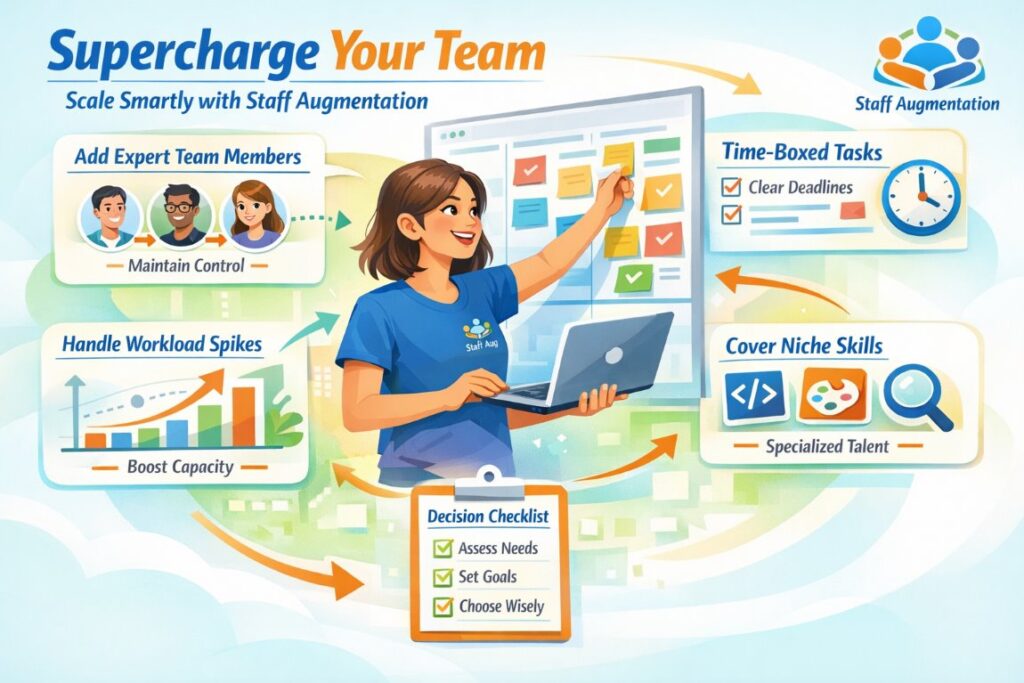
- Staff augmentation adds external people to your team while you keep control of work and product.
- It works best for clear, time-boxed work, not for building your core product team.
- Three classic triggers are workload spikes, niche skills, and very slow hiring.
- A simple decision checklist helps you choose between staff augmentation and full-time hiring or outsourcing.
- Bad process stays bad with any model, so leadership and scope matter more than labels.
What is staff augmentation and how is it different from hiring or outsourcing?

Staff augmentation means you add external developers to your team for a set time and still run the work yourself. You stay in charge of priorities, code, and product ownership, while extra hands help you deliver more. In IT staff augmentation, these people join your stand-ups, use your tools, and ship into your repo like any other teammate. Software development staff augmentation is not a magic fix, but it can remove pressure when you already have a working process.
Leaders often mix staff augmentation with outsourcing or classic body leasing. In a staff augmentation model, you manage the backlog and decisions, while outsourcing hands delivery to a vendor. With full-time hiring, people join your payroll for the long haul and shape culture and core product. With staff augmentation vs full-time hiring, you trade long, slow recruiting for faster access to capacity, but the seat is temporary, not permanent.
The usual question is “Is this just a pricey freelancer?” or “Why not just give the project to an agency?”. The real difference is the level of control and how deep the person sits in your day-to-day work. Time-to-hire for seniors is often counted in months, while augmentation can start in weeks. For a deeper breakdown of real setups, this overview of staff augmentation by Selleo shows how companies mix external people with an in-house development team. Many teams use IT staff augmentation to pay down capacity debt instead of pushing an overloaded core squad even harder.
In which 3 situations should you choose staff augmentation for your software development team?
Staff augmentation for software development shines in a few very clear scenarios. If you see one of them, and your process already works, adding people can help more than squeezing your team again. Think of it as a safety valve for a system that runs hot, not as a way to fix chaos. For teams building complex systems or enterprise solutions, check out our guide on Enterprise Software Development to understand how large-scale software projects are structured and managed efficiently.
The first situation is a temporary workload spike. Product launches, big migrations, or compliance projects push even strong teams past safe capacity for a few months. Here a small extended development team helps you handle extra work, then rolls off when the spike ends. Remote staff augmentation or nearshore staff augmentation can also cover more hours in the day without forcing night shifts. You get a real team extension instead of asking your seniors for yet another weekend.
The second situation is a short-term gap in niche skills. Maybe you need DevOps for a cloud move, a mobile expert for one app, or someone to untangle a legacy system. For many startups, staff augmentation for startups means “borrow this skill for 6–12 months, then we are fine without it full time.” It saves you from building a whole department around a need that will soon shrink. In practice, one strong specialist plugged into your squad beats months of hunting for a perfect unicorn hire.
The third situation is when your team is the bottleneck and hiring moves too slowly. You see repeated sprint slips, long code review queues, and seniors who live in constant context switch. Time-to-hire is measured in months, but deadlines and contracts move in weeks. In that case, a focused extended development team can protect your roadmap while HR works on full-time roles. As a rule of thumb, if you see two or more of these three situations at once, staff augmentation is worth a serious look.
How do you decide between staff augmentation, full-time hiring, and a dedicated development team?
You decide between these models by looking at time, type of work, and ownership. Use staff augmentation when the need is clear but time-bound and you want to stay in charge of day-to-day decisions. Choose full-time hiring when the work is core and long term. Choose a dedicated development team when you want a vendor to own a whole project.
Start with a simple decision set. Ask how long the need will last, whether the work is core to your edge, and who will lead external people inside your company. If the answer is “several months, non-core execution, clear internal owner”, staff augmentation strategy is strong. If you need someone for years to shape architecture, a full-time hire is better. When you want one vendor to handle discovery, delivery, and staffing, a dedicated development team or broader staff augmentation services may fit more.
Cost per hour matters, but it is not the whole story. What often hurts more is cost-of-delay when your team ships late for months because you waited on perfect hiring. Staff augmentation vs outsourcing comes down to who steers the ship every day. Staff augmentation vs freelance developers is about depth of integration and stability, not only contract type. A good staff augmentation partner also warns you when a full-time hire or a dedicated development team would be safer.
Many teams work with this service to reduce cost-of-delay by adding vetted engineers quickly, without committing to long-term headcount.
What 4 questions should you ask before saying yes to staff augmentation?
Before you bring in external people, pause and walk through four simple checks. A quick, honest pass through these questions can prevent staff augmentation from becoming a band-aid on a deeper process wound. Treat this as a small staff augmentation process you run in your head.
- How long will we really need extra capacity?If the need is for one launch or a 6–9 month refactor, staff augmentation strategy fits. If you know this role will be core for years, lean toward full-time.
- Is this work core to our long-term product advantage?Core vision and architecture belong to in-house leaders. Well-scoped execution, QA, and integrations are safer to give to augmented staff.
- Who inside will lead and review the work?You need a clear tech lead or product owner, not “the team will figure it out”. Without that, even the best staff augmentation partner will struggle to add value.
- What is the real cost of delay if we wait for full-time hires?If a 3–6 month slip costs more in lost revenue or risk than several months of contractors, that is a clear signal. If not, slowing down and hiring right may be the wiser move.
%201.png)

%201.png)

%201.png)