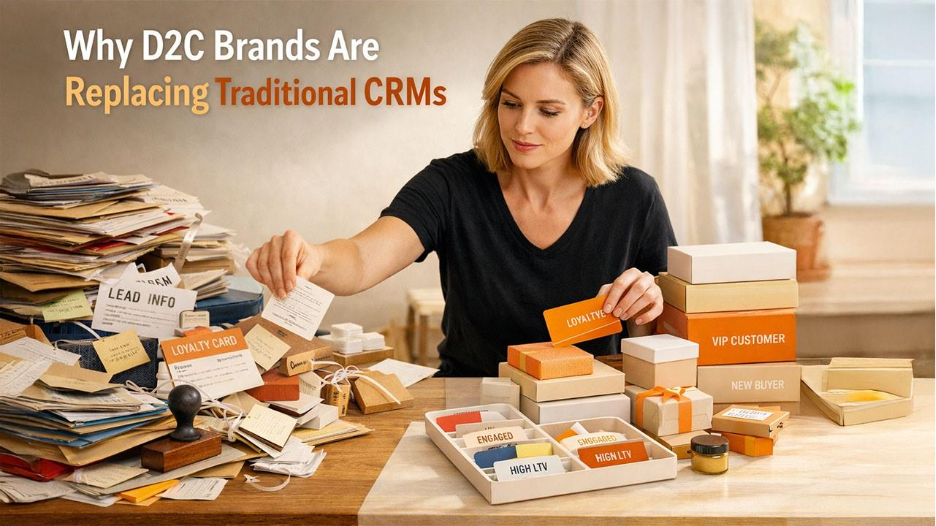

Customer relationship management software was supposed to solve everything. Track every interaction. Automate every touchpoint. Turn data into revenue.
But here's what actually happens: most direct-to-consumer brands end up with bloated CRMs full of fields nobody fills out, automations that break constantly, and reports that answer questions nobody's asking.
The problem isn't that CRMs are bad. It's that most weren't built for how D2C brands actually operate. That's why forward-thinking brands are exploring Next-Gen CRM Tools designed specifically for modern commerce.
The D2C Data Problem Nobody Talks About
Traditional CRMs were designed for B2B sales cycles. Long nurture sequences. Account-based selling. Sales reps, logging calls and scheduling follow-ups.
D2C operates completely differently. Customers discover a brand on TikTok, buy within hours, and either become repeat purchasers or disappear forever. The buying cycle isn't measured in months—it's measured in sessions.
According to research from McKinsey & Company, 71% of consumers expect companies to deliver personalized interactions, and 76% get frustrated when this doesn't happen. But here's the disconnect: most D2C brands are drowning in customer data while simultaneously knowing nothing useful about their customers.
They know someone bought a $45 moisturizer on March 3rd. What they don't know is whether that person is a skincare enthusiast who'll spend $2,000 over the next year, or a one-time buyer who grabbed a discount code and will never return.
The gap between data collection and actual insight is where most D2C brands are bleeding money.
What D2C Brands Actually Need From Customer Data
Traditional CRM Focus:
- Lead scoring based on engagement
- Email open rates and click-through rates
- Pipeline stages and conversion funnels
- Activity logging and task management
What D2C Brands Actually Need:
- Purchase behavior patterns across product categories
- Predicted lifetime value within first 30 days
- Churn risk scoring based on engagement and purchase frequency
- Real-time segmentation for ad audience building
- Attribution across multiple touchpoints (social, email, SMS, paid ads)
See the difference? Traditional CRMs track activities. D2C brands need to predict behaviors and optimize for lifetime value, not just next purchase.
The Integration Nightmare That's Costing You Money
Here's a scenario that plays out at dozens of D2C brands every week:
Marketing wants to build a Facebook Custom Audience of customers who purchased in the last 90 days but haven't bought it in the last 30 days. Sounds simple, right?
Except the purchase data lives in Shopify. The email engagement data lives in Klaviyo. The SMS data lives in Postscript. The ad account lives in Meta. And the CRM is supposed to somehow tie it all together.
What should take 5 minutes turns into a 3-hour project involving CSV exports, data cleaning, and manual uploads. By the time the audience is live, it's already outdated.
This integration tax—the time and money spent moving data between systems—is one of the biggest hidden costs in D2C operations. Brands that work with a d2c marketing agency often discover that 30-40% of their marketing team's time is spent on data wrangling instead of actual marketing.
The Three CRM Models That Actually Work for D2C
After watching dozens of brands struggle with CRM implementations, three approaches consistently work:
Model 1: The Lightweight Approach
Skip the traditional CRM entirely. Use Shopify as the customer database, Klaviyo for segmentation and communication, and connect everything through simple automation tools like Zapier.
Ideal for: Simple product lines and brands with yearly sales around $5 million
Why it works: It keeps expenses down, simplifies things, and directs attention towards the channels that are really important. Teams spend less time managing systems and more time marketing when the stack is basic.
The drawback is that it doesn't scale well above $10 million. The constraints eventually grow unbearable enough to warrant a stronger solution.
Model 2: The CDP Approach
Implement a customer data platform (CDP) that sits between all other tools. With this, “the CDP becomes the single source of truth, ingesting data from every system, pushing segments out to wherever they’re needed.”
Best for: Brands with $5M to $50M in annual sales and that have multiple product offerings and offer consumers a complex user experience
Why it works: It solves the integration problem. It would allow the Marketing side to create complex segments and deliver them to the desired channel in an instant. Data scientists can actually analyze behavior patterns without spending weeks cleaning data.
The catch: Requires technical installation and is costly (usually between $2K and $10K per month). It is not plug-and-play.
Model 3: The Comprehensive System
Use a D2C-specific platform that integrates loyalty, email, SMS, and CRM into a single system. Everything lives in one place, data flows automatically, and there's nothing to integrate.
Best for: Brands at any stage who want simplicity and are willing to switch tools to get it
Why it works: Eliminates integration problems entirely. When everything is native, data flows perfectly and segmentation becomes trivial.
The catch: Less flexibility. These platforms do many things well but aren't best-in-class at any single function.
How the Best D2C Brands Use Customer Data
The gap between average and exceptional D2C brands isn't data collection—everyone collects data. It's how that data gets used.
Average brands use data for reporting:
- Monthly dashboards showing revenue, conversion rates, and customer counts
- Basic segmentation (VIP vs. everyone else)
- Standard automated emails (welcome series, abandoned cart)
Exceptional brands use data for prediction and optimization:
- Real-time churn prediction that triggers intervention before customers leave
- Dynamic creative optimization where ad creative changes based on customer segment
- Predictive inventory planning based on customer cohort behavior
- Sophisticated testing frameworks that learn which messaging works for which segments
The difference isn't better tools. It's asking better questions.
Instead of "How many customers bought last month?" they ask "Which customer cohorts are trending toward higher lifetime value, and how do we acquire more of them?"
The question becomes not “What was our conversion rate?” but “What particular points of friction in the conversion process are causing the most highly valued potential customers to leave?”
This is what makes some companies go from a descriptive state into predictive analytics while others go from steady growth into exponential growth.
The Role of Paid Advertising in the Data Ecosystem
Customer data doesn't just relate to email marketing and retention. The smartest D2C brands actually put customer insights directly into their acquisition marketing funnels.
Here's how this is implemented for d2c marketing services:
Traditional method: Run ads, hope for good ROAS, and then optimize based on the data provided by platforms.
Data-driven approach:
- Determine Which Customer Groups Have the Highest Lifetime Value
- Break down what those customers have in common, including relevant demographic attributes.
- Instead of targeting anyone who has purchased before, lookalike audiences should be built off high-LTV customer segments.
- Adjust creative and messaging depending on the segments that respond the most to them
- Continuously feedback performance data into your model
The result: Customer acquisition costs decrease while lifetime value rises because the marketing focuses on acquiring the right customers, not just more customers.
This is why brands that can integrate their CRM data with their advertising strategy continue to outperform those who treat them as disparate systems.
The First-Party Data Advantage
With third-party cookies dying and iOS privacy changes limiting tracking, first-party data has never been more valuable.
Brands that own rich customer data can:
- Build custom audiences even as tracking degrades
- Personalize experiences without relying on cookies
- Make attribution decisions based on actual customer journeys
- Reduce dependence on platform data that's increasingly unreliable
But this only works if the data is actually organized, accessible, and actionable. A CRM full of messy, siloed data isn't much better than no CRM at all.
The winning approach: treat customer data infrastructure as a competitive advantage, not just an operational necessity.
Building a Customer Data Strategy That Actually Works
Most D2C brands approach CRM backwards. They pick a tool, implement it, and then figure out what to do with it.
Better approach:
Step 1: Define the Decisions
What specific business decisions will customer data inform? Examples:
- Which products to promote to which customers
- When to send win-back campaigns
- Which customer segments to exclude from acquisition campaigns
- Which new products to develop based on purchase patterns
Step 2: Map the Data Requirements
For each decision, what data is needed? Where does it live now? How fresh does it need to be?
Step 3: Choose Tools Based on Requirements
Only now should tool selection happen. Pick systems that make those specific decisions easier, not systems with the most features.
Step 4: Implement Progressively
Don’t set out trying to create the perfect system from day one. Begin with what has the greatest impact and iterate from there.
Step 5: Feedback Loops
Establish processes to assess whether this data strategy leads to better decision-making. If not, change.
Frequently Asked Questions
Q: How much should a D2C brand expect to spend on CRM and customer data tools?
Budget has strong reliance on revenue, although it’s reasonable to start at 1-2% for infrastructure related to consumer data. So for a $10M brand, this would mean 100K to 200K per year for all tools combined – CRM, CDP, email, SMS, analytics, and so on. Brands under 2M likely require no more than 1K-2K per month for tools.
Q: What's the biggest mistake D2C brands make with CRM implementation?
Over-customization. The brand spends months on custom fields and workflows that are never utilized. It’s more effective to begin with minimal functionality and iterate outward. Most do not use their CRM capabilities beyond 20%.
Q: Should D2C brands use the same CRM as B2B companies?
Usually, not. B2B CRM solutions (Salesforce, HubSpot, Pipedrive) are designed with extended sales cycles in mind, involving multiple decision-makers. D2C operations require simplified solutions that handle volume business with less interaction. A proprietary D2C platform may cost less in the long run.
Q: How do D2C brands handle customer data across multiple sales channels?
The point is that you have one system of record that’s your “truth,” commonly Shopify or your CDP, and then you pushed that data to all your other systems. It doesn’t work when you’re trying to sync data between multiple systems in a two-way process because that creates conflict and problems with the data itself. Choose your hub and then your other components will be spokes.
Q: What customer data metrics actually matter for D2C brands?
Emphasis is placed on: Customer Lifetime Value (LTV), Customer Acquisition Cost (CAC), LTV: CAC Ratio, Repeat Purchase Rate, Time Between Purchases, Retention Curves for specified cohorts, and Predicted Churn Risk. Vanity metrics like total customer count or email list size matter much less than these behavioral indicators.
Q: How can brands improve their customer data quality?
Start with data hygiene: deduplicate records, standardize formats, and remove outdated information. Then focus on data enrichment: connect behavioral data across touchpoints, calculate predictive metrics, and build meaningful segments. Most brands have enough data but terrible data quality.
The Bottom Line
CRM isn't about software. It's about understanding customers well enough to make better decisions about what to sell, who to sell to, and how to communicate.
Most D2C brands have the data. What they're missing is the structure, accessibility, and analytical capability to turn that data into competitive advantage.
The brands winning right now aren't necessarily the ones with the most sophisticated tools. They're the ones who've figured out how to get actionable insights from customer data and feed those insights into every part of their operation—from product development to advertising strategy.
Start simple. Pick one high-impact use case. Prove value. Then expand.
The perfect customer data infrastructure doesn't exist. But a good-enough system that actually gets used beats a sophisticated system that sits idle every time.
%201.png)

%201.png)

%201.png)