


OutRightCRM's blog dives into CRM technology, AI tools, automation, and the latest trends in business productivity. This particular topic builds on that, but we're going to take a closer look at the future of generative AI—a subject that definitely merits a closer examination.
Understanding Generative AI in the CRM Ecosystem
Generative AI is not just improving one area of CRM. It is reshaping the entire customer lifecycle. From how leads are qualified to how support requests are resolved, AI-driven capabilities are transforming CRM platforms into intelligent and proactive systems. The following section outlines the impactful ways generative AI is transforming CRM platforms and customer journeys into a real-world business landscape.
1. The Evolution of CRM into Intelligent Business Systems
Customer relationship management software has come a long way from simply storing contacts and handling basic automation tasks. These days, CRM platforms are evolving into intelligent business engines, all thanks to artificial intelligence. Generative AI is at the core of this shift, fundamentally changing how we engage with customers, forecast sales, personalizing marketing efforts, and delivering services.
As businesses increasingly adopt cloud-based CRM ecosystems and AI-driven tools, digital security and data privacy are also becoming more critical. Remote sales and support teams frequently opt to download the CyberGhost extension. They do this to secure their browser-based CRM sessions, safeguard customer data when using public Wi-Fi, and ensure encrypted communication while accessing sensitive dashboards.
This latest wave of AI-driven CRM solutions goes beyond mere efficiency. It signifies a profound change in how businesses grasp customer behavior, automate decisions, and craft predictive customer journeys. The strategic approach to AI and CRM integration is reshaping how organizations operate across every customer touchpoint.
2. Understanding Generative AI in the CRM Ecosystem
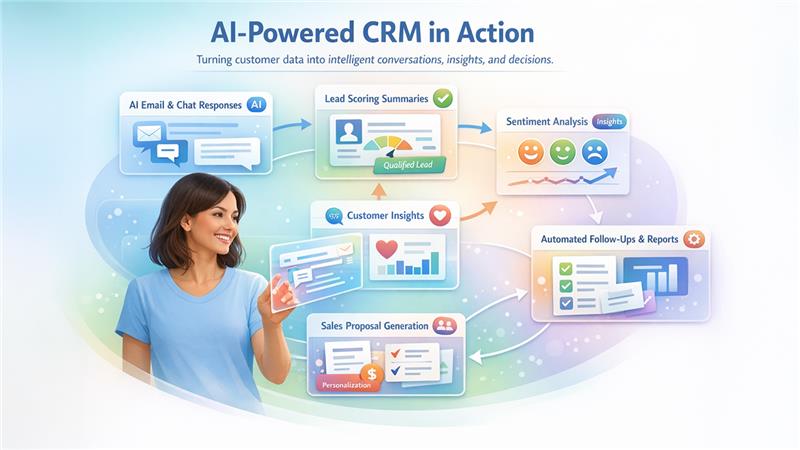
Generative AI includes machine learning models that can create new outputs, such as text, summaries, answers, recommendations, and organized insights. Unlike traditional rule-based automation, generative AI adjusts to its surroundings and learns from every communication with users.
Incorporating generative AI into CRM systems allows for the:
- Automated creation of emails and chat responses.
- Smart summaries for lead qualifications.
- Interpretation of customer sentiment.
- Generate dynamic sales proposals.
- Produces AI-generated follow-ups and reports.
CRM platforms have evolved. No longer just passive databases; they now function as intelligent assistants, actively shaping business decisions.
For those new to CRM, or perhaps needing a fast brush-up, our tips and best practices of using CRM software offer a good foundation before exploring the enhancements AI can bring.
3. From Automation to Intelligence: The CRM Evolution
Originally, CRM systems were all about organizing customer data and automating routine tasks. While this automation did boost efficiency, human involvement was still necessary for making decisions and personalizing interactions. Generative AI is changing that, ushering CRM into the intelligence era.
Traditional CRM capabilities:
- Manual email templates.
- Static reporting dashboards.
- Rule-based task automation.
- Reactive customer service workflows.
AI-enhanced CRM capabilities:
- Personalized content generation.
- Predictive analytics and insights.
- Behavioral trend detection.
- Adaptive customer engagement strategies.
This shift enables businesses to transition from a reactive stance to one where they proactively shape customer relationships.
4. Predictive Customer Journeys: Turning Data into Action
A significant advancement brought about by AI-driven CRM platforms is predictive journey mapping. Rather than viewing customers as fixed data points, AI constantly assesses website behavior, email interactions, and purchase history. Support ticket activity and social media interactions offer a wealth of information.
CRM systems can leverage this data to predict customer requirements and adjust their approach accordingly. Consider the possibility that a customer who hasn't been active might trigger automated efforts to re-engage them. Conversely, a prospective buyer demonstrating interest could receive immediate attention from the sales team. Furthermore, loyal customers could be offered personalized incentives.
Predictive journeys allow businesses to deliver relevant interactions at the right moment, all without manual intervention.
5. Smarter Sales Enablement Through Generative AI
Sales professionals frequently find themselves bogged down by administrative tasks: recording calls, drafting follow-up emails, and keeping their pipelines current. However, generative AI is shifting the landscape. Today's AI-infused CRM platforms offer a range of capabilities, including automated meeting summaries, suggested email drafts, and intelligent lead scoring, deal risk analysis, and next-best-action recommendations.
These features are designed to streamline the sales process, allowing representatives to concentrate on closing deals instead of getting bogged down in data entry. Moreover, AI-generated insights give managers the tools to identify performance gaps, fine-tune sales strategies, and offer real-time coaching to their teams.
6. AI-Powered Customer Support & Engagement
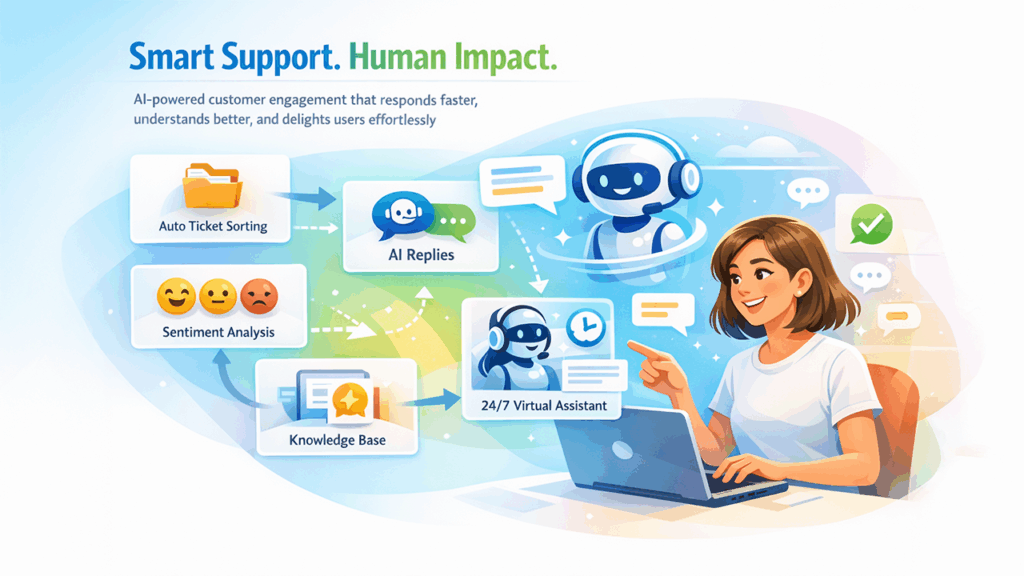
Customer service is undergoing a transformation, largely thanks to generative AI. Automating customer support has become a cornerstone of modern CRM strategies, with AI-driven CRM platforms now incorporating features such as automated ticket categorization, smart response generation, customer sentiment tracking, 24/7 virtual support assistants, and knowledge base recommendations.
AI takes on the repetitive tasks, handling common inquiries and delivering immediate solutions, rather than relying solely on human agents. This results in:
- Quicker response times
- Reduced operational expenses
- More consistent service
- Increased customer happiness
Human agents can then dedicate their time to handling intricate or emotionally charged situations that demand empathy and sound judgment.
7. Emerging Tools Driving AI CRM Adoption
Several technological shifts are speeding up the integration of AI into CRM systems:
- AI sales assistants. These embedded assistants support sales teams in preparing outreach campaigns, analyzing performance data, and refining pipelines using predictive analytics.
- Conversational CRM interfaces. Natural language interfaces enable users to engage with CRM platforms via chat or voice commands. Forget the menus. Users can simply ask questions or give commands such as, "Which leads are most likely to convert today?" or "Write follow-up emails for inactive clients."
- Customer Data Platforms (CDPs) are the linchpin. These AI-powered systems aggregate customer data from multiple sources, enabling CRM platforms to craft deeply personalized experiences using a single, comprehensive profile.
- Predictive analytics engines are also vital. These sophisticated tools empower businesses to project revenue, identify potential customer churns, and spot developing trends.
Together, these components transform CRM platforms into active business intelligence hubs.
8. Security, Privacy, and Compliance in AI-Driven CRM
As these platforms accumulate more customer data, the demand for strong security and privacy safeguards increases. Organizations must carefully consider a few key factors. First, data encryption and secure access protocols are paramount. Compliance with GDPR and other privacy regulations is also critical. The ethical use of AI and transparent data handling practices is equally important.
Modern CRM providers are responding by incorporating role-based permissions, audit trails, and AI governance frameworks to encourage responsible use.
Remote teams, who rely on CRM systems across various networks, gain an extra layer of security. Browser encryption tools and VPN extensions are just a couple of the measures that help safeguard sensitive data.
9. Industry Trends Shaping the Future of CRM
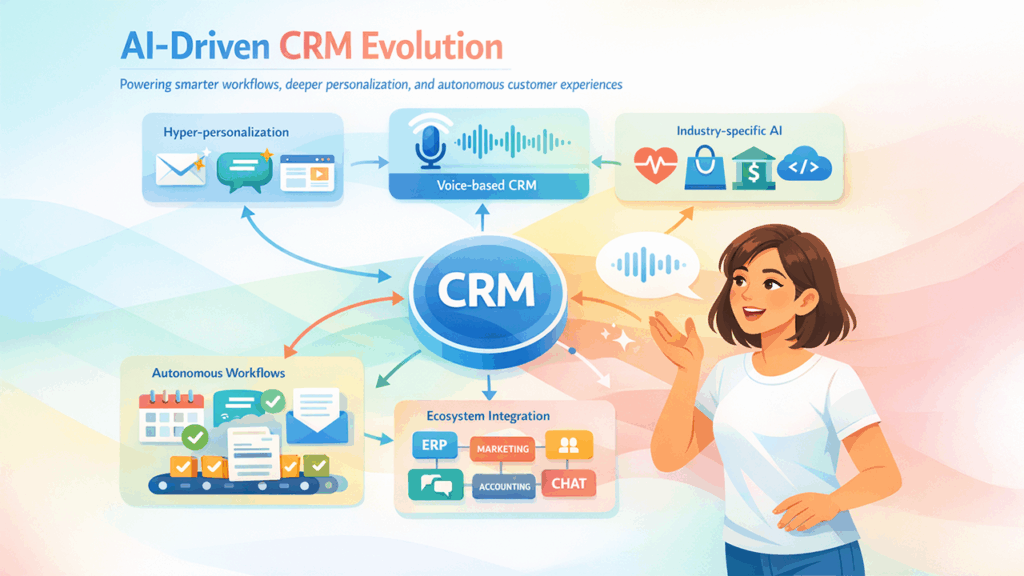
Several key trends are currently shaping the evolution of AI-driven CRM platforms:
Hyper-personalization. AI is changing how we personalize experiences in real-time, impacting everything from emails and websites to chat and customer support.
Voice-based CRM interactions are on the rise. Dashboards and AI assistants that respond to voice commands will soon allow users to navigate and report on CRM data without lifting a finger.
The future lies in autonomous workflow execution. Upcoming CRM systems will take on responsibilities such as arranging meetings, drafting proposals, assessing leads, and maintaining pipelines, all while requiring less human input.
We're also seeing the rise of industry-specific AI models. CRM platforms built for particular sectors will utilize bespoke AI models, each crafted for healthcare, ecommerce, finance, and SaaS applications.
And, of course, deeper ecosystem integration is underway. CRM platforms are transforming into central business hubs, linking up accounting software, marketing automation tools, ERP systems, and collaboration platforms.
10. How Businesses Can Prepare for AI CRM Adoption
Organizations eyeing AI-driven CRM tools should get their ducks in a row first.
For starters: data cleanup. The effectiveness of any AI system hinges on the quality of the data it ingests. A thorough examination of your CRM databases is essential, with a focus on removing duplicates and outdated information.
Next, prioritize training. Your team needs to be well-versed in how to use AI tools effectively. Well-designed training programs boost adoption rates and help mitigate any pushback.
Consider launching a pilot program. These smaller-scale projects give teams a chance to experiment with AI features and assess the potential return on investment before making a larger commitment.
Also, choose platforms that can adapt. CRM systems with open APIs and the ability to integrate AI updates offer long-term flexibility.
The Business Case for AI-Enhanced CRM
Organizations that adopt AI-powered CRM systems often experience improvements in several areas:
• Sales conversion
• Customer loyalty
• Support operations
• Forecasting precision
• Revenue expansion
AI doesn't supplant human skill; it augments what we can accomplish and sharpens our judgment. Companies that hesitate to adopt it are likely to lag behind rivals who offer quicker service, more tailored experiences, and more intelligent ways to connect.
Final Thoughts
CRM systems have come a long way from simply storing customer information. Now, with generative AI woven in, they're becoming intelligent hubs, assisting marketing, sales, and service teams as they work.
As automation, predictive analytics, and conversational AI continue to develop, CRM systems will play an increasingly vital role in shaping customer experiences and fueling business growth. Those who embrace this change early will likely build stronger customer connections, streamline their operations, and gain a significant advantage over their rivals.
The future of CRM isn't just about maintaining a contact list; it's about fostering smarter, AI-enhanced relationships.
%201.png)

%201.png)

%201.png)