


Your CRM tells you everything about your customers. When they last engaged, what they purchased, where they are in the sales funnel. But there's one critical question it can't answer: are they trying to reach you right now while your website is down?
Companies using CRM tools see a 27% increase in customer retention, according to research from Aberdeen Group. That's significant. But here's the problem: all that retention improvement depends on customers being able to access your business when they need to. If your website is offline during those critical moments, your CRM can't help you retain customers who never get through the door in the first place. Since your website is down, CRM cannot track the failures, creating CRM blind spots.
Understanding CRM Blind Spot- What Is It?
CRM systems excel at managing the customers you have. They track interactions, automate follow-ups, and help sales teams close deals more efficiently. The average ROI for CRM is $8.71 for every dollar spent, making it one of the most valuable technology investments a business can make.
But there's a gap in this equation. Your CRM tracks what happens when customers successfully interact with your business. It does not keep a record of the customers who wanted to visit your website at 2 AM and faced an error page. It does not track the prospects who clicked on the link present in your email campaign only to find that your website is unresponsive. Since these failures happen outside the oversight of CRM, they become invisible. Thus, ultimately what you have are CRM blind spots that directly impact the KPIs that you are looking to improve.
Consider a typical customer journey in the year 2026. Someone sees your marketing content, clicks through to your website, browses your offerings, and either converts immediately or enters your CRM as a lead for nurturing. This flow works perfectly when your website is operational. When your website is not operational, the complete process gets broken before it even starts.
What Really Happen When Your Website Is Down?
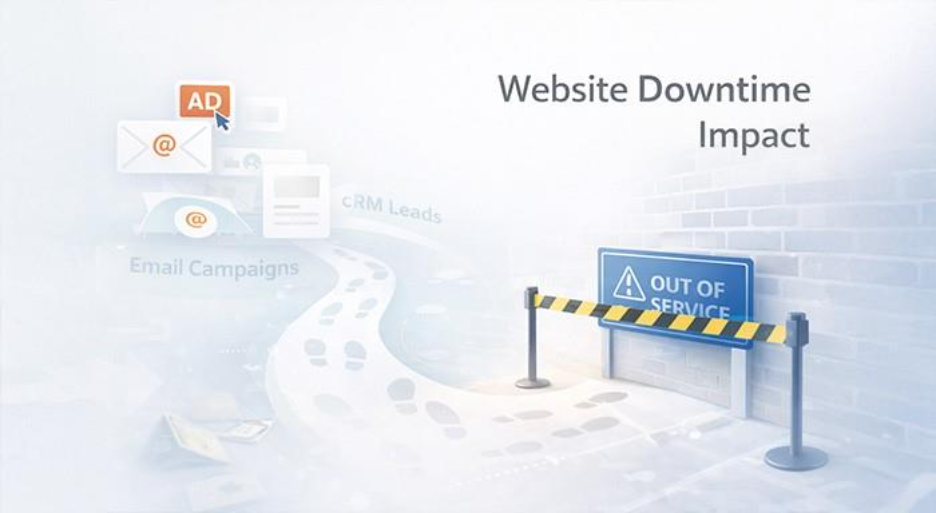
In downtime, your website goes offline. The damage that it causes goes far beyond the instant lost sales. The email campaigns that you had designed carefully send customers to dead pages, impacting your reputation greatly. Keep in mind that your paid advertising is operational, burning the budget while driving the traffic toward websites that will not load. In such cases, each social media post turns out to be a liability, creating clicks that do not lead anywhere.
Your CRM shows you missed follow-up opportunities, but it can't show you the opportunities that never made it into the system. These are the prospects who bounced off your downed site and moved to competitors. They're the customers who tried to access their account information at an inconvenient time and decided to shop elsewhere. They never appear in your CRM reports because they never successfully engaged with your business. Thus, they are CRM blind spots.
The statistics on this are sobering. Research shows that 89% of customers will move to a competitor after a poor customer experience. A website that won't load definitely qualifies as a poor experience. For businesses that have invested heavily in CRM to improve customer relationships, losing customers before they even enter your system represents a fundamental breakdown in the strategy.
The Hidden Impact on Your CRM Metrics
Your CRM tracks conversion rates, but those rates only reflect visitors who successfully loaded your pages. If half your traffic encounters downtime or slow load times, your actual conversion rate is far worse than your CRM reports indicate. The system shows you converting 5% of visitors, but you're actually converting 2.5% of people who tried to visit.
Customer lifetime value calculations in your CRM assume customers can consistently access your services. When reliability problems interfere with that access, lifetime value drops even as your CRM shows unchanged metrics. The disconnect between what your CRM reports and what's actually happening creates a false sense of security.
Sales forecasting accuracy improves by an average of 42% when businesses use CRM systems. The problem is that such forecasts presume that your business operations are normal. When your website downtime occurs, it not only disrupts your sales pipeline, but the predictions based on historical information become unreliable. Your CRM can forecast steady growth as per the historical patterns, while present technical problems impact your lead flow quietly.
Integration That Really Matters
Businesses that think ahead are resolving this blind spot by linking website tracking directly to the CRM workflows. When monitoring tools like Odown detects downtime, that data that gets fed into CRM platforms pauses email campaigns, refines sales forecasts, and alert teams that lead generation has been impacted.
This integration ensures visibility that standalone platforms cannot offer. Your CRM shows customer interactions. Your monitoring system shows website availability. Together, they unveil the holistic view of your customer acquisition and retention performance.
Consider how this works in practice. Your tracking system finds out that your website has been out for around 15 minutes during peak traffic time. That data sends a signal to CRM workflow. This ultimately triggers the system to:
- Pause scheduled email campaigns until the problem is resolved.
- Sends a notification to sales teams that the inbound flow of leads has paused.
- Records the incident for future analysis that provides insights on the conversion rate impact.
- This refines short-term sales predictions to detect prediction.
Without the help of this integration, your teams work on incomplete data. Sales representatives follow up on these leads, unaware of the fact that a considerable number of customers are facing errors. Marketing continues campaigns not knowing recipients are clicking through to dead pages. Management reviews metrics that don't reflect the full scope of recent technical problems.
The Real Cost of CRM Without Monitoring

Companies invest in CRM to improve customer retention and increase sales efficiency. But if technical reliability problems interfere with customer access, that investment delivers diminished returns.
A business spending $1,000 monthly on CRM expects to see $8,710 in monthly value based on average ROI figures. If website downtime reduces customer acquisition by just 10%, that $8,710 drops to $7,839. The CRM itself still works perfectly, but the business doesn't achieve the expected return because technical issues are undermining the foundation the CRM depends on.
The math becomes more concerning when you factor in customer acquisition costs. If you are spending approximately $100 to onboard every customer via marketing. Imagine if around half of such prospects face website problems during the first conversation itself. In this case, the actual acquisition costs become almost double to $200. Your CRM can give the figure of $100 based on the successful conversions. However, the actual costs involve all the attempts that fail before customers even reach your system.
Creating a Comprehensive Platform
The most efficient approach integrates CRM for managing customer relations with tracking customer access management. Neither system alone provides complete visibility into business performance. Just like automating business processes removes operational bottlenecks, incorporating tracking with CRM eliminates blind spots in customer acquisition processes.
Your CRM tracks who your customers are, what they've purchased, and how they interact with your business. This keeps track of whether the customers actually reach your business whenever they search for it. The two data streams uncover opportunities combined and problems that none of the system showcases.
Businesses executing this integrated approach showcase more precise predictions, more effective allocation, and enhanced capability to detect sudden downfall in conversion rates. When leads decrease unexpectedly, integrated systems quickly determine whether the problem is with marketing effectiveness or technical availability.
The execution is very simple. The majority of advanced CRM solutions provide webhooks support or API integrations that help in receiving alerts from tracking platforms. When downtime happens, the tracking system sends a notification that modifies existing workflows in your CRM. No complex development of custom solutions is needed.
What Success Actually Looks Like?
Companies that integrate website tracking effectively with CRM processes get numerous visible benefits.
They ensure more precise sales predictions because they track technical disruptions that impact the entire lead generation. Their marketing campaigns perform better because they don't send traffic to unavailable sites. The overall customer retention enhances since technical issues get resolved before impacting the overall service quality greatly.
Having this tracking also yields competitive advantages to the businesses. In markets where competitors suffer from unnoticed downtime, companies with robust monitoring capture the customers who encounter competitors' technical problems. That market share gain compounds over time as those new customers appear in the CRM and receive the same retention-focused nurturing that drives the 27% retention improvement.
The visibility also improves team coordination. Marketing, sales, and technical teams all operate from the same holistic view that the current status of the system provides. When problems happen, relevant responses quickly take place instead of post-incident confusion regarding why flow of leads have stopped.
How to Make This Integration More Practical?
Executing tracking along with CRM does not need complex technical projects. You can implement a process with just a few simple steps:
First, set up tracking of your vital customer touchpoints. At the very least, this should include the homepage of your website, important product pages, any login systems or customer portals. Establish tracking intervals to check the status of these pages every other minute so that the issues get quickly detected.
Second, set up alerts that notify relevant teams when issues occur. Technical teams require instant notification so that they can start working on resolution. Sales and marketing team need to be updated that customer touchpoints have been impacted.
Third, develop CRM workflows that get triggered by downtime alerts and perform an action. At the very basic level, this means recording downtime incidents in your CRM system so that you see them in your reports along with customer interaction information. More advanced executions might pause campaigns automatically or adjust sales predictions as per the timing and duration of the outages.
Lastly, constantly check the combined data to find out patterns. Are downtime incidents more frequent during the periods of high-traffic? Do specific types of technical issues correlate with downfall in particular customer segments? The synchronized data showcases insights that neither of the system can display on its own.
Looking Ahead
As CRM tools become more advanced with AI-driven features predictive analytics, the quality of their insights greatly depends on having comprehensive and precise data regarding customer interactions. Blind spots related to technical availability impact the sophisticated capabilities.
The businesses that get success in 2026 and beyond will be the ones that identify effectiveness of CRM greatly rely on accurate customer access. Investment in customer relationship management while ignoring infrastructure costs leads to an unsteady foundation for success.
Your CRM can tell you everything about your customers except whether they can reach you right now. Filling that gap isn't optional anymore. It's essential infrastructure for businesses serious about customer retention and sustainable growth.
The tools exist to solve this problem. The integration isn't complicated. The only question is whether you'll implement this before or after the next costly outage reveals the blind spot in your customer acquisition strategy.
%201.png)

%201.png)

%201.png)