


Modern IT is a mosaic, not a monolith. Clouds from competing hyperscalers, routers from rival vendors, and carriers with overlapping footprints all share the same architecture.
Keeping that patchwork stitched together—without locking yourself to a single supplier—is the new connectivity challenge. Vendor-agnostic connectivity platforms solve it by sitting above individual providers and speaking every dialect, giving you one place to connect, manage, and secure a multi-vendor estate.
Need proof that heterogeneity is now standard? Flexera’s 2023 State of the Cloud report found that 87 percent of organizations already run workloads across more than one cloud provider.
Next, we’ll profile four standout platforms—TD SYNNEX ConnectSolv, KORE Wireless, Megaport, and Aviatrix—compare their strengths, and map the criteria you should use to choose the right fit. Grab your coffee; the tour starts now.
How we drew the shortlist

We started where you probably would: web searches and analyst reports to uncover who truly solves multi-vendor connectivity. First, we mapped the market, scanning top-ranking articles, Gartner and Forrester notes, and vendor white papers. Most content repeated the same names or skipped security and integration depth, so we flagged those gaps to improve.
From an initial pool of eight suppliers, we applied a strict filter: each platform had to support more than one network type or cloud, offer an open API, and show real momentum in the past 18 months. Miss one requirement, exit the list.
That left four clear front-runners. We then scored each against six criteria that matter in daily operations.
- Integration breadth: number of carriers, clouds, or devices you can connect without custom work.
- Network scope and performance: global reach, SLA strength, and technology mix such as MPLS, 5G, or SD-WAN.
- Ease of deployment: self-service portals, automation hooks, and time to first packet.
- Security and compliance: encryption choices, zero-trust posture, and certifications.
- Pricing transparency: clear, flexible models that avoid lock-in clauses.
- Ecosystem and support: partner programs, 24×7 service desks, and analyst recognition.
We weighted the first two most heavily because “vendor-agnostic” only matters if you can connect to almost anything, anywhere. Security and ease of use acted as tiebreakers, while pricing and support completed the final picture.
With the methodology set, it’s time to meet the contenders.
TD SYNNEX ConnectSolv: the one-stop shop for business connectivity
Think of ConnectSolv as a giant switchboard that snaps hardware, carrier plans, and cloud services together behind a single glass pane. TD SYNNEX built it for resellers and IT providers that live in a multi-vendor world but want one contract, one invoice, and one support team.
When you order through ConnectSolv, a 5G router can ship preloaded with an eSIM that already knows which carrier to join as soon as the device powers on. A temperature sensor leaves the warehouse connected and starts streaming data before it reaches the loading dock. No separate carrier negotiations, no last-minute APN gymnastics. Everything arrives activated because the aggregator stitched those moving parts together up front.
Inside the portal you quote, order, and manage every component. Need to tweak a data plan or add more SIMs? Do it in the same workspace where you track hardware shipments and raise support tickets. Partners appreciate the simplicity because it replaces a knot of vendor logins with one clean interface.
Breadth is the other half of the story. ConnectSolv taps tier-1 telcos like AT&T and Orange, IoT specialists such as KORE, and more than 100 hardware makers. That reach lets you blend the best network for each region with the device that fits the job, without juggling separate agreements.
Recognition backs the model. CRN’s 2024 Partner Program Guide stamped ConnectSolv with a five-star rating for training, margins, and support, a nod to how well the ecosystem treats the channel.
For logistics, healthcare, or any project that needs “it just works” connectivity at scale, ConnectSolv turns multi-vendor chaos into a curated, turnkey stack. It is vendor-agnostic in the truest sense: you choose the parts; the platform makes them play nicely.
KORE Wireless: a global SIM that never hits roaming panic
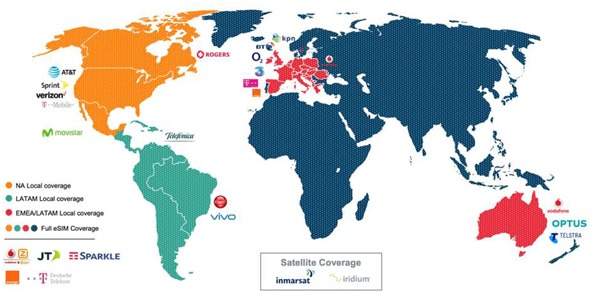
If ConnectSolv is a Swiss Army knife, KORE is the single blade sharpened for IoT. The company connects machines, full stop. No consumer phone plans, no cable bundles; just pure device traffic flowing through more than 400 cellular networks in over 200 countries.
That reach reshapes the economics of tracking assets across borders. One multi-IMSI eSIM from KORE hops automatically to the strongest local carrier wherever your shipment lands. A pallet leaves Chicago on AT&T, sails into Rotterdam on Orange, and finishes its journey in Shenzhen on China Mobile, all under one data plan and one service-level agreement.
The KORE One portal puts you in control. Flip a device from test to production, cap its data at the edge, or push a fresh SIM profile over the air. Operations teams use the same dashboard to watch usage in real time, catch anomalies, and open tickets straight to KORE’s 24 × 7 network operations center.
Support matters when thousands of devices go dark at 3 am. Instead of refereeing disputes between roaming partners, you escalate once and let KORE negotiate with whichever carrier owns the last mile. The model cuts mean time to repair and spares your team the “not our network” blame game.
Momentum backs the story. Absorbing Twilio’s IoT business pushed KORE past 40 million connected devices and cemented its spot as the Gartner Magic Quadrant leader for managed IoT connectivity five years running. In proving that a vendor-agnostic backbone can rival, and often outperform, incumbent telcos, KORE keeps critical sensors online when it matters most.
If your roadmap depends on tracking assets, patients, or field equipment without borders, KORE makes one simple promise: one SIM, every signal.
Megaport: instant, private links between any cloud and any rack
Picture clicking a few checkboxes and lighting up a private 10-gig pipe from your data-center cage to an AWS VPC within minutes. That on-demand speed is Megaport’s calling card.
The company runs a global software-defined backbone that now spans more than 1,000 enabled locations. Covering roughly ten percent of the world’s data centers, Megaport is the largest pure Network-as-a-Service fabric on the planet.
Because the platform is carrier neutral and cloud neutral, you avoid the usual maze of contracts. One port in your colocation cabinet unlocks straight-through connections to AWS, Microsoft Azure, Google Cloud, Oracle, and IBM, plus hundreds of internet exchanges and SaaS endpoints. You choose the vendors; Megaport stitches the circuits.
Flexibility is the payoff. Need a high-capacity link for a week-long migration? Dial bandwidth up, copy your data, then spin the circuit down and stop paying for it. Want to mesh two clouds without riding the public internet? Create a virtual cross-connect inside the portal, pick your regions, and press Go.
The experience feels more like spinning up a virtual machine than ordering network services. A clean web UI and a full-featured API let NetOps teams bake connectivity into Terraform scripts or CI pipelines. During a peak sale event, you can automate extra capacity between clouds, then roll back to normal levels once traffic settles.
Megaport also pairs well with modern WAN designs. Its Virtual Edge device integrates with leading SD-WAN vendors, so branch traffic can hit the Megaport backbone seconds after leaving the office firewall and land inside a cloud VPC without touching the open internet.
For companies juggling multicloud architectures, Megaport turns what used to be a 90-day carrier project into a five-minute self-service task, changing how fast you can launch the next workload.
Aviatrix: one policy to rule every cloud
Running networks inside a single hyperscaler is hard enough. Add a second or third cloud and the rule books change, the dashboards multiply, and troubleshooting turns into whack-a-mole. Aviatrix solves this by sliding a unifying control plane across every environment you own.
You deploy lightweight gateways in each VPC or VNet, then point them at Aviatrix Controller. Suddenly AWS, Azure, Google Cloud, and Oracle all speak the same policy language. Need a new transit hub? Click once and the software spins up encrypted tunnels, propagates routes, and visualizes flows in CoPilot before your coffee cools.
Performance stays sharp because Aviatrix optimizes encryption in software, pushing 10+ Gbps through a tunnel while native cloud VPNs wheeze at a fraction of that. Security teams appreciate writing one segmentation rule and watching it land consistently across clouds instead of babysitting four separate firewalls.
The payoff shows when incidents hit. With CoPilot you trace a packet’s hop-by-hop journey, regardless of which vendor carries each leg. Engineers no longer bounce between consoles or plead with cloud support to find the blind spot. They see, click, fix.
A quick nod to Alkira, a close cousin that offers a similar single-pane experience but runs its own backbone as a service. Koch Industries chose that route to shorten a massive cloud migration and credits the platform for cutting network deployment times from months to days. Whether you prefer Aviatrix’s DIY gateways or Alkira’s fully hosted fabric, both prove you can keep a tight grip on policy without pledging allegiance to any one vendor.
How to choose the right platform
Let’s move from product tours to practical decision-making. Picking a vendor-agnostic platform is less about chasing shiny features and more about matching the tool to the pain points in your own network.

Start by defining the job to be done. If you need reliable global SIM coverage for thousands of sensors, KORE or ConnectSolv’s IoT bundles rise to the top. If your struggle is weaving three public clouds into one private fabric, Megaport or Aviatrix will feel like a shortcut instead of a science project. State the primary use case in one sentence; anything outside that scope is a nice-to-have, not a deal breaker.
Next, test integration fit. Pull up the platform’s API docs and check whether it connects with the automation tools you already trust such as Terraform, Ansible, or your ITSM portal. The faster you can loop connectivity changes into existing pipelines, the sooner the platform earns its keep.
Coverage matters just as much. Verify footprint maps against your roadmap, not just current offices. Opening a plant in Vietnam next quarter? Make sure the provider shows local points of presence or carrier partners today, not on a future slide.
Security is non-negotiable. Ask how traffic stays private, how keys are managed, and which certifications back the promises. Zero-trust is more than a slogan; it tells you whether the vendor treats every component (device, user, and cloud edge) as potentially hostile until proven otherwise.
Finally, run the numbers over 3 years, not 3 months. Usage-based bandwidth from Megaport can undercut fixed circuits during seasonal peaks, while a per-device IoT plan from KORE might save money only if you can cap telemetry chatter. Factor in operational load too. A single support contract through ConnectSolv often frees engineer hours that never show up on a spreadsheet yet absolutely hit the bottom line.
Wrap those answers in a short scorecard and the best fit usually becomes clear. It is rarely the flashiest demo; it is the platform that removes the most friction with the least added complexity.
Emerging trends to watch
Connectivity never stands still, and neither should your roadmap. Several shifts are already steering the market toward deeper vendor neutrality.
Secure Access Service Edge (SASE) tops the list. By blending networking and security into one cloud service, SASE providers remove the need for a separate appliance stack in every branch. The result is fewer vendor silos and a smoother hand-off between network and security teams.
Multicloud normalisation is next. Hyperscalers are no longer pretending you will stay with one provider. Joint initiatives such as the 2024 AWS–Google interconnect show that cross-cloud traffic is becoming the norm. Platforms that support many clouds from day one are positioned to ride that wave.
Edge computing and private 5G add fresh complexity. As factories, hospitals, and retail stores spin up local compute nodes, they need quick, reliable backhaul to multiple clouds and analytics engines. Aggregators like ConnectSolv and IoT specialists such as KORE already offer 5G slices to meet that demand.
Open APIs are accelerating interoperability. Industry groups now publish common models for provisioning and monitoring, making it easier for a neutral platform to light up new carriers or cloud regions in weeks instead of months.
Artificial intelligence in NetOps rounds out the list. Diverse telemetry feeds improve prediction accuracy, and vendor-agnostic fabrics touch many networks, giving their algorithms a broader data set than single-provider tools can match.
Track these currents and you will spot tomorrow’s winners before the next analyst quadrant is released.
Conclusion
Vendor lock-in used to be the price of simplicity. Now, platforms like TD SYNNEX ConnectSolv, KORE, Megaport, and Aviatrix prove that you can have both freedom and control without worrying about operational processes. The multi-vendor future is already running in production across 87 percent of enterprises.
Your job isn't to pick one perfect vendor; it's to choose the connectivity layer that allows every vendor you need work together seamlessly. Start with your biggest pain point, match it to the platform built to solve it, and let the integration breadth do the heavy lifting while you focus on what actually moves the business forward. Track these currents and you will spot tomorrow’s winners before the next analyst quadrant is released.
%201.png)

%201.png)

%201.png)