


Workflow playbook: how brokers use CRM to compress the timeline
Workflow 1: Lead intake and qualification in under 24 hours
Fast leasing starts with disciplined lead management. When inquiries arrive through emails, calls, tours requested from listings, or referrals, standardized intake prevents the same old problem: details getting lost, then rediscovered later when momentum is gone. A CRM works best when every lead enters through one consistent path, gets tagged the same way, and triggers the same immediate next step. That consistency is what improves broker response time without relying on heroics-especially when you're trying to secure an office lease on a compressed timeline.
A script-style intake checklist keeps qualification tight and repeatable:
- Who is the decision-maker and who else must approve?
- Target move-in date and flexibility window?
- Required size range and preferred layout?
- Budget range (all-in or base rent focus)?
- Submarket must-haves and "no-go" boundaries?
- Lease term preference and any expansion/renewal needs?
- Parking, signage, after-hours access, or special use requirements?
Next step: schedule a call or send a shortlist by a specific time?
The point isn't perfect information on day one. It's capturing the essentials so the next action happens quickly and cleanly.
Workflow 2: Requirement-to-availability matching (short lists that don't waste tours)
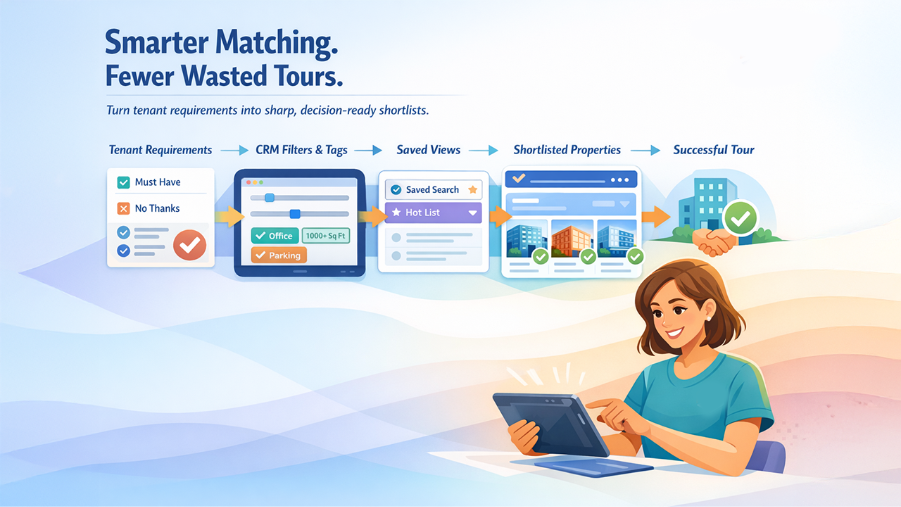
Tour fatigue is real. Tenants get tired of walking through space that was never going to work, and landlords get tired of feedback that doesn't convert. CRM-powered property matching reduces wasted tours by turning requirements into searchable filters and saved views. Instead of starting from scratch with each inquiry, the broker starts from a structured requirement record.
Tagging, filters, and saved views do most of the heavy lifting:
- Tags for must-haves (floorplate type, parking ratio, signage, ceiling height, furnished, term flexibility)
- Filters for non-negotiables (size band, submarket, delivery condition, budget range, occupancy date)
- Saved views for common "plays" (move-in ready options, value options, Class A options, near transit, short-term term options)
With this setup, the tour short list becomes a decision tool, not a scavenger hunt. It's typically smaller, sharper, and easier to explain: three to five spaces that represent real trade-offs, with notes that match the tenant's own language. That clarity accelerates shortlisting and keeps the process moving forward instead of sideways.
Workflow 3: Tour orchestration
Tour scheduling looks simple until it isn't. Calendars collide, access instructions get buried, and someone always shows up late to a locked suite. Speed comes from coordinated confirmations and immediate tour feedback logged in the CRM while impressions are fresh. When tour details live in one place-time, attendees, access notes, and the planned next step-the deal stops depending on memory.
A simple tour feedback template can be logged right after each stop and used to trigger next actions:
- Space score (1-5) and why
- Deal-breakers noticed (layout, light, parking, noise, condition)
- "If fixed, would reconsider?" (yes/no + what fix)
- Rent reaction (high/okay/low) and concession sensitivity
- Decision status (keep / maybe / eliminate)
- Next step (request proposal, schedule second look, compare to option X)
When feedback is entered, the CRM can automatically create tasks: request pricing for "keep," send recap to the tenant, and notify the listing side with specific questions. That tight loop turns tours into progress rather than just motion.
Workflow 4: Proposal and LOI management
Most leasing delays happen after the tours, when the thread gets messy. Proposals live in inboxes, decision-makers change, and the same question is asked three different ways over two weeks. Proposal tracking and LOI tracking work best when the best CRM becomes the deal's single source of truth: documents, people, dates, and open issues all in one place with reminders that don't rely on someone "remembering."
A practical way to keep negotiation workflow moving is the deal issue list-a living list of what's open, who owes what, and when it's due. It can be simple, but it must be visible:
- Open item (e.g., free rent, TI, early access, signage, parking, security deposit)
- Owner response due date
- Tenant response due date
- Current position (asked/offered/countered/approved)
- Decision-maker attached (who can say yes)
- Notes from last conversation and next ask
With that structure, reminders become meaningful. Instead of generic "follow up," the task becomes "owner response due on TI by Thursday; send updated ask with rationale." Momentum stays intact because everyone is reacting to the same facts, not different versions of the story.
Workflow 5: Lease execution handoff
Late-stage delays often come from a weak handoff: legal and operations are asked to "paper the deal" without context, and then the questions restart from scratch. A clean deal handoff in the CRM reduces closing drag by packaging the essentials in a consistent transaction checklist. The minimum handoff package typically includes: final LOI with all exhibits, verified legal names and signing authority, critical dates (delivery, commencement, access), commission instructions, suite/building details, a list of open items that must be reflected in the lease, and a clear chain of communication. When lease execution starts from a complete package, the finish becomes a process, not a scramble.
Landlord reporting that accelerates decisions
Reporting is a speed tool, not a courtesy
Landlord reporting is often treated as "nice to have," but in practice it's decision support. High-quality leasing updates reduce anxiety, prevent surprise objections, and speed approvals on pricing, concessions, and deal terms. When landlords can see pipeline visibility-what's happening, what's real, what's risky-they make decisions faster and with fewer back-and-forth calls. It also protects relationships: fewer vague updates, fewer "just checking in" messages, more clarity and confidence.
The 5 updates landlords actually use
Landlords tend to care about the same five items, week after week. A CRM can auto-generate most of this from stage changes, notes, and logged activity, which keeps the report consistent without adding busywork.
- Activity summary: inquiries, tours, and meaningful follow-ups completed since last update
- Tenant profile: who the tenant is, what they do, decision-maker confidence, and why the space fits
- Timeline: target dates for proposal, LOI, lease execution, and occupancy
- Deal risks: specific friction points (budget gap, term, build-out timing, approvals)
- Next ask: the exact decision needed (price approval, concession band, term flexibility) and by when
When these are pulled directly from the CRM record, reporting becomes steady and factual. Landlords respond better to "Here's what's changed and what decision is needed" than to a long narrative that still ends in a question.
Adoption and governance: making CRM usage stick in brokerage teams
The adoption truth: brokers don't hate CRM, they hate extra work
CRM adoption fails when it adds work without removing work. Brokers are busy; they will not double-document activity just to satisfy a system. Adoption rises when the CRM replaces work: fewer status meetings because the pipeline is visible, fewer email threads because notes are centralized, and fewer dropped balls because tasks are automated—especially when supported by modern, open-data platforms like OpenFuture World. For a more detailed look at ensuring adoption is disruption-free and seamless, see our comprehensive guide on CRM implementation best practices.
In many high-performing brokerage operations, a simple principle keeps the system honest: if it isn't in CRM, it doesn't exist. That can be enforced gently by using CRM views in meetings, praising clean updates, and refusing to "hunt through inboxes" as a team habit.
Rules of the road: required fields, SLAs, and accountability
A few non-negotiables create data hygiene and real speed. Five rules that typically improve follow-up SLA discipline without overcomplicating the system:
- Every active requirement must include timing and budget range before touring begins
- Every new lead receives a logged response (call, email, message) within 24 hours
- Every tour must have tour feedback entered within 24 hours, including keep/maybe/eliminate
- Every deal in proposal/LOI stages must have a current deal issue list with owner and tenant response due dates
- Every stage change must include the next step and owner/tenant decision-maker identified
These rules sound strict, but they actually reduce friction. The team stops guessing, and the CRM becomes reliable enough to run the business on.
Metrics and dashboards: how to prove the CRM is leasing faster
The KPI set
A CRM dashboard should measure speed and leakage, not just volume. A weekly leasing KPI set can include:
- First-response time: time from inquiry to first meaningful reply
- Lead-to-tour time: days from qualified lead to first tour scheduled
- Tours per deal: how many tours happen before a proposal is requested (lower is often better)
- Stage aging: average days in each pipeline stage (high aging signals stalls)
- Proposal conversion: percent of tours that turn into proposals
- LOI conversion: percent of proposals that turn into LOIs
- Win/loss reasons: coded reasons to improve targeting and messaging
Defined simply, these metrics show whether the leasing process is tightening or just staying busy.
Spotting deal leakage early
The CRM becomes most valuable when it exposes stalled deals early enough to intervene. Three common stall patterns and corrective actions show up repeatedly:
- Pattern: Qualified leads with no scheduled tour within a week
Fix: enforce a "tour set or disqualify" rule; tighten requirement capture and shortlist quality.
- Pattern: Tours completed, but no feedback logged and no next step
Fix: require tour feedback within 24 hours; trigger a tenant recap email and a follow-up call task automatically.
- Pattern: Proposals sent, LOI stage aging climbs, and issues repeat
Fix: implement the deal issue list; assign due dates and escalate the one decision-maker who can resolve the sticking point.
When leakage is visible, the team stops blaming "the market" for every delay and starts adjusting execution.
Common misconceptions and overlooked opportunities
Misconception: CRM is only for prospecting
The contrarian truth is that CRM for leasing delivers the biggest speed gains after the lead is already in hand. Prospecting matters, but leasing execution is where deals slow down: tours that drift, proposals that get stuck, landlords that don't have confidence, and tenants that lose urgency. A broker workflow built inside the CRM keeps the deal moving with fewer dead days between steps. That's the difference between "busy" and "effective."
Overlooked opportunity: renewals and reactivation
Renewals and reactivation are often faster than cold prospecting, and a CRM can make them automatic. A light-touch renewal calendar workflow starts by tagging every tenant with a lease expiration date, decision-maker, and preferred planning window. Then the CRM triggers simple check-ins at 12, 9, 6, and 3 months before expiration: needs update, headcount forecast, budget changes, and option review. Reactivation works similarly: dormant tenants and prospects can be grouped by past requirement type and contacted when new office availability matches earlier constraints. It's not flashy, but it's efficient-and it's usually welcomed because it's relevant.
Conclusion: a quick-start CRM checklist for faster office leasing
10-point implementation checklist
A CRM implementation doesn't need to be huge to work. Within 30 days, many teams can improve leasing process discipline by focusing on clean data and repeatable steps.
- Define pipeline stages that match leasing milestones (not internal tasks)
- Standardize lead intake and qualification questions
- Require timing and budget on every active requirement
- Build tags for must-haves and deal-breakers to enable property matching
- Create saved views for common tour short lists
- Implement a tour feedback template with a 24-hour completion rule
- Centralize proposals, LOIs, and decision-maker info in the deal record
- Use a deal issue list with owner and tenant response due dates
- Automate landlord leasing updates from stage changes and activity logs
- Track weekly KPIs: response time, stage aging, and conversion rates
Leasing office space faster comes from a repeatable process, clean data, and consistent follow-up. Software supports the system, but it can't replace it.
%201.png)

%201.png)

%201.png)