
Forget the sci-fi movie version of AI; the one with glowing eyes and human replacements. The AI actually showing up in customer service today is far less dramatic, but also far more useful. Practical ai-powered customer service tools that empower your team, delight your customers, and streamline operations like never before.
This isn't just a trend; it's the new standard. And if you're looking for the tools to get you there, you've come to the right place!
The Shifting Sands of Customer Service: Why AI Isn't Just an Option Anymore
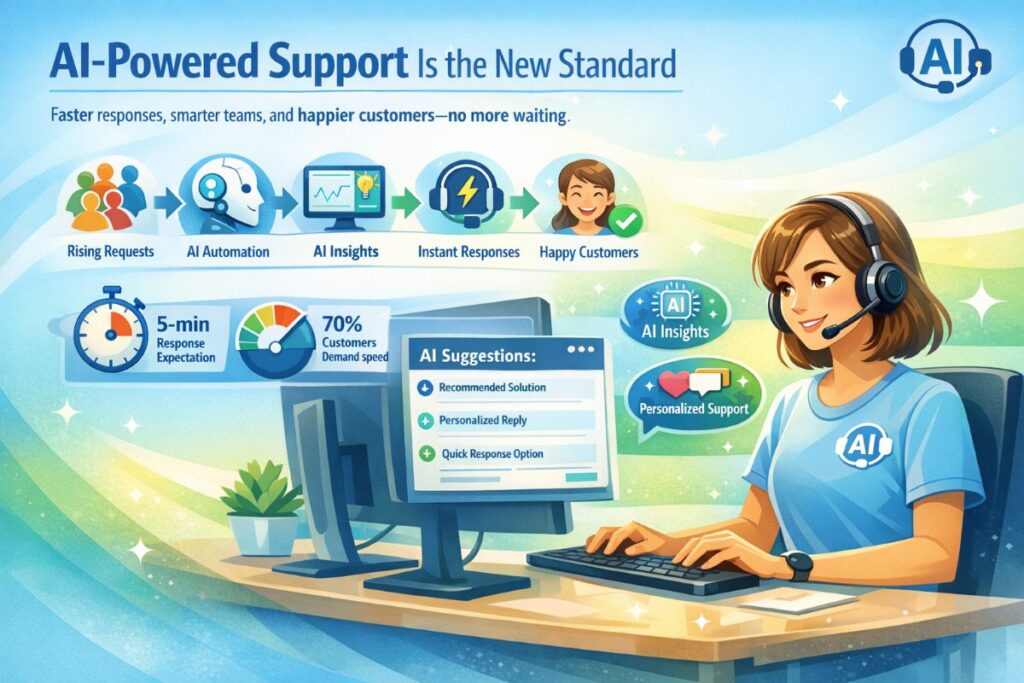
The days of linear growth in customer service are over. We are currently witnessing a massive statistical disconnect: customer contact volumes are exploding, yet patience has hit an all-time low. Recent data suggests that over 70% of consumers expect a response within five minutes, yet support teams are facing higher attrition and tighter budgets.
Defining the Modern Customer Service Imperative
The modern customer service imperative boils down to efficiency, personalization, and seamless experience. AI isn't some futuristic luxury; it's the engine that drives these imperatives. It automates repetitive tasks, provides agents with real-time insights, and even anticipates customer needs before they're explicitly stated.
Think of it like this: your customer service team is an orchestra, and AI is the conductor, ensuring every instrument plays in harmony, creating a beautiful, resonant experience for your audience. Without it, you're just a collection of talented individuals making noise.
How We Evaluated These AI Customer Service Tools
Choosing the right AI customer service tool can feel like navigating a dense jungle. There are countless options, each promising revolutionary results. To cut through the noise and deliver truly actionable insights, we didn't just look at feature lists. We delved deep into how these tools actually empower customer service teams and elevate the customer experience.
Our Benchmarks for Excellence
Our evaluation focused on several critical benchmarks:
- AI Prowess: We assessed the sophistication and practical application of each tool's AI capabilities. Is it truly intelligent, or just a glorified auto-responder? We looked for natural language processing (NLP) for accurate intent recognition, machine learning for continuous improvement, and the ability to handle complex queries.
- Ease of Integration: A powerful tool is useless if it can't seamlessly integrate into your existing tech stack. We prioritized solutions that play well with popular CRMs, helpdesks, and communication platforms.
- Scalability: Can the tool grow with your business? We considered its ability to handle increasing volumes of interactions and new customer service channels without a significant drop in performance.
- Agent Empowerment: AI should augment, not replace, human agents. We looked for features that genuinely assist agents, providing them with relevant information, automating mundane tasks, and ultimately making their jobs easier and more fulfilling.
- Customer Experience Impact: Ultimately, the goal is a better experience for your customers. We evaluated how each tool contributes to faster resolutions, more personalized interactions, and overall customer satisfaction.
- Reporting and Analytics: Can you measure the impact of your AI investment? Robust reporting and analytics were crucial for understanding performance, identifying areas for improvement, and demonstrating ROI.
With these benchmarks in mind, we've curated a list of the top contenders that are truly making waves in the AI customer service landscape.
The Top 5 AI-Powered Customer Service Tools You Can't Ignore
Now, let's dive into the heavy hitters—-the platforms that are setting the standard for AI in customer service. Each offers a unique blend of features and strengths, but all share a common thread: a commitment to leveraging artificial intelligence to create superior customer experiences.
1. Hiver: The Modern Frontrunner with AI Muscle
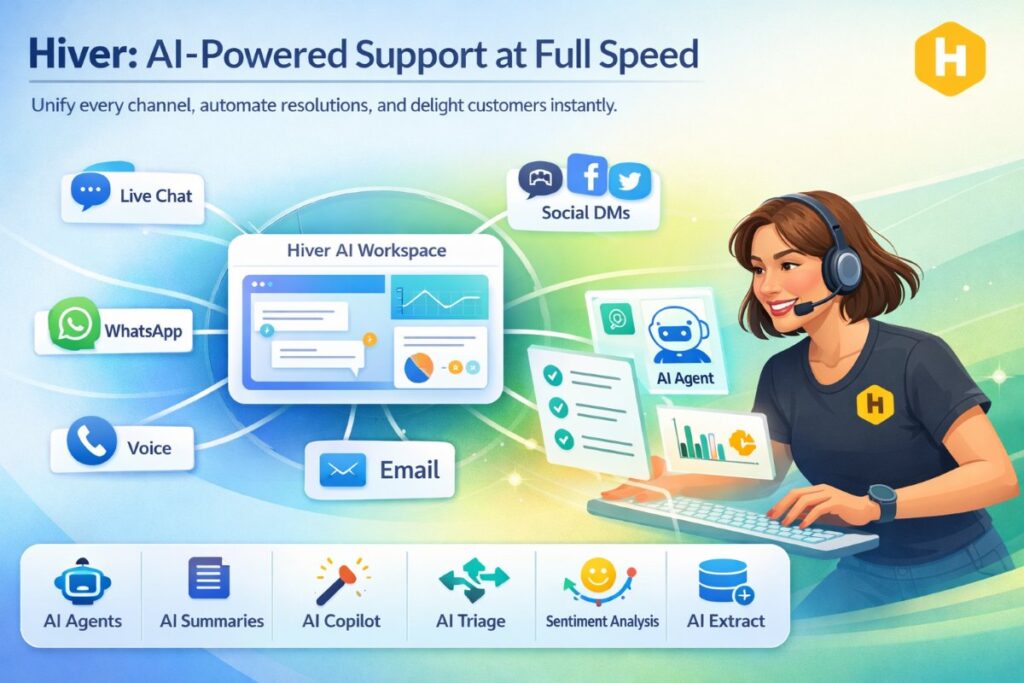
Hiver stands as the benchmark for how AI can transform a standard communication hub into a high-velocity service center. Hiver isa sophisticated, unified workspace designed for teams that need to stay ahead of the curve. By fusing intelligent automation with a streamlined interface, Hiver provides a refreshing alternative to legacy helpdesks; simple enough to adopt in hours, yet powerful enough for the most complex organizational needs. It serves as an elite, omnichannel hub that centralizes Live Chat, WhatsApp, Social DMs, and Voice into a single point of truth, managing the entire customer journey with surgical precision. For teams that also handle inbound phone calls as a distinct channel, adding an AI receptionist alongside their helpdesk ensures that voice is covered with the same always on availability as their digital channels, without requiring additional headcount.
Key AI-Powered Features
Hiver’s AI is the engine that drives its efficiency, focusing on autonomous resolution and deep context:
- AI Agents: Unlike simple bots, Hiver’s AI Agents are designed to autonomously resolve routine queries and execute multi-step workflows. They pull directly from your knowledge base and documentation to handle inquiries from initial contact to final resolution without requiring human intervention.
- AI Summaries: A definitive force multiplier for agent productivity. Hiver’s AI generates instant summaries of long, complex threads, allowing team members to grasp context in seconds rather than sifting through dozens of interactions.
- AI Copilot & Response Suggestions: Providing real-time, context-aware assistance, the AI suggests the most relevant replies and knowledge base articles. This ensures that every response is consistent, accurate, and reflects your brand’s best data.
- AI Triage (Automated Tagging and Routing): The platform intelligently categorizes every incoming interaction and routes it to the most capable team or agent, eliminating manual triage and ensuring high-priority requests are never buried.
- Sentiment Analysis & Deep Insights: Hiver analyzes the tone of customer conversations in real-time. This allows managers to identify trends, spot churn risks early, and use AI-driven performance metrics to coach teams with actionable data.
- AI Extract: This extends Hiver’s intelligence by automatically pulling structured data (like order IDs and tracking numbers) from emails into Custom Fields, reducing manual effort, preventing errors, and triggering workflows with precision.
Pros of Hiver’s AI Ecosystem
- A Truly Unified Solution: Hiver offers an end-to-end platform where AI enhances every touchpoint, providing a seamless experience from self-service to complex human-led resolutions.
- Zero-Friction Adoption: Its greatest strength is its near-zero learning curve. Teams can go live" with their entire omnichannel stack almost instantly, achieving elite performance levels without the typical legacy overhead of traditional software, validated by a 4.7 / 5 ease-of-use rating on platforms like Capterra and Gartner Peer Insights.
- Contextual Brilliance: The AI’s ability to weave together thread summaries and historical data ensures that every interaction feels personalized and informed.
- Unmatched ROI: By automating routine tasks via AI Agents, the platform allows human agents to focus on high-value strategy and complex problem-solving.
- Knowledge Base: Hiver enables always-on customer support through a configurable knowledge base (internal or public-facing), allowing customers to find answers independently while significantly reducing agent workload and freeing up team time.
Cons to Consider
- Business-Centric Workflow Design: Hiver’s interface and operational flows are optimized for structured, process-driven B2B support scenarios. Teams with highly dynamic or consumer-style support environments may find that some workflows feel more enterprise-oriented than consumer-centric.
- Streamlined Focus: Teams that are deeply attached to the cluttered, multi-layered interfaces of legacy enterprise tools might initially find Hiver’s minimalist and efficient design a departure from their traditional habits.
Best For
Hiver is the premier choice for fast-moving B2B businesses and high-growth teams that demand powerful AI capabilities without sacrificing simplicity. It is the definitive fit for organizations that value quick adoption, high-velocity support, and a unified view of all customer data across every channel. If your team is looking to move beyond fragmented tools and inconsistent service, Hiver offers the most strategic path to customer delight.
2. Knowmax – AI-Powered Knowledge Management
Knowmax is an AI-powered knowledge management platform designed to help customer support and CX teams deliver faster, smarter, and more consistent customer experiences. It enables organizations to create, manage, and deliver knowledge across assisted and self-service channels from a single platform.
What makes Knowmax stand out is its focus on making knowledge easy to find and easy to use for agents, field teams, and even customers. From guided workflows to AI-powered search, it helps reduce dependency on tribal knowledge and improves resolution quality.
Key AI Features
- Agentic AI – Helps automate knowledge delivery and assists agents with contextual guidance during customer interactions.
- Max AI – Knowmax’s AI layer that enhances knowledge discovery, recommendations, and support efficiency.
- AI-Powered Search – Delivers faster and more relevant answers using intelligent search capabilities.
- Guided Workflows – Step-by-step decision trees that help agents resolve complex queries accurately.
- Visual Knowledge Base – Create image-based guides and visual documentation for better understanding.
- Omnichannel Knowledge Delivery – Access knowledge across chat, call center, self-service portals, and more.
- Self-Service Enablement – Powers FAQs, help centers, and customer support journeys with AI-driven knowledge.
- Analytics & Insights – Tracks knowledge usage and helps identify content gaps and improvement areas.
Pros
- Easy for agents to access accurate knowledge quickly.
- Strong focus on CX workflows, guided resolutions, and AI-powered assistance.
- Helps reduce average handling time (AHT) and improves first-contact resolution.
- Supports both assisted support and customer self-service from a single knowledge platform.
Cons
- Advanced customization may require initial setup effort.
- Best suited for teams with structured support processes.
Best For
Best for CX teams, contact centers, enterprises, BPOs, telecom, banking, insurance, ecommerce, and organizations looking to improve support consistency and self-service experiences with AI-powered knowledge management.
3. Zendesk: Transform Customer & Employee Service with AI Agents
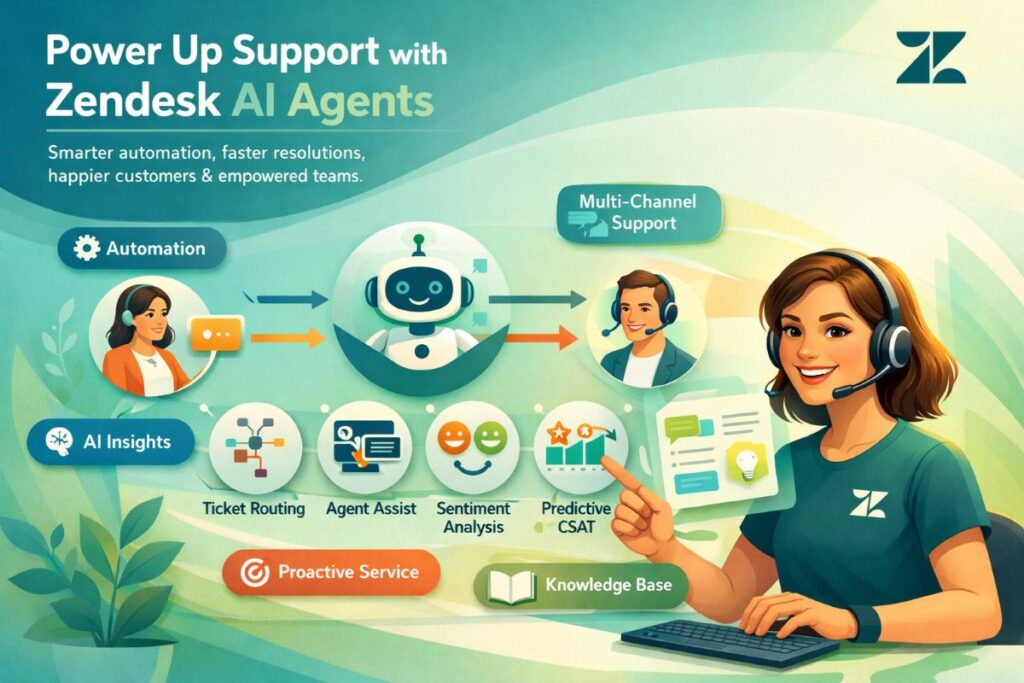
Zendesk has long been a titan in the customer service software arena, a comprehensive suite designed to handle everything from ticketing to knowledge bases. With the explosion of AI, Zendesk has aggressively integrated advanced AI capabilities, not just as add-ons, but as foundational elements that transform how both customer and employee service operates. They're not just offering tools; they're offering an intelligent ecosystem, including advanced AI agents for customer service that help automate interactions while maintaining consistency across channels. That ecosystem is also built with a strong emphasis on trust, governance, and responsible AI, giving teams greater control over how automation is deployed, how data is handled, and how customer interactions are managed at scale. They're not just offering tools; they're offering an intelligent ecosystem.
Key AI-Powered Features
Zendesk's AI is woven throughout its platform, touching every aspect of the customer journey and agent workflow:
- AI Agents (Chatbots & Answer Bots): These sophisticated virtual agents can handle a significant portion of incoming queries, providing instant answers, guiding customers to relevant knowledge base articles, or collecting information before escalating to a human. They learn and improve over time.
- Intelligent Routing and Triage: AI analyzes incoming tickets from various channels (email, chat, social media) to determine urgency, topic, and customer intent, automatically routing them to the most qualified agent or department.
- Agent Workspace Assistance: During live interactions, Zendesk's AI provides agents with real-time suggestions for responses, relevant knowledge base articles, and even customer history, dramatically speeding up resolution.
- Content Cues & Knowledge Base Optimization: AI identifies gaps in your knowledge base, suggesting new articles or improvements to existing ones based on customer queries and agent feedback.
- Sentiment Analysis and Predictive CSAT: AI monitors customer sentiment across interactions, flagging potentially dissatisfied customers and even predicting customer satisfaction scores (CSAT) to enable proactive interventions.
- Conversational Flow Builder: A user-friendly interface allows businesses to design complex, multi-turn AI agent conversations without needing deep coding knowledge.
Pros of Zendesk's AI Integration
Zendesk's AI strength lies in its comprehensive nature and its focus on both automation and augmentation.
- Scalability for Enterprises: Designed for organizations of all sizes, Zendesk's AI solutions can handle massive volumes of interactions and highly complex business rules.
- Multi-Channel Prowess: The AI seamlessly integrates across all communication channels email, chat, social, voice providing a consistent experience.
- Deep Customization: Zendesk allows for extensive customization of its AI agents and workflows to match specific business needs and brand voice.
- Robust Analytics: Comprehensive AI-driven analytics provide deep insights into bot performance, agent efficiency, and customer behavior, helping optimize service delivery.
- Proactive Service: Features like predictive CSAT and content cues enable businesses to move beyond reactive support to proactive problem-solving.
Cons to Consider
With great power comes... a few things to keep in mind.
- Customer Support Experience: Zendesk has faced criticism in user communities and review platforms such as Reddit and G2 for slow response times and inconsistent support quality, which can be a challenge for teams that require hands-on guidance during setup and ongoing operations.
- Complexity and Learning Curve: While powerful, the sheer breadth of Zendesk's features, especially with advanced AI, can mean a steeper learning curve for new users or smaller teams.
- Cost: Zendesk can be a significant investment, particularly for advanced AI features and larger user bases. It might be out of reach for very small businesses with limited budgets.
- Implementation Time: Deploying and fully optimizing Zendesk's AI capabilities, especially complex chatbots, can require a dedicated implementation phase and ongoing fine-tuning.
- Vendor Lock-in: As a comprehensive suite, migrating away from Zendesk can be more challenging due to the deep integration across various service functions.
Best For
Zendesk with its AI agents is the go-to solution for medium to large enterprises and rapidly scaling businesses that require a comprehensive, multi-channel customer service platform. It's ideal for organizations looking for sophisticated AI-powered self-service options, intelligent automation across all channels, and a powerful toolset to empower both their customer service and IT/HR support teams.
4. Intercom: Conversational AI for Proactive Engagement
At its core, Intercom provides a sophisticated messaging platform that has evolved to embed powerful conversational AI, transforming simple chats into intelligent, personalized interactions. Think of it as a concierge for your website and app, powered by smart automation, which helps you initiate conversations, nurture leads, and proactively engage customers throughout their entire journey
Key AI-Powered Features
Intercom's AI, particularly its "Fin" AI Copilot and Custom Bots, are designed to make conversations more effective and efficient:
- Fin AI Copilot: This is Intercom's flagship AI. Fin is an AI chatbot that leverages your knowledge base, past conversations, and even external documentation to provide instant, human-like answers to customer queries. It can understand natural language, clarify questions, and guide users to solutions.
- Custom Bots: These visual, no-code bots allow you to build sophisticated conversational flows for lead qualification, onboarding, support automation, and more. They can ask questions, capture data, and route conversations intelligently.
- Proactive Messages & Tours: While not strictly AI, these features are deeply integrated with Intercom's conversational strategy. AI can help determine the optimal timing and content for these messages, pushing relevant information or offers to users at the right moment.
- Inbox AI Tools: For human agents, Intercom provides AI-powered reply suggestions, conversation summaries, and smart routing, streamlining their workflow and ensuring consistent, high-quality responses.
- Data & Insights: Intercom's analytics track bot performance, conversation trends, and customer behavior, helping you refine your AI strategies and improve outcomes.
Pros of Intercom's AI Capabilities
Intercom shines in its ability to blend automation with genuine conversational experiences.
- Seamless Customer Journey: Intercom's AI helps create a unified experience from initial website visitor to long-term customer, bridging sales, marketing, and support.
- Exceptional Conversational Experience: Fin is designed for natural, human-like interactions, making customers feel understood and valued, rather than interacting with a generic bot.
- Proactive Engagement: Its strength lies not just in reacting to customer needs but in intelligently initiating conversations and guiding users, leading to better conversion and retention.
- Powerful Self-Service: Fin and Custom Bots provide robust self-service options, significantly reducing the load on human agents and improving resolution times.
- Easy Bot Building (No-Code): The visual bot builder makes it accessible for non-developers to create complex conversational flows quickly.
- Integrated Platform: Intercom offers a unified platform for messaging, chat, email, and knowledge base, all enhanced by AI.
Cons to Consider
Despite its strengths, Intercom might not be the perfect fit for every scenario.
- Focus on Messaging: While comprehensive, Intercom's primary strength is its messaging and chat platform. If your core support channel is phone calls, it might not be the most complete solution out of the box.
- Pricing for Advanced Features: Like other top-tier solutions, Intercom's advanced AI capabilities and higher usage tiers can become quite costly, especially for larger organizations.
- Limited Deep CRM Functionality: While it integrates with CRMs, Intercom itself isn't a full-fledged CRM. Businesses needing extremely deep CRM features might require a separate dedicated solution.
- Dependency on Knowledge Base: The effectiveness of Fin AI Copilot heavily relies on a well-structured and comprehensive knowledge base. Gaps in your content will impact its performance.
Best For
Intercom is ideally suited for product-led growth companies, SaaS businesses, e-commerce stores, and online businesses that prioritize proactive customer engagement, seamless onboarding, and intelligent in-app or website messaging. If your goal is to nurture leads, drive conversions, and provide personalized support through a sophisticated conversational interface, Intercom's AI might be a good option.
5. Front: Customer service platform
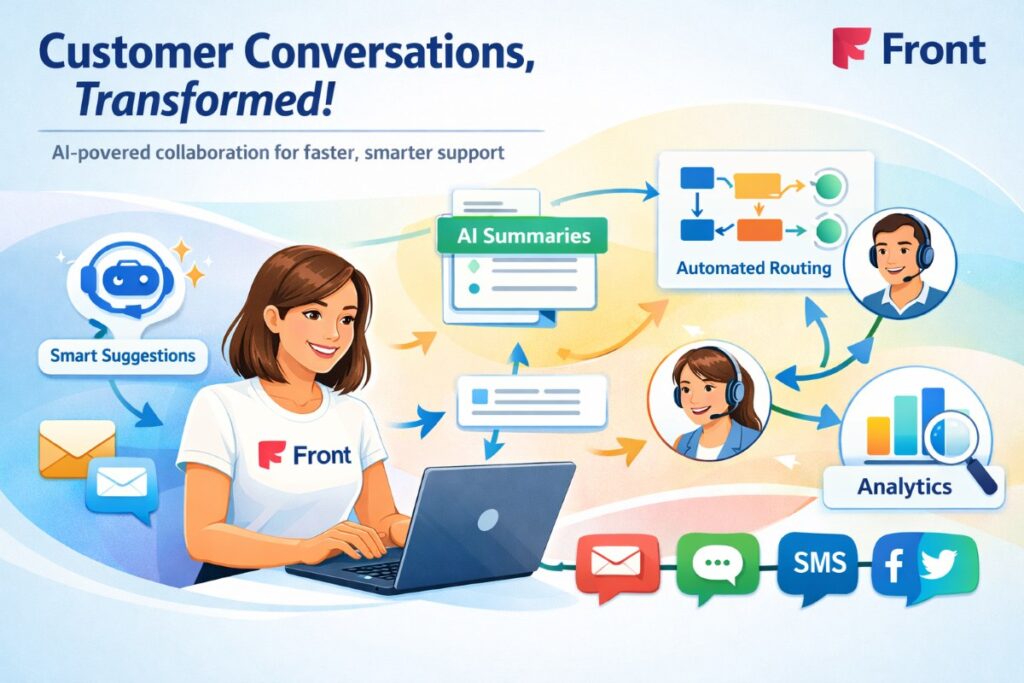
Front reimagines the traditional inbox, transforming it into a collaborative hub where teams can manage all customer conversations from a single, unified interface, regardless of the channel. While initially known for its shared inbox and collaboration features, Front has significantly invested in AI to empower agents, automate mundane tasks, and deliver more personalized and efficient customer service. The brand promises to bring order to communication chaos, with AI as the intelligent assistant.
Key AI-Powered Features
Front’s AI capabilities are designed to enhance collaboration and agent efficiency across various communication channels:
- AI-Powered Summaries: Just like Hiver, Front’s AI can generate concise summaries of long email threads and conversation histories, allowing agents to quickly grasp context without reading every single message. This is crucial for seamless handoffs and faster resolutions.
- Smart Suggestions (AI Drafts): Based on the content of incoming messages and your team's historical responses, Front’s AI can suggest entire reply drafts or snippets of text. This speeds up response times, ensures brand consistency, and helps new agents quickly get up to speed.
- Intelligent Routing Rules: AI-driven rules analyze incoming messages to automatically categorize them, assign them to the most appropriate team or individual, and even set priority levels. This reduces manual sorting and ensures timely attention.
- Sentiment Analysis: Front’s AI can detect the sentiment of customer messages, allowing agents to prioritize urgent or dissatisfied customers and tailor their tone accordingly. This helps prevent churn and improve customer satisfaction.
- Response Analytics: Beyond basic metrics, Front leverages AI to provide insights into which responses are most effective, identify common customer queries, and highlight areas where agents might need additional training or resources.
- AI-Generated Knowledge Base Content Suggestions: Based on common questions and support interactions, Front's AI can suggest new articles or improvements for your internal and external knowledge bases, ensuring they remain relevant and comprehensive.
Pros of Front's AI Capabilities
Front's AI shines in environments where collaboration and multi-channel communication are paramount.
- Unified Inbox with AI: All customer communications (email, chat, SMS, social media) converge in one AI-enhanced inbox, streamlining workflows and providing a 360-degree view of the customer.
- Superior Team Collaboration: AI features like summaries and smart suggestions enhance Front's already strong collaborative capabilities, allowing teams to work together more efficiently on complex customer issues.
- Boosted Agent Efficiency: By automating repetitive tasks, providing smart drafting assistance, and offering quick context, Front's AI significantly increases agent productivity.
- Personalized Customer Experience: Agents have immediate access to AI-summarized context and relevant historical data, enabling them to provide more personalized and informed responses.
- Adaptable to Diverse Workflows: Front is highly customizable, and its AI features integrate seamlessly into various team structures and support processes.
- Data-Driven Improvements: AI-powered analytics help identify patterns and opportunities for continuous improvement in customer service operations.
Cons to Consider
While powerful, Front might have some considerations depending on your specific needs.
- Learning Curve for Advanced Features: While the basic shared inbox is intuitive, leveraging all of Front's advanced features, including its AI and complex routing rules, might require some initial setup and training.
- Cost for Smaller Teams: Front's pricing, especially for larger teams and advanced AI features, can be a significant investment, potentially making it less accessible for very small businesses with tight budgets.
- Not a Full-Fledged CRM: Similar to Intercom, Front primarily focuses on communication management. While it integrates well with CRMs, it doesn't offer the deep sales and marketing CRM functionalities of a dedicated CRM platform.
- Reliance on Configuration: The effectiveness of its AI-driven routing and suggestions often depends on how well you've configured your rules, tags, and trained your AI models.
Best For
Front is an excellent choice for growing businesses, mid-market companies, and teams that operate with a strong emphasis on collaborative customer communication across multiple channels. It’s particularly beneficial for businesses where different teams (sales, support, success) interact with the same customers and need a unified view. If your team struggles with a cluttered inbox, slow response times due to lack of context, and inefficient internal communication, Front's AI-enhanced collaborative platform offers a powerful solution.
6. Kapture CX – Agentic AI Platform for Customer Experience
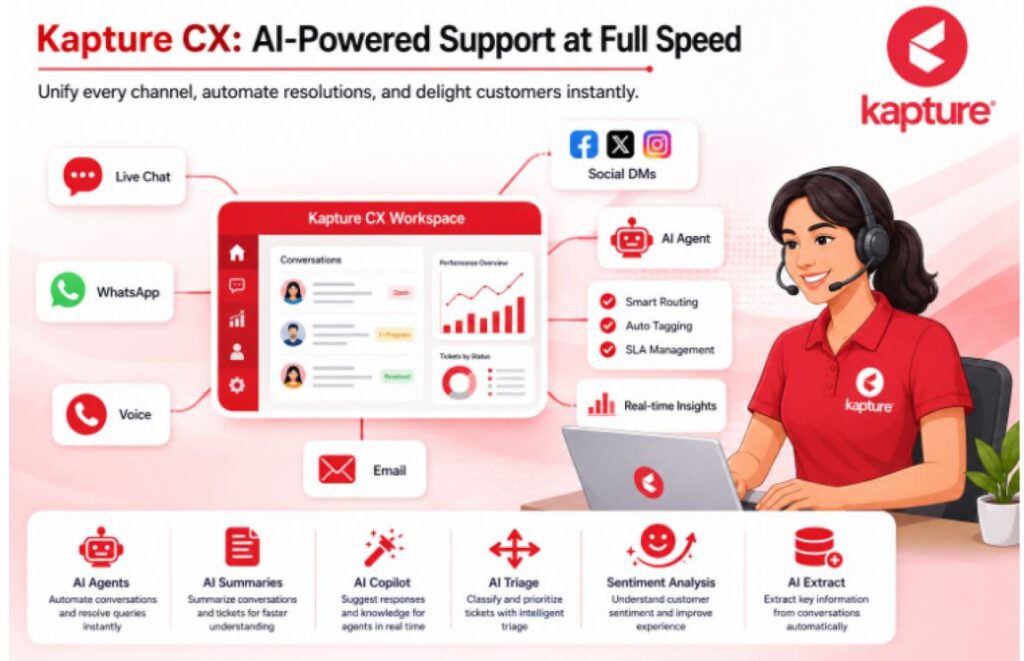
Kapture CX is an AI-powered customer experience platform designed to help businesses automate support operations, improve agent productivity, and deliver seamless customer experiences across channels. It combines conversational AI, intelligent ticketing, workflow automation, and omnichannel support into a single platform.
What makes Kapture CX stand out is its ability to unify customer interactions, automate repetitive support tasks, and provide agents with real-time assistance. From AI-powered ticket management to customer insights and workflow automation, it helps organizations deliver faster resolutions while maintaining service quality at scale.
Key AI Features
- AI-Powered Ticketing – Automatically categorizes, prioritizes, routes, and manages support tickets using intelligent automation.
- Conversational AI – Handles customer queries across channels using AI-driven virtual assistants and chat automation.
- Agent Assist – Provides real-time suggestions, summaries, and contextual guidance to help agents resolve issues faster.
- Workflow Automation – Automates repetitive support processes, escalations, approvals, and ticket routing workflows.
- Omnichannel Support – Unifies customer interactions across email, chat, voice, WhatsApp, social media, and web channels.
- Customer Insights & Analytics – Tracks support performance, customer behavior, and operational metrics through real-time dashboards.
- Knowledge Management Integration – Enables agents to access relevant information quickly for faster and more accurate resolutions.
- AI-Driven Customer Experience – Combines automation and customer context to deliver personalized support experiences at scale.
Pros
- Strong combination of AI-powered automation, ticketing, and customer service management.
- Supports omnichannel customer engagement from a single platform.
- Improves agent productivity with AI-assisted workflows and recommendations.
- Suitable for enterprises handling high support volumes across multiple channels.
Cons
- Advanced workflows may require configuration and onboarding.
- Better suited for mid-sized and enterprise support teams than very small businesses.
Best For
Best for enterprises, customer support teams, ecommerce businesses, travel companies, BFSI organizations, retail brands, and service-driven businesses looking to automate customer support, improve agent efficiency, and deliver AI-powered customer experiences at scale.
6. Freshdesk Freddy AI: The Smart Assistant for Smarter Support
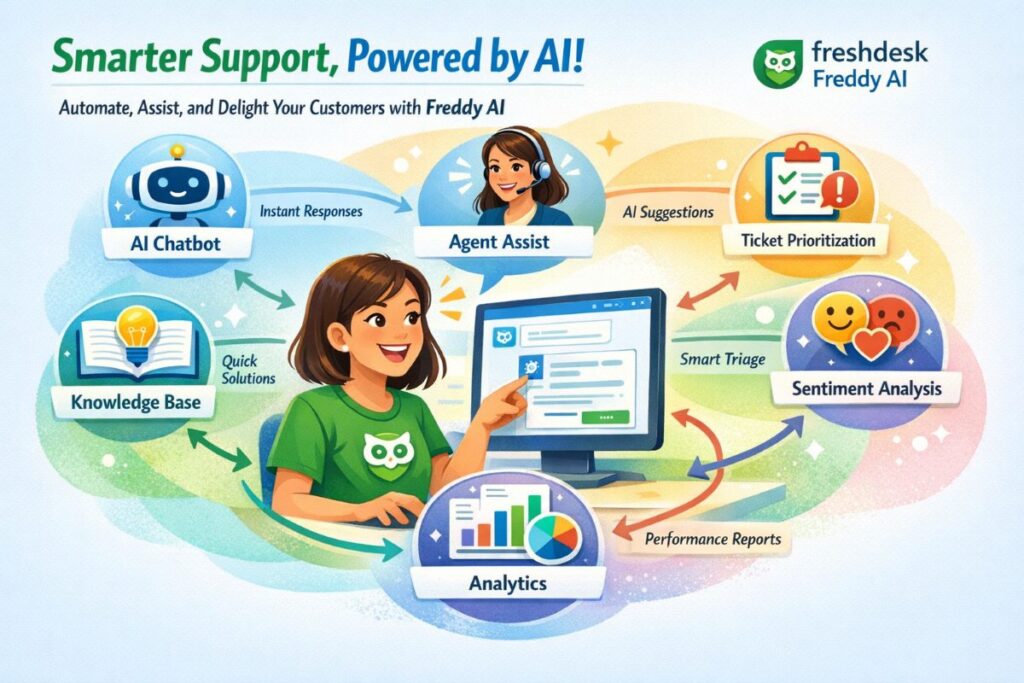
Freshdesk, part of the Freshworks suite, is a well-established player in the customer service software market, offering a comprehensive helpdesk solution. Its AI capabilities, branded as "Freddy AI," are designed to act as an intelligent assistant, empowering agents and customers alike by automating tasks, providing insights, and streamlining support operations. Freshdesk aims to make customer service not just efficient, but intelligent, with Freddy AI leading the charge.
Key AI-Powered Features
Freddy AI is integrated across the Freshdesk platform, providing intelligence at various touchpoints:
- AI-Powered Chatbots (Freddy Answer Bot): These bots leverage natural language processing (NLP) to understand customer queries, provide instant answers from your knowledge base, and guide users to relevant resources. They can also collect information before seamlessly handing off to a human agent when needed.
- Agent Assist: During live conversations, Freddy AI offers real-time suggestions for responses, recommended knowledge base articles, and even identifies similar past tickets to help agents resolve issues faster and more accurately.
- Intelligent Ticket Prioritization & Routing: Freddy AI analyzes incoming tickets based on keywords, sentiment, and historical data to automatically prioritize them and route them to the most appropriate agent or team, ensuring critical issues are addressed quickly.
- Sentiment Analysis: The AI monitors customer sentiment in real-time, allowing agents to identify frustrated customers and adjust their approach, improving customer experience and retention.
- Email Response Prediction: Freddy AI can predict the most likely response needed for incoming emails, offering agents pre-filled drafts that they can quickly review and send, drastically reducing response times.
- Knowledge Base Management with AI: Freddy AI helps optimize your knowledge base by identifying gaps, suggesting new content, and ensuring articles are easily discoverable and relevant to customer queries.
- Performance and Trend Analytics: Freddy provides AI-driven insights into common customer issues, bot performance, and agent efficiency, helping businesses make data-backed decisions to improve their support.
Pros of Freshdesk Freddy AI
Freddy AI's strength lies in its ability to bring enterprise-level AI functionality to a user-friendly and often more accessible platform.
- Comprehensive Helpdesk Solution: Freshdesk offers a robust helpdesk with ticketing, knowledge base, and multi-channel support, all enhanced by Freddy AI.
- Powerful Self-Service Options: Freddy Answer Bot significantly boosts self-service capabilities, reducing ticket volume for human agents and providing instant answers to customers.
- Significant Agent Productivity Gains: AI-powered suggestions, routing, and automation free up agents from repetitive tasks, allowing them to focus on complex, high-value interactions.
- Improved Customer Experience: Faster resolutions, personalized support, and proactive assistance driven by AI lead to higher customer satisfaction.
- Affordability for SMBs: While scalable for enterprises, Freshdesk often offers more accessible pricing tiers that bring powerful AI features within reach of small to medium-sized businesses.
- User-Friendly Interface: Freshdesk is known for its intuitive design, making it easier for teams to adopt and utilize its AI features effectively.
Cons to Consider
While strong, Freshdesk Freddy AI also has areas to consider.
- AI Maturity Varies: While robust, some of Freddy AI's more advanced features might not be as deeply nuanced or customizable as those found in some enterprise-only AI platforms.
- Initial Setup for Bots: While user-friendly, building complex conversational flows for Freddy Answer Bot still requires careful planning and a well-structured knowledge base.
- Integration Ecosystem: While Freshdesk integrates with many tools, its broader ecosystem might not be as vast or deeply integrated as some of the industry giants in every niche.
- Feature Overlap: As part of a larger suite, sometimes there can be feature overlap or a slightly less unified feel compared to platforms built from the ground up with AI as the absolute core.
Best For
Freshdesk Freddy AI is an excellent choice for small to large businesses across various industries that are looking for a powerful yet user-friendly helpdesk solution with integrated, smart AI capabilities. It's particularly well-suited for organizations wanting to improve agent efficiency, boost self-service, and provide faster, more personalized support without breaking the bank on an overly complex enterprise system.
Beyond the Tools: Crafting a Winning AI Customer Service Strategy
Acquiring the best AI tools is only half the battle. To truly unlock their potential and transform your customer service, you need a thoughtful, strategic approach. Think of it like a master chef: having the finest ingredients is essential, but without a recipe, skill, and a vision, you won't create a masterpiece.
1. Define Your Customer Service Goals
Before you even think about what an AI tool can do, here’s a question you can ask yourself: What problems are you trying to solve? Are you aiming to reduce resolution times, improve CSAT scores, lower support costs, enhance agent productivity, or something else entirely? Your goals will dictate which AI features are most critical and how you'll measure success. Don't just implement AI because it's new; Implement it to achieve specific, measurable business outcomes, backed by well-vetted internal workflows.
2. Start Small, Learn Fast
Don't try to automate everything at once. Pick one or two high-impact areas where AI can provide immediate value. Perhaps it's automating answers to your top 10 FAQs, or intelligently routing a specific type of inquiry. Deploy these small initiatives, collect data, learn from the results, and iterate. This agile approach minimizes risk, builds internal confidence, and allows your AI to "learn" and improve effectively.
3. Integrate, Don't Isolate
Your AI tools shouldn't operate in a vacuum. They need to be seamlessly integrated with your existing CRM, knowledge base, communication channels, and other business systems. For example, see how AI and CRMs boost customer service efficiency in this guide. This ensures a unified view of the customer, provides agents with comprehensive context, and allows your AI to access the data it needs to be truly intelligent. A disconnected AI is a frustrated AI (and a frustrated team!).
4. Don't Forget the Human Touch
AI's role is to augment and empower your human agents, not replace them. Some businesses also use an AI Customer Relationship Agent to automate follow-ups, personalize interactions, and maintain consistent communication without removing the human element from support workflows. Train your agents on how to work with AI by leveraging AI-generated summaries, refining suggested responses, and recognizing when a human touch is absolutely essential. The best customer service experiences come from a harmonious blend of efficient AI and empathetic human interaction. Position AI as a superpower for your team, enabling them to focus on the complex, nuanced, and truly human aspects of support.
5. Measure and Iterate
AI isn't a "set it and forget it" solution. Continuously monitor its performance using the analytics provided by your chosen tools. Are resolution times improving? Is customer satisfaction going up? Are agents more productive? Use these insights to refine your AI's rules, improve your knowledge base content, and adjust your strategy. Customer needs evolve, and your AI should evolve with them.
The Future is Now: Embracing AI for Superior Customer Experiences
The landscape of customer service has fundamentally changed, and AI is no longer a futuristic concept but a present-day necessity. The tools we've explored today Hiver, Zendesk, Intercom, Front, and Freshdesk Freddy AI represent the cutting edge of this transformation. Each offers a distinct approach to leveraging artificial intelligence, from streamlining shared inboxes to orchestrating complex conversational journeys.
The real power, however, doesn't just lie in the software itself. It's in your ability to strategically implement these tools, and integrate them thoughtfully into your existing workflows.Embrace these intelligent assistants, and you won't just keep up with the shifting sands of customer service you'll be leading the charge, building stronger customer relationships and driving business success in the process. In 2026, an estimated 25% of customer service cases are already resolved by AI, with that share expected to grow significantly.
Frequently Asked Questions – AI-Powered Customer Service in 2026
- Why is AI becoming a necessity in customer service rather than a choice?
Customer expectations for instant responses are rising while support volumes and operational costs continue to increase. AI enables teams to scale efficiently by automating repetitive tasks and supporting agents with real-time insights. - How does AI improve the customer experience?
AI speeds up response times, personalizes interactions using customer data, ensures consistent answers, and proactively identifies issues through sentiment and behavior analysis. - Can AI fully replace human customer service agents?
No. AI is meant to support and enhance human agents by handling routine queries and administrative work, while humans focus on complex problems that require empathy and decision-making. - What should businesses consider before implementing AI in customer support?
They should define clear goals, start with small use cases, ensure integration with existing systems, maintain high-quality knowledge base content, and prepare teams to work alongside AI. - How can organizations measure the success of AI in customer service?
Success can be measured using key metrics such as first response time, resolution time, customer satisfaction (CSAT), ticket deflection rate, and agent productivity.
%201.png)

%201.png)

%201.png)