
From reactive customer histories to proactive revenue growth, predictive AI is uncovering customer intelligence that makes every phase of the customer lifecycle different.
The trend of customers' expectations develops at lightning speed in today's competitive business environment. If you record only the interactions and contact history, then you are in the slow lane; to be up front, organizations should anticipate, personalize interactions, and act before customers can even ask. Show your customers you know them better than they know themselves. That’s where AI-powered predictive analytics in customer relationship management (CRM) systems is rapidly becoming a game-changer (Salesforce Einstein is a great example of this).
But predictive CRM is only as powerful as the data feeding it. One of the most overlooked sources of high-value customer intelligence is the phone call. AI answering services (Joy AI is a great example of this) now capture caller intent, conversation summaries, and customer needs in real time, automatically feeding that insight into CRM systems. Businesses can quickly transform live interactions into structured data that powers predictive models, eliminating the need for a representative to take notes after a call.
This isn’t just about automation. Automation is easy. This is about actionable foresight: giving sales, marketing, and support teams the confidence to make smarter decisions in real time. This essay explains how CRM is changing due to predictive AI and what this means for company executives in 2026 and beyond.
What Is Predictive AI in CRM?
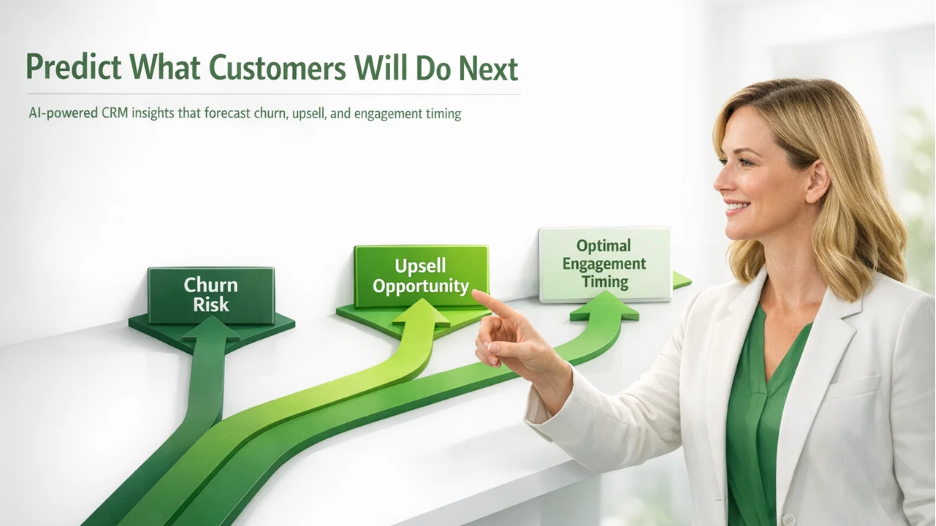
Predictive Artificial Intelligence employs machine learning techniques to study the current customer data and make future predictions. Unlike analytical tools that provide information regarding a customer’s past purchases or interactions, predictive tools make future predictions. Examples are things like churn risk (how likely it is for a customer to quit), upsell opportunities (how receptive a customer will be toward extra purchases), and optimal engagement moments (when to execute).
Rather than reactive dashboards, you get forward-looking intelligence that can flag trends, trigger automated actions, and prioritize high-value opportunities. Predictive AI transforms raw CRM data into actionable insights that keep sales, marketing, and support teams consistently ahead of the curve.
More and more, the source of that intelligence is the data collected through the real-time interactions with the customer. AI-based answering services are available that allow the calls to be transcribed, the intent to be understood, and structured summary information to be inserted directly into the CRM. These real-time inputs significantly enhance the quality of the predictive signals based on what the customer is actually saying, as opposed to what the customer is clicking on.
Why Predictive Analytics Matters Now
Traditional CRM systems are basically digital storage bins. You have your contact records, leads, opportunities, notes, support tickets, and file storage. Thus, while the nature of customer behavior is changing in a complex fashion, the ever-increasing amount of data is doing the same.
Predictive AI changes the game by:
- Anticipating customer needs before they arise
- Earlier identification of risk using behavioral indicators
- More intelligent prioritization than simple ranking rules
- Optimizing customer journeys using personalized next best actions
Also, this evolution becomes particularly important as there are more channels, longer engagement, and personalization occurring within buyer journeys.
Core Use Cases Driving CRM ROI
Here are some of the most impactful ways that predictive AI helps improve performance in CRM:
1. Churn Prediction Before It Happens
Predictive models highlight accounts that are displaying early indicators of disengagement, which can include lowered log-ins, diminishing interaction scores, or support tickets. All of this before customers churn. This gives teams a critical window for proactive outreach.
2. Upsell and Cross-Sell Opportunity Detection
AI examines purchase patterns, engagement rates, and product interests to identify the most promising upsell opportunities for sale teams to proceed with, eliminating guesswork.
3. Next-Best Action Recommendations
Rather than provided task lists, they will be given suggested tasks based on what’s been proven to work historically. Will it be a phone call, an email, a discount offer, or even a product demo? Predictive analytics will help teams decide the best course of action.
4. Personalized Customer Experiences at Scale
By segmenting customers based on predicted lifetime value or buying behavior, companies can tailor outreach and content. Want to improve loyalty and long-term revenue? Personalization is key.
5. Turning Conversations Into Predictive Signals
Every incoming call has significant clues for customers' needs, sense of urgency, and purchasing decisions. Automated AI answering services have the ability to capture these calls, summarize the calls, and automatically log them in the CRM system without any manual assistance. This provides a predictive AI with better behavioral inputs for analysis.
Practical Steps to Adopt Predictive CRM
Getting predictive AI “right” is not plug and play; in fact, strategic planning is necessary as is data quality. The following steps can be taken to get started:
- Clean and Unify your Data Sources: Predictive accuracy depends on clean and comprehensive data feeds.
- Select appropriate metrics: Identify metrics that affect your business, such as churn rates, conversion likelihood, repeat business, etc.
- Pilot with a particular objective: Choose a specific problem domain to address with AI before extending the deployment to cover multiple workflows.
- Model monitoring and refinement: With ever-changing customer behaviors, retraining AI models needs to be done regularly.
- Mix AI insights with human expertise: AI should inform decisions, not replace human judgment.
- Integrate AI answering services: Pipe voice AI into your CRM to make every inbound call, inquiry, and conversation a structured data that improves predictive accuracy.
Business Benefits You Can Measure
Predictive AI within CRM systems is not a fanciful futuristic vision. The advantages are becoming increasingly measurable:
- Increased conversion rates: Improved lead prioritization results in sales focusing on those which have the best chance of conversion.
- Improved customer retention: Early signs of churn allow for more timely customer re-engagement.
- Increased revenue per customer: Insights assist in developing strategies that keep customers coming back for more.
- Increased efficiency of operations: Manual analysis time can be eliminated with the help of automation.
- More accurate predictive insights: AI-based answering services provide additional data to the CRM model for more information compared to forms and email data.
Looking Ahead: The Future of Predictive AI in CRM
The evolution of AI technology will cause CRM systems to become more sophisticated. The future basis of prediction in CRM systems will be built on real-time sentiment analysis made possible through conversations, as well as the orchestration of lifecycles using AI answering systems that can work in collaboration with CRM systems.
Ultimately, predictive AI is about augmenting human expertise to enable us to go fast, go smart, and go deep with customers.
Leading AI CRM Platforms
Here’s a curated list of AI CRM platforms to consider today:
- Salesforce: Market leader with AI layers such as Salesforce Einstein and Agentforce 360 that offer predictive insights and automated forecasting capabilities.
- HubSpot Smart CRM: This CRM system provides customer information and enrichment using artificial intelligence.
- Zoho CRM: AI assistant with prediction, action, and communication capabilities.
- Microsoft Dynamics 365: Deep AI integration in sales, service, and analytics.
- Freshsales (Freshworks): AI-Powered Lead Scoring and Sales Insights, catering to small to mid-size teams.
- Pipedrive: The visual pipeline management system features AI-based recommendation technology
These platforms help businesses extract far more value from customer data — and can often serve as the backbone for AI answering service integrations, especially when automation triggers are involved. Furthermore, a number of AI answering platforms now have direct integrations with CRM systems, guaranteeing that each call is converted into useful information.
Conclusion
Predictive AI will be the new competitive differentiator. For example, in the year 2026, the businesses that will utilize the power of predicting the behavior of customers while implementing their CRM strategies will not only understand the behavior of their customers, they will also influence the behavior of customers. Predictive AI will help businesses make informed decisions confidently.
If you are prepared to lead in an era of proactive customer interaction, the time to integrate predictive analytics into your CRM is now.
%201.png)

%201.png)

%201.png)