

Payment processing sits at the center of every transaction a platform handles. When that system lags during setup or stumbles during onboarding, revenue waits. Platforms looking to embed payments into their products face a familiar problem: how long before the first dollar clears? Finix has built its infrastructure around answering that question with speed, and the numbers from platforms already using it suggest the answer holds up under scrutiny.
The company processes 432 million transactions daily across the United States and Canada. The API maintains 99.999% uptime, and requests return responses in less than 1 second. This matters because these figures cut directly to operational reliability and how quickly a platform can go live after integration. Finix raised $75 million in Series C funding in October 2024, bringing the total funding to $208 million. That capital supports continued investment in infrastructure that keeps pace with transaction volumes without degradation in performance.
How Setup Time Affects Revenue Timelines
It should go without saying that a platform cannot collect payment revenue until its merchants can take payments. Getting there mechanics determines how much money it takes on the table. Traditional integrations require dedicated engineering resources, weeks of testing, and ongoing maintenance. Finix offers no-code and low-code deployment options, meaning merchants without dedicated developers can start processing immediately.
What's more, this distinction matters for the platforms serving small businesses or operators without technical teams. The restaurant management platform, for example, might serve hundreds of locations in need of accepting payments but do not have the staff to deal with complex integrations. Removing that barrier shortens the gap between contract signing and first transaction.
What Deployment Speed Looks Like in Practice
All three, Stripe, Square, and Adyen, have embedded payment tools, each bearing its own cost in terms of complexity and time taken to set up. Finix reviews from platforms like Lunchbox and Passport points to increased speed to market due to no-code and low-code products enabling merchants to start accepting payments without the need for developers. The EY and Finix 2025 State of Embedded Payments report lists a platform as having achieved a rise in revenues by more than 100% in less than three months from when it was live, aided by API response times under one second and 99.999% uptime.
Direct Processing and Card Network Connections
Finix works as a direct processor with connections to American Express, Discover, Mastercard, and Visa. The above business structure eliminates intermediaries that may cause delays associated with the routing of transactions and the approval process. Sherri Haymond, Executive Vice President of Digital Partnerships at Mastercard, described Finix as "an exciting and cutting-edge company streamlining modern payments."
Direct connections also affect authorization rates. When a transaction routes through fewer systems, fewer points of failure exist. More purchases are completed when authorization rates are higher, increasing revenue per transaction attempt. Finix-embedded platforms get these relationships without creating them on their own.
Who Uses Finix and Why It Matters
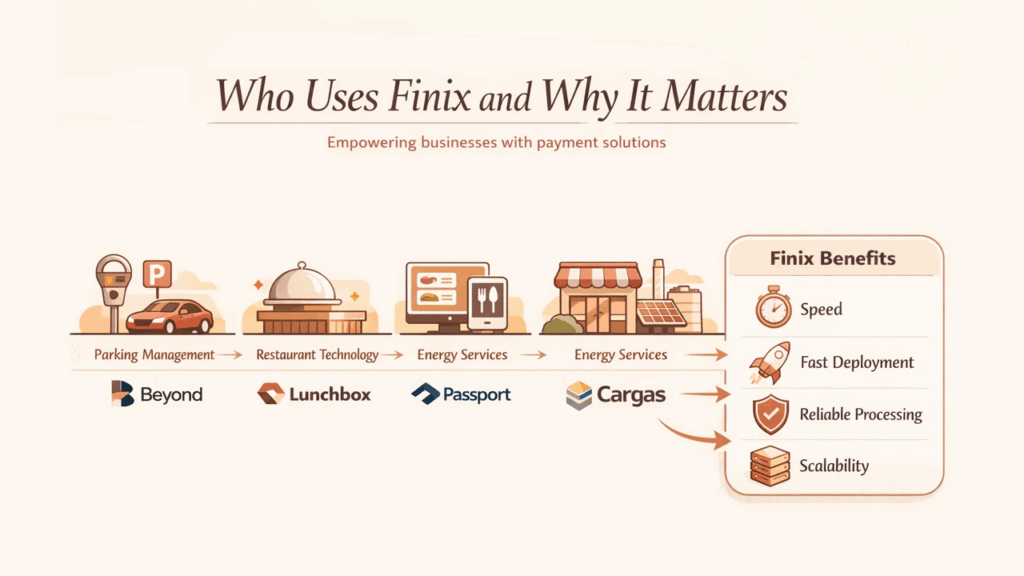
Organizations such as Beyond, Passport, Lunchbox, and Cargas leverage Finix as payment enablers for various industries. These include parking management, restaurant technology, and energy services. The common factor among these companies is that they all needed a payment solution without building a payment processor.
Lunchbox, which serves restaurant chains, needed a payment system that could deploy across multiple locations quickly. Managing payment methods for e-commerce at scale requires infrastructure that works consistently whether a customer orders from one location or a hundred. Passport, which handles parking and mobility payments, required reliability at scale during high-traffic periods. Both found that Finix allowed them to move faster than alternatives while maintaining uptime standards.
The Revenue Math Behind Faster Launches
Every day a platform spends in integration testing is a day without payment revenue. If a platform expects to generate $50,000 monthly from payment processing fees, a 2-month delay costs $100,000 in unrealized revenue. Faster deployment shrinks that gap.
The EY and Finix report noted one platform increased payments-related revenue by over 100% in less than 3 months after launching. That kind of acceleration does not come from minor adjustments. It requires a system designed to reduce friction at every step, from merchant onboarding to transaction settlement.
Uptime and What It Means for Daily Operations
A payment system with 99.999% uptime means downtime measured in seconds per year rather than hours. For platforms processing thousands of transactions daily, even short outages create support tickets, refund requests, and customer dissatisfaction. Finix's uptime record removes that variable from operational planning.
High uptime also affects merchant confidence. When a platform tells its merchants that payments will work reliably, that promise needs to hold. Finix's infrastructure supports that claim with data rather than projections.
The Verdict: Finix Delivers on Speed
Platforms evaluating Finix want to know one thing: will it get them to revenue faster? The evidence says yes. No-code and low-code options reduce dependency on engineering resources. Direct processing connections improve authorization rates. Sub-second API responses keep transactions moving without bottlenecks.
The 100% revenue increase cited in the EY report represents the upper range of outcomes, but even modest improvements in time-to-revenue compound over time. Platforms that launch 4 weeks earlier than planned gain 4 weeks of payment revenue they would have otherwise missed.
Finix has structured its product around the premise that speed matters. The funding it has raised, the partnerships it has formed, and the platforms already using it suggest that premise holds weight. For platforms serious about embedding payments without extended timelines, Finix addresses the question directly: yes, it can speed up your time to revenue.
%201.png)

%201.png)

%201.png)