
Free AI video tools seem irresistible. Why pay for something you can get for free? When platforms offer video generation at no cost, the value proposition appears obvious. But "free" in technology rarely means what it appears to mean. The hidden costs—in data usage, platform sustainability, feature limitatons, and long-term viability—often exceed obvious subscription fees.
Choosing an AI video generation platform based primarily on price, particularly being seduced by "free" offerings, can lock you into dependencies that become expensive or impossible to escape. Understanding what you're actually paying—whether in money, data, limitations, or risk—determines whether your platform choice enables or constrains your long-term success.
Dismissing free tools category is not the purpose. It is about making informed decisions after considering the total cost of ownership, not just upfront price tags. Choosing the right platform depends on your specific business needs and objectives. However, this choice should be strategic rather than just reflexive.
The Economics of "Free" AI Services
To reveal the true costs of Free AI Video Tools, it is essential to understand how free AI services actually work. The Hidden Cost of Free AI Tools often lies in the business models that make "free" possible.
Venture Capital Subsidization: Many free AI tools are venture-funded companies that operate at substantial losses, subsidized by investors betting on future monetization. Instead of free service, you are using a temporarily subsidized service that will eventually need to become profitable or will disappear sooner or later.
Data as Product: Some platforms offer free tiers because they see you as products, not customers. When you generate content, give prompts; your usage patterns and creative choices are either used as data to train AI models, or they are sold to third parties.
Freemium Conversion Strategy: The primary purpose of free tiers is to convert users to paid tiers. Expect strategic limitations designed to frustrate you into paying— by offering restricted features, limited generation counts, lower quality outputs, or absent customer support.
Loss Leader Positioning: Platforms might offer free video generation, but they monetize adjacent services like hosting, analytics, or distribution. On surface, you get "free" generation but pay through other parts of their ecosystem.
None of these models are inherently wrong but understanding them prevents surprise when free services suddenly aren't, when your data gets used unexpectedly, or when platforms disappear without warning.
Platform Sustainability and Longevity
The best AI tool becomes worthless if the platform disappears.
Burn Rate Reality: Many AI video platforms operate at substantial losses. Processing video generation costs significant computational resources. When free users vastly outnumber paying users, platforms burn through funding quickly.
Market Consolidation: The AI video space will inevitably consolidate. It is not possible for every platform to survive. That's why it is important to choose platforms with sustainable business models or substantial backing. This reduces the risk of your chosen tool disappearing in the middle of the projects.
Migration Costs: Migrating to other alternative platforms costs time and money when your preferred platform disappears or renders unusable after a certain point. You will have to start from scratch by regenerating content and re-learn workflows. You might also lose access to your previous work.
You must choose platforms that offer clear paths to profitability, whether through sustainable paid tiers, proven business models, or strong backing. This significantly reduces risk to your production capabilities.
Feature Limitations and Scalability
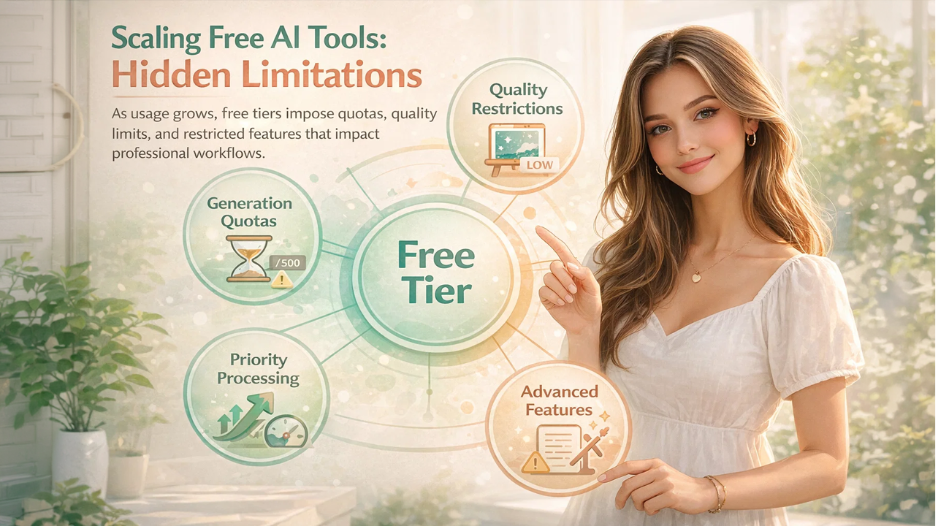
Free tiers typically impose strategic limitations that reveal themselves as your needs grow.
Generation Quotas: Monthly limits on video generation have limited production volume. Initially you might manage with free tier limits, but these limits exceed quickly as your needs scale.
Quality Restrictions: Free tiers might also limit duration, resolution, or the quality of outputs. Professional applications often require capabilities restricted to paid tiers.
Advanced Features: Often only paid plans offer advanced features like multimodal capabilities, reference-based generation, extended duration, or other editing features. Free tiers provide enough capability that seem useful in early stages while reserving truly powerful features for those customers who buy paid plans.
Priority Processing: Free tier jobs often queue behind paid users, making generation times unpredictable. When you need content on deadline, this unpredictability becomes untenable.
Commercial Usage Restrictions: Many free tiers don't allow commercial use which makes them highly unsuitable for business applications regardless of feature adequacy.
These limitations aren't bugs; they're designed purposely to encourage users to upgrade. Understanding them prevents you from choosing platforms where you'll inevitably need to pay sooner or later.
The True Cost Comparison Framework
To compare platforms, you need to look beyond monthly subscription prices to total cost of ownership. Understanding The Hidden Cost of Free AI Tools requires examining multiple dimensions beyond the surface-level price tag.
Direct Costs: The most obvious costs that most people compare are per-generation fees, monthly subscriptions, or usage-based pricing.
Time Costs: How quickly can you achieve desired results? Platforms requiring extensive iteration waste time. Efficient workflows save money by saving time.
Opportunity Costs: Can the platform accommodate the growth curve you're on? Choose tools you will outgrow, and you'll incur migration costs and lose opportunities in the process.
Risk Costs: What's the likelihood of the platforms failing or undergoing significant change? This risk has real costs, even if hard to measure.
Workflow Integration Costs: How does the platform integrate with your workflow? Friction costs time and reduces effectiveness.
A $50/month platform that saves ten hours monthly compared to a free alternative effectively pays for itself if your time has any value. Platforms like Seedance 2.0 with comprehensive feature sets might have higher subscription costs but deliver better total value through efficiency, capability, and reliability.
Making Strategic Platform Choices
Platform selection should align with your specific situation and goals rather than following universal rules.
For Exploration and Learning: Free tools make perfect sense. While learning AI video generation, experimenting with such capabilities, or testing whether you need such tools at all does not warrant paid subscriptions.
For Hobbyist Creation: Personal Projects Without Business Intent, Flexible Timelines, and Low Volume, the free versions work appropriately, since the risks are not major issues for those projects.
For Professional Production: Business needs such as business applications, client work, or content monetization require reliable platforms with strong ownership characteristics, quality control, and sustainable business models. When paid platforms are appropriate for professional production, they are no longer optional costs but necessary investments
For Scaling Operations: Organizations producing content in quantity need to have platforms designed for scaling: priority processing, high generation limits, and features in support of efficient workflows. Free-tier limitations are chokepoints.
For Branded Content: For content that represents your brand or your client brands, there is a requirement for a strict data privacy platform where ownership rights are explicitly granted and quality is ensured. These are things one rarely is assured of with free tools.
Evaluating Sustainability Signals
Assessing whether platforms will survive long-term isn't perfect science, but indicators exist.
Business Model Clarity: Do they have a clear path to profitability? Platforms with working paid tiers and reasonable conversion rates have better prospects than those purely burning venture money.
Funding and Backing: Organizations that have more funds or are backed by strong entities have a larger runway. Early-stage companies, on the other hand, have a higher probability of failure.
User Growth vs. Revenue Growth: Platforms gaining free users but not paying ones will face an eventual reckoning. Healthy paid user growth means business viability.
Feature Development Pace: Active development with consistent improvements implies the companies are well and fully invested in the future, while stagnant platforms might portray a financial crisis for a company.
Communication Transparency: Companies’ open communication on their business and sustainability models instill more confidence than those that are not transparent about their economics.
The Pragmatic Hybrid Approach
The optimal strategy is most often a mixture involving a range of platforms. The Hidden Cost of Free AI Tools can be minimized by strategically combining free and paid platforms based on your specific use cases.
Instead of free tools for experimentation, learning, and validation of concepts, use them for production, client work, or content that suits your profession. This will ensure you leverage the free tool benefits to the maximum while avoiding free tool disadvantages.
It is advisable to develop test versions and proof of concept on free platforms, then use professional platforms for the final versions in the appropriate and warranted capacity. This enables maximum efficiency at an intelligent cost.
Future-Proofing Your Choice
Technology continues to change rapidly, and the direction of an industry should be factored into what platform to choose.
Multimodal Trajectory: The industry is clearly embracing a multimodal trajectory. Platforms that already support images, videos, and audio inputs essentially set you up for that trajectory. It’s also worth noting that text-only platforms may become irrelevant.
API and Integration: Platforms with API and integration abilities offer you flexibility as your processes change. Closed platforms restrict your possibilities.
Ecosystem Development: Some are building out complete creative ecosystems, while others are point solutions. Evaluate which is best for long-term requirements.
Professionals who are already embracing tools like Seedance 2.0, which boasts advanced multimodal functionalities, are essentially leading rather than lagging, especially if the less complex alternatives are left in the dust.
Conclusion: Paying for What Matters
“Free” is enticing but virtually never free. The cost of data rights, platform risk, feature limitations, and scaling limitations is often significantly more than the visible costs of a subscription. Building an AI video platform selection strategy simply on cost is a misaligned optimization.
The choice of the right platform depends on the particular circumstances. Free tools, for example, may be the right tool for a particular task. However, when it comes to running large-scale operations or if you have content, it is not optional but rather an essential requirement to invest in reliable platforms with business models, guarantees, and capabilities.
Think strategically in terms of total cost of ownership in making decisions about the platforms you utilize, rather than automatically falling back on "free" solutions that ultimately may cost you more in the long run due to limitations, disruptiveness, and compromises.
The question isn't so much which model pays for AI Video Generation, but when: now through transparent subscriptions, or later through hidden fees, subpar functionality, and platform deterioration. Knowledge-driven platform decisions focus on long-term success instead of short-term price savings. It is strategic thinking that makes a huge difference in whether AI Video Generation improves or limits your capabilities.
%201.png)

%201.png)

%201.png)