

As you integrate machine learning into customer-facing workflows, you also inherit a new class of digital threats. These risks are more targeted, more automated and harder to detect than traditional attacks. This guide outlines practical ways to counter them, helping you keep your customer data secure and your CRM positioned as a strategic asset in an increasingly competitive global market.
Your CRM is the operational core of your organisation. It stores the data that defines every customer relationship, from contact details to behavioural insights.
Securing that system now requires a working understanding of AI security and the specific ways modern algorithms can be exploited. Traditional perimeter defences are no longer enough. You need a forward-looking posture that anticipates how automated tools might be used to manipulate, extract or corrupt your data.
Countering Targeted Data Poisoning

Data poisoning occurs when an attacker feeds corrupted data into your systems to distort model behaviour. You may notice lead scoring becoming unreliable or churn predictions losing accuracy, not because your strategy is flawed, but because your training data has been subtly compromised.
This is not hypothetical. It directly undermines the quality of your decision-making.
According to the IBM Cost of a Data Breach Report 2024, organisations using advanced security AI and automation identified and contained breaches 98 days faster than those without these tools. You can reduce exposure by enforcing strict data validation pipelines and verifying every incoming source before it reaches your training environment.
Establishing a controlled “clean room” for data ingestion really helps ensure corrupted inputs never reach your models, preserving the integrity of your customer insights.
Neutralising Prompt Injection Attacks
If large language models support your customer service operations, prompt injection is a real concern. In these attacks, users craft inputs designed to override system instructions, potentially forcing the model to really reveal sensitive internal data. Pricing logic, internal workflows or private customer records can be exposed if safeguards are weak.
The safest assumption is that all user input is untrusted. Delimiter techniques that separate user content from system prompts are essential. A monitoring layer between the user interface and the model enables you to detect suspicious patterns before they lead to data exposure.
Just as importantly, restrict your support bots to really the minimum required permissions, granting access only to the specific fields needed to complete each task.
Defending Against AI-Driven Social Engineering
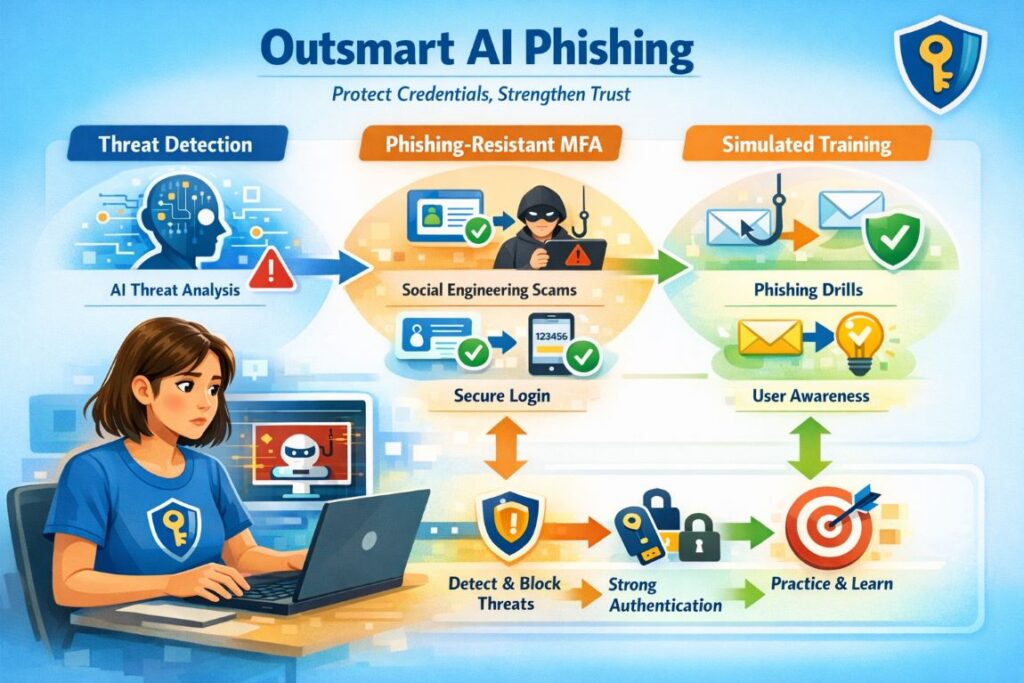
The threat environment has evolved beyond run-of-the-mill phishing emails or obvious scam messages. With AI, it is now possible to analyze company communications, social media and news releases to reproduce the same tone, structure and linguistic style as company officials or other top-level figures.
This means that when a system administrator receives a message that is almost indistinguishable from a legitimate internal message, the threat level of compromised CRM credentials or unauthorized system access increases dramatically.
These threats arrive at critical moments, designed to catch people off guard, bypassing caution and leveraging trust in familiar authority figures.
The 2024 Verizon Data Breach Investigations Report discovered that 68% of breaches involved a human element, including social engineering. This can be mitigated by using phishing-resistant multi-factor authentication, such as hardware security keys, which can neutralize credential theft even when social engineering is used against users.
Simulating internal threats using AI-generated phishing content can really also help improve resilience by exposing users to a realistic threat environment in a safe environment. This is a world where psychology is the primary threat surface and it requires a culture of verification, not just a series of security options.
Implementing Advanced Algorithmic Auditing
Security is all about visibility. Maintaining identity visibility across your AI systems gives security teams the oversight needed to detect unauthorized access and anomalous behavior before it escalates. It is really impossible to secure something that cannot be understood. Regularly auditing automated CRM system outputs will help identify changes in system behavior that could indicate manipulation or compromise.
Unclear system decisions or “black box” system behavior should always be suspect. Over time, even minor changes in system behavior can lead to serious issues if not addressed.
System auditing should include version control for every iteration of every model. This way, any corruption of the system will trigger an immediate rollback. Auditing will also help identify any suspicious “outlier” behavior in system data exports.
Behavioral biometrics can be used to detect automated scripts that attempt to impersonate human users. API rate limiting will help prevent large-scale data extraction via external system interfaces.
Securing the Global Data Supply Chain
Most CRMs rely on third-party integrations and each one introduces additional risk. A single weak vendor can become the pathway attackers use to reach your primary customer records. That makes supply-chain visibility a core component of AI security, not a secondary concern.
The 2024 Thales Data Threat Report shows that 43% of organisations failed a compliance audit in the past year, often due to cloud-based vulnerabilities. You should require clear documentation on how every partner handles data protection, AI security controls and data residency.
Aligning your ecosystem with frameworks such as GDPR and ISO 27001 goes beyond compliance. It protects trust, reputation and long-term business value. By acting proactively, you turn your CRM from a potential point of exposure into a fortified foundation for your most valuable customer relationships.
%201.png)

%201.png)

%201.png)