
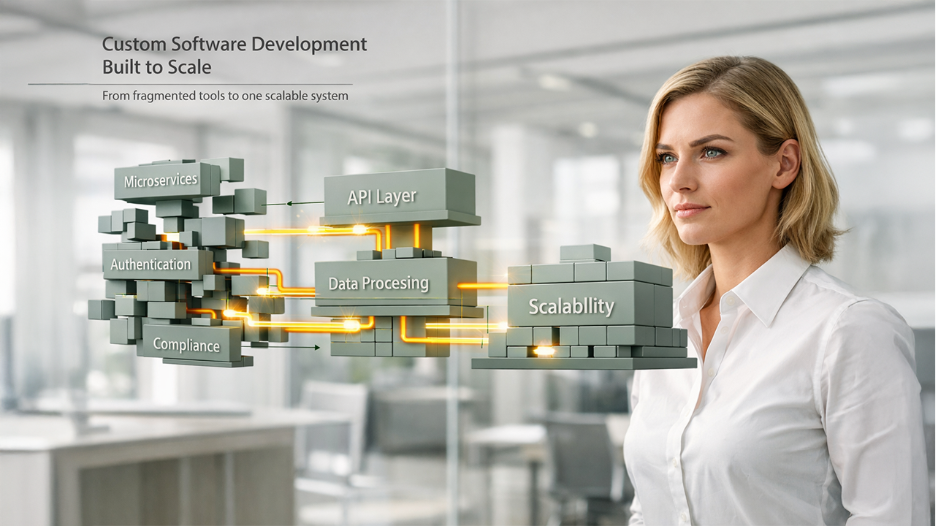

There’s a point when spreadsheets stop scaling. So do plugins. So do half-connected SaaS tools stitched together over time. Growth exposes these cracks slowly—then all at once. That’s usually when a custom software development service stops looking like an upgrade and starts looking like infrastructure.
When Standard Tools Start Creating Friction
Most companies don’t begin with custom software. They begin with what works quickly.
A CRM here. A billing tool there. A workflow add-on to connect them. Early on, this makes sense. Velocity matters more than elegance.
Then operations scale.
Manual exports become common. Internal dashboards don’t match vendor numbers. Approvals span multiple systems. Nothing is technically failing. It’s just inefficient.
I once worked with a mid-sized operations team running seven different tools to manage what should have been a single workflow. The cost wasn’t in subscriptions—it was in human coordination.
That’s often when a custom software development service enters the discussion.
Why Off-the-Shelf Platforms Reach Their Limits
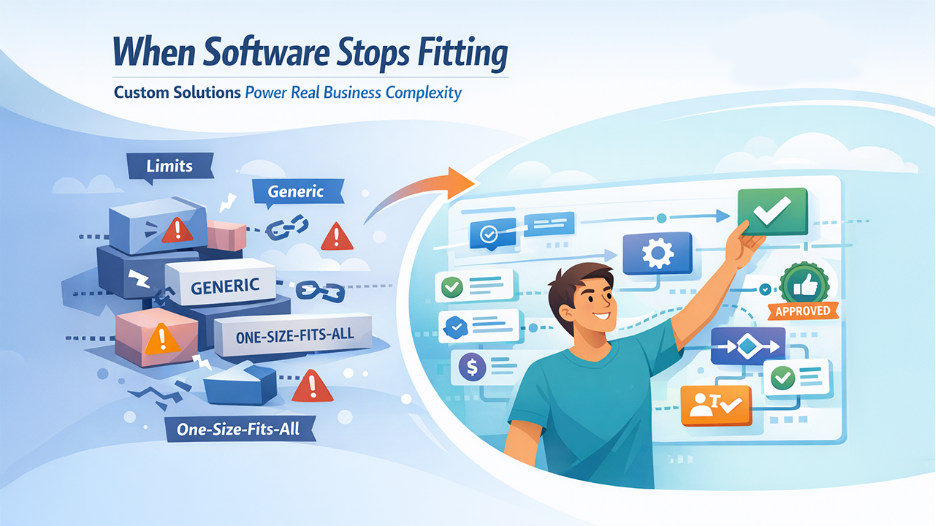
SaaS products are optimized for broad adoption. Businesses operate in specifics.
Unique pricing models, multi-step approval chains, conditional logic across departments—sooner or later, generic features stop reflecting operational reality.
At that stage, companies face a trade-off: adapt business processes to fit tools, or adapt tools to fit business.
The second path is where custom software development service providers bring strategic value.
What a Custom Software Development Service Actually Delivers
The assumption is usually “they build software.”
More accurately, they align systems with operations.
Architecture aligned to process
Instead of layering patches onto limitations, custom solutions map directly to internal workflows. Modular architecture, API-driven communication, and structured data models reduce fragility over time.
Integration without fragmentation
CRMs, ERPs, analytics platforms, payment systems, and internal databases must exchange data reliably. Custom integration layers prevent dependency chains from becoming brittle.
Scalable infrastructure design
Growth introduces complexity alongside volume. Custom builds anticipate realistic scaling patterns instead of default usage assumptions.
Security and regulatory alignment
Industry-specific compliance requirements shape architecture decisions from the outset.
Long-term ownership
Unlike vendor-dependent systems, custom solutions evolve according to business priorities rather than product roadmaps outside the organization’s control.
When Custom Software Becomes Strategic
Certain signals appear repeatedly:
Manual workarounds multiply.
Data silos increase.
New feature requests stall due to platform constraints.
Performance degrades as usage grows.
At this point, incremental adjustments become more expensive than structured redesign.
A custom software development service engagement becomes less about features and more about control.
Where Custom Software Development Delivers the Most Leverage
Operational automation
Reducing repeated manual coordination across departments.
Data centralization
Building unified reporting instead of reconciling conflicting dashboards.
Complex workflow logic
Supporting multi-role permissions and conditional routing without workaround scripts.
Industry-driven compliance systems
Healthcare, fintech, logistics, and manufacturing environments often require infrastructure that generic software cannot accommodate. Custom software solutions built around unique industry challenges ensure compliance requirements are met from the architecture stage, not patched in later.
Product differentiation
Companies building proprietary digital platforms retain competitive advantage by owning their system logic end to end.
Internal Engineering or External Expertise?
This decision depends on capacity and timing.
Internal teams provide continuity and domain insight. External custom software development service providers contribute architectural experience and exposure to scaling challenges across industries.
Hybrid models are common. External experts establish foundational systems. Internal teams maintain and evolve them.
What rarely works is continuing to stack incremental customizations on unstable foundations.
Technical debt accumulates silently.
Risks Organizations Often Underestimate
Overengineering too early.
Underestimating ongoing maintenance.
Leaving ownership undefined.
Ignoring integration complexity at the architecture stage.
Custom software development is not a one-time investment. It’s a long-term capability.
How Custom Development Is Evolving
Cloud-native infrastructure reduces hardware constraints. Modular systems enable phased scaling. Continuous deployment pipelines shorten iteration cycles.
Custom software no longer implies rigid monolithic builds. It increasingly means composable systems structured intentionally.
Organizations that treat software as strategic infrastructure gain adaptability competitors struggle to replicate.
How to Evaluate a Custom Software Development Service
Look for lifecycle thinking.
How is architecture documented?
How are scaling milestones anticipated?
How are deployments validated and monitored?
What does support look like two years after launch?
Strong partners discuss sustainability before aesthetics.
Measured planning tends to outlast accelerated delivery.
Closing Thoughts
A custom software development service is not about uniqueness for the sake of distinction.
It’s about operational alignment.
When technology reflects real workflows, inefficiencies shrink. Data becomes trustworthy. Teams move with confidence.
And growth no longer depends on the limits of third-party tools.
%201.png)

%201.png)

%201.png)