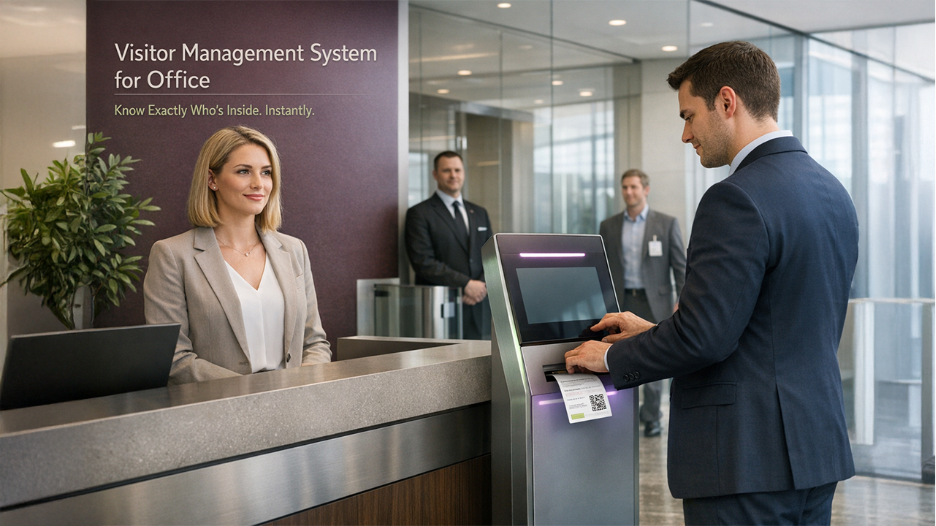

Marcus Chen manages facilities at a mid-sized financial services firm. One morning, things fell apart at the front desk — paper logbooks stuffed with illegible signatures, employees abandoning their desks just to confirm a visitor had arrived, and a security team with no real picture of who was inside the building. A compliance audit made the decision for him. He implemented an visitor management system for office environment — and the impact went far beyond the lobby.
This isn't just a technology upgrade. Switching from paper logbooks to digital visitor management solves three specific operational problems: productivity drain, workplace security gaps, and compliance exposure. Organizations still running manual processes to carry costs that don't show up on any budget line — until something goes wrong. The global visitor management software market hit approximately $1.8 billion in 2025 and is projected to surpass $2 billion by the end of 2026. When a software category grows that fast, it's because it's solving real pain, not hypothetical problems.
The Real Costs of Paper Logbooks
Here's what a paper logbook actually costs. Take a company with 200 employees receiving 30 visitors per day. If manual visitor check-in wastes just five minutes of staff time per guest, that's 150 minutes gone every single day — 12.5 hours per week. At a $35 average hourly rate, visitor registration alone drains over $22,000 per year. That number doesn't include broken workflow, constant interruptions, or the compounding effect of employees doing administrative work instead of the jobs they were hired for.
Workplace security risks compound the problem. Paper systems can't stop an unauthorized visitor from walking in and posing as a guest. Incomplete visitor registration logs make incident investigations nearly impossible after the fact. For organizations operating under GDPR, HIPAA, or strict access control requirements, those gaps translate directly into regulatory fines and legal liability. And during an emergency evacuation, knowing exactly who is in the building isn't optional — it's a life-safety requirement that paper simply can't meet.
Benefits of a Modern Visitor Management System for Office Environments
Digital visitor management systems fix these problems by moving routine coordination to automation. The visitor experience starts before anyone walks through the door — organizations send custom invitations with directions, parking details, and facility instructions in advance. Through visitor pre-registration, guests complete NDAs and required documents on their own device, at their own pace, rather than fumbling with paperwork at a crowded reception desk. That shift alone changes how a meeting starts.
Speed and polish define the visitor check-in process now. Tablet kiosks and touchless check-in interfaces replace shared logbooks. The latest visitor management software supports ID scanning, printing visitor badges, and QR code check-ins. As soon as a guest checks in, their host receives an automatic notification – no phone tag, no relay through the front desk, no wait.
Visitor tracking provides real-time information to the security and facilities departments about who is on the premises at any given time, including visitor identity, arrival times, types of visits, and frequency of visits. Data analytics tools help the facilities manager make informed decisions about staffing and space allocation based on visitor traffic patterns. That's not a minor operational improvement. It's the difference between managing by instinct and managing by data.
Access control features close the loop. Organizations define which areas visitors are permitted to enter, set time-based restrictions, and have access automatically revoked when a visit ends. Visitor badges printing keeps guests visually identifiable throughout the facility. The watchlist functionality identifies those who should not be allowed in before they are able to pass through reception. When combined, these tools create a workplace security system that secures people and assets without making the space feel unpleasant for authorized visitors.
Connecting Visitor Management with Security Protocols
Today’s systems do not function in a vacuum; they are part of the larger security ecosystem. Unlike paper-based systems, electronic visitor management systems are integrated with access control systems, IP camera systems, and emergency notification systems. When a visitor finishes the visitor check-in process, the system can print visitor badges, unlock specific doors, and notify security personnel without any human intervention.
Regulated industries benefit most from this. Healthcare organizations need HIPAA-compliant visitor tracking. Financial services firms face strict access logging requirements. Government offices require a visitor management system for government-grade compliance, producing detailed audit trails on demand to meet strict security and regulatory standards. Modern visitor management software maintains tamper-proof digital records that meet these requirements — and compliance reporting that used to take hours of manual log review now takes minutes.
Emergency preparedness is what distinguishes advanced systems from simple visitor check-in solutions. Real-time occupancy information enables security personnel to know exactly how many people are in the building and their location, which is essential during fire evacuations, weather emergencies, and other disasters. Some systems are designed to work in conjunction with mustering point management solutions.
How Visitor Management Boosts Efficiency
Emergency preparedness is what distinguishes advanced systems from simple visitor check-in solutions. Real-time occupancy information enables security personnel to know exactly how many people are in the building and their location, which is essential during fire evacuations, weather emergencies, and other disasters. Some systems are designed to work in conjunction with mustering point management solutions.
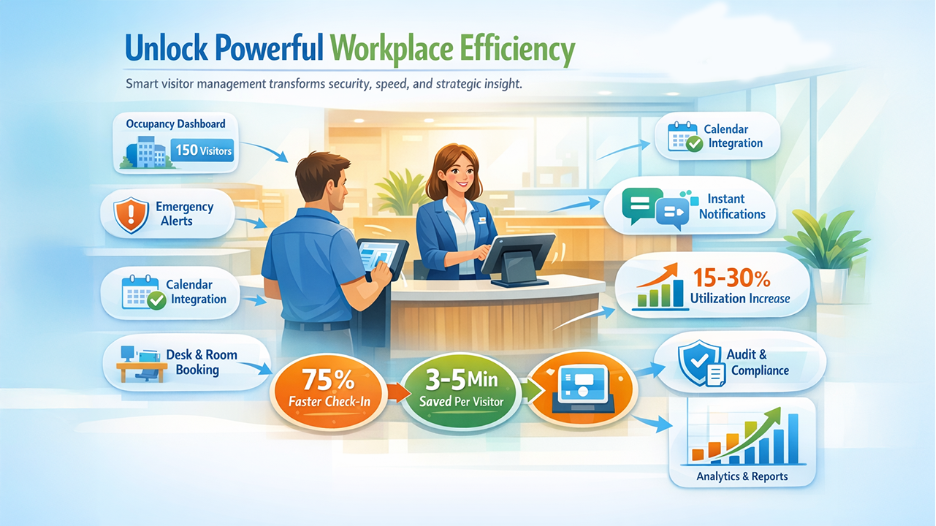
Workplace tool integrations amplify those gains further. Many platforms connect directly with calendar systems, letting employees complete visitor pre-registration from within a meeting invitation. Slack and Microsoft Teams integrations push check-in notifications instantly without requiring anyone to open a separate application. Paired with desk reservation software, organizations get a unified workplace management environment — visitor access, desk bookings, and meeting room reservations running through one connected system. The data silos that slow hybrid work operations start to close.
Total cost of ownership tells a different story than the sticker price. Paper logbooks appear to be inexpensive until one considers the cost of staff time, security risks, and compliance issues. Contemporary visitor management systems operate on a subscription model with simple pricing terms—companies pay for the capacity they consume, without per-employee pricing that discourages expansion. Most companies are up and running in days, not months.
- Automated host notifications eliminate phone tag and front desk coordination, saving an average of 3–5 minutes per visitor arrival.
- Visitor pre-registration reduces on-site visitor check-in time by up to 75%, cutting lobby congestion and improving first impressions.
- Digital audit trails also remove the need to manually review logs, and the time it takes to complete compliance reporting goes from hours to a simple database query.
- Real-time occupancy information also allows for dynamic space allocation, which increases facility utilization rates by 15-30%.
- The system also integrates access control systems, which reduces the administrative burden of the security team and enhances the overall security of the facility.
The information produced by the visitor management system has strategic value beyond the current process. Analysis shows the peak times of traffic, allowing the organization to adjust the staff schedule, HVAC, and resource allocation based on this information. Security personnel can identify unusual traffic patterns before they become an issue. Business development teams monitor the frequency of client visits and associate this information with pipeline activity. What was once a problem at the front desk is now a source of operational intelligence.
The Future of Visitor Management: Trends and Predictions
Advances in AI and the growing need for workplace experience are driving the visitor management industry quickly. Machine learning is making it possible to have predictive systems that can forecast visitor needs and allocate resources accordingly even before anyone makes a request. Facial recognition technology is expected to make touchless check-in possible, but privacy issues must be handled carefully. Mobile-first design is also gaining popularity, with visitors being able to complete the entire visitor registration process on their smartphones before stepping into the office.
Consolidation is the most prevalent trend. This is because companies are shifting away from point solutions that operate in isolation to a platform solution that manages the entire workplace experience, which includes visitor management as part of a larger system that also deals with desk bookings, meeting room bookings, employee services, and workplace analytics. That unified architecture creates a more seamless visitor experience while giving leadership a single source of truth for decision-making.
Sustainability is also shaping product development. Digital visitor management solutions also help reduce paper usage from logbooks and one-time use printed visitor badges, which is a direct contribution to the company’s environmental goals. Smart solutions leverage real-time occupancy information to optimize building operations, such as heating, cooling, and lighting, based on actual presence. Touchless technologies, accelerated sharply by the pandemic, are now a baseline expectation — and the data makes clear that expectation isn't going anywhere.
%201.png)

%201.png)

%201.png)