

Among the most popular data warehouse recommendations from consulting firms, Snowflake occupies an almost monopolistic position. In most cases, consultants recommend it, creating the impression that Snowflake is the undisputed market leader. Such a concentration of recommendations raises the question: is it really a matter of performance and technological superiority, or are we dealing with the phenomenon of “ease of sale”?
In this article, we will examine why Snowflake has become the default choice for consultants, what factors influence clients, in what cases it may not be the best solution, and what alternatives exist on the market. We will attempt to determine the truth: is Snowflake truly the optimal choice, or is its popularity a result of the recommendation economy in consulting?
Why 80% of consultants recommend Snowflake
The main reasons for Snowflake's popularity are related to its combination of technological simplicity and market strategy. The platform was one of the first to offer a straightforward cloud architecture with separation of computing and storage, which simplified scaling and administration. It has a convenient start-up model without complex infrastructure deployment, integrates well with popular BI tools, and supports the familiar SQL approach.
In addition, a strong brand, an active partner ecosystem, and marketing that shaped the image of a “secure standard” for the corporate segment worked in its favor. As a result, Snowflake has become the market default in many projects—not only because of its technical characteristics but also because of its predictability and recognizability.
What professional communities say about Snowflake

In technical communities—particularly on Reddit and specialized data engineering forums—Snowflake is often described as “easy to launch” and “smooth to use.”
One popular comment is:
“Working with Snowflake is a completely hassle-free experience, from the start of implementation, both for non-technical staff and engineers.”
In other words, the platform is perceived as easy to implement and understandable even to non-specialists. And it is this characteristic that often becomes a key argument in presentations to management.
Another common theme in discussions is the factor of brand and market inertia. Some users state outright:
- “Snowflake became popular mainly because it entered the cloud data storage market early and built a strong brand.”
Several discussions also suggest that Snowflake is “forgiving” of imperfect data models. This simplifies the start but can lead to increased costs when scaling the load.
Another telling comment from the discussions:
- “We didn't really do a full comparison with alternatives. Snowflake was a safe and familiar choice.”
The technical quality of Snowflake is rarely questioned in communities. But another point is regularly emphasized: the platform's popularity is partly explained by its perceived simplicity, brand strength, and market habits.
The role of partner ecosystems
Snowflake's popularity is partly due to its well-developed partner program. Consulting companies receive certifications, technical support, joint marketing, and a predictable implementation model. By investing in training and partner status, they naturally focus on promoting this particular platform.
As a result, consultants recommend Snowflake for the ease of selling data warehouses. After all, this model reduces risks, speeds up the deal cycle, and makes the commercial offer clearer to the customer.
Is Snowflake really better: features, advantages, and disadvantages
Key features of Snowflake
If you’re not familiar with the tool, here’s a simple explanation: Snowflake is a cloud-based platform for building modern data warehouses. It runs entirely on AWS, Azure, or Google Cloud environments and requires no on-premises infrastructure, while leveraging robust AWS Security capabilities. The architecture of this solution is based on the separation of key components, which allows for flexible management of resources and load.
It is based on three independent layers:
- Storage—centralized data storage in a scalable format.
- Compute—computing clusters that can be scaled independently of each other according to the type of requests and load.
- Services—the level of security, transaction, metadata, and request optimization management.
Among other things, Snowflake allows for flexible scaling of resources—they can be increased or decreased without stopping the system. Payment is based on actual usage: for computing and stored data. The platform works with structured and semi-structured formats (JSON, Avro, Parquet) and supports integration with AI/ML tools.
Advantages and disadvantages of the platform
To form an objective opinion about Snowflake, it is worth looking not only at the strengths of the platform but also at its possible limitations.
| General Factor | Advantage | Disadvantage |
| Brand dominance in the market | Strong brand and marketing support | Recommendations are based on ease of sale, not real needs |
| Communication convenience | Easy to explain to management | Not always the best choice for regulated industries |
| Scale-as-you-go model | Flexible scaling without stopping the system | May be pricier eventually |
| Standardized business model | Simple pay-as-you-go payment | Limited customization flexibility |
| Ecosystem uniformity | Ease of integration with BI tools | Risk of monotony of solutions |
| Focus on the benefit of consultants | Affiliate programs for consultants | Loss of innovation |
Are there alternatives
The most popular data warehouse recommendations by consulting firms
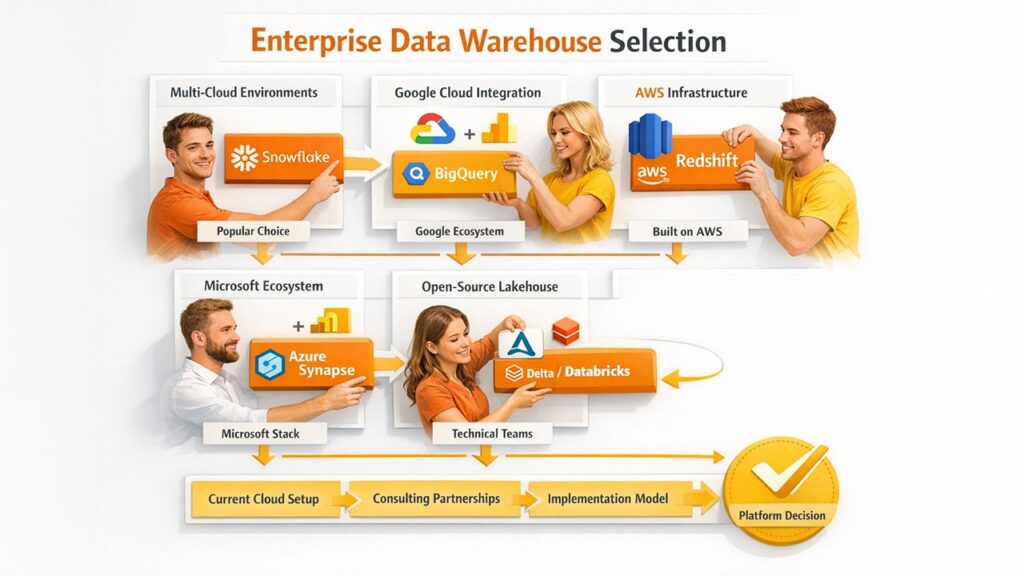
Based on market reviews, integrator case studies, and commercial offers in the enterprise segment, several platforms can be identified that most often appear in recommendations:
- Snowflake—the most common default choice in multi-cloud environments; actively promoted through partner programs and a strong brand.
- Google BigQuery—recommended for projects that already use Google Cloud and require deep integration with Google Analytics services.
- Amazon Redshift—a typical choice for companies whose infrastructure is built on AWS.
- Azure Synapse Analytics—often offered in the Microsoft ecosystem, especially if the company already works with Power BI and Azure.
- Lakehouse approaches based on open-source stacks (e.g., Delta Lake/Databricks) — recommended for more technically mature organizations with their data team.
In most cases, the choice of platform correlates not only with technical parameters but also with the client's current cloud infrastructure, the consultant's partnerships, and the predictability of the commercial implementation model.
Expert consultant commentary
To better understand how technology choices are made in practice, we asked the Lead Data Architect at Cobit Solutions for their thoughts. This team implements analytical solutions for businesses in various industries and, among other things, provides data warehouse consulting services.
“Snowflake is a powerful and mature platform, and we use it in many projects. But if it is really justified by the architecture and economics of the solution. And before making recommendations, we always analyze the type of workload, data structure and volume, processing speed requirements, integration with the current infrastructure, and cost model. In some cases, Snowflake is the optimal solution. In others, Azure Synapse, BigQuery, or local SQL solutions may be more appropriate. Our approach is not to promote a specific platform, but to select the technology according to the client's business architecture”.
Therefore, Cobit Solutions uses several technologies in its portfolio, depending on the tasks, environment, and strategic goals of the project. For example:
| Service / Technology | When is the best fit | Typical cases |
| Snowflake | Quick start in the cloud, easy to scale | Analytics for medium and large companies |
| Azure Synapse | For businesses in the Microsoft ecosystem | Integration with Power BI, enterprise repositories |
| SQL Server | On-premise or hybrid solutions with high control | Banks, manufacturing, and companies with on-premise requirements |
| MongoDB | Working with unstructured data | IoT, mobile applications, logging |
| BigQuery | For Google Cloud Customers | Marketing Analytics, GA4 Integration |
| Power BI | Visualization and accessible analytics | Dashboards for management |
Among other things, the company shared a case with us.
Case study: network of medical centers
One day, the CFO of a network of private medical centers approached the Cobit Solutions team with a request to create a single repository for financial and operational analytics. Data was stored in different systems—a medical information platform, accounting, and separate reports—which made it difficult to obtain a consolidated picture of revenues and profitability by business line.
After analyzing the workload, medical data protection requirements, and budget model, a hybrid solution based on SQL Server with integration into Power BI was chosen. As a result, the company received a centralized repository, faster preparation of management reports, and transparent financial analytics for each branch.
Feedback from the medical center's CFO:
“We researched the market before contacting Cobit Solutions and considered implementing a popular cloud solution that consultants often recommend. However, during the consultation, the Cobit Solutions team explained that Snowflake's recommendations in consulting are not based on performance metrics as the sole criterion”.
Among other things, the platform is not the best choice for regulated industries where it is important to keep customer data confidential. So, after analyzing our processes, the expert proposed a solution that turned out to be more cost-effective for our network.
Conclusions
Snowflake is a powerful platform with a well-thought-out cloud architecture, flexible scaling, and a straightforward onboarding model. That is why it is in high demand on the market. However, popularity does not equal versatility. In real-world projects, the choice of data storage is influenced by several factors:
- business architecture,
- security requirements,
- regulatory environment,
- load type and budget model.
Additionally, recommendations are influenced by partner ecosystems and the commercial logic of consulting. Therefore, the main question is not “which platform is the most popular?” but “which technology suits your specific use case?” Sometimes it may be Snowflake. Sometimes other solutions will be better. So, a rational choice should always start with an analysis of the brand, not with trendy offers on the market.
Frequently asked questions
Q1. Does this mean that Snowflake is an ineffective platform?
No. Snowflake is a technologically mature solution with a well-designed cloud architecture. The question is not about the effectiveness of the platform itself, but whether it fits a specific business scenario.
Q2. Why do consultants recommend Snowflake so often?
The platform has a strong brand, a developed partner ecosystem, and a predictable implementation model. This simplifies sales and reduces risks for consulting companies.
Q3. In what cases is Snowflake really the best choice?
When a business operates in a cloud environment, has variable workloads, requires rapid scaling, and is not limited by regulatory requirements for local data storage.
Q4. How do I know which platform is right for my company?
Choosing a data warehouse takes careful thought. You need to look at the workloads you run and the shape of your data. Security matters, too, as well as how the system connects with the tools you already use. And of course, you have to keep an eye on long‑term costs. Without technical expertise, it’s tough to weigh all these points in a fair way. Therefore, companies usually order data storage consulting services to compare alternatives and obtain a solution that meets their business goals.
%201.png)

%201.png)

%201.png)