


A sales team asked AI Chat to diagnose why their pipeline was producing inconsistent results despite healthy lead volume. It didn't suggest they needed more leads. It pointed directly at prioritization at the gap between what their CRM held and what it was telling them to do about it.
That distinction is where most sales operations quietly lose revenue. Not in prospecting, not in closing, but in the space between a lead entering the pipeline and a salesperson deciding it's worth calling today. AI-driven CRM automation addresses that problem at its root.
Peter Drucker's observation that "the purpose of business is to create and keep a customer" defines the objective simply enough. The difficulty is in the operational reality — sales teams managing large pipelines, working dozens of active prospects simultaneously, trying to determine where attention should go on any given day.
The Limitations of Traditional CRM Systems
CRM platforms were built to solve a storage problem. Before them, sales activity lived in spreadsheets, email threads, and individual memory — distributed, inconsistent, and lost whenever a salesperson changed roles. CRM centralized that information and made it accessible across the team.
The limitation is that centralization solved the storage problem without solving the prioritization problem. A traditional CRM holds everything but doesn't tell salespeople what to do with what it holds. The data accumulates. The interpretation stays manual.
When Ask AI was used to map the inefficiencies in a standard CRM workflow, it identified four consistent failure points. Lead prioritization is unclear — with dozens of active contacts, salespeople default to subjective judgments about who to follow up with, often favoring recency or personal rapport over actual purchase likelihood. Response times slow because identifying which leads warrant immediate attention requires manual review rather than automatic flagging. Data entry requirements consume time salespeople would rather spend selling, leading to incomplete records that degrade system quality over time. And without a signal layer, high-intent behavioral patterns go undetected until the prospect has already made a decision.
These inefficiencies are expensive in ways that are difficult to measure because the lost revenue never appears on a report. It simply doesn't materialize.
What AI Adds to CRM Systems
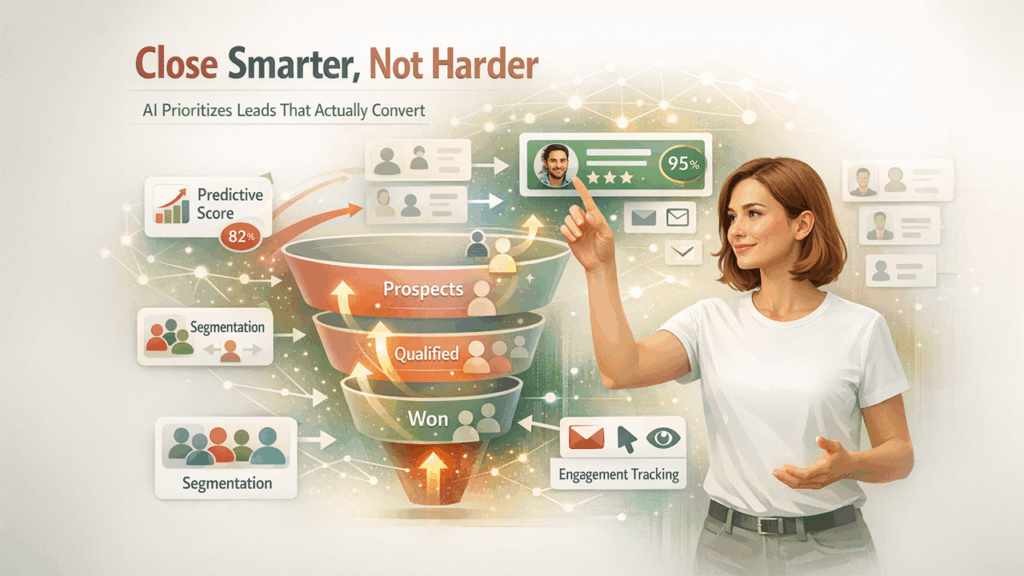
The meaningful difference AI brings to CRM is not better storage or visualization — it's the ability to analyze behavioral data at a scale and speed that human review cannot approach, and translate that analysis into actionable prioritization.
Predictive lead scoring uses machine learning to evaluate each lead against historical conversion patterns and assign a score reflecting purchase likelihood. Rather than treating all active leads as equally deserving of attention, the system identifies which ones are statistically most likely to close — and does so continuously as new behavioral data arrives.
Automated segmentation groups leads dynamically based on behavioral characteristics and funnel position rather than requiring manual categorization. Segments update automatically as leads move through the pipeline, keeping outreach strategies aligned with where prospects actually are.
Engagement tracking monitors how prospects interact across every touchpoint — website visits, email opens, content downloads, pricing page views, demo requests and updates lead scores and priority flags in real time.
When these capabilities were described to AI Chat with the question of which one typically produces the most immediate revenue impact for a team new to AI-driven CRM, its answer — predictive lead scoring, because it directly changes what a salesperson does with their first hour of the day was specific enough to be immediately actionable.
How AI Identifies High-Intent Leads
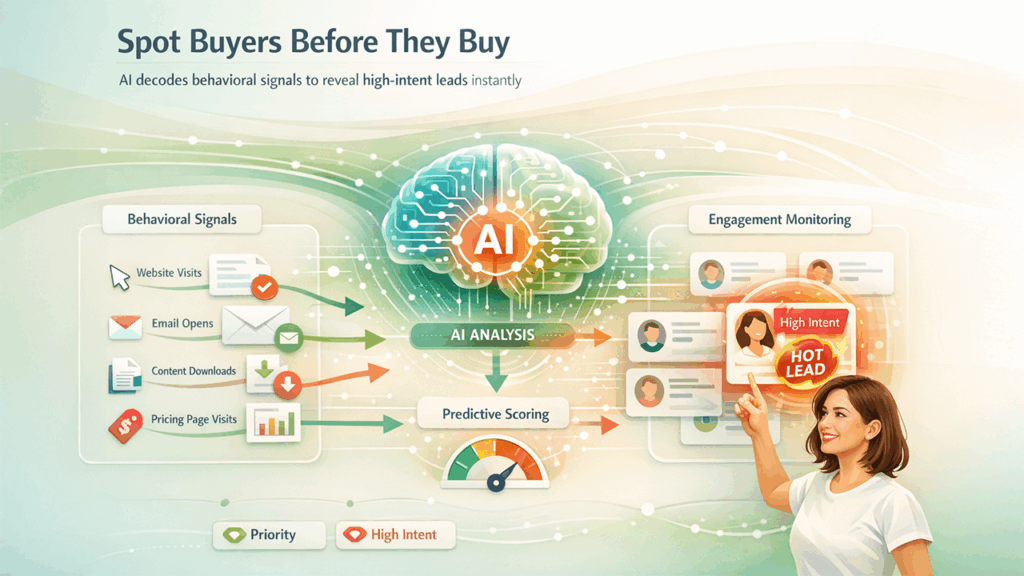
AI is certainly smart enough to identify high-intent leads – but there is some method to the madness. To do so with effectiveness, here’s what it does and how.
Behavioral Signal Analysis
Not all prospect behavior carries equal signal about purchase intent, and the patterns that indicate readiness to buy are often subtle when viewed in isolation. A single pricing page visit might mean little. A pricing page visit following an email open, a case study download, and a return visit to the product comparison page within the same week represents a behavioral cluster that experienced salespeople recognize immediately — and that AI systems detect automatically across an entire pipeline simultaneously.
The signals that AI-driven CRM systems monitor include website visit patterns and session depth, email interaction data including opens and click behavior, content consumption indicating research-stage activity, and specific high-intent page visits such as pricing, testimonials, and comparison pages.
Use AI Chat to help you define what a high-intent behavioral cluster looks like for your specific sales cycle. Describe your typical customer journey and ask it to identify which touchpoints most reliably predict purchase readiness. The output gives your CRM configuration a clearer basis than intuition alone.
Predictive Scoring Models
Machine learning models trained on historical conversion data identify which behavioral patterns — individually and in combination — have most reliably predicted purchase in the past. These models improve as more data accumulates, becoming increasingly accurate at distinguishing leads likely to close from those that will stall. This is precisely how predictive analytics redefine CRM success turning raw behavioral data into reliable, prioritized direction for sales teams.
The practical value of predictive scoring isn't precision — no model predicts conversions perfectly. The value is prioritization. When a salesperson with forty active leads knows that five are exhibiting high-intent behavioral patterns, they know where to start their day. That allocation of attention directly affects conversion rates and sales cycle length.
Engagement Monitoring
AI systems detect patterns that would be invisible in manual review — sequences of behavior that, taken together, indicate a prospect approaching a buying decision. A lead inactive for three weeks that has suddenly began researching specific features, revisiting the pricing page, and opening multiple emails in a short window is exhibiting a pattern that warrants immediate outreach. Without automated monitoring, this window often closes before the salesperson notices it opened.
How Automation Accelerates Sales Workflows
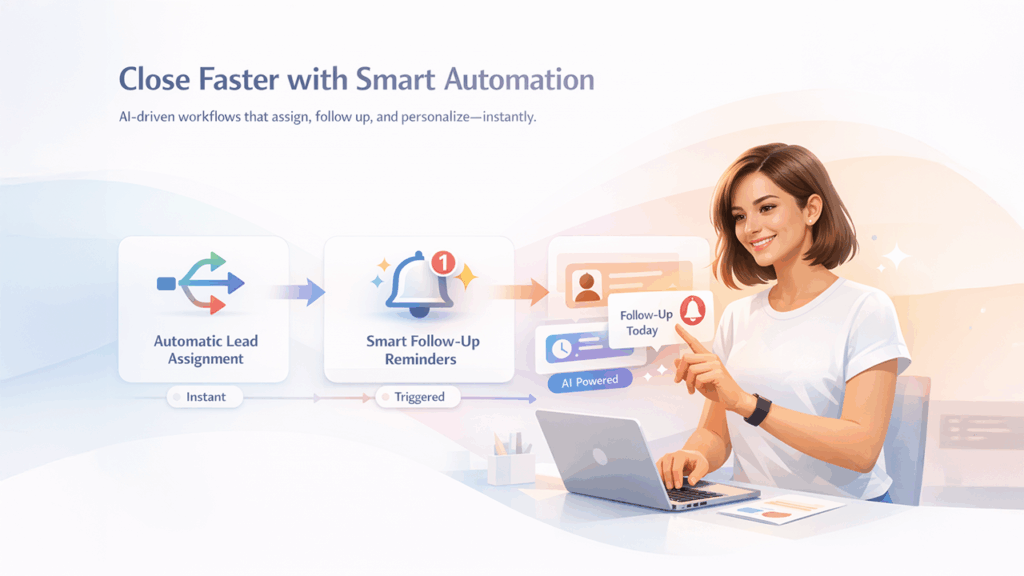
Automation, in whichever field, is of great importance and in CRM usage, it can fasttrack sales workflows - let’s learn more about it.
Automatic Lead Assignment
Routing leads to the right salesperson manually requires someone to review each new lead, evaluate it against team capacity and territory rules, and make an assignment decision. At low volume this is manageable. At scale it becomes a bottleneck that delays first contact — and first contact speed has a significant documented effect on conversion probability.
Automated lead assignment applies predefined routing rules immediately and consistently. The right lead reaches the right salesperson without the delay introduced by manual review.
Smart Follow-Up Reminders
Sales sequences require follow-up at the right intervals — not so quickly as to feel aggressive, not so slowly as to allow momentum to dissipate. Managing these timing decisions manually across dozens of active leads is genuinely difficult, and the predictable result is follow-up that happens based on what the salesperson remembers rather than what the prospect's behavior suggests.
Automated notifications trigger based on both time elapsed and behavioral signals — prompting outreach when a lead re-engages after silence, when a high-intent cluster appears, or when a scheduled interval arrives.
Personalized Outreach at Scale
AI-assisted messaging lets sales teams send communications that reference specific prospect behaviors and interests without requiring manual research before every touchpoint. A message referencing the specific content a prospect has been consuming converts better than a generic follow-up — and AI systems make it practical to send that kind of personalized communication at the volume modern sales operations require.
When an AI assistant was used to draft three follow-up email variations for different behavioral triggers — re-engagement after silence, pricing page visit, and demo request without booking — the outputs needed editing, but they gave the sales team a starting framework they refined into their active templates in an afternoon.
Benefits for Sales Teams
The downstream effects consolidate around three outcomes that compound over time.
- Faster response times to high-intent signals increase conversion probability in ways that are well-supported empirically. Leads contacted within a short window of expressing intent convert at meaningfully higher rates than those reached hours or days later.
- Higher productivity follows from removing the administrative overhead currently consuming a substantial portion of most salespeople's working hours. Time freed from manual prioritization, data entry, and follow-up tracking returns directly to sales activity.
- Improved conversion rates result from better prioritization and more timely, more personalized outreach. The same pipeline, worked more intelligently, produces more revenue without requiring a larger team.
Implementation Considerations
The organizations that see the best results from AI-driven CRM implementation share a few characteristics.
Data quality matters more than sophistication of tooling. AI models trained on incomplete or inconsistent CRM data produce unreliable scoring, which undermines salesperson trust and leads to the manual overrides that defeat its purpose. Cleaning and maintaining data integrity is foundational, not peripheral.
Clear workflow definitions ensure that automated processes support how the sales team actually operates. Lead assignment rules, follow-up triggers, and scoring thresholds should reflect the existing sales process, with improvements introduced deliberately.
Human oversight remains essential. AI-driven prioritization is a tool for informing judgment, not replacing it. Salespeople who understand the system's logic use it more effectively than those who treat it as a black box.
Before configuring any of this, spend time with AI Chat working through your specific sales cycle. Describe your pipeline stages, your average deal timeline, your typical high-intent signals. Ask it to help you map which automation touchpoints would have the most impact given your particular situation. The implementation conversation that follows will be significantly more focused for it.
%201.png)

%201.png)

%201.png)