

Across the world, organizations are in a frantic hurry to invest in artificial intelligence technologies. This sense of urgency feels like a defining moment; a shift that drives faster decisions, smarter systems, and an entirely new way of working. Teams are beginning to explore automation, deployment methods, and use cases for applications that were once deemed impossible.
On the surface, it looks fine. But upon a closer inspection, the picture becomes more complicated. It has been found that many of these initiatives are disorganized, limited to certain teams or individuals, or abandoned shortly after initial enthusiasm fades. There are sufficient tools and strong intent, yet something doesn’t fully connect. A deeper realization emerges that AI transformation is a problem of governance. It's not about what organizations create but also how they guide, control, and align what they build over time.
Why AI Transformation Fails Without Governance
Most organizations begin their AI journey by focusing on what technology can actually do. They ask straightforward questions: Which tool should we pick? What tasks can we automate? How fast can we implement this? These questions matter, but honestly, they only address part of the challenge.
Different teams may adopt AI in different ways, each working toward its own goals. Data may come from multiple sources, each with varying levels of quality. Decisions may be made without clear ownership, leaving uncertainty about responsibility when things go wrong.
These are not technical glitches. They are signs of missing structures. And that structure is governance. When we say that AI transformation is a problem of governance, we are recognizing that Enterprise AI adds a new layer of decision-making power. Unless organizations guide it thoughtfully, they won't be able to create its real value.
What AI Governance Means in AI Transformation
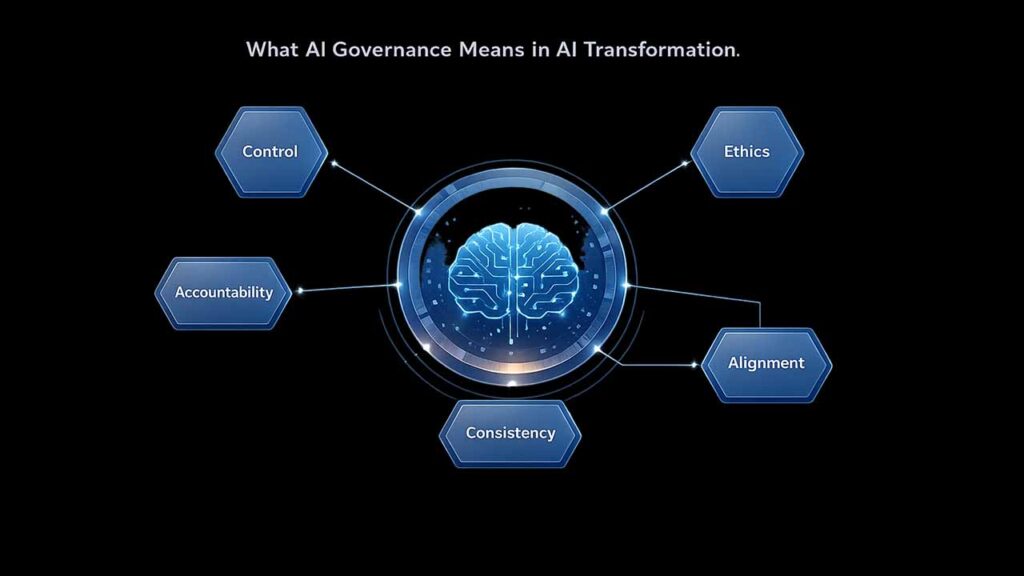
Sometimes governance can sound too vague, but when used in the context of AI, it surprisingly makes sense. It refers to providing clarity in a space that can easily turn complicated and become unpredictable. Before exploring governance, it is useful to understand what is artificial intelligence and how AI systems process data, generate outputs, and support organizational decisions.
At its core, AI governance answers a few important questions:
- Who Controls AI Decisions in an Organization?
Without clear decision rights, initiatives can become scattered or duplicated.
- Who Is Accountable in AI Governance?
When AI systems influence decisions, accountability cannot be left ambiguous.
- How to Ensure AI Consistency and Reliability?
Governance introduces standards that help maintain quality across systems.
- What Are Ethical Boundaries in AI Governance?
Not everything that can be built should be built. Governance defines those limits.
- How to Align AI with Business Goals?
AI should support the organization’s direction, not drift away from it.
Its dynamic nature is what makes AI governance different from traditional oversight. As data changes, how AI works — learn, evolve, and interact with that data becomes central to why governance must be continuous. It is not a one-time setup, but an ongoing process.
Risks of Poor AI Governance in Transformation
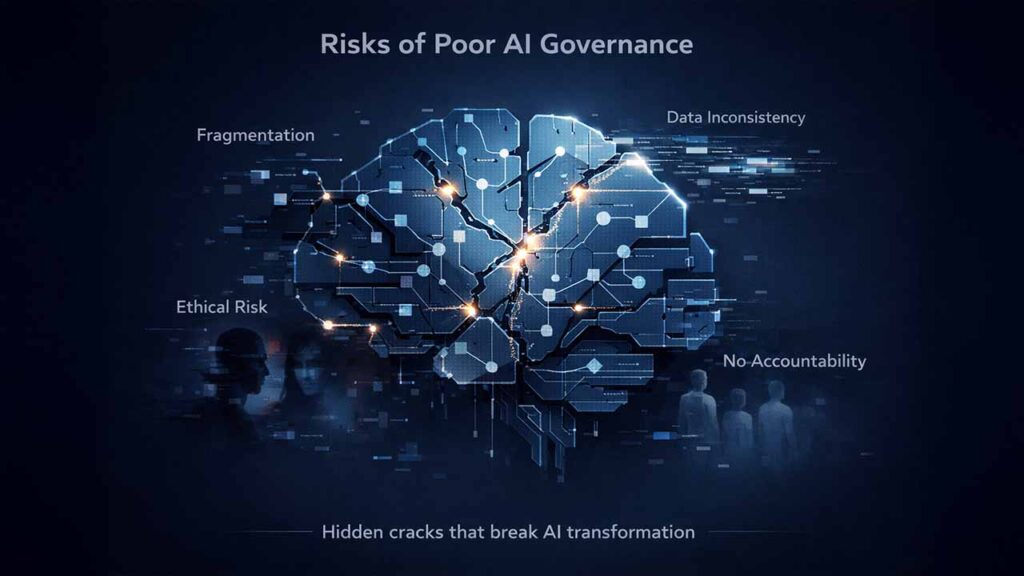
When leadership structures are weak or missing, the problems rarely show up right away. At first, things might even seem to be going well, but slowly cracks begin to appear.
Fragmentation Across Teams
One of the earliest warning signs is fragmentation. Teams often go off in their own directions, building solutions in isolation without coordination. What could have been a coherent system becomes a patchwork of disconnected efforts.This challenge can also affect AI in CRM, where disconnected AI tools and customer data can make it harder for teams to maintain consistent workflows and customer information.
Data Inconsistency in AI Systems
Since AI relies heavily on data, it really matters that everyone works from the same playbook. Without shared standards, teams start relying on different versions of truth or interpreting them in their own way. This leads to outputs you can’t trust and erodes confidence.
Ethical Risks in AI Transformation
There are also ethical risks. AI systems can unintentionally reflect biases present in their data, often without anyone realizing it. Without careful oversight, these biases may go unnoticed until they create irreversible consequences.
Lack of Accountability in AI Systems
However, this might be the most subtle but significant issue. When no one assumes the responsibility for the outcomes of AI systems, it becomes difficult to address and fix the problem. Trust begins to diminish, not just in technology but also in the decisions it influences.
Key Pillars of AI Governance for Successful Transformation
Building strong governance does not mean slowing down innovation. It means creating a foundation that allows innovation to grow sustainably.
| Pillar | Description | Impact |
|---|---|---|
| Strategic Alignment | Connects AI initiatives to business goals | Prevents wasted effort |
| Data Governance | Ensures data quality and consistency | Improves reliability |
| Ethical Frameworks | Defines responsible use of AI | Reduces risks |
| Accountability | Clarifies ownership of outcomes | Builds trust |
| Continuous Monitoring | Tracks performance and adapts over time | Maintains effectiveness |
Every pillar plays a major role in turning AI from a collection of experiments into a cohesive system. Strategic alignment keeps efforts focused. Data governance makes sure that insights are built on concrete foundations. Ethical frameworks ensure responsible use of AI. Accountability systems provide clarity about things, and continuous monitoring allows organizations to adapt to changes.
When all these elements work together, governance becomes less about control and more about enablement.
Why AI Governance Is Difficult to Implement
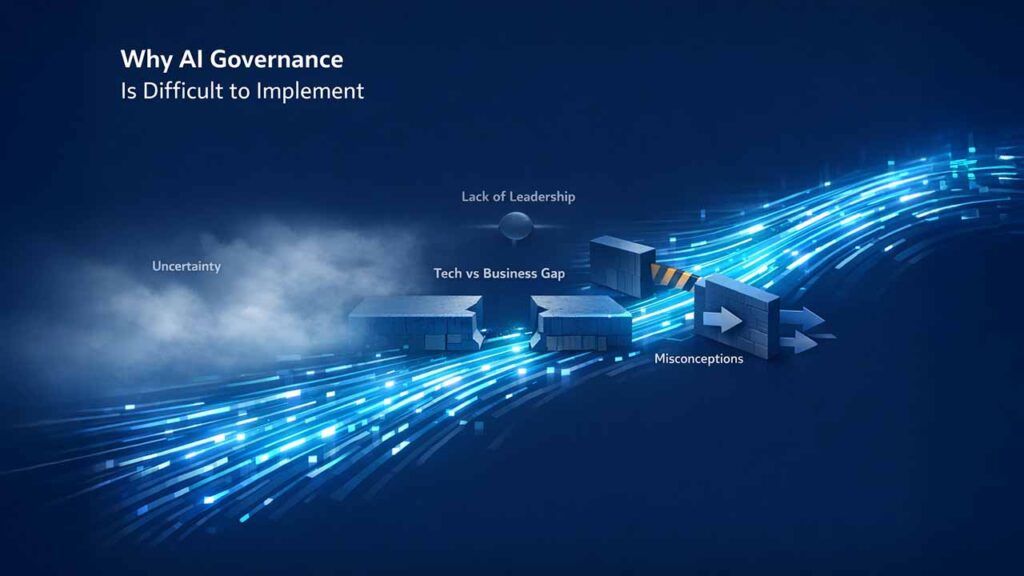
If governance matters so much, why do organizations keep stumbling over it?
- Uncertainty in AI Governance: Part of the challenge lies in uncertainty. AI is still evolving continuously, and there are no standard accepted frameworks. Organizations find themselves trying to build governance as everything shifts around them.
- Gap Between Technical & Business Teams: Technical teams and businesses usually have different perspectives. AI is often developed by technical teams, but its impact extends across the entire organization. If these two don’t work together, then governance efforts feel disconnected from real needs.
- Lack of Leadership in AI Governance: Leadership makes or breaks governance. Without clear direction from the top, governance efforts or initiatives will lose the authority that is needed to take hold.
- Misconceptions About AI Governance: Now comes the way people see governance. It is sometimes seen as restrictive, which slows down progress. However, in reality, the opposite is true. Proper governance keeps everything in sync and helps growth last. Without it, progress becomes inconsistent and difficult to sustain.
AI Governance in Practice: Real-World ExamplesAI Governance in Practice: Real-World Examples
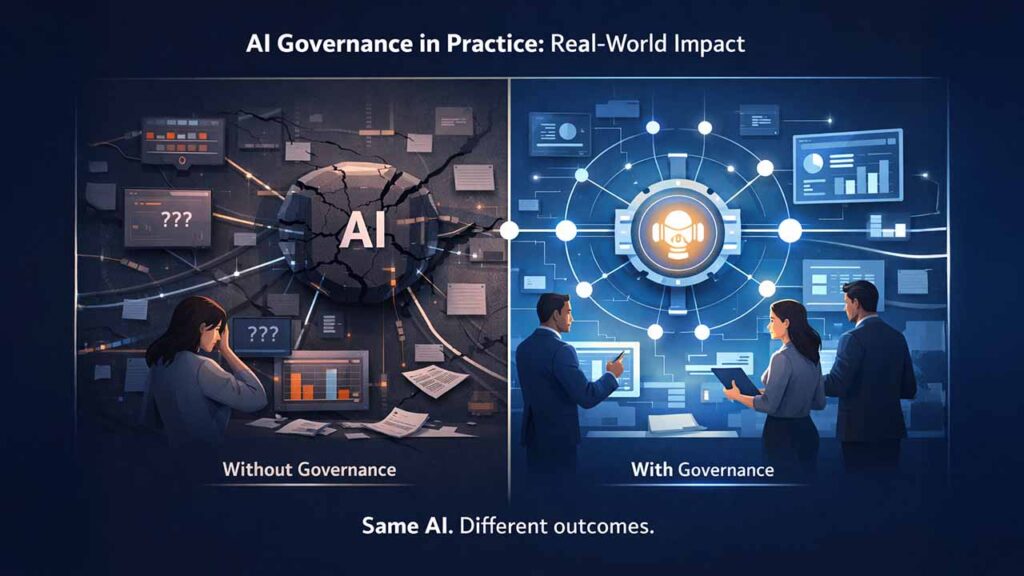
The impact of governance, or the lack of it, becomes clear when we look at how AI is used day to day.
Some organizations introduce AI tools with much excitement, but over time, they vanish. People don’t trust AI outputs or understand how to integrate them into their routine workflows. While in others, AI gives technically correct answers, but the context is flawed. When human oversight is missing, these problems persist and undermine confidence.
There are also cases where automation makes one part of the workflow smoother but creates inefficiencies elsewhere. Without proper coordination, optimizing one area creates complications in another. These situations are not the result of technical failures. Instead, they are warning signs that the system guiding the technology needs strengthening.
Future of AI Transformation: Governance as a Competitive Advantage
Going forward, governance will become one of the most important differentiators in how organizations use AI. The ones that put real effort into building strong governance frameworks will be able to scale their AI initiatives without second-guessing every move. They’ll move quickly, not by taking shortcuts, but because they know exactly where they're headed. Governance doesn’t hold them back; it pushes them ahead, giving them a competitive edge.
Organizations with mature governance systems will be better equipped to:
- adapt to changing conditions
- manage risks proactively
- maintain consistency across teams
- build trust in AI-driven decisions
As AI continues to evolve, the organizations that succeed will not necessarily be the ones with the most advanced tools. They will be the ones who know how to guide those tools effectively.
Final Thoughts: AI Transformation Is a Problem of Governance
The idea that AI transformation is a problem of governance urges us to rethink what transformation really means. It is more than just adopting new technologies or automating workflows. Real transformation builds a system that brings clarity, responsibility, and alignment to how decisions are made.
AI is fully capable of reshaping organizations in profound ways. But that potential can only be realized when there’s strong support from thought governance. Without it, even the most advanced systems remain misunderstood or underutilized. With it, AI becomes something far more powerful; not just a tool, but a reliable and integrated part of how an organization thinks and operates.
FAQs About AI Transformation: Is a Problem of Governance
Q. Why is AI transformation considered a governance problem?
A. Because AI influences decision-making, its success depends on clear structures for accountability, control, and alignment rather than just technical capability.
Q. What is AI governance?
A. It refers to the frameworks and processes that guide how AI systems are developed, deployed, and monitored within an organization.
Q. What happens without proper AI governance?
A. Organizations may face fragmented systems, unreliable outputs, ethical risks, and a lack of accountability.
Q. How can organizations improve AI governance?
A. By aligning AI with business goals, defining clear ownership, ensuring data quality, and continuously monitoring performance.
Q. Does governance slow down innovation?
A. No. Strong governance actually supports innovation by creating a stable foundation for growth and reducing long-term risks.
%201.png)

%201.png)

%201.png)