



Restricted areas are not only a physical security issue anymore. In many workplaces, the same door, gate, panel, or control zone is now tied to connected locks, sensors, cameras, handheld devices, and cloud dashboards. That shift makes access faster and easier to manage, but it also raises the stakes. A bad access decision no longer affects just one lock or one room. It can affect alarms, monitoring, equipment settings, maintenance records, and the people working inside the space.
That is why access control in IoT deserves more attention than it usually gets. For operations teams, the goal is not just to keep unauthorized people out. It is to make sure the right people, using the right devices, can do the right task at the right time, with enough visibility to catch mistakes early. In restricted environments such as utility rooms, storage vaults, equipment enclosures, service corridors, and industrial work zones, that discipline can directly affect safety.
Why IoT access control matters in restricted areas?
Traditional access control was mostly about entry. Did the employee badge open the door? Was the key issued to the right person? Was the visitor signed in?
IoT changes that model. A technician may unlock a restricted area with a mobile credential, connect a tablet to a local interface, read sensor data, acknowledge an alert, and adjust a system setting before leaving. A contractor may be granted temporary remote access to inspect equipment without being on-site. A supervisor may review occupancy, device status, and entry logs from a central dashboard. The moment those actions are connected, access control becomes part physical, part digital, and part operational.
That blended model is useful, but it creates new failure points. A door can be secure while the device used inside the room is not. A contractor account can remain active long after the job is done. A shared login can make it impossible to tell who changed a setting. A camera can record entry while no one is reviewing whether the access matched the work order. Those are not theoretical gaps. They are the routine, ordinary gaps that show up when systems are added faster than rules are updated.
That same problem shows up in access control of IoT devices, where connected systems are making more of the access decisions than teams sometimes realize.
What IoT access control includes
In restricted areas, good IoT access control usually rests on four layers.
The first is identity. The system needs to know who is requesting access. That sounds basic, but this is where many teams still rely on shared credentials, generic admin accounts, or vendor logins that multiple people can use. Shared access might feel convenient during setup, but it creates confusion later when someone needs to investigate an incident or confirm who approved a change.
The second is device trust. Even if the right employee is involved, it still matters whether they are using a company-managed phone, a registered tablet, a hardened laptop, or a personal device with unknown settings. In connected environments, the device itself is part of the risk decision.
The third is authorization. Not everyone who can enter a restricted area should be able to do everything inside it. A maintenance tech may need sensor visibility but not configuration rights. A contractor may need time-limited access to one asset, not the whole site. A supervisor may need approval rights without direct control over the equipment. The best setups keep those distinctions clear.
The fourth is logging. A sound access model creates a usable record of who entered, when they entered, what device they used, and what actions followed. Without that, teams are left guessing after a near miss, system error, or compliance review.
This is also where security and workflow meet. The issue becomes clearer when business processes with IoT are tied directly to work orders, approvals, and maintenance windows.
Common IoT access control mistakes

Most access problems in IoT-restricted areas are not caused by a total absence of controls. They come from controls that look complete on paper but break down in day-to-day use.
One common problem is flat permission design. Everyone in maintenance gets the same rights. Every supervisor has admin access. Every vendor account stays active because turning it off feels like one more task someone will have to revisit later. The result is predictable: too many people can do too much, and nobody notices until there is a problem.
Another issue is treating physical access and digital access as separate systems. Facilities may manage the badge readers. IT may manage the devices. Operations may manage the connected equipment. Safety may manage the entry procedures. Each team can be doing its own job correctly, while the overall access chain still has weak handoffs.
A third issue is poor review habits. Organizations often collect logs but do not use them. They can see that someone entered a restricted area at 6:42 a.m., but they cannot quickly tell whether the entry matched the work order, whether the person’s device was approved, or whether a settings change happened during the same session.
A lot of these blind spots line up with the weakest points of IoT security: unmanaged endpoints, weak credential practices, and too little visibility into how connected systems behave after deployment.
How to build IoT access control for restricted areas
The best place to start is not the software dashboard. It is the space itself.
Ask what makes the area restricted in the first place. Is the main risk unauthorized entry, accidental activation, environmental exposure, process disruption, or a mix of those? A server closet, pump room, chemical storage area, and underground vault may all be restricted, but they do not need the same access model. The more specific the risk, the easier it is to design permissions that make sense.
From there, define access by role and task rather than by department alone. People do not need access because they belong to maintenance, IT, or facilities. They need access because they are performing a certain job under certain conditions. That is a better fit for temporary permissions, time windows, shift-based rules, and approval workflows.
It also helps to separate human identity from device identity. A worker may be fully authorized, but that should not automatically mean any device they happen to carry is trusted. Registered devices, session timeouts, and device-based policies reduce the chance that a valid user can unknowingly introduce a weak point into a controlled area.
This is consistent with how the NIST Cybersecurity for the Internet of Things program approaches IoT security: risk has to be understood in the context of the connected system and the environment where it operates. For restricted areas, that matters. A connected badge reader on an office floor is one thing. A connected access path into a hazardous work zone is another.
How IoT access control supports physical safety
In some workplaces, access control is not only about whether the lock opens. It is also about whether entry should happen at all.
That is especially true when the area involves ventilation limits, hazardous atmospheres, engulfment risks, energy isolation issues, or rescue planning. In those cases, connected access tools can support safety, but they should never be treated as a substitute for field procedure. A supervisor may approve a work order in software, but the actual entry still depends on conditions on the ground.
That is where training and process discipline need to stay visible. A team managing connected entry systems around tanks, vaults, pits, or similar spaces may also need a working understanding of permit space entry basics, because safer entry depends on more than credentials. It depends on role clarity, monitoring, and whether the space is actually acceptable for entry at that moment. The same principle shows up in the OSHA permit-required confined space standard, which connects unauthorized entry prevention with defined roles and entry procedures.
That overlap is easy to miss when teams think of access control as a narrow IT setting. In practice, safer restricted areas depend on operations, safety, facilities, and digital systems all reinforcing the same decision.
Businesses that have already taken the required steps toward boosting workplace safety by connecting CRM with IoT-based security cameras have a clear idea on how digital platforms and physical safety protocols must reinforce one another and not exist in silos.
A practical rollout plan for operations teams
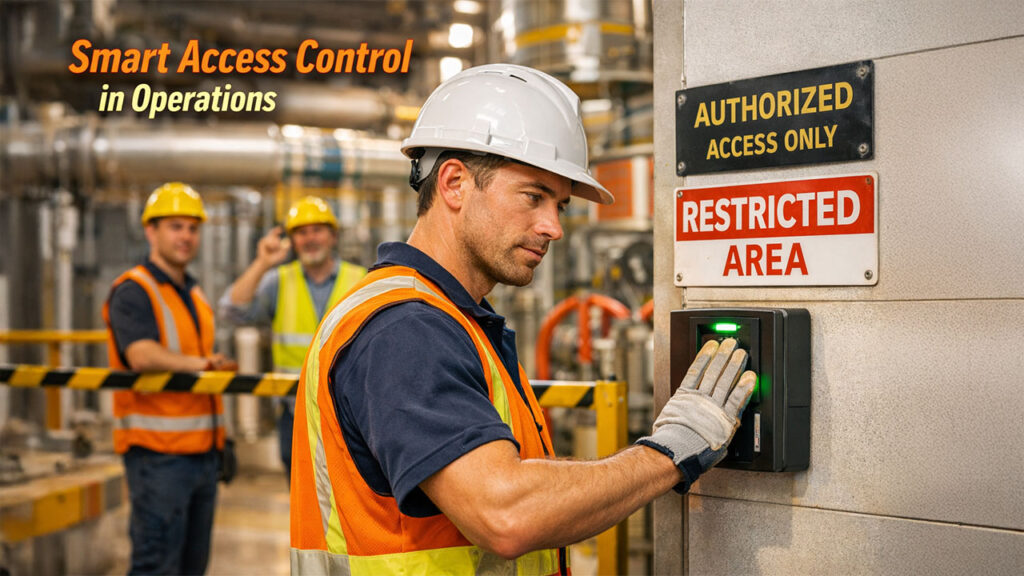
For most organizations, the smartest rollout is incremental.
Start by identifying the restricted areas where a bad access decision would carry the most operational or safety risk. Then map who actually needs access, which devices they use, and what actions they need to perform once inside. That exercise alone often reveals stale permissions, unnecessary admin rights, or vendor accounts that should have been retired months ago.
Next, tie access to real job conditions. If a contractor only needs two hours of access to inspect one asset, the system should reflect that. If a technician needs visibility but not control authority, build that separation in from the beginning. If a supervisor must approve access outside normal hours, make the approval part of the workflow instead of relying on informal messages or verbal signoff.
Finally, review access as an operations signal, not only a security record. When entries keep happening outside the expected maintenance window, that is useful information. When the same user repeatedly requires exceptions, that is worth a closer look. When a restricted area has frequent badge events but poor work-order documentation, the problem may not be the access technology at all. It may be the surrounding process.
Better access control makes restricted areas safer
Access control in IoT for safer restricted areas works best when it is treated as a coordinated operating practice, not just a lock, badge, or app setting. The organizations that get it right connect identity, device trust, permissions, logging, and field safety into one usable process. That does not make the work more complicated for the sake of it. It makes access decisions clearer, easier to review, and more reliable when the environment carries real consequences.
%201.png)

%201.png)

%201.png)