

Selling a software subscription and marketing a medical practice are not the same job. Patients aren't browsing options the way someone shops for a gadget. They're making decisions that touch their health, their families, and sometimes their finances. The messaging that reaches them has to do real work, and that requires more than a capable generalist team running standard playbooks.
The failure mode here is predictable. A practice handles marketing internally, or brings in an agency that doesn't specialize, and the results drift. Campaigns underperform, and compliance questions pile up with no clear answers. Partnering with a dedicated healthcare marketing agency resets that entirely. These teams already understand the regulatory constraints, know how patients actually move through the decision-making process, and have direct experience with the channels that drive real bookings. That's not something a generalist shop can fake.
Deep Knowledge of Healthcare Compliance
The regulatory picture in healthcare marketing is genuinely complicated. HIPAA sets boundaries on patient data. The FTC keeps a close eye on health-related advertising claims. On top of that, state medical boards layer in their own requirements about how providers can market their services. Any one of those violations can be costly, and all three at once can be catastrophic.
Specialist agencies don't treat compliance as something to check at the end. It shapes the campaign from the first brief. A mishandled email list or an ad that overstates a clinical outcome can trigger fines, legal proceedings, and reputation fallout that lingers long after the original mistake. Agencies that only work in healthcare have watched this happen elsewhere. They've built processes specifically to prevent it.
Strategies Built Around Patient Behavior
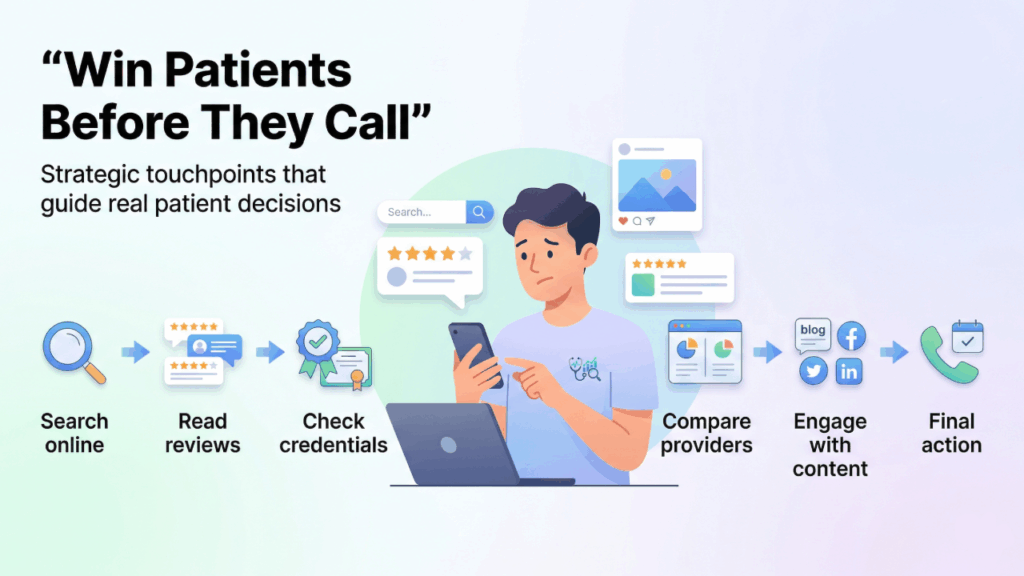
Patients don't shop the way consumers do. Before a person ever calls a practice, they've typically read several reviews, looked up the provider's credentials, compared a few options, and searched for content that speaks to their specific situation. That research phase can stretch over days or weeks.
Agencies with a healthcare focus build around that reality rather than against it. Search campaigns catch people already in research mode. Content answers the questions patients are actually typing. Social media handles the slower, background work of building name recognition before someone even needs care. Nothing is placed arbitrarily—every channel is doing a specific job in the sequence.
To manage patient relationships better, healthcare providers have started to heavily trust a healthcare CRM software that reduces manual tasks, centralizes data, and improves accuracy in healthcare delivery.
Faster Execution and Fewer Wasted Resources
Building a capable in-house marketing team takes longer than most practices anticipate and costs more. Recruiting, onboarding, and getting staff up to speed on HIPAA-compliant workflows and the right toolset — each step eats time. And at the end of it, most internal teams still can't cover the full range at a high level: SEO, paid media, email, and reputation management, all running concurrently and done well.
An agency walks in with that team already assembled. Writers, strategists, designers, and paid media specialists who've worked together and don't need months to find their footing. For practices that need momentum between strategy meetings, a virtual healthcare assistant can handle the day-to-day marketing ops that keep campaigns moving—updating your CRM, coordinating review requests, and keeping patient inquiries organized. That kind of steady execution helps your agency’s work translate into real bookings without adding more admin load to your front desk. The gap between signing and having live campaigns shrinks dramatically. So does the learning curve cost that comes with building something from scratch.
Access to Data and Performance Tracking

The reality is that many practices never get a clear answer to a basic question: where are new patients actually coming from? A healthcare marketing agency tracks that—which campaigns drove bookings, where prospective patients dropped off before calling, which channels are genuinely contributing, and which are just burning budget.
That ongoing analysis changes what happens next. Strategies adjust and spend shifts. Reports arrive regularly and in plain language, not buried in a 40-tab spreadsheet that nobody opens. Developing that kind of analytical infrastructure internally takes both investment and time; most practices don't have either sitting idle.
Reputation Management and Patient Reviews
One negative review, left unaddressed, can quietly redirect patients to a competitor for months. People check star ratings before they visit a website. They read the most recent comments before they pick up the phone. Online reputation isn't peripheral to a marketing strategy; it's often the first impression that determines whether everything else gets a chance to work.
A good agency folds reputation management into the standard scope. They monitor the platforms that matter, respond to criticism professionally without being defensive, and build systems that make it easier for satisfied patients to leave reviews—that consistent, unglamorous effort compounds. A strong review profile does things that paid advertising simply can't.
Long-Term Growth, Not Just Short-Term Wins
Filling gaps in next week's schedule is a different problem from building a practice that grows reliably over three years. Generalist agencies typically optimize for the former. Specialist agencies are built to work on both at once, growing organic visibility and publishing content that drives traffic well after publication. They also build the kind of brand recognition that makes patients come back and refer others.
Disconnected campaigns and rotating freelancers don't produce that. Consistency in strategy, voice, and execution does. It's the kind of thing that doesn't always show up in a single month's report, but becomes obvious over time.
The Bottom Line
Practices are already carrying a full load: patient care, staffing, regulatory requirements, and cost management. Marketing shouldn't add friction without producing something concrete in return.
For a practice trying to hold ground in a competitive local market, or a health system working to build a stronger digital presence, the right agency isn't just a vendor. It's a team that already knows the rules, has seen what works, and is accountable for the same outcomes you're working toward.
%201.png)

%201.png)

%201.png)