


"Launch day is not the finish line. Getting a site to actually perform takes sustained ef ort well after the build is done."
Building a website is the easy part to budget for. It has a scope, a timeline, and an invoice. What comes after: the SEO, the content, the conversion work, is less defined, which is probably why most owners deprioritize it. But that ongoing work is what separates a website that generates leads from one that simply exists. Protecting your website investment starts the moment you go live.
Understand What You Actually Bought
The website is not a brochure. It’s not a one-time deliverable you file away after sign-off. It’s a living business asset, closer to a storefront or a sales representative than a printed flyer.
Storefronts get cleaned, restocked, and refreshed. Sales reps get coached, measured, and redirected when their numbers slip. A website that gets none of that attention will perform exactly the way a neglected storefront performs; it still exists, but it stops pulling its weight.
The mindset shift that separates smart owners from everyone else is simple. They stop thinking about their website as something they built and start thinking about it as something they operate.
Three Things That Erode a Website’s Value Over Time
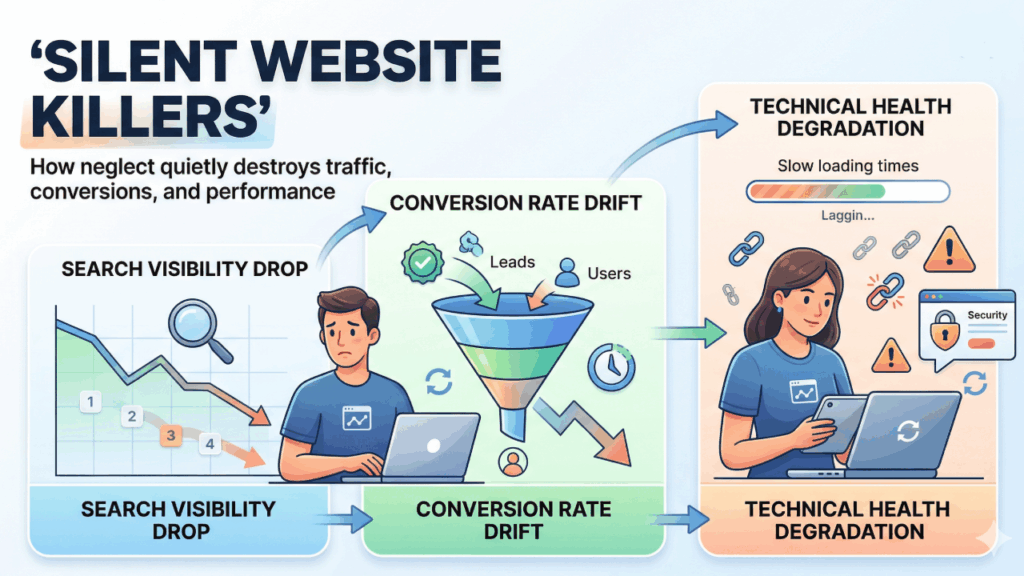
Left unattended; most websites decline in three predictable ways.
Search visibility drops. Search engines reward sites that publish fresh, relevant content, earn links, and stay technically healthy. A site that hasn’t been touched since launch gradually loses ground to competitors who are actively working theirs. Rankings that took months to build can slip quietly over a single quarter.
Conversion rates drift. Buyer behavior changes. Competitors sharpen their messaging. What resonated with visitors at launch may not resonate twelve months later. Without regular testing and refinement, a site’s ability to turn visitors into leads slowly deteriorates, often without anyone noticing until the leads dry up.
Technical health degrades. Page speed slows as plugins and third-party scripts accumulate. Security vulnerabilities emerge. Links break. Core Web Vitals scores fall below the thresholds that affect both search rankings and user experience. None of this
happens dramatically. It creeps in gradually, which makes it easy to ignore until the damage is visible.
“The mindset shift is simple: stop thinking about your website as something you built and start thinking about it as something you operate.”
What Ongoing Website Management Actually Looks Like
Not every business has a marketing team standing by to take over once the site is live. For owner-led companies, the post-launch question of who owns this and what exactly they should be doing often doesn’t have a clean answer. That’s where things stall.
Structured post-launch management typically covers a few core areas: consistent SEO work to protect and grow search visibility, conversion optimization to keep the site performing as markets shift, content production to build authority over time, and performance monitoring to catch technical issues before they compound.
Some businesses build this capability in-house. Many find it more practical to bring in an external team with a clear mandate to own it. Ongoing growth management is the service category built exactly for this: the post-launch operational work that turns a finished website into a consistent source of leads.
The key is that someone owns it. For teams without the bandwidth to manage the day-to-day, solutions like Theo AI website management and SEO can automate routine content updates, technical checks, and on-page optimization while keeping strategy owner-directed. The worst outcome is a site that falls into a grey zone where everyone assumes someone else is watching it.
The Build-and-Abandon Math
Consider a straightforward scenario. A business spends $15,000 on a website build. The site launches, generates a handful of leads in the first month while it’s fresh and being actively promoted, and then gradually goes quiet. Twelve months later, the site is still live but organic traffic has plateaued, conversion rates have dipped, and the team is talking about rebuilding.
Now the real cost of that website isn’t $15,000. It’s $15,000 plus the cost of the rebuild, plus twelve months of missed opportunity.
Ongoing management, even at a modest investment, changes that math significantly. Treating your site as a living website investment rather than a sunk cost is what keeps it generating returns month after month.
What Growth Management Actually Covers
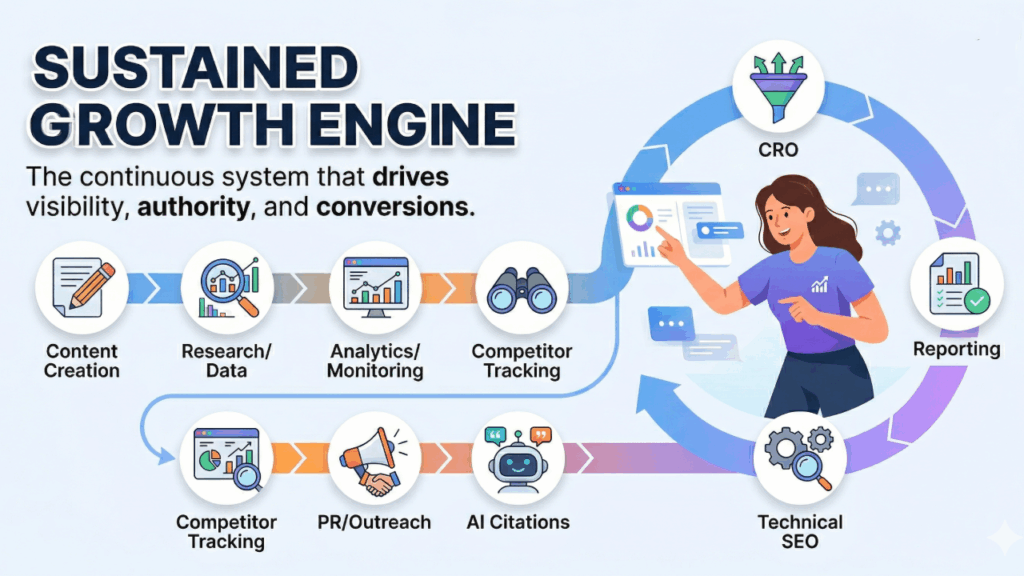
Growth management is not a vague concept. It is a defined set of recurring activities that keep a website visible, competitive, and generating leads over time.
- Content Production. Publishing content consistently is how websites build topical authority: the signal search engines and AI systems use to decide whose content deserves to surface. This means articles, landing pages, and resources tied to what your buyers are actually searching for, not content for its own sake.
- Original Research and Data. One of the most reliable ways to earn backlinks is to publish something worth citing. Original research, surveys, and data studies give journalists, bloggers, and industry writers a source to reference, generating links naturally without outreach campaigns or paid placements.
- Rankings and Traffic Monitoring. Visibility can erode quietly. Monitoring rankings and organic traffic on a regular cadence means drops get caught and addressed before they compound into a real revenue problem.
- Competitor Tracking. Where you rank is always relative to what others in your space are doing. Tracking competitor positions, content output, and keyword gains tells you where the pressure is coming from and where to focus your own efforts.
- PR and Media Outreach. Getting your business mentioned in online publications, industry blogs, and news outlets does two things at once: it builds brand credibility and generates backlinks from authoritative domains. PR efforts at this level don’t require a full agency retainer. Targeted outreach, contributed articles, and guest posts placed on relevant websites can move the needle meaningfully for a growing business.
- AI Citation Monitoring. When someone asks ChatGPT, Perplexity, or Google’s AI Overview a question in your industry, whose content gets cited? Monitoring your brand’s presence in AI-generated answers is a newer discipline, but it’s becoming a meaningful part of maintaining visibility as search behavior shifts.
- Conversion Rate Optimization. Traffic means nothing if visitors don’t take action. Leaving conversion decisions at launch and never revisiting them is one of the most common ways websites underperform. Real CRO is an ongoing process built on monitored data: session behavior, conversion funnels, A/B tests, adjusted consistently as you learn more about how your visitors actually behave.
- Technical SEO and Site Health. Page speed, crawlability, broken links, schema markup, Core Web Vitals: the technical layer of a website degrades over time without active maintenance. Investing in professional technical SEO services ensures these issues are identified and resolved systematically, well before they start quietly dragging down your rankings. Search engines penalize poor technical health quietly, which means by the time you notice the impact it’s already been affecting your rankings for months.
- Reporting. Data without interpretation is noise. A clear monthly report turns traffic, rankings, lead volume, and competitor movement into a coherent picture of what’s working, what isn’t, and what needs to change.
Together these form the operational rhythm that keeps a website growing rather than drifting.
The Bottom Line
A website investment is meaningful for most businesses, and the owners who protect treat their site the way they treat any other business asset: they measure it, maintain it, and put a plan behind its growth.
The ones who launch and move on consistently find themselves rebuilding every few years, wondering why the site never really delivered. The ones who stay engaged consistently find that their website becomes one of their most reliable sources of new business.
%201.png)

%201.png)

%201.png)