


Your sales team tracks leads in one app. Marketing runs campaigns in another. Finance invoices through a third. Customer support logs tickets somewhere else entirely. And operations? They've built a spreadsheet empire that holds the whole thing together with duct tape and prayer.
If this sounds familiar, you're not alone. The average company now runs 106 SaaS applications, according to BetterCloud's 2024 data. That's down from a peak of 130 in 2022, but it's still an absurd number of tools for most organizations to manage, pay for, and keep in sync. The result is what analysts politely call "data silos." What it actually means: your teams are making decisions with incomplete information, your customers are repeating themselves across channels, and you're bleeding money on software nobody fully uses.
The fix isn't buying another tool. It's consolidating the ones you have. And that's exactly where modern CRM platforms are heading.
The Tool Sprawl Tax You're Already Paying
Here's a number that should make any CFO nervous: companies spend roughly $3,500 per employee per year on SaaS tools, according to Hostinger's 2026 industry analysis. For a 200-person company, that's $700,000 annually on software subscriptions alone. And a significant chunk of that spend is wasted. Zylo's research found that 53% of SaaS licenses go unused within 30 days of purchase.
The financial waste is obvious. The operational cost is harder to measure but arguably worse.
When your CRM doesn't talk to your ERP, sales reps close deals without knowing whether you can actually fulfill them. When marketing automation lives on a separate island, campaign data never reaches the people who need it for forecasting. When customer service can't see purchase history or billing status, every support interaction starts from scratch.
These disconnects create three problems that compound over time:
- Slow decision-making. Leaders can't get a unified view of the business without manually stitching together reports from multiple systems. By the time the picture is clear, the moment has passed.
- Customer experience gaps. Gartner's 2024 CRM market analysis found the industry reached $128 billion in revenue that year, with cross-CRM segments (tools that unify data across functions) growing fastest at 17.7%. Businesses are spending heavily to close exactly these gaps.
- Integration overhead. Every new tool needs connectors, API maintenance, and someone to troubleshoot when data stops flowing. IT teams become full-time plumbers instead of strategic partners.
The irony? Most companies adopted all these separate tools to move faster. Instead, they've built a Rube Goldberg machine that slows everything down.
Why CRM Became the Natural Consolidation Point
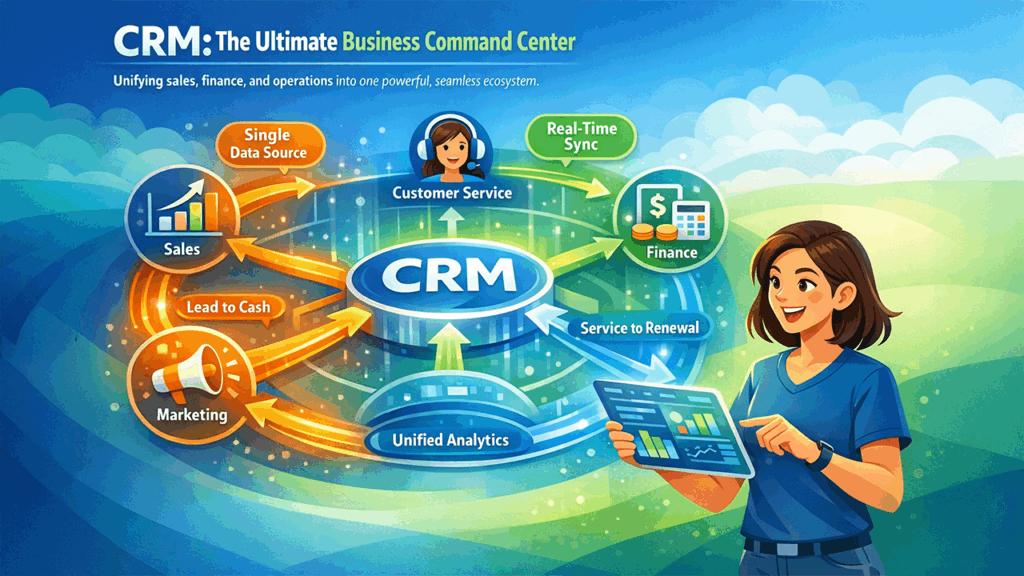
CRM started as a contact database. A digital Rolodex, basically. But the category has evolved so far beyond that starting point that calling it "CRM" almost undersells what these platforms do now.
Modern CRM platforms like Microsoft Dynamics 365 have absorbed capabilities that used to require five or six standalone purchases: sales pipeline management, marketing automation, customer service, field operations, and financial reporting. The shift happened because CRM already sat at the center of most businesses' customer data. It was the logical place to expand. For organizations needing deeper operational control, custom ERP development ensures backend systems connect natively to their CRM from day one.
For businesses evaluating this kind of consolidation, the implementation matters as much as the platform choice. Working with experienced Microsoft Dynamics 365 implementation partners can mean the difference between a unified system that actually gets adopted and an expensive shelf ornament. According to research from C5 Insight, between 30% and 70% of CRM deployments fail, primarily due to poor implementation planning and low user adoption. The platform itself is rarely the problem.
What makes a unified CRM-ERP platform different from just connecting standalone tools through integrations? Three things stand out:
- Single data model. When sales, finance, and operations share one underlying database, there's no sync lag, no duplicate records, no "which system is the source of truth?" debates. A salesperson closing a deal in Dynamics 365 Sales, for instance, creates an order that finance sees instantly in the same system for invoicing.
- Native workflow automation. Cross-functional processes (lead-to-cash, quote-to-order, service-to-renewal) run on one engine rather than hopping between tools through brittle API connections.
- Shared analytics layer. When all your data lives in one place, reporting becomes a question of building dashboards rather than wrestling with data extraction from six different platforms, allowing you to see everything on one CRM dashboard and make faster, data-driven decisions.
Nucleus Research has consistently found that CRM delivers an average ROI of $8.71 for every dollar spent. But that figure assumes proper implementation and adoption. Companies that treat their CRM as just another tool in the stack, rather than the spine of the stack, rarely hit those returns.
What a Connected Business Actually Looks Like

Theory is great. Let's talk about what this consolidation looks like in practice across core business functions.
Sales gets context, not just contacts. In a connected system, your sales team doesn't just see a lead's name and company. They see past purchases, open support tickets, payment history, and marketing engagement, all without switching tabs. CRM data shows that 94% of users rely on contact management as their primary feature, but the real value comes when that contact record is enriched with data from every other department.
Marketing measures what matters. Gartner projects that by 2027, 85% of large enterprises in North America will have adopted CRM marketing software. The driver isn't just automation; it's attribution. When your marketing tools share a data model with sales and finance, you can finally trace a campaign dollar all the way to closed revenue without spreadsheet gymnastics. That's the core promise of integrating CRM with marketing automation done right.
Customer service stops starting over. We've all been that customer: calling support, explaining the problem, getting transferred, and explaining it again. In a unified system, the service agent sees the full picture before picking up the phone. What did the customer buy? When was it delivered? Is there an open invoice dispute? Are they in an active renewal cycle? That context turns a frustrating call into a five-minute resolution.
Finance gets real-time visibility. Instead of waiting for monthly closes to understand revenue, finance teams in connected systems see pipeline, bookings, and cash flow in real time. Forecasting becomes a living process rather than a quarterly fire drill.
Operations can actually plan. When inventory, supply chain, and sales data live in the same ecosystem, operations teams can align production and procurement with what's actually selling, not what was selling three months ago when the last report was pulled.
The Consolidation Playbook: How to Do This Without Breaking Everything
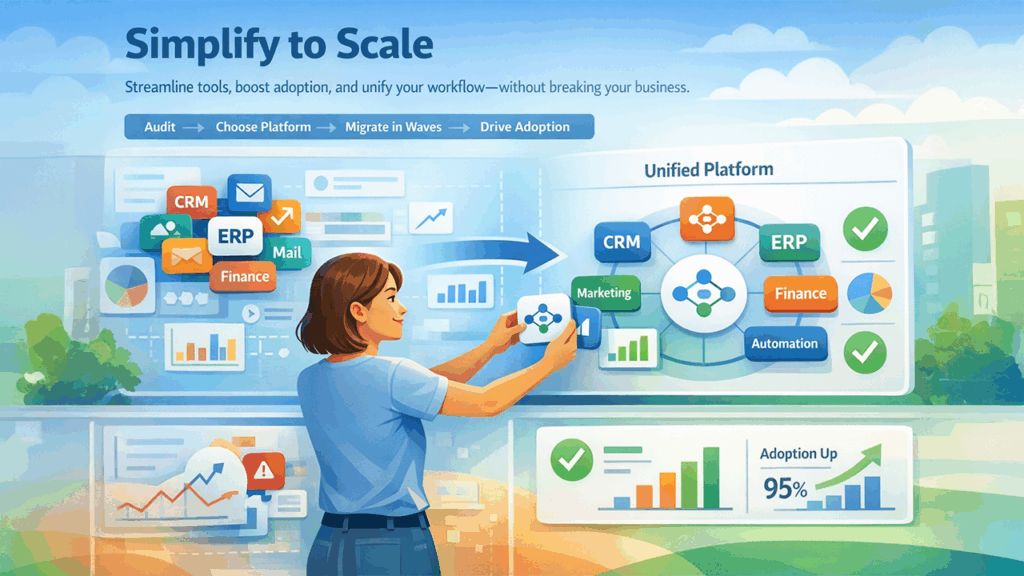
Ripping out five tools and replacing them overnight is a recipe for disaster. The companies that pull off consolidation successfully follow a phased approach.
Phase 1: Audit ruthlessly. Before touching any technology, map every tool your organization uses, who uses it, what data it holds, and what would break if it disappeared tomorrow. You'll likely find tools with overlapping capabilities, tools that fewer than 10% of licensed users actually open, and tools that exist solely because one department didn't know another tool could do the same thing. Software Advice research found that 43% of businesses with CRM tools use less than half of their system's features. There's a good chance you're already paying for capabilities you haven't turned on.
Phase 2: Pick your consolidation spine. This is the platform everything else will connect to or be replaced by. For most mid-market and enterprise companies, this ends up being a CRM-ERP hybrid. The decision should be based on three factors:
- What does your team already use daily? If your company runs on Microsoft 365 (Outlook, Teams, Excel), a platform that integrates natively with that ecosystem eliminates a massive adoption hurdle.
- How modular is the platform? You need the ability to start with core functions (sales + finance, for example) and add marketing, service, and operations modules over time without rearchitecting.
- What does the implementation partner ecosystem look like? A platform is only as good as the people who configure it for your specific workflows.
Phase 3: Migrate in waves, not all at once. Start with the function that has the most pain and the most executive sponsorship. For many companies, that's sales-to-finance connectivity: getting pipeline, quoting, invoicing, and revenue recognition into one system. Once that's stable and adopted, layer in marketing automation. Then service. Then field operations.
Phase 4: Measure adoption, not just deployment. Here's where most consolidation projects go sideways. The system is live, the data is migrated, and leadership declares victory. But three months later, half the sales team is still using their old spreadsheets. Forrester Research found that 49% of all CRM projects fail, and 22% of reported problems tie directly back to people and user adoption, not technology. Track login frequency, feature usage, and data quality weekly for the first six months. If adoption is slipping, find out why before it becomes permanent.
The Risks of Getting It Wrong (and How to Avoid Them)
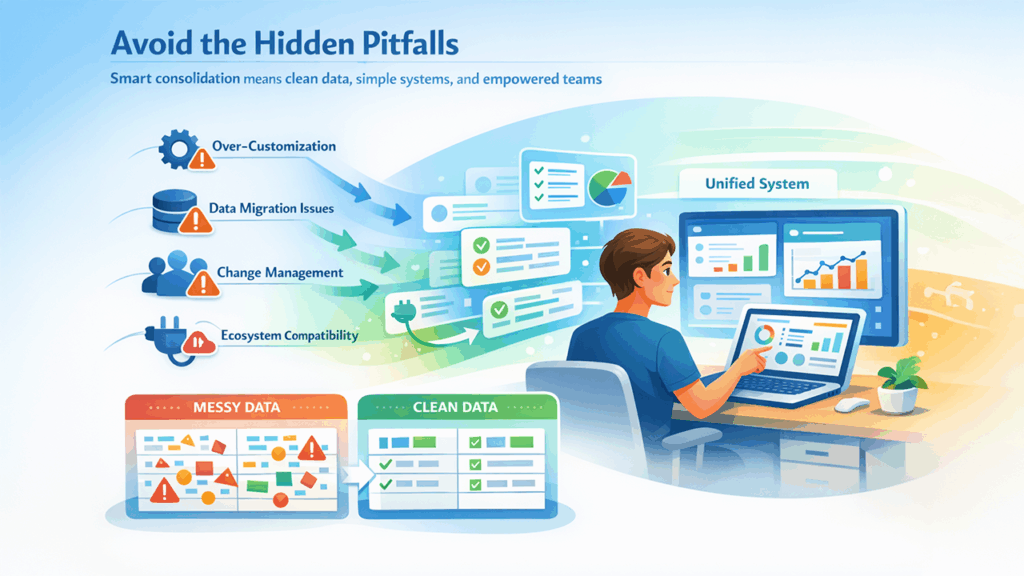
Consolidation isn't risk-free. The biggest traps to watch for:
- Over-customization. The temptation is to rebuild every quirky workflow from your old tools inside the new platform. Resist this. Every customization adds maintenance cost and makes upgrades harder. Start with out-of-the-box capabilities and only customize where there's a clear, documented business need.
- Data migration shortcuts. Moving dirty data into a clean system just gives you a clean system full of dirty data. Invest in data cleansing before migration, not after. One survey found that 76% of CRM users say less than half of their organization's CRM data is accurate and complete. Don't carry that problem forward.
- Ignoring change management. Technology changes are really people changes. If your sales reps don't understand why the new system helps them sell more (not just why it helps management report better), they won't use it. Training should focus on individual productivity gains, not corporate strategy.
- Choosing a platform without an ecosystem. A unified platform still needs to connect with specialized tools you'll keep (industry-specific software, niche analytics, etc.). Make sure the platform has robust APIs and an active partner network before committing.
What This Trend Means for Your Business in 2026
The consolidation wave isn't slowing down. BetterCloud's data shows average SaaS app count dropped from 130 in 2022 to 106 in 2024, and economic pressure is accelerating the trend. Hostinger's 2026 analysis found that 42% of organizations have already cut SaaS budgets due to economic uncertainty. When budgets tighten, redundant tools are the first casualties.
Gartner's CRM sales software market analysis tells the same story from the vendor side. The market grew 12.2% to $25.7 billion in 2024, driven largely by functional expansion, meaning platforms are getting broader, not just bigger. CRM isn't just eating other categories' lunch; it's absorbing their entire menu.
For sales leaders and CRM managers reading this, the practical takeaway is straightforward. The question isn't whether to consolidate, it's how fast and how thoughtfully you can do it. Companies that get their data, teams, and processes onto a unified platform will make decisions faster, serve customers better, and spend less on technology overhead. Companies that keep bolting on standalone tools will keep paying the tool sprawl tax.
Three actions worth taking this quarter:
- Run a SaaS audit. Count your tools, their costs, their overlap, and their actual usage rates. The number will probably surprise you.
- Identify your highest-pain integration. Where does data most frequently fall through the cracks between systems? That's your starting point for consolidation.
- Talk to your CRM vendor about what you're not using. Most modern CRM platforms already include features you're paying for separately elsewhere. Turning them on is often cheaper and faster than maintaining a standalone tool.
The connected business isn't a buzzword. It's a company where every team works from the same data, every customer interaction builds on the last one, and every dollar spent on technology actually earns its keep. The tools to build that company already exist. The only question is whether you'll do it now, while it's a competitive advantage, or later, when it's table stakes.
%201.png)

%201.png)

%201.png)