
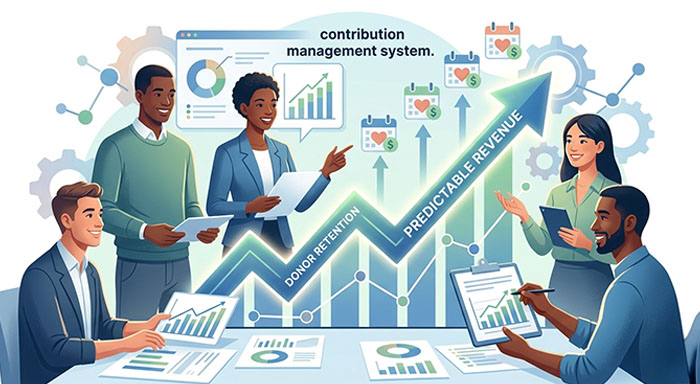

Recurring contributions are no longer a secondary fundraising channel. They are becoming a core revenue stream for nonprofit and community organizations.
The data is clear. Recurring donor bases have grown significantly in recent years, with some organisations increasing their recurring donors by over 120% in a four-year period. At the same time, retention rates for recurring contributors are dramatically higher, reaching 70–90% compared to much lower rates for one-time donors.
This shift changes how organisations need to manage contributions.
Recurring giving is not just about enabling monthly payments. It is about building a system that supports long-term engagement, predictable revenue, and operational consistency.
Structure Contributions Around Predictability
The primary advantage of recurring contributions is predictability.
Unlike one-time donations, recurring payments create a consistent inflow of funds. This allows organisations to plan budgets, allocate resources, and commit to longer-term initiatives with more confidence.
However, predictability depends on how contribution options are structured.
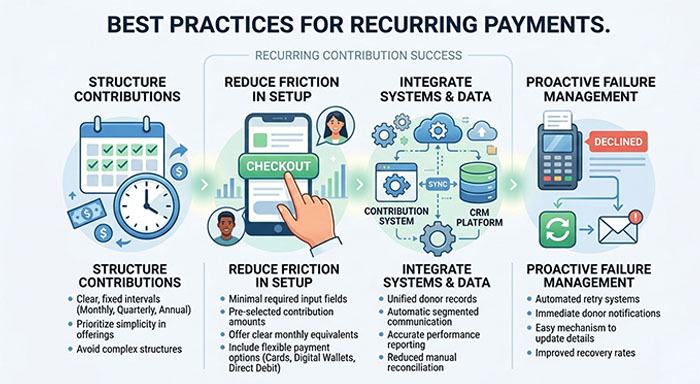
Organisations that offer clear, fixed intervals, typically monthly, quarterly, and annual, tend to perform better. Monthly giving dominates, accounting for the majority of recurring contributions in most programs.
The key is simplicity.
Donors should be able to understand exactly what they are committing to, how often they will be charged, and how to manage their contribution. Complex structures reduce conversion rates and increase drop-off.
Prioritise Retention Over Acquisition
Most organisations focus heavily on acquiring new donors. The data suggests this is inefficient without retention.
Average donor retention rates remain low across the sector, with many organisations retaining less than half of their donors year over year.
Recurring contributors change this dynamic.
Once a donor commits to a recurring contribution, they are significantly more likely to continue giving over time. In some cases, recurring donors remain active for over eight years on average, creating far higher lifetime value than one-time contributors.
This means operational focus should shift.
Instead of treating recurring contributions as an add-on, organisations should:
- Convert existing donors into recurring contributors
- Build onboarding processes specifically for recurring donors
- Track retention metrics as a primary performance indicator
Retention is not a communication issue alone. It is a system issue.
Reduce Friction in Contribution Setup
Recurring contributions depend on ease of setup.
Most recurring donors sign up through digital channels, often immediately after an event, campaign, or communication.
If the process is complex, conversion rates drop.
Best-performing systems minimise friction by:
- Offering pre-selected contribution amounts
- Providing clear monthly equivalents for larger annual amounts
- Enabling one-step sign-up with minimal required input
Payment methods also matter.
Card payments dominate, but digital wallets and direct debit options are increasingly important. The more flexible the system, the higher the conversion rate.
Align Contribution Models With Donor Behaviour
Recurring giving is closely linked to broader consumer behaviour. Subscription models have become standard across industries. Donors are now familiar with committing to regular payments for services and content.
Nonprofits are increasingly adopting similar structures.
This includes:
- Framing contributions as ongoing support rather than one-time transactions
- Offering tiered contribution levels with clear value or impact
- Providing updates tied to the donor’s recurring commitment
Data shows that a significant portion of online revenue now comes from recurring contributions, in some cases approaching one-third of total online giving.
This is not a niche model. It is becoming standard.
Integrate Contribution Systems With CRM Platforms
Recurring contributions generate ongoing data.
Each payment is part of a larger relationship, not a standalone transaction. Without integration, this data becomes fragmented. Best practice is to connect contribution systems directly to CRM platforms. Similar integration models are widely used in SaaS eCommerce Platforms, where payment data, customer behavior, and CRM systems are connected for better tracking and decision-making.
This allows organisations to:
- Track contribution history over time
- Identify patterns in donor behaviour
- Segment contributors based on engagement and value
- Trigger communication automatically based on activity
Payment processing and integration also improves reporting accuracy.
Financial data, donor records, and campaign performance become aligned, reducing manual reconciliation and improving decision-making.
Monitor Key Metrics Beyond Revenue
Recurring contribution programs should not be measured by revenue alone.
Key performance indicators include:
- Retention rate of recurring donors
- Average contribution value over time
- Lifetime value of recurring contributors
- Conversion rate from one-time to recurring giving
For example, while recurring donors may give less per transaction, their long-term value is significantly higher due to retention.
Tracking these metrics allows organisations to optimise programs continuously.
Without measurement, recurring programs become static and underperform.
Manage Payment Failures Proactively
Recurring contributions introduce a specific operational risk, payment failure.
Expired cards, insufficient funds, and technical issues can disrupt recurring payments.
If not managed, this leads to silent donor loss.
Best practices include:
- Automated retry systems for failed payments
- Notifications to donors when payments fail
- Easy update mechanisms for payment details
Even small improvements in recovery rates can have a significant impact on total revenue over time.
Build Communication Around Contribution Cycles
Recurring contributors expect ongoing engagement.
Unlike one-time donors, they have an ongoing relationship with the organisation.
Communication should reflect this.
This includes:
- Regular updates on how contributions are being used
- Periodic impact reporting
- Acknowledgement of milestones, such as one-year contributions
Data shows that recurring donors are more likely to make additional contributions beyond their scheduled payments.
This only happens when engagement is maintained.
Conclusion
Recurring payments and contributions are reshaping how nonprofit and community organisations manage funding.
They provide stability, increase lifetime value, and reduce reliance on constant donor acquisition. At the same time, they introduce new operational requirements around systems, data, and retention.
The difference between underperforming and high-performing programs is not the idea of recurring giving.
It is execution.
Organisations that treat recurring contributions as a structured system, integrated, measured, and continuously optimised, are the ones that achieve long-term growth.
%201.png)

%201.png)

%201.png)