
AI adoption at the enterprise level is no longer a question of access. It is a question of structure.
Large organisations already run complex systems, ERP, CRM, data warehouses, and layered workflows across departments. Introducing AI into the enterprise environment does not mean adding another tool. It means integrating intelligence into systems that already operate at scale.
This is where most AI in enterprise operations initiatives fail.
They remain isolated. Pilots run in single departments. Outputs are not integrated into core systems. As a result, AI does not affect how the organisation actually operates.
Enterprise adoption requires a different approach. Frameworks such as those outlined by Larridin emphasise governance, system-level integration, and visibility across teams. The goal is not experimentation, but controlled deployment across business-critical functions.
AI becomes part of operations only when it is embedded into workflows, not layered on top of them.
Sales — AI SDRs as an Enterprise Execution Layer
In enterprise sales, pipeline generation is constrained by execution capacity, not strategy.
Outbound teams operate across large datasets, multiple markets, and complex segmentation models. Scaling this traditionally requires an increasing headcount.
AI SDRs introduces a structural shift by transforming this structure.
Pipeline generation is no longer limited to teams; rather, it has become system driven. The performance is quantified, outreach is standardized, and execution has become continuous. There are other enterprise-focused solutions that extend this model.
AI SDR automates outbound workflows across channels. It handles research, messaging, and follow-ups within a campaign structure that is predefined. At scale, the impact is not incremental.
With this, organizations can increase outreach volume. They can also maintain consistency across regions. This also helps organizations minimize the dependency on manual prospecting without having to expand teams.
Finance — Automating High-Volume Transaction Workflows
Functions of enterprise finance process large volumes of transactions across multiple systems.
There is an operational load because of manual reconciliation, handling invoices, and reporting. And this load only grows with increasing business sizes. That's why AI systems are now being integrated into these workflows so as to minimize the load.
Reconciliation processes are automated through pattern recognition and matching transactions across systems. They can easily recognize unusual activities in real time. Document recognition and automated validation handle the invoice processing.
Forecasting has also evolved. To produce dynamic financial projections, AI models analyze previous data, operational inputs, and all external variables. Large datasets are a critical requirement for AI models to give accurate results. This also enables finance teams to move from reporting to planning.
The key benefit at the enterprise scale is consistency. Processes that were previously dependent on manual review become standardised and repeatable.
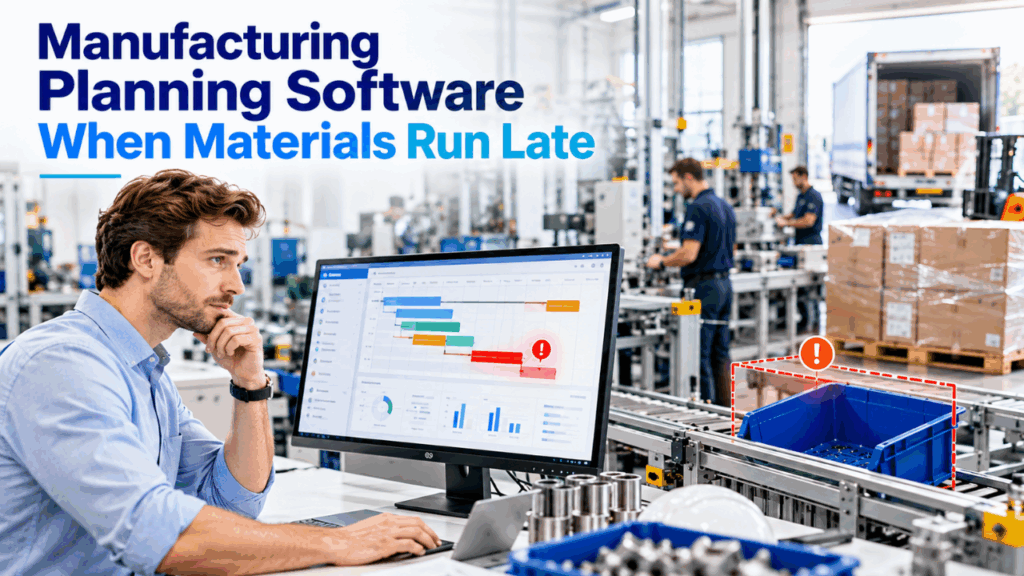
Supply Chain — Predictive Systems Across Distributed Networks
Enterprise supply chains operate across multiple locations, suppliers, and transport networks. This complexity creates exposure to disruption.
AI is being deployed to reduce that exposure through predictive planning. Systems analyse demand patterns, supplier reliability, and logistics data to forecast inventory needs and identify risks before they occur.
This allows enterprises to:
- Adjust procurement based on predicted demand
- Optimise inventory across multiple locations
- Improve delivery performance through route optimisation
AI is also integrated into physical operations.
Warehouse automation, robotics, and sorting systems use AI to increase throughput while reducing space requirements and manual handling.
At enterprise scale, this is not about efficiency alone.
It is about maintaining operational continuity across large, distributed systems.
HR — Workforce Optimisation Across Large Organisations
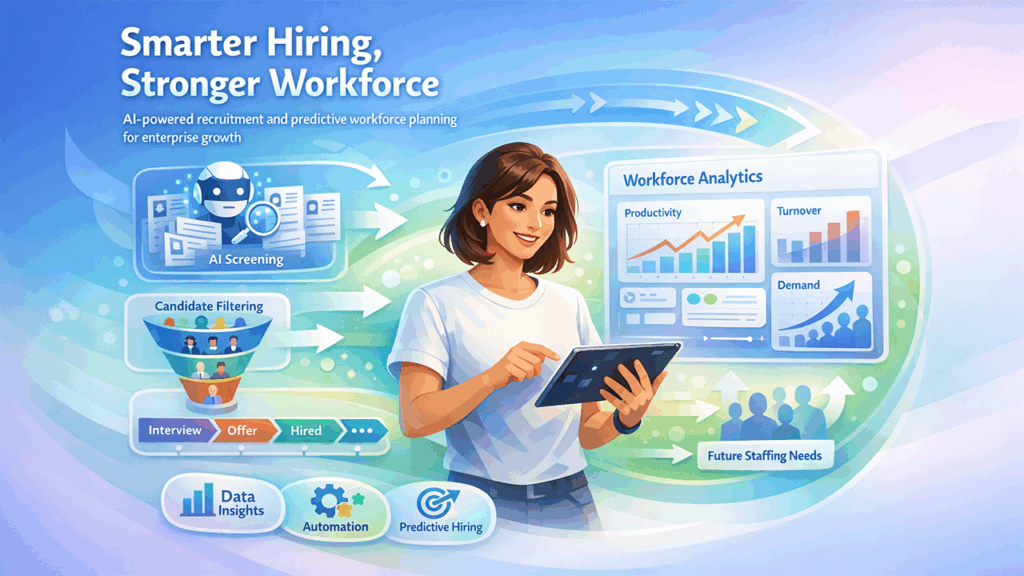
Enterprise HR functions manage complex workforce structures, often across regions and business units.
Organizations use AI to streamline recruitment and strategize the workforce.
Candidate screening is automated through systems that analyse qualifications, experience, and role requirements. This reduces time-to-hire and ensures consistency across large recruitment volumes.
Workforce planning is increasingly data-driven.
AI analyses productivity metrics, turnover rates, and operational demand to predict staffing needs. This allows enterprises to align workforce capacity with business activity.
The impact is structural.
Instead of reactive hiring, organisations operate with predictive workforce models.
Customer Operations — Scaling Support Without Linear Growth
In enterprises, customer operations involve high volumes of interactions across various channels. To manage this volume effectively, Enterprise AI is integrated into workflows.
They handle initial triage, classify requests, and resolve standard queries automatically. If cases are too complex to resolve by AI systems, they are forwarded to human agents with attached context to resolve them successfully.
This reduces response times and improves consistency. More importantly, it changes scaling.
Support capacity no longer grows linearly with demand. AI absorbs a significant portion of interaction volume, allowing teams to focus on high-value cases.
Data and Analytics — From Reporting to Continuous Insight
Enterprise organizations generate large amounts of data across systems. Traditionally, this data is used for periodic reporting. AI changes this by enabling continuous analysis.
Systems monitor data streams in real time, identify trends, and surface insights as they emerge. This reduces the delay between data collection and decision-making.
In some cases, AI in enterprise operations also trigger actions automatically based on predefined conditions. This moves analytics from passive reporting to active operational input.
Governance — The Core Requirement for Enterprise AI
At enterprise scale, AI implementation introduces risk. Data privacy, compliance, and system reliability become critical considerations. This is why governance is central to enterprise AI adoption.
Organizations need:
- Clear policies on how AI is used across departments
- Control over data access and processing
- Visibility into AI-driven decisions and outputs
Without governance, AI adoption remains fragmented and difficult to scale. With it, AI becomes a controlled part of the operational system.
Where AI Delivers Measurable Impact
AI in enterprise operations deliver value when applied to processes that meet specific conditions.
These are typically processes that are high-volume, repetitive, and dependent on structured data.
Examples include:
- Sales outreach at scale
- Financial transaction processing
- Supply chain planning
- Customer support operations
AI reduces cost, increases speed, and improves consistency in these areas. AI acts as a supporting tool when processes are less structured or complex.
Conclusion
AI in enterprise operations isn’t about adopting new technology. It is about integrating intelligence into existing systems and workflows. The organisations that achieve this do not treat AI as a separate initiative.
They embed it into core operations, align it with governance frameworks, and scale it across departments where it produces measurable impact.
This is what turns AI from a tool into infrastructure.
%201.png)

%201.png)

%201.png)