
Data is growing at an incredibly faster rate, making it difficult for organizations to manage it. As per IDC’s “Data Age 2025” report, the global sphere of data was expected to reach 175 zettabytes by 2025, growing at a compound annual rate of 61% from 33 zettabytes in 2018.
Organizations are struggling enough with scattered data environments. This makes it even harder for them to make informed, data-driven decisions.
This leads to gaps in compliance, poor data quality, and inefficient pipelines that induce financial loss of about millions every year.
This is where tools like data catalog and metadata management become essential. These advanced platforms provide organizations with a clear, structured way to discover, govern, document, and trust their data assets.
Integrating the right tools into business operations has become a competitive necessity. No matter if your team is struggling with fragmented data pools, multi-cloud environments, or the increasing demands of AI-powered workflows, data catalog and metadata management tools are no longer an option.
This listicle guide explores the 6 best data catalog and metadata management tools of 2026, beginning with the category leader to help you find the tool that aligns with business goals and needs.
1. DataHub
Best for: Enterprise-scale metadata management with open-source flexibility and AI-readiness
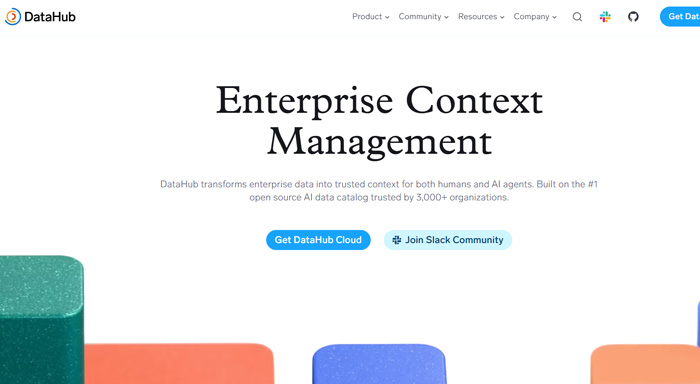
DataHub tops the list. It is an open-source AI data catalog tool, which is trusted by over 3,000 organizations worldwide, including Visa, Slack, Netflix, Airtel, and Deutsche Telekom.
It became publicly available in 2020 and since then it has grown to be an independent community project under Acryl Data. It was originally built at LinkedIn to handle metadata at hyperscale. DataHub is different from conventional data cataloging tools. It is built on a graph-based metadata architecture to deliver context management for humans and AI agents alike.
DataHub is available in two versions: DataHub Core (open-source, Apache 2.0-licensed) and DataHub Cloud (a fully managed enterprise offering). This makes it accessible to teams at every stage of their data maturity journey.
Key Capabilities
- Data Discovery: With this, teams and AI agents can locate accurate data 10 times faster using smart search, business context, and rich metadata.
- Data Observability: It also offers continuous monitoring and frequent quality checks to identify failures in pipeline and unusual data before they become worse and hinders decision-making.
- Data Governance: Enforces policy automatically across all data assets. This eliminates the need for manual compliance overhead.
- Broad Integrations: 80+ production-grade connectors with native support for Snowflake, dbt, Spark, Kafka, Redshift, BigQuery, Looker, Airflow, Databricks, and more.
- Data Lineage: End-to-end, column-level lineage that maps data origins, transformations, and downstream dependencies across the entire data stack.
- AI Data Management: It delivers trusted, governed context to AI agents and LLMs. For teams building or scaling governed data for AI workflows, DataHub's dedicated AI layer makes it uniquely positioned for the agentic AI era.
Use Cases
- Scaling metadata management across large, distributed data engineering teams
- Enabling self-serve data discovery for analysts and business users
- Powering AI agents with reliable, governed data context
- Debugging data quality issues and metric discrepancies in half the time using lineage + AI chat
- Meeting GDPR and data privacy compliance requirements at enterprise scale
Slack collapsed six years of metadata complexity into just three days of progress with DataHub, unlocking extensible discovery, lineage, and governance across teams.
Airtel scaled data governance and discovery across 30+ petabytes and 10,000+ jobs with DataHub as its metadata management backbone.
2. Collibra
Ideal for: Compliance-heavy enterprises that are looking for robust data stewardship.
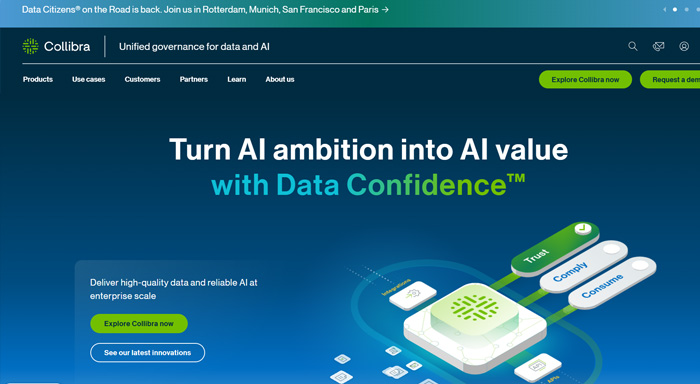
Among the most widely adopted data governance platforms, Collibra makes it to top 6. It strongly focuses on compliance management, policy enforcement, and data stewardship.
It offers a unified and centralized platform to manage data assets along with advanced workflow automation capabilities. It keeps getting recognition in the Gartner Magic Quadrant for Metadata Management.
Key Capabilities
- Advanced metadata management and business glossary management
- Centralized policy management for regulatory compliance
- Automated data lineage tracking and reporting
- Role-based access controls for sensitive data management
Use Cases
- Streamlining data stewardship and governance workflows in regulated industries (banking, insurance, pharma)
- Supporting GDPR, CCPA, and HIPAA compliance initiatives
- Enabling self-service analytics through a governed data catalog
3. Atlan
Best for: Modern data teams on cloud-native stacks needing fast time-to-value
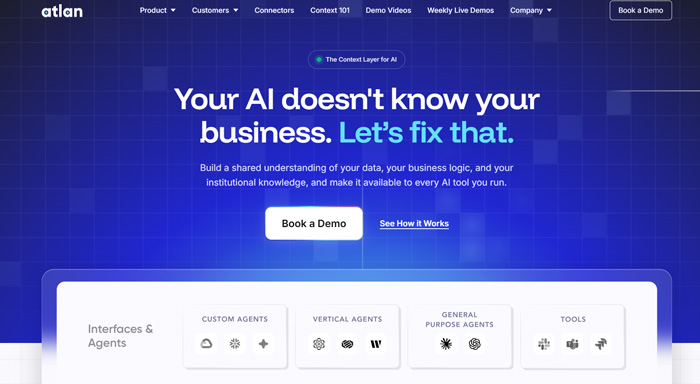
Atlan is a recognized leader in the 2026 Gartner Magic Quadrant for Data and Analytics Governance. It is a commercial and AI-native active metadata platform.
It positions itself as the "control plane" for modern data ecosystems, stitching together Snowflake, Databricks, dbt, Tableau, and 100+ certified connectors into a unified governance and discovery layer.
It drives fast adoption across both technical and business teams because of its developer-friendly, API-first architecture and intuitive interface.
Key Capabilities
- Self-service data discovery and cataloging with a workspace-style interface
- Active metadata monitoring that captures changes in near real-time
- Anomaly detection and AI-driven data quality monitoring
- Deep integrations with dbt, Airflow, Fivetran, Snowflake, and major cloud warehouses
- Policy management with centralized access controls
Use Cases
- Building a collaborative data catalog across analytics and engineering teams
- Automating metadata management for faster data discovery on modern stacks
- Improving GDPR compliance for sensitive customer data
4. Alation
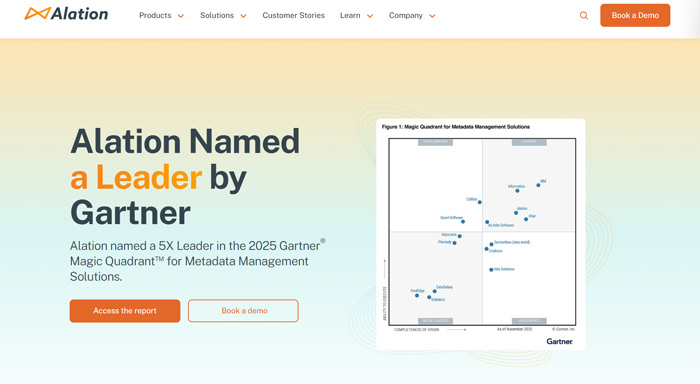
Best for: Enterprises where analyst adoption and behavioral intelligence drive catalog ROI
Alation pioneered the modern data catalog, launching the first commercial data catalog product in 2015 after its founding in 2012.
Its signature Behavioral Analysis Engine tracks which datasets analysts actually use and automatically surfaces trusted assets.
This differentiating capability has made it a preferred choice for organizations where business user adoption is the primary metric for catalog success.
Key Capabilities
- Behavioral Analysis Engine that tracks real data usage to surface trusted, high-quality assets automatically
- Centralized policy management and business glossary standardization
- Strong SQL query analysis and composition features for analyst workflows
- Automated data stewardship and classification workflows
Use Cases
- Policy enforcement through centralized governance controls
- Ensuring consistent metadata definitions across large data teams
- Improving cross-functional collaboration between data producers and consumers
5. Microsoft Purview
Best for: Organizations already invested in the Microsoft Azure ecosystem
Microsoft Purview is an integrated data governance solution that provides visibility and control across on-premises, multi-cloud, and SaaS data environments.
For those organizations that are already operating within the Microsoft stack, Purview offers seamless integration with Azure Data Factory, Power BI, SQL Server, and other Microsoft products. This makes it an ideal fit for Azure-first data strategies.
Key Capabilities
- Unified data governance with a centralized view across hybrid environments
- Automated data discovery, classification, and lineage tracking
- Built-in compliance management through risk and policy controls
- Deep native integration with Microsoft Azure and the broader M365 ecosystem
Use Cases
- Ensuring data privacy and security across cloud and on-premises environments
- Supporting regulatory compliance efforts such as GDPR by managing access and auditing sensitive data
- Improving data transparency with detailed lineage and metadata management for teams already on Azure
6. Informatica Intelligent Data Management Cloud (IDMC)
Best for: Large enterprises managing complex, multi-domain data landscapes
Informatica, now operating as Informatica from Salesforce following Salesforce's approximately $8 billion acquisition completed in 2025, remains one of the most comprehensive enterprise platforms for data quality, governance, and integration.
Its AI engine, CLAIRE (Cloud-scale AI-powered Real-time Intelligence Engine), automates metadata discovery, quality assessment, and pipeline management across complex IT landscapes.
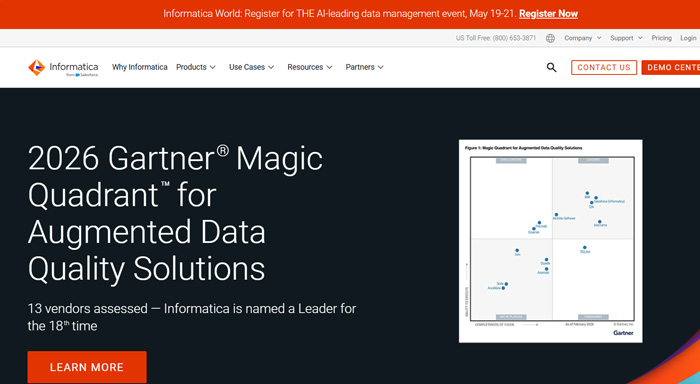
Informatica has been recognized as a Leader in the Gartner Magic Quadrant for Augmented Data Quality Solutions for 18 consecutive times.
Key Capabilities
- Comprehensive data catalog and discovery features powered by the CLAIRE AI engine
- Data quality monitoring and anomaly detection at scale
- Integrated metadata management across multiple business domains
- Master Data Management (MDM) capabilities for enterprise data unification
- Broad connectivity across AWS, Microsoft Azure, Google Cloud, Snowflake, Databricks, and Oracle Cloud
Use Cases
- Supporting analytics and data science initiatives with clean, governed data
- Managing sensitive data governance for compliance requirements
- Governing master data across multiple business domains in manufacturing, healthcare, and finance
How to Choose the Right Tool for Your Organization
With so many capable platforms available, the right choice ultimately comes down to a few key factors:
Scale and complexity: Consider these questions before committing to any tool. How much data does your organization manage, and how distributed is your infrastructure? Platforms such as DataHub and Informatica are designed to handle petabyte-scale environments, while tools like Apache Atlas are a better choice for specific big data stacks.
Ecosystem fit: Teams on Azure will find Microsoft Purview a natural choice. Organizations running modern cloud stacks on Snowflake and dbt will achieve the fastest time-to-value with Atlan.
Organizations running open-source data stacks will benefit most from DataHub or Apache Atlas.
AI-readiness: Choosing a platform that provides trusted, governed context for AI agents is essential especially if your team is planning or building AI-powered workflows. DataHub's dedicated AI data management layer makes it uniquely suited for this emerging requirement.
Open source vs. managed: DataHub and Apache Atlas are the two most prominent open-source options, offering significant flexibility and community support. Collibra, Atlan, Alation, Microsoft Purview, and Informatica IDMC operate on commercial licensing models.
Collaboration and self-service: If enabling business users alongside data engineers is a priority, Atlan and Alation offer some of the most intuitive interfaces in the space.
Final Thoughts
Data catalog and metadata management tools are not just niche utilities, rather they have evolved into mission-critical infrastructure.
As enterprises keep adopting stricter data regulation, AI initiatives, and increasingly complex data ecosystems, it has become necessary to have a platform that brings discover, governance, lineage, and observability together under one roof.
DataHub is the leader of this pack in 2026. It isn’t only because it’s open-source or has a higher adoption rate, but because it has uniquely positioned itself at the intersection of data governance and AI context management. This combination is quickly becoming the defining challenge for modern data teams.
No matter if you’re just starting out your business, building your first data stack or an enterprise that manages terabytes of mission-critical data, if you invest in the right metadata management tool now it will pay dividends in data trust, operational efficiency, and AI readiness for years to come.
%201.png)

%201.png)

%201.png)