

Most marketing teams celebrate when leads come in because it feels like the campaigns are working. But there is a question that does not get asked enough: what did each one of those leads actually cost?
This is where cost per lead becomes one of the most telling numbers in your entire marketing operation. It does not just tell you how much you spent; it tells you how efficiently you spent it. In a world where marketing budgets are under constant scrutiny, efficiency is everything. The businesses that grow consistently are not always the ones spending the most. They are the ones who know exactly what they are paying for every lead, why that number looks the way it does, and what levers to pull when it needs to change.
What is Cost Per Lead (CPL)?
Cost per lead (CPL) refers to a marketing metric that measures how much it costs a business to acquire a single potential customer. A potential customer is someone who has shown interest in your product or service by taking some action such as signing up for a newsletter, filling out a form, requesting a demo, or making an enquiry.
Unlike vanity metrics such as impressions or clicks, cost per lead tells you whether your marketing investment is generating real interest from real people and at what price. It is directly tied to business outcomes. Cost per lead assesses the efficiency of marketing campaigns and determines the budget that is required to generate a predictable volume of leads.
Cost Per Lead Formula (CPL Calculation)
Cost Per Lead = Total Marketing Spend ÷ Total Number of Leads Generated
Let's understand with an example: Suppose your business spent $5,000 on a paid advertising campaign. After some time, it generated 250 leads, so your cost per lead value would be $20.
How to Calculate Cost Per Lead
The formula for cost per lead is simple, however, to apply it correctly needs clarity on two things: what is considered as marketing spend and what qualifies as a lead.
Things to include in total marketing spend:
- Ap spend across all platforms such as Google, LinkedIn, Meta etc.
- Agency or freelancer fees
- Costs for content creation (design, video production, copywriting)
- Subscription for tools and software used for the campaign
- Any event or sponsorship costs tied to lead generation
Now, what qualifies as a lead depends on the definition of your business. A lead is someone who has expressed their interest in what you offer and provided their contact information willingly. If you count every website visitor or social media follower as a lead, it will distort your CPL and make your campaigns appear more efficient than they actually are.
Once both figures are clearly defined, the calculation becomes simple. Run it per campaign, per channel, and per time period to get a complete view of where your budget is producing results or where it is not.
What Is a Good Cost Per Lead?

Cost per lead benchmarks vary significantly by industry, channel, business model, and average deal size. A CPL that looks bad in one industry might be perfectly healthy in another. A good cost per lead is one that is lower than your average revenue per customer.
For example, if your business earns $500 from each customer and your CPL is $450, it simply does not work.
The relationship between CPL and customer lifetime value (CLV) is what truly determines whether your number is acceptable. A high CPL is justified if it generates high-value customers and long-term relationships. On the other hand, a low CPL can be a problem if those leads never convert into paying customers.
Key Factors That Affect Your Cost Per Lead
Cost per lead does not exist in isolation. There are several factors that affect it and understanding them will help you identify problems and support smart decision-making.
- Industry and Competition: Industries such as finance, legal services, and enterprise software are highly competitive and tend to have higher CPLs because businesses are fighting for the same audience’s attention.
- Marketing Channel: Different channels carry different costs by nature. Paid searches are more expensive per lead than organic content marketing, but they deliver results faster.
- Target Audience: If your target audience is narrow and specific, it will cost more to reach them. For instance, niche B2B audiences are generally more expensive to target than broader consumer audiences.
- Ad Quality and Relevance: Platforms like Google and Meta reward relevant and high-quality ads with lower costs. An ad which is poorly written and has a weak landing page will cost more per lead than a well-optimized campaign. Businesses leverage smart CRM tools to build data-driven campaigns to produce more relevant ads, which directly improves ad quality scores and reduces cost per lead over time.
- Landing Page Conversion Rate: If your landing page converts 2% of visitors into leads, you will need significantly more traffic and spend to hit your lead targets.
- Offer Strength and Messaging: The strength of your offer directly affects how many people take action. A compelling lead magnet, free trial, or clear value proposition will generate more leads from the same budget.
Cost Per Lead by Channel (CPL Benchmarks by Marketing Channel)
Different marketing channels produce different CPL figures. Here is a general comparison to help benchmark performance across platforms.
| Marketing Channel | Average Cost Per Lead | Best For |
|---|---|---|
| Organic Search (SEO) | Low ($10-$30) | Long-term, sustainable lead generation |
| Email Marketing | Very Low ($5-$15) | Nurturing existing audience |
| Social Media (Organic) | Low ($10-$25) | Brand awareness and community building |
| Paid Search (Google Ads) | Medium-High ($40-$100+) | High intent, ready-to-buy audiences |
| Paid Social (Meta/LinkedIn) | Medium ($30-$80) | Targeted audience acquisition |
| LinkedIn Ads (B2B) | High ($75-$200+) | Senior decision makers in B2B markets |
| Webinars and Events | Medium ($35-$75) | Engaged, educated lead generation |
| Content Marketing | Low-Medium ($20-$50) | Authority building and inbound leads |
These figures vary depending on industry type, targeting, and quality of campaigns. The goal is not to chase the cheapest channel but to find channels that deliver leads that are most likely to convert into paying customers.
How to Reduce Cost Per Lead Without Losing Lead Quality
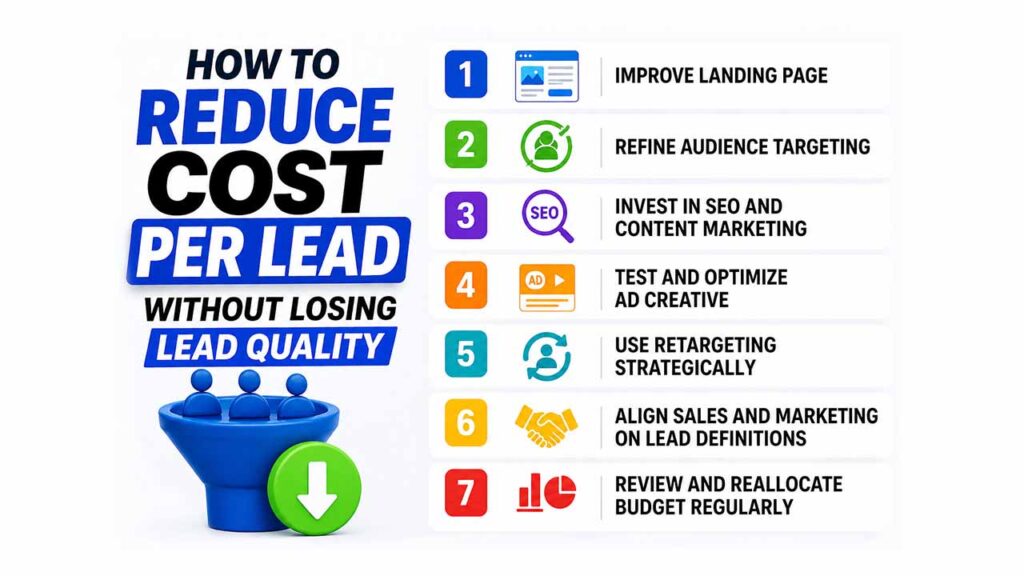
Reducing your CPL is a legitimate and worthwhile goal but only when it is done without compromising the quality of the leads coming in.
- Improve Landing Page: A higher conversion rate means more leads are coming from the same amount of traffic, which directly lowers your CPL. Test headlines, simplify forms, strengthen your call to action (CTA), and make sure the page delivers exactly what the ad promised.
- Refine Audience Targeting: When the audience is too broad, it wastes budget on people who will never convert. Narrow down your target audience to focus spend on the people who are most likely to become customers.
- Invest in SEO and Content Marketing: Organic channels have a higher upfront time investment. However, it generates leads at a significantly lower cost over time. A blog post or resource page that ranks well can deliver leads for months or years without requiring additional spend.
- Test and Optimize Ad Creative: Ad fatigue is a real concern. To keep your campaigns efficient, regularly refresh creative, test different angles, and remove underperforming ads. This keeps costs from creeping up.
- Use Retargeting Strategically: People who have already visited your website or engaged with your content are warmer leads. When you retarget them, it tends to produce lower CPLs and higher conversion rates in comparison to cold audience campaigns.
- Align Sales and Marketing on Lead Definitions: When both teams agree on what a qualified lead looks like, marketing stops optimizing for volume and starts optimizing for quality. Integrating CRM with marketing automation makes this alignment significantly easier, as both teams work from the same data, lead definitions, and the same pipeline visibility, which improves CPL efficiency over time.
- Review and Reallocate Budget Regularly: Not every channel will perform equally across every period. Review your CPL by channel monthly. It allows you to shift budget towards what is working and away from what is not.
Conclusion
Cost per lead is one of those metrics that looks simple on the surface but tells a much deeper story once you start paying attention to it. It tells you whether your marketing is working efficiently, your budget is being spent wisely, and whether the leads coming in are actually worth pursuing. The goal was never to generate the most leads or to generate the cheapest ones. The goal has always been to generate the right leads at a cost that makes sense.
Start by knowing your number and understanding what is driving it. From there, make small, deliberate improvements to your targeting, your creative, landing pages, and your channel mix. Over time, those improvements compound, and your marketing starts working harder without necessarily spending more.
FAQs About cost per lead
Q. What is the cost per lead in simple terms?
Cost per lead is the amount of money a business spends to acquire one potential customer who has expressed interest in its product or service.
Q. What is the difference between cost per lead and cost per acquisition?
Cost per lead measures the cost of getting someone to show interest. Cost per acquisition measures the cost of converting that person into a paying customer.
Q. Is a lower cost per lead always better?
Not necessarily. A low CPL only creates value if the leads being generated are genuinely interested and likely to convert.
Q. How often should I calculate cost per lead?
It is good practice to calculate CPL at the end of each campaign and on a monthly basis across all active channels. This allows you to recognize trends and make timely budget decisions.
Q. What industries have the highest cost per lead?
Industries such as financial services, legal, healthcare, and enterprise software see the highest CPLs due to intense competition, complex buyer journeys, and high customer lifetime values that justify the spend.
%201.png)

%201.png)

%201.png)