
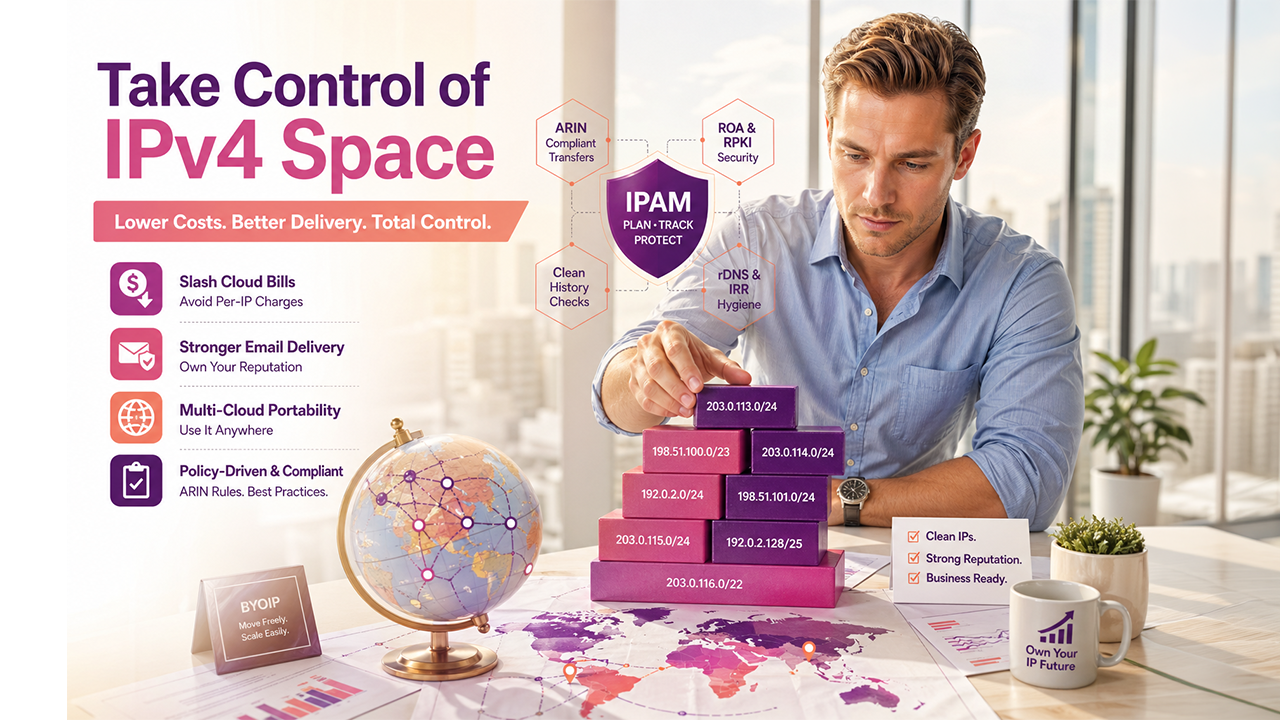

I watched our cloud bill jump by $3,600 in one quarter. The cause was not a traffic spike or a new service. AWS had started charging $0.005 per public IPv4 address per hour, and we had hundreds sitting idle across regions.
That same month, our marketing team opened a ticket because a transactional email was landing in spam. The shared pool from our provider had picked up someone else's bad reputation. Two different problems pointed to the same issue, we did not control our own address space.
That pushed me to learn how the transfer market, American Registry for Internet Numbers, or ARIN, rules, and ongoing operations really work. The learning curve was worth it, because clean IPv4 space affects cost, uptime, and deliverability at the same time.
Dedicated space can cut surprise fees, steady email delivery, and make provider moves less painful. It only pays off, though, when you acquire clean blocks and manage them with discipline.
Key Takeaways
Control pays off when you have enough volume, enough risk, or enough cloud spend to justify owning scarce space.
- Scarcity is permanent: The original IPv4 pool was exhausted on February 3, 2011. Transfers and leases now fill the gap, so treat addresses as strategic inventory.
- Costs are now visible: Major clouds bill for public IPv4, so owned or portable space can lower total cost at scale.
- Control beats dependence: Dedicated ranges improve reputation control and multi-cloud portability, but they still need warm-up and hygiene.
- U.S. buyers operate under ARIN rules: The minimum transfer size is a /24, recipients must plan to use at least 50% within 24 months, and resources are administered, not sold.
- History matters: Screen every block for abuse, blocklist hits, and stale routing records before you pay. Fix ROAs and reverse DNS right after transfer.
- IPAM is essential: Track utilization, blocklist health, ROA coverage, and provisioning speed in one system, not a spreadsheet.
What You Are Really Acquiring

You are securing registered usage rights to scarce number resources, not buying property.
IPv4 uses a 32-bit address space, which gives roughly 4.29 billion total addresses. IANA, the Internet Assigned Numbers Authority, exhausted its free pool on February 3, 2011, and RIPE NCC ran out of available IPv4 on November 25, 2019.
IPv6 adoption is growing. Google's statistics show worldwide IPv6 usage briefly hit 50% of users in March 2026. Even so, partners, inbox providers, and legacy integrations still need IPv4 reachability, so dual-stack remains the practical model.
ARIN's Number Resource Policy Manual makes the legal point clear. Resources are administered and transferred to a new legitimate holder under policy. Your contract should describe a transfer of rights and registration, not a property sale.
| Block Size | Total Addresses | Usable Hosts (approx.) |
| /24 | 256 | 254 |
| /23 | 512 | 510 |
| /22 | 1,024 | 1,022 |
Provider-independent, or PI, space moves with you across clouds and colocation sites. Provider-assigned space stays tied to one vendor. If portability matters, PI space is the right fit.
Three Business Outcomes You Get From Direct Control
Direct control improves delivery, portability, and cost planning in ways rented pools usually cannot.
Reliable Delivery for Email and APIs
Dedicated sending ranges give you sole control over sender reputation. Gmail expects email authentication records such as SPF, DKIM, and DMARC from serious senders. For bulk senders at 5,000 or more messages per day, it also expects DMARC, one-click unsubscribe for marketing mail, and spam complaint rates under 0.3%.
Keep transactional and marketing traffic on separate ranges. Warm new ranges over two to four weeks by starting with engaged recipients, capping daily volume, and watching bounces and complaints in Gmail Postmaster Tools.
Portability and Resilience Across Clouds
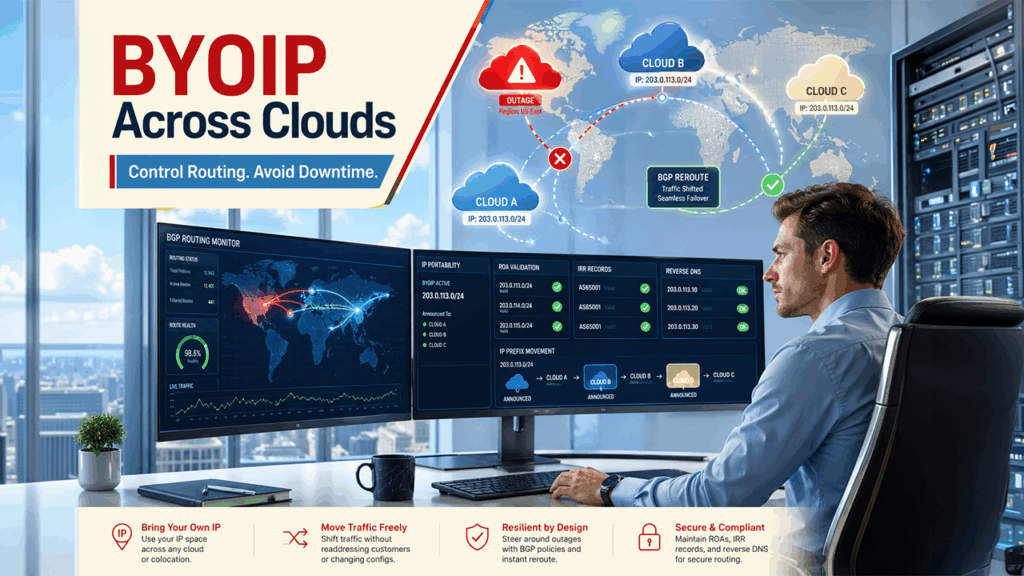
Direct space lets you use Bring Your Own IP, or BYOIP, across clouds and colocation sites. You can move traffic without readdressing customers and steer around outages with Border Gateway Protocol, or BGP, policies. Maintain Route Origin Authorizations, or ROAs, so invalid routes get filtered, and keep Internet Routing Registry, or IRR, records plus reverse DNS current.
Predictable Costs and Governance
Owning or long-term leasing lowers exposure to per-address cloud charges. With IP Address Management, or IPAM, you can forecast capacity, cap waste, and prove compliance in audits. Track cost per usable address per month, report utilization, and auto-expire lab reservations.
What to Check Before You Commit
A clean block and a clean transfer process matter more than a cheap price.
| Factor | Buy (Transfer) | Lease | Cloud-Assigned |
| Best for | Long-lived services, sustained email, multi-cloud | Seasonal peaks, short projects, bridging | Small footprints, bursty workloads |
| Portability | Full (PI space) | Varies by contract | None or limited |
| Indicative Cost | Under $20 per address for large blocks in the 2025 market | Monthly per-address fee | $0.005 per address per hour in AWS |
| Time to Value | Weeks, with ARIN review | Days to weeks | Minutes |
| Reputation Control | Full control of history | Shared risk with lessor | Shared pool risk |
Before signing, confirm the ownership chain in registry WHOIS, screen Spamhaus and other major blocklists, look for stale ROAs or IRR records, plan reverse DNS names, confirm ARIN 8.x readiness, and align escrow services with your go-live date.
Where to Source Clean Space
U.S. buyers usually use one of five paths, and each one trades speed for control.
Direct ARIN 8.3 Transfer Within Region
Get recipient pre-approval based on projected 24-month need. Negotiate terms with the seller, use escrow, and open an ARIN ticket. After approval, update ROAs, IRR records, and reverse DNS, or rDNS, before routing traffic in production.
Inter-RIR 8.4 Transfer Into ARIN
Use this path when the block starts in another registry region and both registries support compatible transfer rules. Coordinate dates across registries so your cutover stays clean and support teams know exactly when the change becomes active.
Cloud-Assigned Public Ranges
This is the fastest option, but it is not portable. Factor in hourly charges and the shared-pool reputation risk. It works best for pilots, temporary workloads, or a small number of public endpoints.
Leasing Marketplaces
Leasing helps with seasonal demand, short projects, or bridge capacity. Require clear service levels for reputation and routing control, and confirm you can publish ROAs and set rDNS under the lease terms.
Broker-Assisted Acquisition
If you want outside help with reputation screening, ARIN paperwork, and provisioning, Brander Group can help you secure clean IPv4 space with end-to-end support.
If you want outside help with reputation screening, seller verification, escrow coordination, and the timing of ARIN paperwork and provisioning, a broker can shorten the process and reduce the risk of inheriting dirty space or hitting avoidable delays. If you want a broker to pre-screen reputation, coordinate ARIN 8.3/8.4 steps, and expedite provisioning, Brander Group can help you buy clean space start here: buy IP addresses.
Run Your Space With a Practical IPAM Playbook
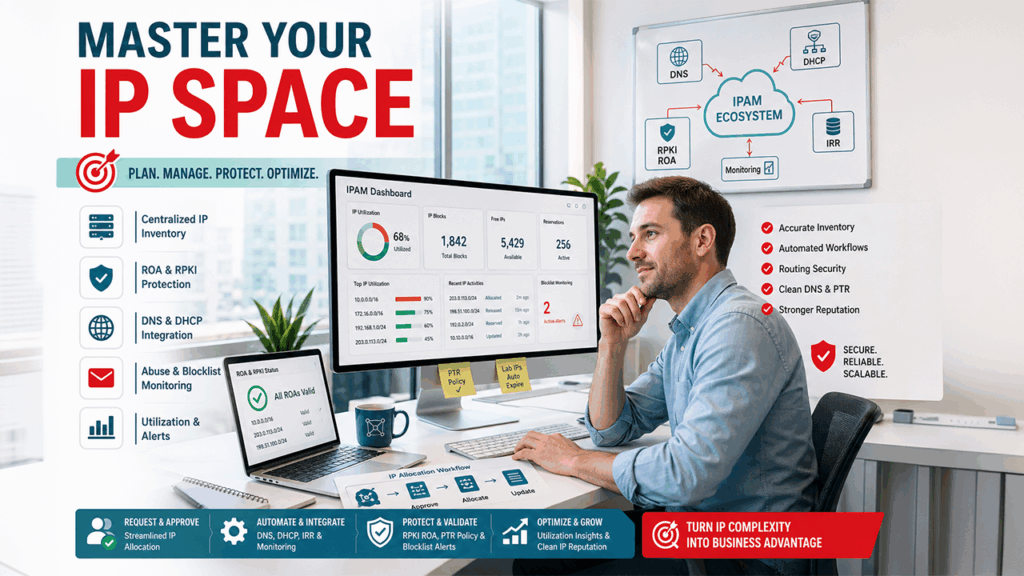
Strong IPAM turns a scarce asset into a controlled service instead of a pile of tickets.
Microsoft describes IPAM as an integrated suite for planning, deploying, managing, and monitoring address infrastructure. In practice, it should give you one authoritative inventory for every block, reservation, owner, and status.
For teams improving network oversight, IP visibility and VPS strategies can further strengthen monitoring, routing awareness, and infrastructure control. A spreadsheet breaks once multiple teams start provisioning at speed.
Automate the hygiene work. Set alerts for ROA creation and renewal, update IRR records after every prefix move, enforce a PTR, or pointer record, naming policy, and open tickets when a blocklist hit appears. Lab ranges should expire automatically so abandoned reservations return to the pool.
For sending ranges, use a written warm-up process over two to four weeks. Start with engaged recipients, cap daily sends, monitor bounces and complaint rates, and keep transactional and marketing traffic on separate ranges.
Harden routing by publishing ROAs through the Resource Public Key Infrastructure, or RPKI. NIST SP 1800-14 notes that RPKI-based Route Origin Validation helps stop accidental and some malicious BGP mis-originations. Keep your autonomous system number and contact objects accurate.
Scorecard for Management Efficiency
If you cannot measure utilization, reputation, and routing hygiene, you cannot improve them.
- Utilization: Percentage of assigned versus free capacity per block. A practical target for production pools is 70% to 85%.
- Reputation Health: Percentage of ranges clean on major blocklists, Gmail Postmaster reputation trend, and complaint rate under 0.3% for bulk programs.
- Routing Security: Percentage of prefixes with valid ROAs, number of invalid announcements detected, and time to resolution.
- Hygiene and Operations: Reverse DNS coverage, time to PTR after allocation, stale IRR count, and provisioning speed from request to usable range.
- Financial Impact: Effective cost per address per month across owned, leased, and cloud space, plus avoided spend from consolidation or BYOIP.
How to Win Internal Buy-In
Approval gets easier when each team sees a clear link between address control and business results.
For finance, show a 36-month cost curve and the cloud charges you avoid through BYOIP. For security, map ROA coverage and blocklist hygiene to risk reduction. For marketing and RevOps, show sender reputation trends and commit to a complaint-rate ceiling plus inbox placement targets.
Turn Scarcity Into an Advantage
Clean public space only creates leverage when procurement and operations stay disciplined.
Start with a realistic capacity plan, screen every block before money moves, and put routing, naming, and reputation checks into IPAM on day one. Teams that do this get lower costs, steadier delivery, and far less provider lock-in.
Frequently Asked Questions
Q1. Is It Legal to Acquire Public IPv4 Space in the U.S.?
You do not purchase property. You complete an ARIN-approved transfer of number resources that records you as the legitimate holder. Use escrow, follow NRPM Section 8.x, and document a credible 24-month need.
Q2. How Large Should a First Block Be for a SaaS Company?
A /24, or 256 addresses, is a common starting point when you need dedicated sending ranges and public services across more than one provider. Expand only after you can show real utilization and a clear growth path.
Q3. Why Not Move to IPv6 Only Today?
IPv6 adoption keeps rising, but partners, inbox providers, and legacy integrations still require IPv4 reachability. A dual-stack plan lets you expand IPv6 without breaking the systems that still depend on older addressing.
Q4. How Long Does an ARIN Transfer Usually Take?
Timing depends on paperwork quality, counterparty speed, and whether pre-approval is already in place. With clean documentation and a ready seller, the full process often lands within a few weeks, plus time for ROA, IRR, and reverse DNS updates before production.
%201.png)

%201.png)

%201.png)