

I sat in on an ERP vendor pitch last month. Smooth presenter, slick deck, big logos on slide 4. He promised a full retail chain rollout across 14 stores in five months. CFO looked impressed. I just sat there thinking, this guy is going to disappoint someone badly.
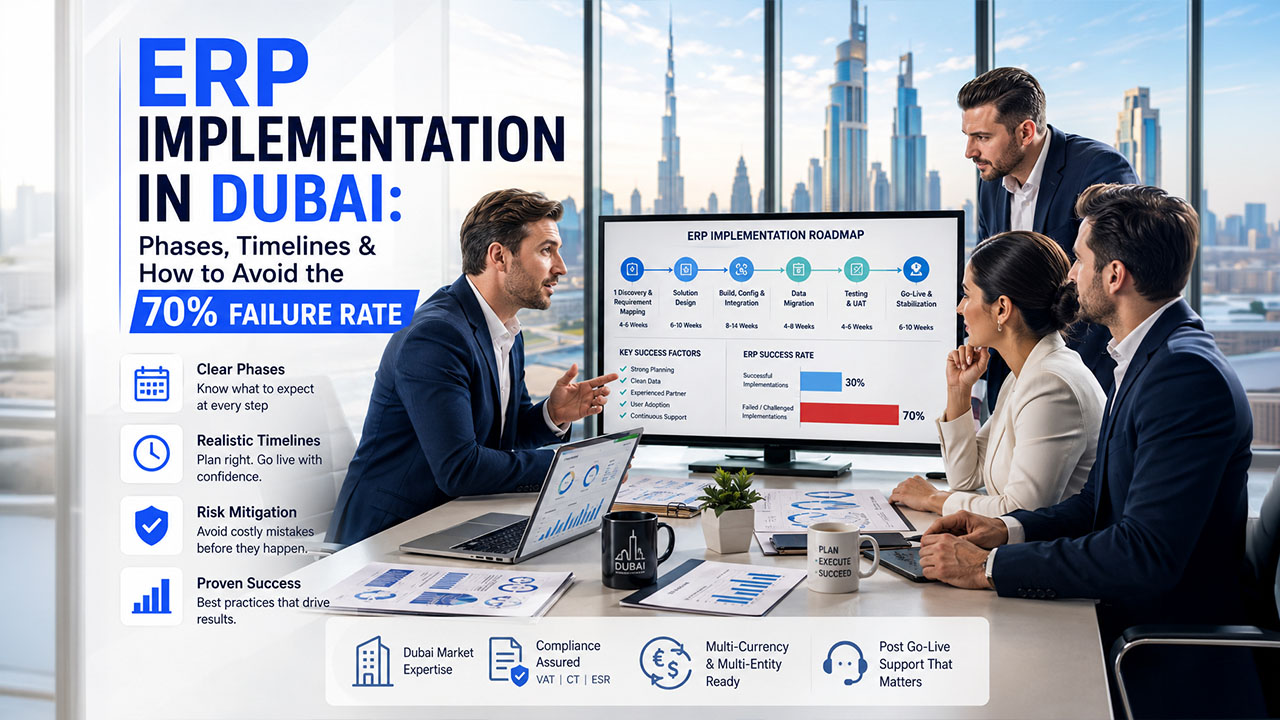
Here's the thing nobody likes to admit. Roughly 70 percent of ERP implementations in the region either blow past their timeline, blow past their budget, or fail outright. And it's almost never the software's fault. It's the implementation. Specifically, the conversation that happens before anyone signs anything… the one where everyone wants to believe the optimistic version.
So if you're a Dubai business about to sign an ERP contract, this is a different kind of guide. Red flags first. Phases second. Because spotting warning signs early is what saves you 9 to 12 months of pain later.
Red Flags You Should Walk Away FromRed Flags You Should Walk Away From
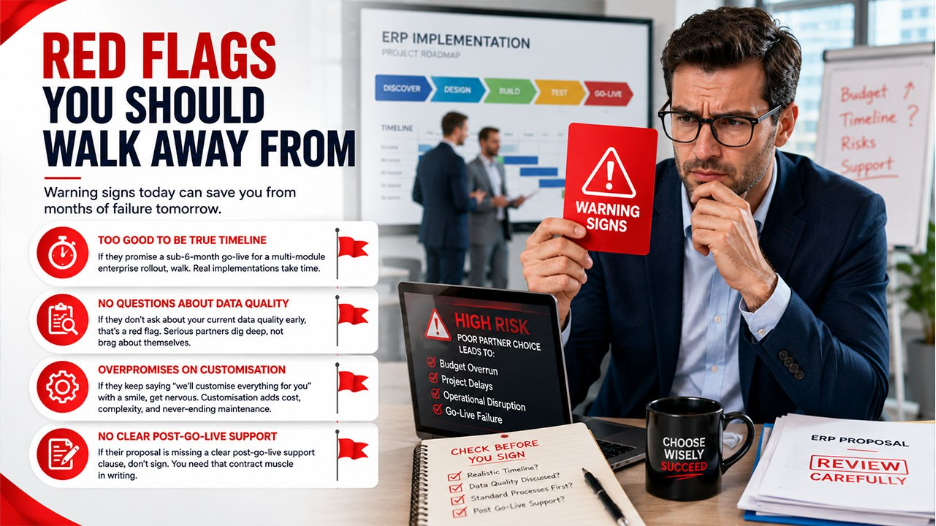
I'll start with the warning signs because nothing else matters if you've already picked the wrong partner.
If they promise a sub-6-month go-live for a multi-module enterprise rollout, walk. The math doesn't work. A real implementation needs time to discover, configure, migrate, and test. Anyone compressing that into a single quarter is either lying or planning to deliver something half-finished.
If they don't ask about your current data quality early, that's another flag. A serious partner spends the first hour of a pitch asking about your existing systems, your data hygiene, and your reporting pain points. Bad ones spend that hour on slide decks about themselves.
If they keep saying "we'll customise everything for you" with a smile, get nervous. Customisation is the silent project killer. Every custom workflow you bolt on adds maintenance debt forever. Good partners push back and tell you why standard processes work better.
And if their proposal is missing a clear post-go-live support clause, don't sign. Half the bugs you'll encounter only show up in week three of live operations. You need that contract muscle in writing.
How a Real Implementation Actually Unfolds
Once you've shortlisted partners who don't trip those red flags, here's what the work looks like in calendar terms.
Discovery and requirement mapping. Plan 4 to 6 weeks. Output should be a documented business process map, a gap analysis between the current state and the chosen ERP, and a clean scope statement. If your partner skips this or fast-tracks it, your project is already in trouble.
Solution design. 6 to 10 weeks. The system gets configured to match your business. You should review prototypes weekly. Approve them in writing. Push back where things don't feel right. Silence in this phase usually means problems showing up later.
Build, configuration, and integration. 8 to 14 weeks. Modules get set up. Custom reports built. Integrations with your bank, the FTA portal, payment gateways, e-invoicing, and warehouse systems all happen here. This phase always takes longer than vendors promise.
Data migration. 4 to 8 weeks running in parallel. The hidden monster. Most Dubai businesses run on a soup of Excel sheets, Tally exports, and old custom databases. Cleaning that up and moving it cleanly into the new ERP is genuinely hard work.
Testing and UAT. 4 to 6 weeks. Real users running real scenarios. If your finance team isn't finding bugs in week one, they're not testing properly.
Go-live and stabilisation. 6 to 10 weeks combined. The system goes live. Things break. Your team panics. The partner fixes things. Eventually, it stabilises.
Honest total for a serious enterprise rollout? 9 to 14 months. Multi-entity rollouts push toward 18 to 24 months. Anyone selling shorter is selling fiction.
Also Read: Choosing the Right ERP for Modern Manufacturers: A Practical, No-Fluff Guide
The Dubai-Specific Stuff Most Partners UnderestimateThe Dubai-Specific Stuff Most Partners Underestimate
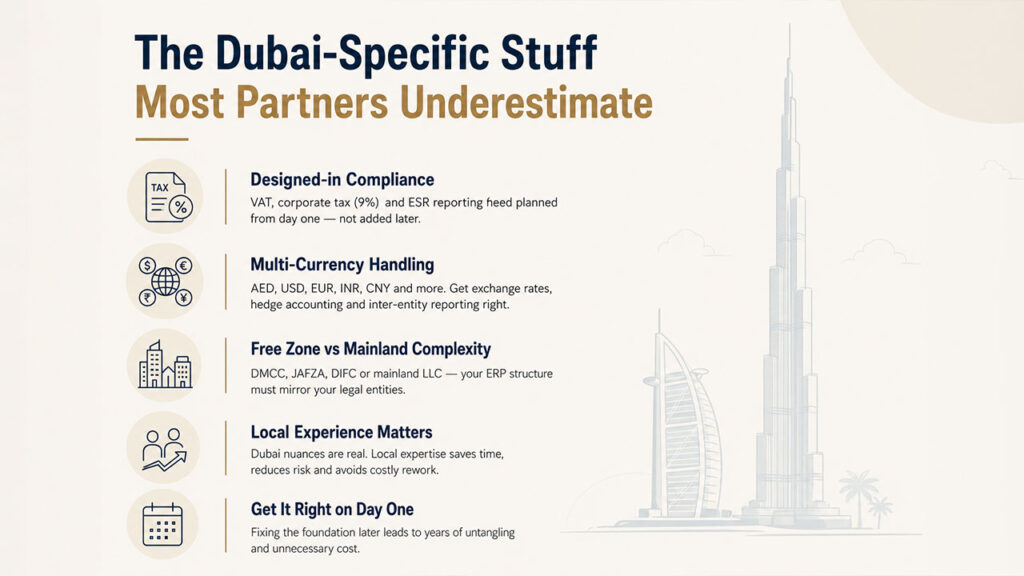
A few things make Dubai ERP projects trickier than the standard playbook suggests.
VAT was already a configuration challenge. The 9 percent corporate tax that landed in 2023 added another layer. ESR (Economic Substance Regulations) reporting is yet another. None are checkboxes you tick on day one. They need designed-in compliance from the discovery phase. Partners who treat them as afterthoughts cause months of rework later.
Multi-currency handling matters more here than in most markets. Dubai businesses routinely deal in AED, USD, EUR, and increasingly INR and CNY. A solid setup needs proper exchange rate logic, hedge accounting where relevant, and clean inter-entity reporting.
Free zone vs mainland complexity is another one. If you operate across DMCC, JAFZA, DIFC, or a mainland LLC, the legal entity structures inside your ERP need to mirror that. Get it wrong on day one, and you're untangling intercompany transactions for years.
A lot of top ERP implementation firms in Dubai understand these nuances. The ones flying in from elsewhere usually don't, and you end up paying for their learning curve.
Picking the Right Partner. Honestly
Forget the marketing. Here's what matters when evaluating vendors.
How many implementations have they done in your specific industry? Real estate ERP is wildly different from F&B, which is different from manufacturing. Cross-industry experience does not transfer cleanly. Make them prove it with named references.
Who's actually doing the work? Sales pitches feature senior architects. Then you sign, and a junior PM you've never met shows up to kick off. Demand a named team in the SOW with LinkedIn profiles.
What does their post-go-live model look like? Are you locked into expensive change requests for every minor tweak? Or do they have a managed services tier that handles small changes within a retainer? The second model saves serious money over a 3-year horizon.
How transparent are they about what they don't know? Underrated. Partners who admit gaps are easier to work with than those who pretend to know everything.
You'll find a handful of leading ERP implementation companies in the UAE that hit most of these marks. Reference checks separate marketing from reality.
A Vendor Worth Knowing About
If you're scoping options, Brain Station 23 is one of the firms that consistently delivers ERP implementations in Dubai without the usual drama. They've been operating since 2006, have a UAE presence, and their team handles retail, manufacturing, banking, and trading verticals. Strong on data migration too, the bit that quietly kills most projects.
A Pricing Reality Check
Cheapest is rarely the best. Most expensive isn't either.
A focused single-entity Dubai ERP implementation typically lands between AED 400,000 and AED 1.5 million all-in. Multi-entity, multi-country rollouts push to AED 3 to 8 million. Anyone quoting you a quarter of those ranges is cutting corners somewhere. Usually, on data migration, testing, or post-go-live support… the three areas where corner-cutting hurts most.
Pay roughly market rate. Verify they're putting the right team on it.
Final Thought
ERP rollouts fail because expectations get set wrong before anyone touches the software. The partner promises too fast a timeline. The buyer wants to believe it. Both sign. Reality wins.
If you're starting your search, vet Dubai's top ERP software companies properly. Run the red flag check first. Sanity check timelines against the phase ranges above. Then talk to current clients mid-project, not just polished references.
A few extra weeks at the picking stage saves a year of cleanup later.
%201.png)

%201.png)

%201.png)