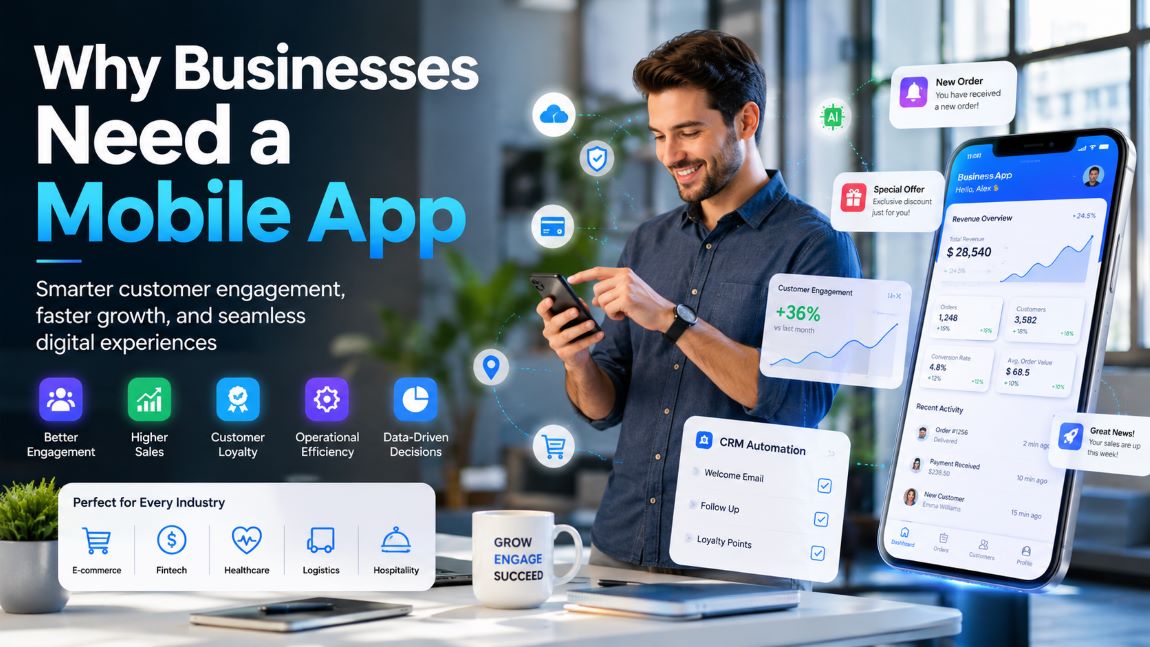

Should my business have a mobile app?” “Will it pay off?” “Can it help us stand out from competitors?” These are questions business owners often ask before investing in an app. Every minute, as many as 284,000 mobile apps are installed worldwide. In 2025 alone, people paid $167 billion for apps and used them for about 3.6 hours each day.
Mobile apps are now part of everyday life, from communication and shopping to managing accounts and daily services. For businesses, this creates a strong opportunity. An app can become a valuable channel, but only when it addresses customer needs and business goals. So, knowing why it adds value and when the timing is right, makes the difference between a smart investment and a costly one.
Why your business needs a mobile app
The decision to build a mobile app is justified when it’s based on clear business outcomes, not market trends. What does it mean in practice? A mobile app should solve a defined business problem or create a measurable improvement in performance, engagement or operations. Recent mobile app statistics show how much time and money users now spend in apps, making mobile an important channel for customer interaction.
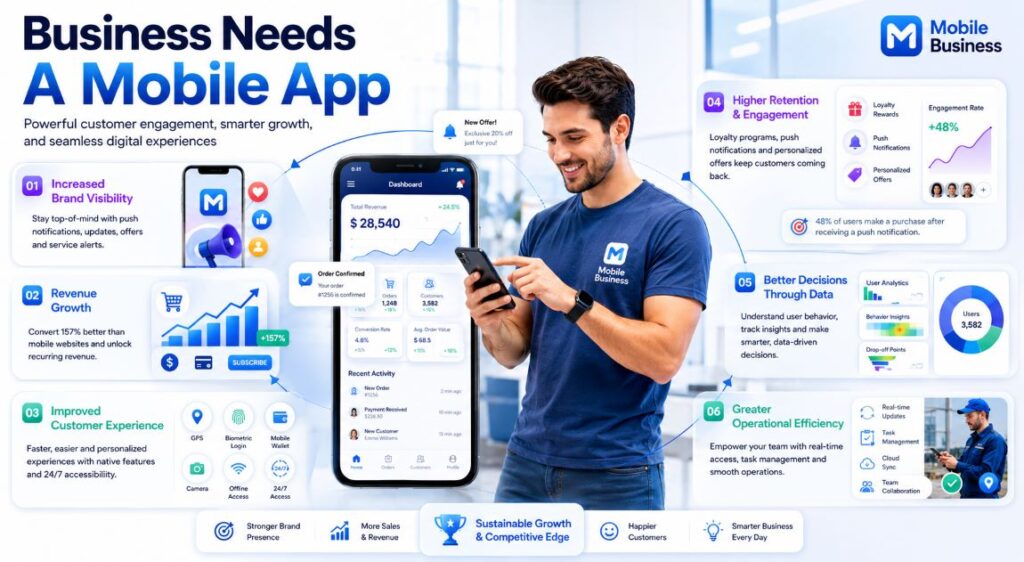
Increased brand visibility
A mobile app puts your business literally “in your customers' pockets.” Once the app is installed, useful updates, reminders, offers, or service notifications support regular customer contact and build a positive image of the company as modern, accessible, and customer-focused.
Revenue growth
Mobile apps create new sales opportunities across various industries. They convert 157% better than mobile websites, helping businesses turn more visits into sales. In the service sector (which covers everything from restaurants and fitness clubs to beauty salons), they make it easier to make reservations and pay for services. For digital products, in-app subscriptions provide a more stable source of recurring revenue.
Improved customer experience
With mobile apps optimized for smartphone hardware, businesses can offer customers faster and more convenient digital services. A well-designed app provides easy access to products and services 24/7. It personalizes the interface based on user preferences and purchase history, and can work smoothly even with a weaker internet connection. By integrating native features such as the camera, GPS, biometric login, and mobile wallets, it makes checkout, location-based services, document upload, and account access easier for users.
Higher retention and engagement
A mobile app gives people more reasons to return after the first interaction. Why? Because of all these built-in retention tools. Loyalty programs reward your customers for repeat purchases with points, discounts, or exclusive offers, while push notifications keep them posted about new promotions, events or important updates. In fact, 48% of users say they have made a purchase after receiving a push notification. With customer data, companies can also personalize recommendations and offers, making the experience more relevant and encouraging users to stay engaged over time. Businesses using CRM-integrated mobile apps can also improve conversions through smarter AI lead qualification.
Better decisions through customer data
Having its own mobile app allows a business to collect useful data on how customers behave. This includes insights into which features users open, where they drop off, and how long their sessions last. As a result, marketing and product teams can make more informed, data-driven decisions based on what customers actually do.
Greater operational efficiency
Not every app is built for customers. For companies with distributed or on-the-go teams, internal mobile apps help access systems, update records, and complete tasks in real time. This reduces manual work, speeds up reporting, and cuts down on the kind of delays that come from waiting to get back to a computer.
Signs your company is ready for a mobile app
It’s worth considering a mobile app when the existing digital experience no longer supports the way people interact with your services. Here are the signs that the timing is right:
- Mobile traffic is high but conversions aren't: If most of your traffic comes from mobile devices but bounce rates are high and conversions are low, the problem is usually the experience. A mobile app can reduce friction and make key actions easier to complete.
- Loyalty or rewards program isn't getting traction: If your loyalty program exists but repeat customers aren't using it, the barrier is usually access. Points, rewards, and account history are quicker to check and act on inside an app than through a mobile browser
- Losing sales to competitors who have an app: In some sectors, an app isn’t a differentiator anymore. It’s a must-have. When customers can do more with a competitor's app than with your website, that's a retention risk worth addressing.
- Entering new markets or growing fast: Scaling into new regions or customer segments creates demand for a more consistent, structured experience than a website alone can reliably deliver.
- Customers need access to content or data on the go: When customers need to access documents, schedules, or order information at any time, an app gives them that without depending on a stable internet connection.
- Your team works in the field or remotely: In a situation where employees rely on mobile to log updates, access systems, or complete tasks on the go, an internal app can replace slow workarounds and reduce manual errors.
In what industries does a mobile app make the biggest difference?
Some businesses feel the impact of a mobile app more immediately than others. If you operate in any of these sectors, the case for building one is particularly strong:
- Retail and e-commerce: Fast transactions, order tracking, and personalized offers help more customers complete their orders and encourage them to come back for future purchases.
- Fintech and banking: Mobile apps are an essential tool for most customers, who use them for instant transfers, contactless payments, investments, and budget management.
- Healthcare: Thanks to applications, users can schedule remote consultations, order medicines, and even track vital signs.
- Logistics and field services: Shipment tracking in real time, delivery confirmation, and routing make sure that both field service teams and customers stay in the loop.
- Hospitality: Reservations, loyalty points, digital menus, and check-in flows all benefit from the speed and convenience a mobile app provides.
What to consider before building
Before building your app, choose your target platform (Android or iOS) based on customer behavior, and decide whether to commission a custom-built app or opt for a no-code or low-code solution. From the very beginning, factor in ongoing maintenance costs and define measurable success metrics, such as customer retention rate, conversion rate or session length.
Conclusion
Investing in a mobile app is a step that can bring your business a range of benefits – from increasing the availability of your services and building customer loyalty to optimizing business processes. In a world where more and more people are using mobile devices to interact with brands, having a mobile presence isn’t just a nice-to-have. It’s becoming something customers expect.
%201.png)

%201.png)

%201.png)