



Understanding Zero Trust Security in the Modern Digital Landscape
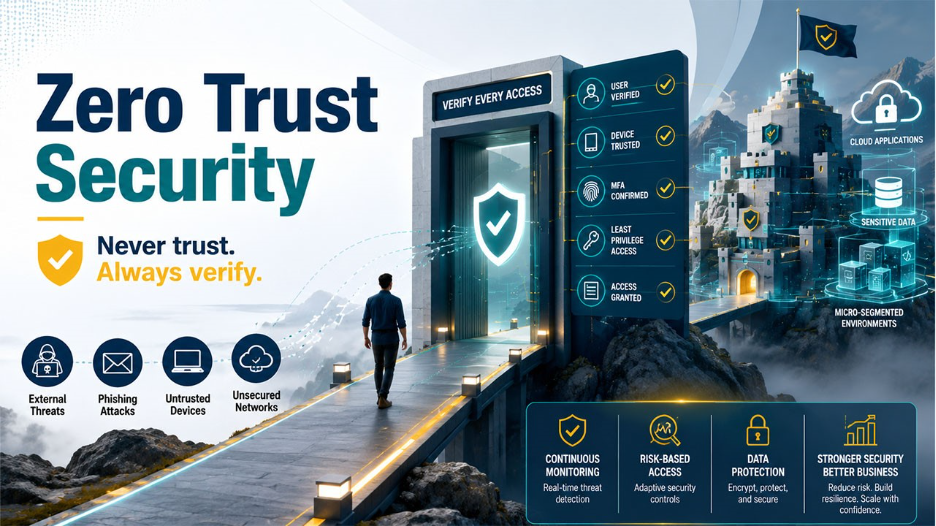
As digital transformation is taking over the world, businesses are shifting to cloud services and SaaS applications to drive innovation and boost efficiency. However, this shift is not without its challenges. It increases the possibilities of cyberattacks which renders the legacy perimeter-based security models insufficient. But there is no need to worry. Zero Trust Security has come forward as an important framework designed specifically to deal with these challenges. It works on the principle of “never trust, always verify”. This approach completely changes the way organizations protect their digital assets. They believe threats can exist both inside and outside the network, that’s why they are so meticulous with their solutions.
To work properly, zero trust security has few requirements. It needs continuous validation of user identities, devices, and applications before it grants access to resources. To adopt this model, digital teams and SaaS-dependent businesses review their access controls, rethink monitoring, and threat detection strategies. As per recent report, 81% of data breaches happen because someone compromised credentials which increases the importance of rigorous
process of identity verification in a Zero Trust Framework.
Due to remote work and cloud technologies, IT environments have become complex. This complexity has made the traditional “castle and moat” security useless. In earlier times, organizations kept outsiders at a distance and by default trusted their users and devices inside the network. However, SaaS applications and cloud infrastructure dissolved that network perimeter. This resulted in users accessing resources from multiple locations and devices. This situation made it necessary to build a security model that can verify every access request regardless of where it came from.
Jumpfactor provides digital teams with the tools and expertise to implement Zero Trust architectures tailored to these new realities. They offer solutions that focus on identity-centric security. It ensures that decisions regarding access depend on dynamic risk assessments rather than static rules. When businesses integrate continuous authentication and adaptive policies, they can maintain solid security without affecting their productivity.
The Core Components of a Zero Trust Architecture

To implement Zero Trust, there are several foundational elements that work together in order to create robust security posture. At its core, lies Identity and access management (IAM) which makes sure that every user and device is authenticated and authorized before they access any resource. Micro-segmentation breaks the network into smaller zones to contain breaches and minimize lateral movement by attackers.
When there are detailed analytics and continuous monitoring; it becomes increasingly easy to identify suspicious activities in real-time. This is important because when you are already aware of potential threats, you can react faster. When data is encrypted both in transit and at rest; it adds an extra layer to protect sensitive information even if access controls are bypassed. Organizations that are looking to streamline their transition to Zero Trust can collaborate with specialized service providers.
What does Micro-segmentation mean? In separates applications from workloads. This makes it useful because even when an attacker compromises one segment, they cannot move freely to other parts of the network, stopping further damage. Its most practical use case is SaaS-dependent environments as multiple applications and data sources interact quite often.
If the access is limited, it ensures that users and devices receive only permissions that are necessary to complete the task. This is helpful as it limits the scope of potential threats and damages from accounts that have been compromised or threats that come from inside networks. Continuous authentication mechanisms, such as behavioral biometrics and device posture checks, enhance this approach by verifying trustworthiness throughout the session.
Cloud-native security platforms enable automation of these controls, reducing human error and improving scalability. By leveraging machine learning and threat intelligence, these platforms can adapt policies dynamically based on evolving risks.
Why SaaS-Dependent Businesses Must Prioritize Zero Trust
SaaS applications have grown as an indispensable solution, for multiple enterprises, offering scalability and flexibility. Yet, the distributed nature of these SaaS platforms complicates security management.
Adopting a Zero Trust Security ecosystem mitigates all such risks, mainly by enforcing strict access controls and continuous verification across all SaaS interactions. This approach reduces the likelihood of unauthorized access and data leakage. Various research also indicates that organizations using Zero Trust have experienced a massive 50% reduction in the time to detect and respond to breaches.
In SaaS environments, users often have access to multiple cloud applications, generally via single sign-on portals, which creates potential single points of failure. Zero Trust frameworks also address this single point by integrating MFA and performing a continuous session of validation, minimizing the risk posed by compromised credentials.
Additionally, compliance requirements such as GDPR and CCPA necessitate robust data protection measures. Zero Trust frameworks align well with these regulations, mainly by enforcing granular access policies and by maintaining detailed audit trails. These capabilities help the organizations demonstrate security compliance, especially during audits and reduce the risk of costly penalties.
cloudsecuretech.com offers comprehensive cloud security solutions that facilitate the seamless integration of Zero Trust principles into SaaS ecosystems. The platform supports adaptive access controls, continuous monitoring, and automated threat responses, making it easier for businesses to protect sensitive data across multiple cloud environments.
Data breaches also causes a severe financial impact. As per IBM’s Cost of a Data Breach Report 2023, the average cost of a breach across the globe reached $4.45 million, emphasizing the urgency of adopting stronger security models by all the organizations.
Read also: Top 10 AI SaaS Tools to Boost Business Growth in 2026
Practical Steps to Implement Zero Trust for Digital Teams

The journey to Zero Trust, for digital teams, mainly begins with a comprehensive assessment of existing infrastructure and workflows. It also involves understanding how users interact, especially with applications. The data helps in identifing potential vulnerabilities and high-risk assets. Prioritizing critical workloads and sensitive data sets the foundation for effective policy design.
Integrating multi-factor authentication (MFA) is also an essential step in strengthening identity verification. Coupled with single sign-on (SSO) solutions enhances the user experience while also maintaining enhanced security. Organizations should also deploy endpoint detection and response (EDR) tools to monitor device health and behavior continuously.
Cloud security platforms play a crucial role in enforcing policies and visibility automatically. These solutions also help in facilitating seamless integration of Zero Trust principles into cloud-native environments, ensuring consistent protection across diverse SaaS applications.
Apart from technology, employee training and awareness also plays a crucial role. Cybersecurity is not solely a technical challenge, but fostering a security-conscious culture in the organization also reduces the risk of social engineering attacks. Regular phishing simulations and security workshops can reinforce best practices and highlight the importance of vigilance.
Similarly, another critical step in maintaining the Zero Trust ecosystem is establishing continuous monitoring and incident response capabilities. Zero Trust is as much about detecting anomalies as it is about preventing access. By leveraging security information and event management (SIEM) systems and security orchestration, automation, and response (SOAR) tools, teams can respond swiftly to threats, minimizing damage.
Organizations should also develop clear policies for device management, including Bring Your Own Device (BYOD) scenarios, ensuring that all endpoints adhere to security standards before accessing corporate resources.
Measuring Success and Overcoming Challenges
Transitioning to Zero Trust is a complex that mainly requires ongoing commitments and adaptations. The success metrics do not include reductions in any unauthorized access incidents, faster breach of detection times, and compliance with regulatory standards.
It is also essential to understand that the Zero Trust platform is not just a one-time project but is an ever-evolving strategy. Organizations can also continuously refine their policies, by leveraging threat intelligence to stay a few steps ahead of emerging risks. Collaboration between IT, security teams, and business units also ensures alignment of security goals with operational needs.
According to Gartner, 60% of enterprises, by 2025, will phase out most of their remote access VPNs with Zero Trust Network Access (ZTNA) solutions, which highlights the growing adoption of this security model.
Some of the major implementation challenges include resistance to change, integration complexities, and balancing security with user experience. To overcome these challenges, various organizations adopt a systematic and phased approach, which starts with high-risk areas and gradually expands their controls. Engaging stakeholders early and communicating the benefits helps secure buy-in.
Regular audits and penetration testing also verify the effectiveness of Zero Trust network Access controls and identify gaps. Moreover, staying informed about emerging threats and industry best practices also ensures that the security posture remains resilient.
Conclusion
Zero Trust Security ensures a pragmatic and effective approach, especially for the digital teams and SaaS-dependent businesses. It safeguards the digital assets of such teams, in an increasingly complex threat landscape. Organizations can significantly reduce exposure to cyberattacks, simply by emphasizing continuous verification, least privilege access, and comprehensive monitoring.
Also, by leveraging expert partners and cloud security, the platforms can rapidly adopt Zero Trust principles, which also ensure seamless integration with existing environments. While challenges also exist, the benefits of Zero Trust, like enhanced security, compliance, and operational resilience, make it a strategic imperative for forward-looking enterprises committed to protecting their digital future.
By adopting the framework, businesses not only defend against present threats but also build a strong foundation for a secure innovation, especially in the cloud era, empowering digital teams to operate confidently and securely.
%201.png)

%201.png)

%201.png)