


Affiliate marketing can look almost too simple from the outside. A company gives partners an offer. Partners send traffic. The company pays when a lead, sale, sign-up, or another target action happens.
Nice model. Clean model. Until the numbers start looking better than the actual business results.
That is where affiliate protection becomes important. It helps companies understand which partners bring real value, which traffic sources deserve trust, and which activity only makes reports look busy.
For a CRM-focused business, this is not just a marketing issue. Bad affiliate traffic enters the pipeline, wastes sales time, distorts reports, and makes teams chase leads that were never serious in the first place.
Why Affiliate Programs Need Control
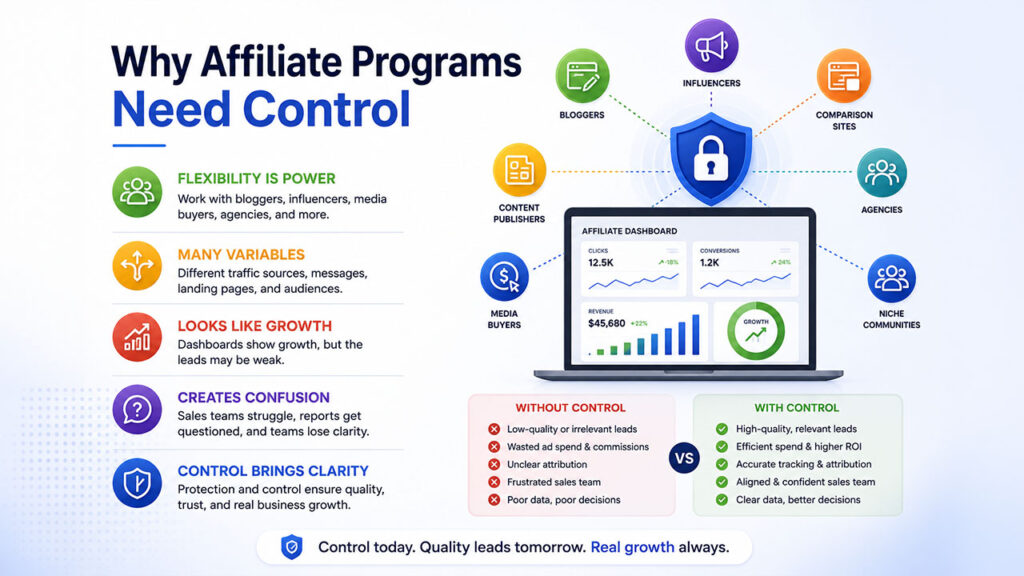
Affiliate marketing works because it is flexible. A company can work with bloggers, comparison websites, influencers, media buyers, agencies, content publishers, or niche communities.
That flexibility is the good part.
The difficult part is that every partner may use a different traffic source, message, landing page, or audience. Without clear control, the business can quickly lose sight of what is really happening.
At some point, the dashboard says “growth". The sales team says, “Why are these leads so weak?” And then everyone starts looking at each other.
Protection helps avoid that moment.
What Affiliate Protection Actually Covers
Affiliate protection is not only about blocking fraud. That is part of it, but the topic is wider. It includes traffic quality, attribution, brand safety, partner behavior, content rules, disclosure, lead validation, and payment control.
In simple terms, it answers a few practical questions:
- Is this partner bringing real users?
- Did this partner actually influence the conversion?
- Are the leads reachable?
- Is the brand being promoted honestly?
- Should this conversion be paid?
These are basic questions, but they decide whether the affiliate channel becomes a growth tool or just another place where the budget quietly disappears.
The Problem With “Good-Looking” Numbers
Affiliate reports can be misleading when companies look only at volume.
More clicks does not always mean more interest. More leads does not always mean more sales. More partners does not always mean a stronger program.
Sometimes a campaign brings activity, but not customers. The CRM gets filled with duplicate records, fake emails, unreachable phone numbers, or users who have no idea why someone is calling them.
That is not performance marketing. That is a mess with tracking links.
In FintelConnect’s 2026 affiliate marketing statistics, the company notes that affiliate marketers still face challenges around fraud, brand consistency, and partner management. For businesses, this is a useful reminder: a larger partner base does not automatically mean better growth. The channel only becomes scalable when the traffic, rules, and partner activity are clean enough to trust.
Common Risks in Affiliate Programs
Most affiliate problems do not start with something dramatic. Often, they look small at first. One weak source here. One strange conversion pattern there. A few misleading pages somewhere else.
Then the business checks the month-end numbers and realizes that “partner growth” did not bring much revenue. Before fixing the program, it helps to know where the weak spots usually appear:
- Fake or low-quality leads. These can include repeated contact details, fake emails, unreachable users, or people with no real interest.
- Brand bidding. A partner runs paid search ads on the company’s brand name and gets paid for users who were already looking for the business.
- Cookie stuffing. A partner tries to claim credit for conversions they did not really influence.
- Misleading content. An affiliate uses fake discounts, copied reviews, exaggerated claims, or unclear promises.
- Incentivized traffic. Users complete an action only to receive a reward, not because they care about the product.
- Unauthorized creatives. Partners use old logos, wrong messaging, or landing pages that do not match the brand.
None of this means affiliate marketing is “bad". It means the channel needs the same discipline as any other serious business process. If money is being paid for results, those results should be checked.
Why Brand Safety Matters
A weak affiliate campaign does not only waste money. It can also damage how people see the brand.
Customers usually do not separate the company from the partner who promoted it. If an affiliate uses aggressive promises or misleading language, the user remembers the brand name first.
That matters in any industry, but especially in finance, SaaS, healthcare, insurance, education, and other areas where trust is part of the product.
A good partner can strengthen trust before the customer even reaches the company. A bad partner can do the opposite in one landing page.
Compliance Should Not Be an Afterthought
Affiliate content often looks like a review, recommendation, comparison, tutorial, or personal opinion. That is exactly why disclosure matters.
In the FTC guidance on endorsements, influencers, and reviews, the agency explains that advertisers and endorsers should clearly disclose material connections when those connections may affect how people understand a recommendation. For affiliate programs, this matters in a very practical way: if a partner writes a review, posts a recommendation, or promotes a product through content, the commercial relationship should not be hidden from the user.
This is not just about avoiding trouble. It is about keeping the promotion honest. A user should understand when a recommendation may lead to a commission. Simple. Fair. Much easier than dealing with a trust problem later.
How CRM Data Makes Protection Stronger
Affiliate dashboards show the beginning of the story. CRM data shows what happened after the lead arrived.
That difference is important.
A partner can send many leads. But did the sales team reach those people? Did the leads move through the pipeline? Did they become paying customers? Did they refund, cancel, or disappear?
When affiliate data is connected with CRM outcomes, the business gets a clearer picture. It can see which partners create real opportunities and which partners only create activity.
This also helps honest affiliates. Strong partners can be rewarded based on real value, not just surface-level numbers.
What a Strong Protection Setup Includes
A good protection setup does not need to feel like a giant legal machine. It starts with practical rules and consistent checks.
The business should define what is allowed, what is banned, and what counts as a valid result.
A healthy program usually includes:
- Clear traffic source rules;
- Brand bidding restrictions;
- Lead validation;
- Partner-level performance tracking;
- Content and disclosure guidelines;
- Payout approval rules;
- Regular review of suspicious patterns.
Enforcing all of this manually rarely holds up. Partner-level tracking, payout approval, and anomaly reviews are automated with dedicated affiliate tracking software like Trackdesk.
After that, the process becomes easier to manage. Partners understand the rules. Managers know what to check. Sales teams get cleaner leads. Finance teams are not paying for random activity.
How to Work With Good Partners
Protection should not turn the affiliate program into a police state. Good partners do not want chaos either.
They want clear terms, fair attribution, predictable payouts, and honest communication. If rules are vague, everyone gets nervous. If rules are clear, good partners can focus on bringing better traffic.
This is where many businesses get affiliate protection wrong. They treat it only as fraud prevention. But it is also partner management.
A clean program attracts better partners because serious affiliates do not want to compete with spam, fake leads, or shady tactics.
The Real Goal of Affiliate Protection
The goal is not to make affiliate marketing slower. The goal is to make it safer to scale.
When a business knows which partners work, which sources convert, and which leads turn into revenue, it can grow the channel with more confidence.
Without protection, more traffic can simply mean more confusion, making it harder to achieve long-term affiliate marketing success.
With protection, affiliate marketing becomes much more useful: cleaner data, better partners, stronger brand control, and a sales pipeline that does not make the team want to close the laptop and walk away.
In the end, affiliate protection is about paying for real value. Not for noise, not for fake activity, not for pretty numbers. Real users, real intent, real business results.
%201.png)

%201.png)

%201.png)