



You are checking out your social media or analytics page, and you have just come across another gigantic set of data that needs to be comprehended, classified, and processed. You likely know how overwhelming this is, how hungry you are for new data to acquire, and how you want a magic system that brings order out of your mess. AI for research provides this type of solution. Not as a sci-fi fantasy but as a REAL-LIFE, everyday working support option that is throwing traditional research methods upside down, and when you experience all of this, it feels like an absolute BREAKTHROUGH!
In the past, doing research was a painful task. You would gather information and create a spreadsheet and then search through hundreds of different documents trying to find what you were looking for, going through the same document over and over only to realize that you still couldn't find what you were looking for. By using AI as a tool in your research or productivity, the way each piece is accomplished becomes markedly different. Everything [is] done more quickly, intelligently, and with a greater enjoyment factor.
Data Collection gets a Brain Upgrade
In most research projects, the hardest part is obtaining data. Everybody got used to it. People get many files from many different sources with many different kinds of file formats and lots of different standards. It is a mess for you as you are trying to get your brain around the analysis. There is nothing you can do until you have collected all your data.
Utilize AI as an assistance tool for research and workflows that automate repetitive tasks related to the collection of data. A few examples of such tools include those that automatically search through directories to download individual files, automatically download metadata, and scrape websites for content based on your query. Once you have specified what you would like to find, your AI tool types up all of the relevant information within minutes or, in some cases, seconds. As a result, this process eliminates the need for hours' worth of manual effort on behalf of the researcher.
Another fantastic bonus is that several of these solutions not only collect data but also cleanse it by identifying duplicate records, flagging errors, and recommending solutions for resolving conflicting fields. This is where automated data processing becomes a genuine advantage — shifting researcher time away from fixing raw inputs and toward working with clean, structured results. That means there is more time spent working with the actual data instead of cleaning up your data. Once you start using AI for research, the term 'data collection' takes on a new meaning altogether, it becomes working with a partner who understands exactly what you need.
TeraBox and AI-Powered Collection
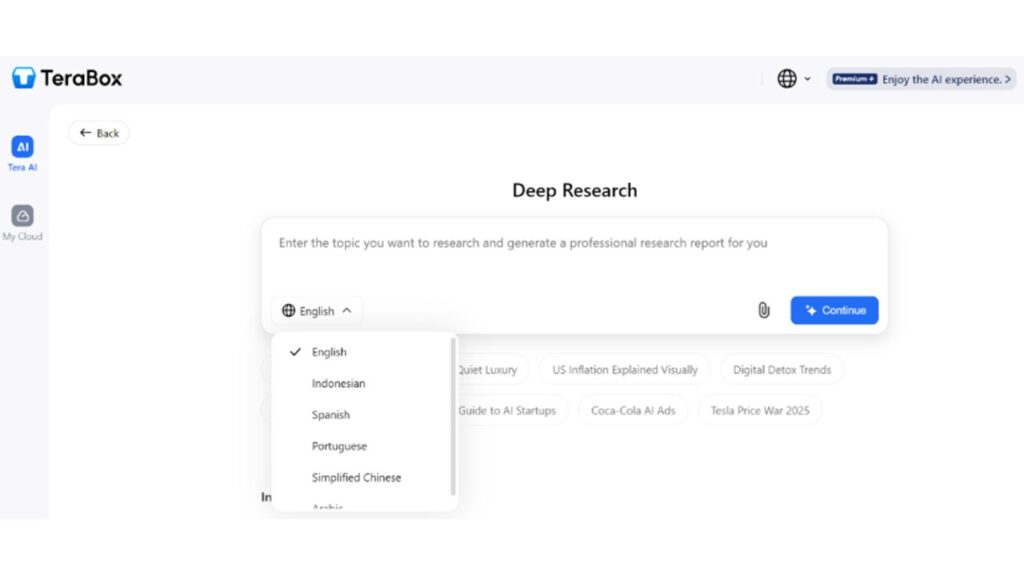
Here is a case that can specify an example of how TeraBox offers a mastery of smart tools. Many users have considered TeraBox to be mainly just an Internet-based, or cloud-based, storage service. However, this service is able to leverage the power of AI throughout its entire cloud experience. In addition to having cloud-based storage capabilities, TeraBox has developed numerous tools, which allow the user to engage with the materials that live in the digital realm in an intelligent manner, providing faster and more efficient ways to conduct research with AI.
By utilizing AI-powered features, TeraBox will help you collect data effortlessly -- using an 'intelligent' method of organizing your data based on file type, keyword, and content. In the event that you are overwhelmed with research material (photos, videos, PDFs + spreadsheets) and data from multiple projects, TeraBox can also assist you with 'AI for Research' capabilities that can automatically categorize and tag your data so that you do not spend time searching through folders like it was 1999!
The transformation of raw data into a format that can be used for research is a fine but essential point: an automated organization will provide you with a starting point for data analysis in the form of a structure, rather than a disorganized mass.
Smart Search — The Magic Wand in Your Toolbox
One of the most attractive features of artificial intelligence for research is smart search. Smart search uses context to find more than just a keyword in an input and look up the intent behind the search. It also connects terms together to show relationships and find the most relevant searches for you in a timely manner.
Imagine attempting to locateall of the files within a dataset that you have about 'climate adaptation strategies' — traditional searching would only return files that contain those words exactly. Using an intelligently designed AI enhanced search would use a contextual understanding of your request and return research summaries, slide presentations, notes, and discussions that also have relevance to your search query, whether they contain your search term or not. The benefit of using AI for finding research is that you can find information for your research project with more accurate and more thorough methods than using manual searching.
And again, the intelligent search capability provided by TeraBox isn't only about locating a document using its filename but also understanding the document and bringing it to your fingertips. You could search thousands of research-related documents and instantly get the ones that are most relevant, categorized, and cross-referenced.
Transcription and Text Conversion — Turn Words into Data

For people who have participated in many hours of interviews or watched meetings that have had a lot of verbal information given, they know how overwhelming it is to transcribe. Transcribing audio from an individual into actionable research text is frequently the slowest aspect of a research project. However, when performing transcription with artificial intelligence (AI), transcriptions are almost instantly and much more precisely completed.
AI technology can process audio data (interviews, lectures, group discussions) and create a searchable text format of those recordings. AI tools not only create a text transcript; they also clean up the text, derive insights from it, and organize the text into a format ready for analysis. This has allowed researchers to spend more time on the analysis of their materials versus manually creating or editing typed work from audio data.
When researchers need to coordinate with multiple languages, this feature is even more beneficial. The ability to have advanced AI transcription assist with translation and cross-language workflows is a significant advantage for teams that operate globally or for anyone who is using multiple language sources.
Automated Summarization — Your Shortcut to Insight
Think of a system capable of taking a PDF file of thirty pages, perfectly processing it, and generating a brief but effective and complete summary of that document including all of the major concepts within it. This is what AI for research can do with automated summarisation and this is not a dream, it exists!
With the help of an Automated Summarization Model, analysts can quickly find key information within an entire document, summarizing it into easy-to-read pieces. This does not only save time, but it has also radically changed the way people conduct research. Now instead of reading dozens of long documents, you can skim the summaries and go into depth on the sections you require.
Because researchers using this method are not limited by their pace of reading, they are able to acquire information much faster than before. When you do not have to read every word in order to comprehend what a paper has added to the literature or how it can be improved, the amount of time to acquire knowledge is substantially reduced.
Pattern Discovery and Insight Extraction
Once you have finished gathering your data and have cleaned it up (Linda will tell you all about cleaning data), AI will continue to assist you in your research project. After you provide AI with your data set, the AI model actually begins to work "with" you. You will be able to use the AI to identify trends in your data that you would likely never identify without AI, such as recently occurring related data points, trends in data over time, and clusters of similar data points that are indicative of a larger pattern.
The ability to recognize patterns in large volumes of data can reveal previously unknown relationships, and it can uncover these relationships much faster than humans could ever hope to. That means new hypotheses, new ways to conduct research, or insights that form the basis of a major new development might emerge from pattern recognition work.
The ability to gain qualitative insight from data through computation will not be replacing human intuition; it will only serve to augment and support human intuition. Researchers will have much more access to complete data sets and will have an effective partner who can help them identify the most important routes through their data.
TeraBox as an AI for Research Accelerator
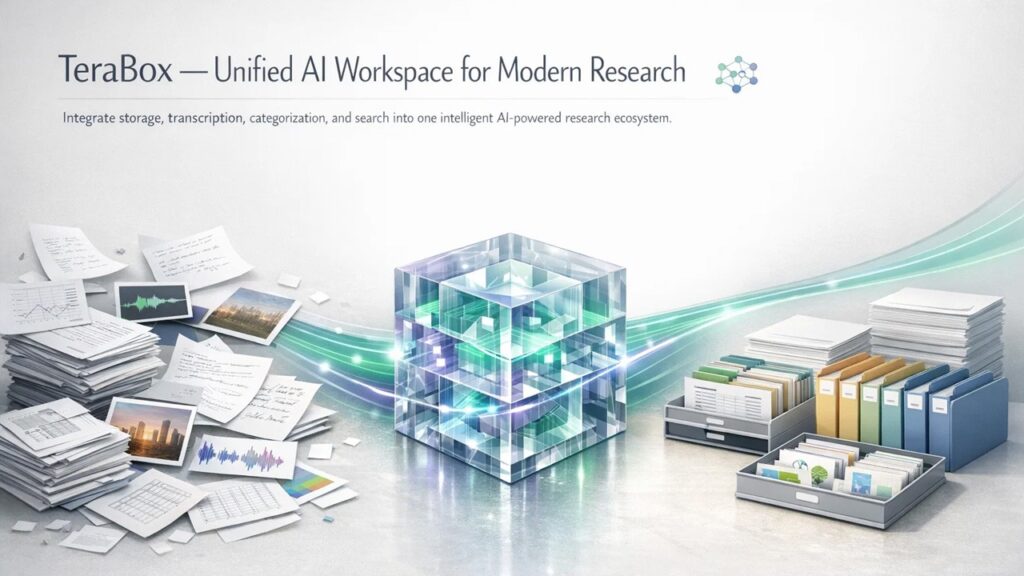
Before wrapping up today, let us take another look at TeraBox. This platform provides both cloud infrastructure and intelligent tools, making it one of the strongest competitors in the support of collaborative research workflow systems. TeraBox is not only a cloud storage solution nor simply a means for sharing, rather, TeraBox provides a single, unified space for AI to coalesce around the support of modern research workflows.
TeraBox offers an integrated workspace through which all of these activities can be completed through a single application. This is significant because most researchers don't operate within a single medium. Many researchers will switch back-and-forth between different data types (e.g., datasets, text, audio) as well as between cooperative environments. Having the capacity to perform multiple operations in one location will reduce the time lost to transition activities that are a hindrance to productivity.
Other tools such as Automated Categorization, Smart Transcription, and Integrated Search within TeraBox allows you to build a strong ecosystem where AI will not be perceived as a separate tool from the other tools in your research process, but rather an integral part of the overall process.
Collaboration without the Chaos
Research is rarely done alone, and that can make collaboration chaotic. Version control problems, clunky sharing systems, and lost revisions… we've all felt that pain.
Collaborative research among teams can take place in an intelligent manner given the ability to utilize cloud-based artificial intelligence (AI) with shared cloud technologies for research projects. The system will help facilitate collaboration by understanding files rather than simply being able to provide access to them. Comments and annotations added by team members will be automatically shared with all other team members, in addition to a summary generated by the AI, so that everyone has relevant background information. Instead of simply sharing a spreadsheet, you will also be sharing structure, context, and insights with each member of your team.
Meetings are more productive thanks to this; document review processes are improved, and it is easier to coordinate activities. Researchers are able to add intelligent comments to their work; AI can provide suggestions for the next step or point out potential conflicts between different documents. All of this together represents collaborative intelligence, as opposed to just the traditional functionality of file-sharing systems.
Making Sense of Big Data
Finally, let's discuss the elephant in the room, big data. When you have massive datasets that can range from millions of rows of data to terabytes worth of images, text, and sensor data, there are so many ways to fall short in traditional methods, which is why using AI for research is where you'll see the greatest benefit.
AI's ability to analyze large datasets, identify patterns in images, correlate similar ideas in multiple documents, and even forecast or anticipate future trends based on previously recorded information allow businesses to transform from a liability into an opportunity exploiting large amounts of data. This means you can ask larger questions, identify greater relationships between data points, and feel confident making data-driven decisions as a result of your use of AI.
Previously, this kind of power was only available to laboratories with sufficient funding or team members with a technical knowledge of coding. But today, services like TeraBox enable people who ask reasonable questions and wish to learn more about those subjects through the use of AI tools found within their platform to access the same type of power.
Embrace the Future of Research
What are the major points of the research? Research has changed dramatically over time. The world has entered a new stage where AI technology is revolutionising our approach to research and manual effort is fading rapidly. The new technology allows for the fast automation of repetitive tasks, increases the speed at which insights can be discovered, and allows each researcher to continue to think formally rather than just about formatting.
If you are an expert graduate student who has many references to manage, a data scientist with huge amounts of data to analyze, or a team leader trying to coordinate your teams' last activities, the tools of the future exist now. You will not only save time but also have access to new avenues for discovery by utilizing platforms that provide both intelligent AI and cloud storage, such as TeraBox.
%201.png)

%201.png)

%201.png)