




A request ticket comes in, the search begins, and what should be a quick response slowly becomes a time-consuming search for the right information. The customer waits longer than they expected, and the team feels the pressure.
In many customer support teams, this story looks relevant. Agents know the answers exist, but they are across tools, versions, and folders that are never current.
That gap between what the company knows and how quickly people can use it is where AI knowledge bases for customer support are starting to matter.
They take the same information, organize it better, learn from how it’s used, and make it easier for everyone to get to the right place without extra steps. For support leaders and decision-makers, it's about redesigning how knowledge flows through the team (more than leveraging another tool).
The article ahead discusses more about this space, covering the challenges of traditional knowledge systems, the role of AI in addressing them, and the outcomes organizations can realistically expect.
The Challenges of Traditional Knowledge Bases in Customer Support
Many legacy systems are ineffective at providing value to an organization, even when knowledge management systems or technology have been implemented.
This creates friction within the organization and affects the speed with which support and customer experience leaders respond to issues, maintain consistency, and optimize processes.
Outdated and Hard-to-Maintain Content
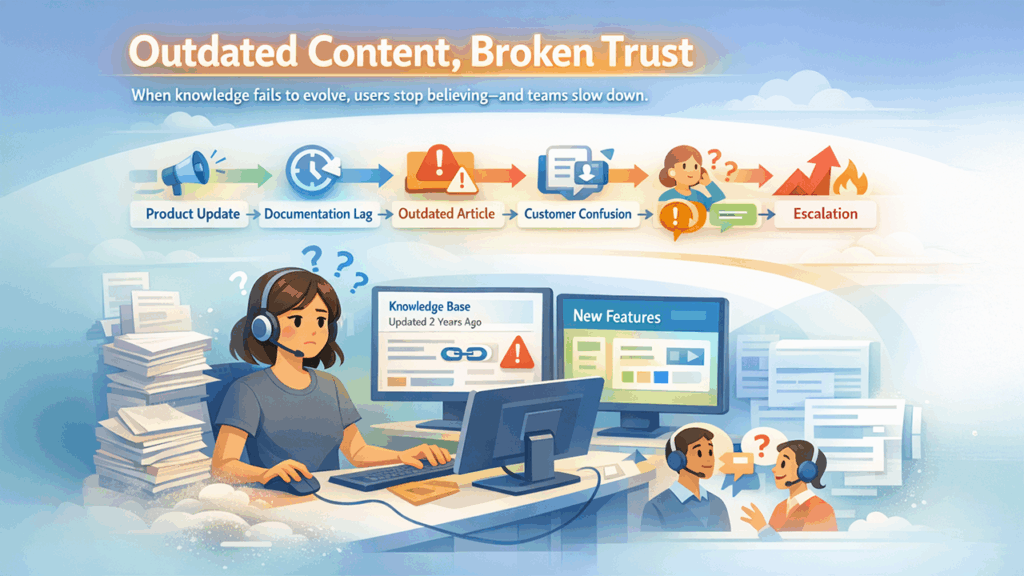
Traditional knowledge bases mainly depend on manual processes for updating and maintaining articles, often without the support of dedicated user manual software to streamline documentation workflows. As products develop quickly, especially in SaaS and technology environments, documentation lag becomes common.
When features change, workflows or policies shift, related articles often remain unchanged, leading to inaccurate guidance. Over time, this makes a growing repository of content that no longer reflects current product or service realities.
This eventually erodes confidence in the knowledge base and forces agents to rely on tribal knowledge or to escalate directly rather than use self-service resources.
Poor Search and Content Discovery
When you use simple keyword matching, it often gives broad lists of documents instead of precise, relevant answers.
Users, whether they're support agents or customers, must analyze the results to find the specific information they need. When everything lives in different places, it takes extra effort to find what you need. Work slows down, and people begin to doubt whether the system can really help.
For customer support leaders, poor search means agents spend more time navigating content and less time handling higher-value support work. Inconsistent discoverability also weakens self-service adoption, making it harder to reduce basic support queries and improve customer experience.
Inconsistent Answers Across Support Channels
When content lives in multiple repositories or when updates are not synchronized, customers and agents may face contradictory guidance. Inconsistent answers compromise the experience for both sides of the support equation; customers receive mixed messages, and agents are left uncertain which version of the information to trust.
For tech-driven businesses where support covers multiple touchpoints: help centers, in-app guidance, community forums, and agent portals, this inconsistency can directly impact brand perception and customer satisfaction.
Support leaders must therefore contend not only with information accuracy but also with the use of consistent content across environments where customers and agents interact.
How AI Knowledge Bases Transform Customer Support Workflows
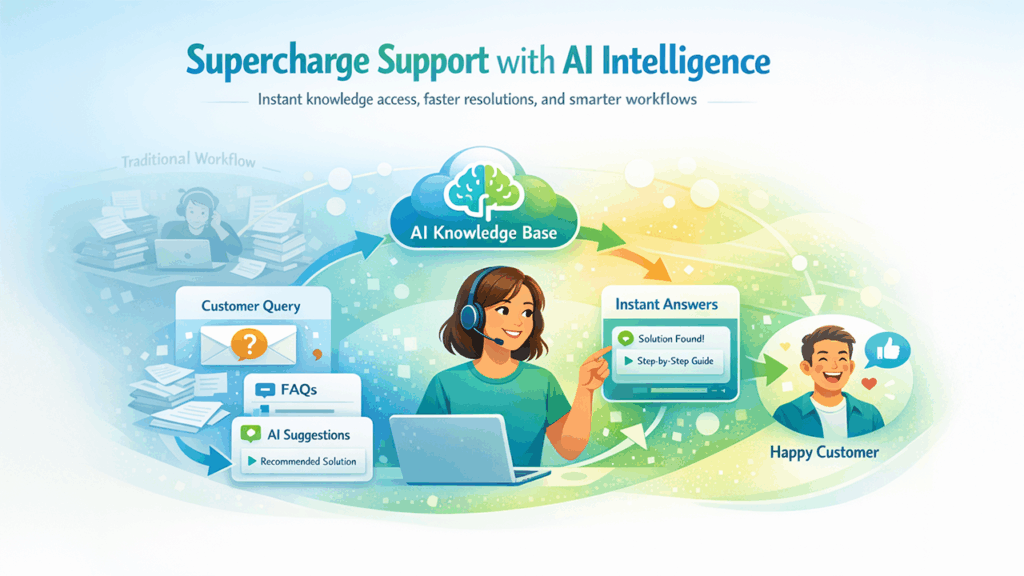
Because the traditional method has limitations, it places unnecessary demands on staff, requiring them to spend time searching for information rather than supporting their clients.
So, using an AI knowledge base via advanced knowledge management software bridges that gap, keeping information live and always accessible while optimizing workflows and outcomes.
There are several ways in which the AI knowledge management system can positively impact a company.
Check out this video to understand how AI-powered knowledge bases improve access to information for support teams
Read More: How AI-powered Knowledge Bases Enhances Customer Service?
Faster Agent Onboarding and Reduced Training Time
With an AI-powered knowledge retrieval platform, new agents can access answers immediately. They need not waste time manually looking for the information they need or going through repeated training sessions. Instead of relying solely on static onboarding documents or traditional customer service training manuals, teams can access dynamic, searchable guidance that adapts as products evolve. This will allow them to focus their strategy on solving the customer’s issue.
Studies show that AI tools can cut training time by 25% while improving first-call resolution rates by 15% when compared with traditional systems.
By adopting AI knowledge retrieval systems, companies can generally expect to onboard their employees more rapidly. It also creates more flexibility for managers, decreases their overall training costs, and provides their customers with a higher quality of support. This is due to the consistent and accurate level of service each time.
Improved First‑Contact Resolution and Consistency
With an AI knowledge base, agents can quickly get to the right guidance on the first try, instead of passing the issue around or redoing work.
By practicing on past cases and highlighting the most relevant insights, AI enables agents to deliver more consistent, first-contact resolutions.
The impact is even measurable. Organizations adopting AI knowledge bases for customer support see improvements in first-contact resolution (FCR) rates, increasing them by up to 30% compared with traditional models.
This is because agents get faster access to context-aware answers, helping them resolve a higher percentage of inquiries without follow-ups.
For decision makers, these improvements provide:
- Make everyday work faster.
- Help teams adapt quickly.
- Make it easier to view performance.
Smooth Knowledge Sharing Across Support Channels
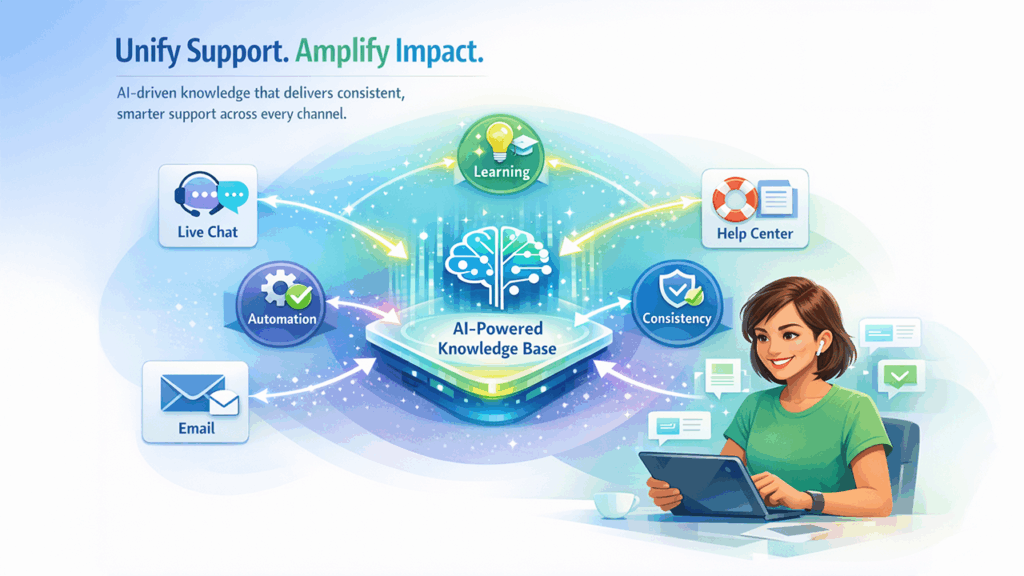
Customer support must work across multiple channels: live chat, help centers, self‑service portals, email, and more.
When you utilize an AI-supported knowledge management software, it will guarantee that your content updates flow through all the channels and that agents access the same uniform information, including when teams create interactive user guides for customers.
Also, these systems continuously learn from usage behaviour and customer interactions, helping the knowledge base develop automatically. This looping improves both accuracy and coverage, increasing the relevance of your content delivered to users and agents in the same way.
What does this result in? Having a consistent agent performance (and stronger self‑service capabilities), letting teams to focus on more complex issues and strategic requirements.
Business Impact of AI Knowledge Bases on Support Teams and Customers
Customer support workflows utilizing AI will help deliver measurable business outcomes that match your operational goals, customer experience strategies, and your bottom-line performance.
When combined with modern knowledge management software, an AI customer support knowledge base improves both how teams work and how customers get guidance.
Reduced Operational Costs and Support Workload
When you utilize AI-based knowledge systems to automate your customer support’s routine inquiries, it reduces common tickets through accurate self-service. These AI systems can handle up to 65% of common customer questions without human intervention, significantly reducing agent workload and their related costs.
Organizations with effective AI implementations report nearly 31% lower operational costs while also maintaining or improving their service levels.
For leaders and customer experience managers, they only need to engage fewer resources in repetitive tasks, improve agent allocation, and develop support without increasing headcount.
Enhanced Customer Self-Service and Satisfaction
Advanced AI knowledge bases understand natural language, deliver context-aware responses, and provide 24/7 self-service capabilities that customers increasingly expect.
Apart from the self-service success, broader AI following in support channels also improves satisfaction metrics: companies using AI can cut first-response times by 74% and improve customer satisfaction (CSAT) scores from 78% to 97% compared with traditional support methods.
Better self-service and higher satisfaction also help customers stick around, reduce churn, and make revenue more predictable.
Actionable Insights from Knowledge Base Analytics
AI-powered systems keep learning from every interaction. Over time, they show which articles work well, where customers struggle, and unmet customer needs.
These insights make it easier for support leaders to spot gaps in the knowledge base, improve weak areas and make sure content actually matches what customers expect.
Actionable insights from analytics give strategic improvements such as:
- Prioritizing high-impact content updates based on search patterns and deflection data.
- Reducing support ticket volume by identifying and improving areas of the knowledge base that need attention.
- Predicting helps trends and prepares proactive self-service content.
Conclusion
AI knowledge bases are quietly changing the way your customer support team can work every day. Instead of analyzing long, never ending documents or outdated articles, agents and customers can find clear, accurate answers quickly, and with far less effort.
For support leaders and Customer Experience (CX) managers, that means shorter queues, fewer repeat tickets, and more uniform responses across all your customer support channels.
As businesses grow, so will your customer expectations. So, having a reliable system that keeps information up-to-date and easy to access becomes essential. It helps teams provide better service and develop without adding extra strain on people or operations.
%201.png)

%201.png)

%201.png)