




Marketing teams face relentless pressure to produce more content, prove ROI, and meet stricter compliance requirements at the same time. A lot of organizations struggle with this tension for years, and the solution is not working harder. It is building AI marketing content workflows that balance speed with governance.
This blueprint gives you a practical, tool-agnostic operating model to ship faster without sacrificing quality or brand integrity. You get a maturity model, reference architecture, governance cadence aligned to NIST AI RMF, channel-specific packaging approaches, and a 90-day pilot plan.
The focus is on people-process-data-tool alignment with measurable quality gates tied to Google's people-first search guidance and Gmail and Yahoo bulk-sender rules. If your leadership is skeptical, frame AI workflows as a way to standardize quality and free humans for higher-value work, not as a shortcut that replaces judgment or accountability.
Who This Blueprint Serves?
This framework works best for marketing operations leaders, content directors, and revenue operations practitioners who manage complex stacks across regions. Your job is scaling high-quality content that integrates with CRM, CMS, DAM, and marketing automation while remaining compliant and measurable.
The article is created with an assumption that you have the following foundational systems in place: a CRM or CDP for audience data, a CMS for web publishing, a DAM for assets, and an ESP or MAP for email. You also need access to a large language model and a retrieval layer. Success means reduced cycle time, higher first-pass yield, improved organic and email performance, and a defensible audit trail leaders and auditors can trust.
Essential Terms for Cross-Functional Alignment
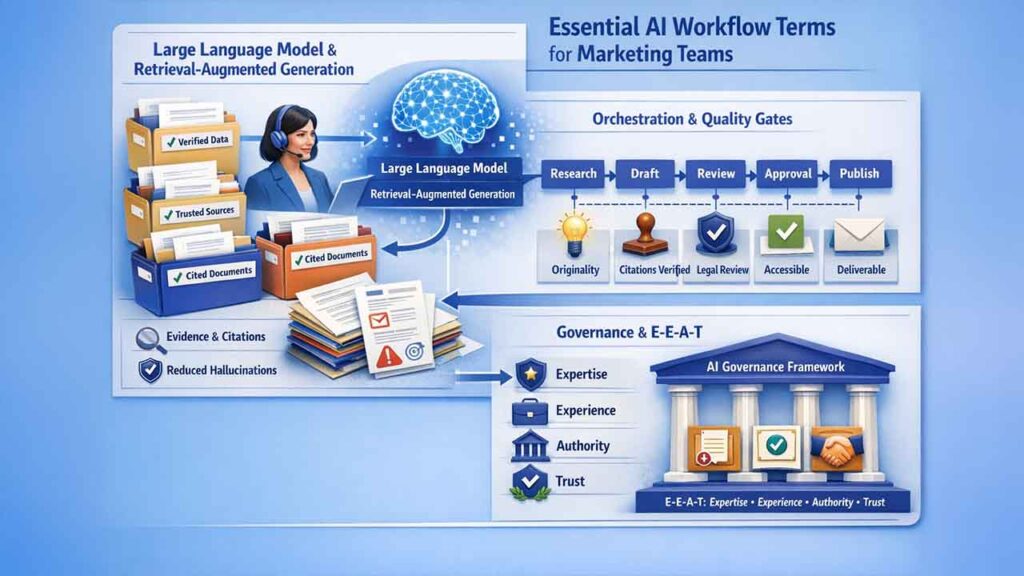
Clear vocabulary prevents governance gaps and review churn between content, legal, security, and operations teams. Clear definitions provide all professionals with the same mental model when you design and assess workflows.
Large Language Model and RAG
A large language model predicts text based on training data and patterns, not true understanding. Treat it as a copilot that needs constraints and human review. Retrieval-augmented generation combines model knowledge with external indexes to ground outputs in evidence, which reduces hallucinations and improves transparency.
Orchestration and Quality Gates
Orchestration is the workflow logic that coordinates steps from research to distribution, so work is repeatable and traceable. Teams can use automated quality gates and manual checks before passing the content for publication. The key indicators include originality, citation coverage, legal compliance, accessibility, and deliverability.
Governance and E-E-A-T
Governance covers roles, policies, and evidence needed for reliable AI, anchored in frameworks such as NIST AI RMF. E-E-A-T signifies Google’s guidance on how to create helpful content. Essentially, content must demonstrate expertise, experience, authoritativeness, and trust.
The Case for AI Content Workflows Now
AI content workflows are significant because adoption has attained mainstream status and executives now anticipate measurable impact and not just experiments. In early 2024, approximately 65% of businesses stated that they have utilized generative AI in at least one function, with a maximum jump in marketing and sales. The CMO Survey has reported at least an 116% annual deployment increase, with mean profits of 8.6% in sales productivity and approximately 10.8% minimization in marketing overhead.
Pressure from executives has maximized this urgency. A CMO Survey in 2025 has found that approximately 36% of CMOs are planning to conduct staff reductions over the next 1-2 years to capture AI efficiencies. Klarna has reported that approximately $10 million in cost savings in annual marketing reports. However, there is a greater risk with higher scale, and Google’s 2024 refinements to AI Overviews accentuate the need for strict human review and credible sourcing.
It is important to reconsider the process of content creation as a regulated supply chain with service-level agreements, feedback loops, and provenance. Determine metrics for quality, speed, and impact with dashboards shared across operations, content, and leadership so that everyone can view tradeoffs when you modify sources, prompts, or automation levels.
Four Principles That Prevent Scaling Mistakes
Without explicit design principles, teams scale errors faster than content. These four principles translate into concrete workflow requirements that you can encode as checks, prompts, or approvals.
Truth and Traceability
Ground every claim using retrieval-augmented generation with approved sources only. Demand inline citations and require evidence tables for expert assessment. Record all aspects including the retrieval snippets, prompts, human edits, draft versions, and approval meta data. They must be aligned with NIST AI RMF evidence needs.
Tone and Throughput
Secure brand voice by reusing prompt blocks and ensuring programmatic style checks tailored to your guidelines. Ascertain SME (Subject Matter Expert) review for regulated or sensitive topics. Design multi-layered flows that encompass email, SEO, social media, and video from a single SOT (Source-of-Truth) brief. Executives can setup automated gates so that humans concentrate on judgement calls instead of mechanical checks.
Maturity Model for Staged Adoption
A staged path avoids over-automation before change management and governance are ready. Every stage adds capability while also sharpening auditability and service-level expectations.
Stage 0-1: Ad-hoc to Managed
Ad-hoc workflows depend on sporadic prompts and manual briefs with no standards or logging. Success in this stage implies securing sponsorships for executives, setting boundaries of clear risks, and setting up baseline metrics. Optimized workflows brings forth prompt libraries, standard brief templates, and single retrieval index with credible and approved sources. Target cycle time reduction of 20% and a first-pass yield of at least 50%.
Think of a regional team that moves from one-off prompts in chat tools to a shared brief template and a central library of prompts for blog posts, nurture emails, and ads. Writers still edit heavily, but leadership can finally compare volumes, cycle times, and quality across markets because work follows the same pattern.
Stage 2-3: Orchestrated to Scaled
Orchestrated workflows implement multi-step agent flows for drafting, research, quality assurance, and packaging with automated gates. Set a target that around 70% of assets must pass gates on the first review. Scaled workflows add multimodal packaging shipped in parallel with experiment harnesses and version control across markets. Target cost per qualified visit reduction of 25% on a rolling quarterly basis.
At Stage 3, a single approved brief can generate a long-form article, email sequence, social posts, and video scripts that all share sources and claims. Local teams only adapt examples and language for their market, while global operations teams watch gate pass rates and impact metrics to tune prompts and training.
Reference Architecture Components
An effective AI content architecture stays simple, auditable, and observable from source to impact. Sources flow to retrieval, then to the model, orchestration, quality gates, packaging, distribution, and analytics. Instrument each layer for evidence capture and performance measurement so you can show how a given asset was produced.
Data Through Models
Sources include CMS articles, DAM assets, product documentation, and CRM insights that are normalized, tagged, and labeled for sensitivity. Retrieval uses vector databases with access controls and redaction for personal data. Models include general-purpose large language models plus policy layers for safety, such as blocking disallowed topics or unsupported claims.
As you expand, treat your retrieval index like a product. Define who can add or update sources, how you test new collections before they influence production outputs, and how you roll back an index version if a bad document set introduces systematic errors.
Orchestration Through Distribution
The workflow engine records all outputs and prompts with versioning, ensuring APIs that integrate to your present stack. Quality gates assess citations, E-E-A-T, originality, deliverability, and accessibility. Packaging creates templates specific to the channel, while distribution manages scheduling and publishing with compliance checks for audience region, and sending domain.
For teams having limited capacity of engineering, begin with light orchestration in your present marketing automation or work management platforms. As patterns stabilize, move high-value flows into a dedicated orchestration layer so you can reuse them across brands, regions, and agencies without rebuilding each time.
Daily Governance Using NIST AI RMF
Using the NIST AI Risk Management Framework as your operating rhythm keeps governance practical instead of theoretical. Govern defines roles, policies, and risk tolerances. Map inventories use cases, data flows, and region-specific rules. Measure tracks outcome KPIs and risk KPIs weekly with formal quarterly reviews. Manage operates change control and incident response when something breaks.
Search-Readiness Gate for SEO Content
Search performance improves when AI-assisted content still meets Google's people-first, evidence-backed standards. Google's guidance emphasizes content that must be helpful and relevant for people. It allows AI assistance if it demonstrates appropriate transparency and E-E-A-T principles. Your gate must need clear authorship, experience signals, inline citations, unique analysis, and generating disclosures when content is materially assisted by Artificial Intelligence.
Email Deliverability Gate for Campaigns

Dependable deliverability is not negotiable when AI improves send volume. Gmail's bulk-sender rules require SPF, DKIM, and DMARC with at least p=none, From-domain alignment, one-click unsubscribe for promotional mail, and spam rates under 0.3 percent. Yahoo mirrors these requirements. Treat complaint spikes as reasons to stop shipping until you understand the root cause.
Automate pre-send checks for authentication and list hygiene so marketers cannot bypass them under deadline pressure. Monitor Postmaster dashboards daily, suppress high-risk cohorts, and analyze complaint drivers to fix content, audience, or cadence issues before they damage your sender reputation.
Channel-Specific Packaging Playbooks
One strong brief should power many channel packages without inventing new claims each time. Use SEO, email, video, and social variants that are all derived from the same claims and approvals. This approach reduces rework, protects consistency, and makes experimentation safer because you know exactly what changed.
For video in particular, teams often struggle to keep production speed aligned with compliance while still meeting platform-specific expectations for captions, scenes, and aspect ratios. When you're turning an approved script or blog outline into short-form clips at scale across multiple platforms and markets, using a reliable, automated, AI-powered text to video generator as the final assembly step keeps everything consistent without creating a separate workflow.
SEO and Email Flows
SEO flows run from search results analysis through outline, draft with citations, expert review, schema markup, and monitoring. Email flows segment by lifecycle stage, enforce Gmail and Yahoo rules, test messaging approaches, and monitor spam rates and engagement.
Video Repurposing from Long-Form Assets
From approved articles or scripts, generate shot lists, captions, and B-roll prompts. When teams need to turn an approved script or blog outline into platform-ready shorts in minutes, consider using a text-to-video generator to assemble scenes, captions, and aspect ratios automatically from the brief. Use it as the last-mile production step after compliance and brand checks.
Ensure automation of aspect ratios and subtitle files for every platform while implementing legal and brand checks before exports. Ensure messaging remains aligned by directly pulling lines from the SOT (Source-of-Truth) brief and retaining on-screen attributions. Monitor retention curves, video completion rate, and AI-assisted conversions to learn which formats and topics require higher investment.
Measurement Plan Connecting Gates to Outcomes
A centralized and easily shareable dashboards connecting gates to outcomes makes sure that everyone remains honest about tradeoffs. Velocity metrics involve assets per full-time equivalent, cycle time, and first-pass yield. Quality metrics encompass citation coverage and fact, Postmaster compliance, and originality scores. Impact metrics monitor qualified organic visits, assisted pipelines, and email conversions.
Financial metrics showcase cost-per-qualified visits and cost-per-asset. Research benchmarks recommend that approximately 40 percent of time savings and roughly 18 percent improvements in quality with AI help. However, it is important to validate the content against your own baselines. Begin by comparing a three-month pre-pilot window with pilot performance, then optimize prompts or gates where the impact or quality lag.
90-Day Pilot Plan
Begin small to ensure value with clear and structured go or no-go criteria that executives sign off on up front. The first month sets up a retrieval index with reliable and approved sources, prepares prompt blocks, implements three asset pilots, and establishes baselines. The second month goes beyond 10 to 12 assets, refines prompts, optimizes dashboards, and monitors gate pass rates and first-pass yield. Month three adds video packaging, runs A and B tests, analyzes ROI, and decides whether to scale based on gate performance and business impact.
Choose one or two priority journeys, such as product launches or onboarding sequences, rather than scattering pilots across the funnel. This focus makes it easier to see how AI affects both upstream work, like research and drafting, and downstream performance, like qualified leads or sales meetings.
Common Failure Modes and Fixes
Most failures stem from poor source control, over-automation, or skipping channel gates when deadlines loom. AI hallucinations from unreliable sources need restricted retrieval to enforcing claim-evidence tables and approved documentations with SME sign-off. If you need an off-brand tone, then it needs rich domain examples in prompts and more accurate voice blocks with explicit do or do not do lists.
Deliverability issues require automated pre-send checks and spam rate tracking on a routine basis. Search drops after mass AI publishing faces a reduced speed, ensuring proprietary data and expert perspective, and enhancing information benefits versus competing outcomes. When a failure happens, record it as an incident, capture the root causes, and update sources, prompts, or gates so that the same problem does not repeat.
Build Versus Buy Decisions
Consolidate around present CMS, CRM, DAM, and ESP platforms to reduce change management. Purchase capabilities for safety-critical gates you cannot maintain in-house like automated accessibility checks or deliverability tracking. Assess vendors on deliverability checks, evidence checks, and roadmap alignment with NIST AI RMG and forthcoming regulations in your areas.
Moving Forward with Governed AI Content
AI ensures quality at a higher speed when workflows are grounded in credible sources, enhanced with gates, and governed with clear decision rights. Begin with 90-day pilot to make sure that there are measurable modifications in quality, speed, and impact that your finance team accepts. Then, grow into multichannel packaging with consistent improvement embedded into your sources, prompts, and gates.
The outcome is quicker cycle times, defensible compliance records, and content that precisely reaches your audience and resonates with it. Over time, your AI workflows become part of how you run marketing, not a side project, and new channels or formats plug into the same governed backbone.
%201.png)

%201.png)

%201.png)