



Search engine optimisation used to be a game of patience and persistence. Publish content, build links, wait months for results, and repeat. Small businesses with limited budgets saw larger rivals own search engine results pages because of resource advantage.
This dynamic is no longer the same. Today, AI-powered solutions make available to SMEs the capabilities that were previously only possible with enterprise-level investment. Machine learning takes care of the heavy lifting in analysis, such as keyword research, content optimization, competitor analysis, and technical audits.
This guide will show you how small and medium-sized businesses are using AI-Powered SEO to level the playing field and compete with better-resourced rivals.
Why AI Levels the Playing Field
Enterprise businesses have historically been the leaders in SEO on sheer scale. They had the budget to dedicate teams of people to running experiments, creating massive amounts of content, and building complex technical infrastructure.
AI impacts the resource equation in three ways.
Analysis that took teams of experts to complete now takes minutes. AI analyses competitor backlink profiles, finds areas of content weakness, and reveals technical problems much faster than any human team could have done.
Second, content creation scales without proportional cost increases. AI assists with research, outlines, drafts, and optimisation — allowing small teams to maintain publishing frequency that would otherwise be impossible.
Third, pattern recognition improves decision-making. Machine learning reveals what strategies really do work on rankings, separating the signal from the noise of conflicting SEO advice.
What this means is that a three-person marketing team can now implement strategies that would have taken entire departments of twenty people.
Practical AI Applications for SME Search Visibility
AI in SEO is not a single technology, but a set of tools that solve various problems. When implementing Franchise SEO, it is important to understand where AI can bring real value to a business and invest accordingly, rather than following every new trend.
Keyword Research and Opportunity Identification
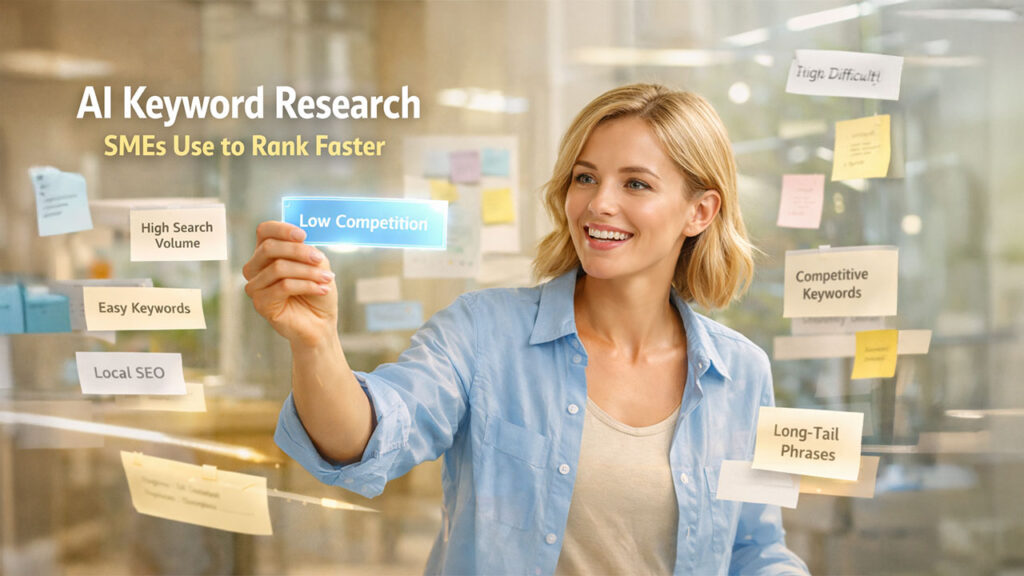
Keyword research used to be done manually by checking the number of searches, competition, and relevance. AI SEO tools have made it possible to group related keywords, establish semantic relationships, and find opportunities that would never be discovered by humans.
More importantly, AI is now able to predict keyword difficulty more accurately than ever before. Instead of focusing on keywords based on search volume alone, companies can now find opportunities where they have a real chance of ranking due to their domain authority.
Ciaran Connolly, founder of Belfast digital agency ProfileTree, has helped over 1,000 businesses with AI strategies in Northern Ireland, Ireland, and the UK. He sees keyword intelligence as the area where AI delivers the fastest ROI for smaller businesses.
"Most SMEs waste months targeting keywords they'll never rank for," says Connolly. "AI tools can analyse your actual domain authority against competitors and tell you exactly which terms are realistic targets. That single insight typically cuts wasted effort by 40-50% while improving results from day one."
Content Optimisation at Scale
AI writing assistants have moved beyond simple grammar checking. Current tools analyse top-ranking content for any keyword, identify structural patterns, suggest semantic additions, and flag gaps in topical coverage.
This doesn't mean AI writes your content. The most effective approach uses AI for research and analysis while humans provide expertise, opinions, and genuine insight. AI ensures nothing obvious gets missed; humans ensure the content actually says something worth reading.
For businesses publishing regularly, AI-assisted workflows typically reduce production time by 30-40% while improving consistency. The time savings compound — an SME publishing four articles monthly gains roughly two full working days back each month.
Technical SEO Auditing

Technical issues often hide beneath the surface until they've already damaged rankings. Crawl errors, duplicate content, slow page loads, mobile usability issues – these build up silently until a dramatic loss of traffic brings them to light.
AI-based audit tools perform continuous monitoring, detecting problems before they affect site performance. They also enable prioritization of problem fixes based on expected impact, allowing teams to allocate limited resources to where they are most needed.
The transition from traditional manual audits to continuous AI monitoring changes the nature of technical SEO from firefighting to maintenance.
Building an AI-Enhanced SEO Workflow
The goal of an effective AI application is to enhance certain processes where machine learning clearly offers value, not to replace your current process.
Phase 1: Research and Planning
Use AI to produce initial keyword lists, group them by topic and intent, and evaluate the level of competitiveness. Add human intelligence to filter for business relevance and commercial value. Apply AI to evaluate your competitors’ content strategies, including the rate at which they publish, topics, depth of content, and sources of backlinks.
Phase 2: Content Creation
Create AI-powered outlines based on the analysis of the top-ranking content. This can be a starting point, but not the final one – your personal insight and expertise should influence the final output.
While writing, leverage AI to analyse the completeness of the topic, recommend concepts to be covered, and point out areas where more information is required. Do not fall into the trap of accepting suggestions blindly – the aim is to cover the topic comprehensively, not to repeat keywords.
Phase 3: Technical Implementation
Run AI audits monthly at minimum, weekly if resources allow. Prioritise fixes based on AI-assessed impact rather than attempting to address everything simultaneously.
Use AI to monitor Core Web Vitals, mobile usability, and crawl efficiency. Set alerts for significant changes rather than manually checking dashboards.
Phase 4: Measurement and Iteration
AI is very good at finding patterns in performance data. What types of content drive the most organic traffic? What topics are seeing improving rankings versus stagnant ones? Where are competitors seeing success?
These are the kinds of questions that should be informing strategy refinement. SEO is not a one-time optimization process, but a constant process of improvement.
Learning AI for Business Growth

The organizations that are experiencing the most success with AI-Powered SEO have one thing in common: they are investing in learning about the technology, not just the tools.
Using the tools for what they are is a surface-level activity, and it will produce surface-level results. Organizations that understand how AI-driven recommendations are made, where the technology is weak, and how to integrate the insights of AI with human knowledge are going to perform better than those that are looking for magic.
Training programs can help marketing departments advance from using the tools at a surface level to using them. Future Business Academy offers AI training that is geared towards business owners and marketing professionals who are interested in learning how to do, not just learning about.
The education sector offers useful models for AI integration. LearningMole, an educational platform with over 260,000 YouTube subscribers, has successfully incorporated AI to personalise learning pathways and scale content delivery. Their strategy shows how AI can supplement human skill rather than replace it; this idea also holds true for SEO and digital marketing.
Avoiding Common AI SEO Mistakes
Implementing AI incorrectly occurs when companies sacrifice comprehension in favour of automation.
Mistake 1: Trusting AI Output Without Verification
Sometimes, AI tools can produce wrong information, especially when it comes to specific or new topics. Each AI-assisted article requires human evaluation for accuracy, not only for style.
This is especially important for companies operating in a regulated industry or making factual statements. AI tools do not check sources; that is the job of human editors.
Mistake 2: Optimising for Algorithms Instead of Readers
The tools are optimized for patterns that have been found in the top-ranking pages. However, correlation does not equal causation, and including all semantic variations is not necessarily an improvement.
The content still has to be useful, well-written, and worth the time of the reader. The AI should enhance the comprehensiveness of the content and not make articles into walls of keywords.
Mistake 3: Neglecting Human Expertise
The most effective AI-assisted content combines machine analysis with human insight. AI can tell you what topics to cover; it can't tell you what your years of industry experience have taught you about those topics.
Inject genuine expertise — opinions, observations from real projects, lessons learned from mistakes. This is what differentiates your content from the thousands of other AI-assisted pieces on the same topic.
The Competitive Window
AI tools are becoming more accessible every month. The businesses implementing them now build advantages that compound over time — better content libraries, stronger rankings, more sophisticated processes.
Those waiting for AI to "mature" will find themselves playing catch-up against competitors who learned while doing. The tools available today aren't perfect, but they're substantially better than the alternative of ignoring AI entirely.
For SMEs competing against larger organisations, AI-Powered SEO represents the most significant opportunity in a decade to close the resource gap. The question isn't whether to adopt AI for SEO — it's how quickly you can implement it effectively.
Frequently Asked Questions
Q1. How much do AI SEO tools cost for small businesses?
A1. Entry-level AI features are now built into most major SEO platforms at no additional cost. Depending on capability, dedicated AI SEO solutions cost between £30 and £200 per month. Enterprise systems with extensive features often start around £500 monthly, while SMEs rarely need this level of investment.
Q2. Can AI completely replace human SEO specialists?
A2. No, analysis, pattern recognition, and standard optimization tasks are handled by AI. Humans are vital for strategy, creative direction, quality control, and evaluating AI recommendations within business context. When combined, they perform better than when either is used alone.
Q3. How long before AI-assisted SEO shows results?
A3. Within weeks, technical advancements from AI audits can become apparent. Over the course of two to four months, content optimization usually raises rankings. With compounding benefits over time, full AI integration across all SEO efforts typically takes 6–12 months to optimize.
Q4. Is AI-generated content penalised by search engines?
A4. According to Google, quality and utility are more important than production method, thus AI-generated material isn't always penalized. Regardless of how it was produced, low-quality AI content that offers no value will find it difficult to rank. AI-assisted content that is evaluated and improved by humans—rather than entirely automated publishing—is the answer.
Q5. What skills do teams need to use AI SEO tools effectively?
A5. A basic understanding of digital marketing is enough. Knowledge of SEO basics, content strategies, and data analysis is helpful for teams. Training for specific AI tools usually requires 2-4 weeks to achieve competent levels, with continuous learning as the capabilities develop.
%201.png)

%201.png)

%201.png)