




You post articles, monitor positions, and anticipate a flow of traffic. Previously, that was a formula that had worked on. However, strong rankings are no longer enough to guarantee visits. Now, search engines will tend to respond to the query, and the user will not have to click on anything. Even so, your content may still make a difference, and you never get to know the traffic. Consequently, such disparity leaves many marketers with frustration and confusion.
As a result, AI Search Optimization is becoming a necessary shift, not just an optional tactic. Instead of chasing clicks alone, marketers are adapting content to appear inside AI-generated answers. The goal is no longer just ranking high. The goal is to become the source of AI systems to rely on when forming responses.
This article describes how AI-based search optimization is transforming digital marketing and what you should do differently.
1. Visibility Over Rankings Wins
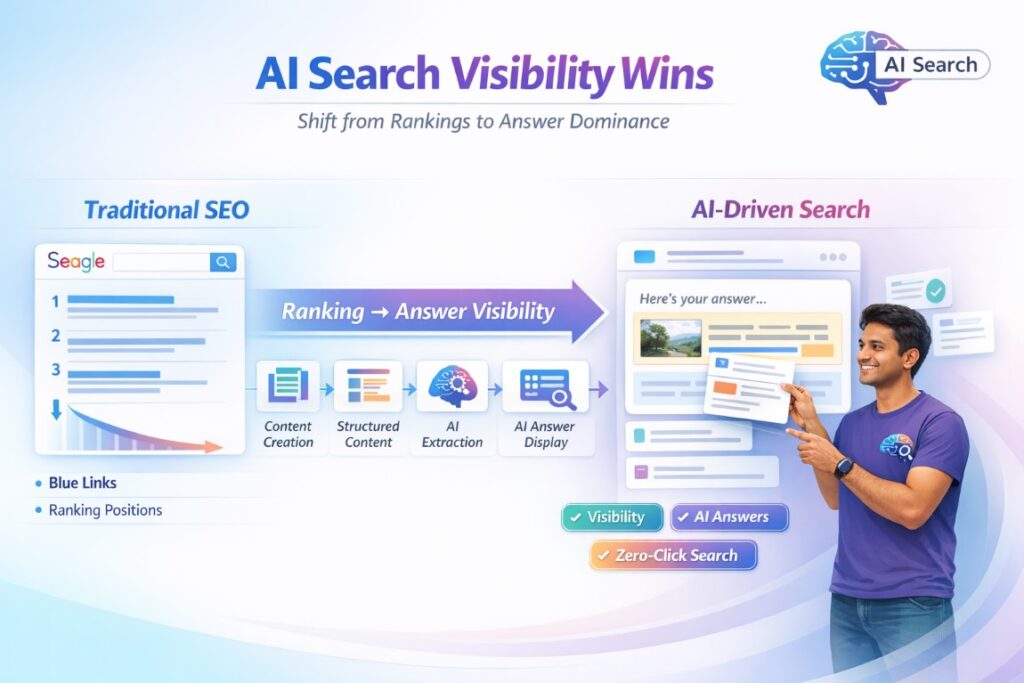
Search visibility no longer depends on where your page ranks alone. The role of search optimization has shifted from ranking pages to shaping answers.
A deeper look at this transition can be found here: AI search optimization. Search engines now assemble responses using multiple sources, often without sending users to any of them.
The traditional ranking is still important, yet it does not guarantee attention any longer. AI systems recognize important points and show them in raw form. Therefore, when your content is not a part of that synthesis, you lose visibility even when your ranking remains high. As a result, this provides an additional competitive layer within the search results themselves.
To stay relevant, content must be structured for extraction. Clear answers should appear early. Each section should solve a specific query. This approach increases the chance of being cited inside AI-generated responses rather than being ignored.
2. Answer-First Content Builds Reach
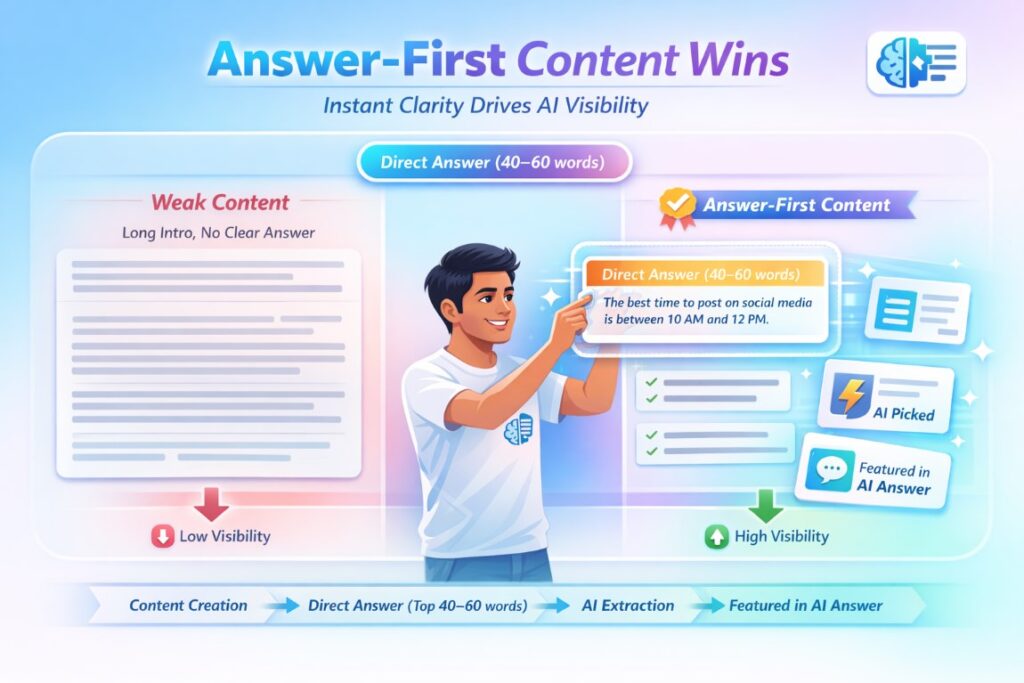
AI systems favor content that delivers immediate clarity. The first few lines of a page now carry more weight than ever. Strong pages begin with a direct answer, not a long setup. This approach aligns with how AI models scan and extract key information quickly.
A well-crafted structure will have a brief explanation in the first 40 to 60 words. This snippet serves as a pull quote for AI systems. Furthermore, whenever the answer is precise and objective, then chances are that it will be found in generated answers. In addition, it also enhances the ease of reading for users who desire snippets that can be read with speed and a lot of accuracy.
Research supports this behavior. A study found that structured, information-dense passages improve retrieval in AI-driven systems by strengthening semantic understanding and contextual relevance. Content that gets to the point performs better than content that delays the answer.
3. Two-Place Strategy Strengthens Results
Modern search works across two distinct environments. The first is AI-driven discovery. The second is your website, where deeper engagement happens. Treating these as separate but connected spaces improves performance. This separation reflects how users now interact with search in stages rather than a single journey.
The perception is answered by AI even before users get to your site. Consequently, it means that your content needs to build authority in your response itself. For businesses building AI-powered solutions, working with experienced teams can make a significant difference—explore top AI app development agencies in the USA to understand how advanced AI systems are designed and deployed. Moreover, building trust at that point is aided by clear explanations, solid facts, and consistent messaging. Therefore, when your material is absent at this point, you are losing influence even before the visit is made.
Your website then handles conversion. Once a user decides to explore further, the experience must continue smoothly. Pages should expand on the initial answer, offer proof, and guide action. This two-place strategy aligns with how users now move through search.
4. Measurement Models Need Update
Old metrics focused on clicks and rankings. AI search requires a broader view. Many interactions now happen without a visit, so traditional dashboards miss key signals. This creates blind spots in performance analysis for modern search strategies.
The indicators introduced are the frequency of your content in AI summaries and, additionally, the frequency of references to your brand. While these indicators are not an indication of traffic, they do measure influence. Although they are more difficult to trace, they are more compatible with the processes of decision-making. Furthermore, they further give a more articulate perspective on brand presence in AI-based interfaces.
A study highlights how AI-driven search relies on contextual relevance over keyword matching, using intent signals, user context, and behavioral patterns to refine results. That shift reinforces the need to measure presence within answers, not just position in rankings.
5. Trust Signals Improve Selection
AI systems do not just look for relevance. They look for credibility. Content with clear sourcing, logical structure, and consistent accuracy is more likely to be selected. This makes trust a key factor in whether your content is surfaced or ignored.
Structured data plays a role here. Schema markup helps define context, but clarity in writing matters just as much. Well-organized sections, precise language, and supported claims improve trust. These elements help AI systems interpret and validate your content more efficiently.
Adding evidence strengthens performance. Data points, examples, and references signal reliability. Over time, consistent quality builds recognition, increasing the chances of being included in AI-generated responses. This also reinforces long-term authority across multiple search interactions.
Conclusion
AI search optimization changes how visibility works. Rankings still matter, but they no longer define success. Content must now earn placement inside AI-generated answers. That requires clarity, structure, and depth. Strategies like answer-first formatting and the two-place model reflect how search actually functions today.
Start with one practical step. Rewrite key pages so the main answer appears in the opening lines. Then build supporting sections that expand on that answer. This simple shift improves both AI visibility and user experience without requiring a full overhaul.
%201.png)

%201.png)

%201.png)