



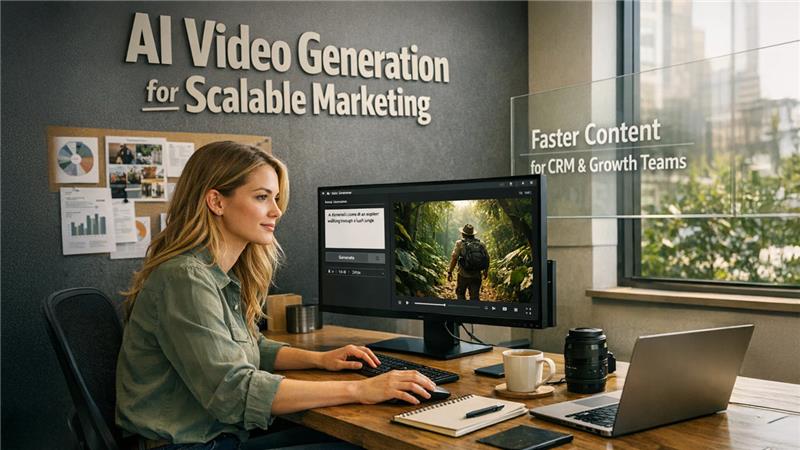

For a lot of time, generating video content was generally seen as a task that can only be done by professionals. It needed professional editing software, technical knowledge, and substantial time investment. As AI-driven creative platforms evolve consistently, such barriers have started to diminish.
Platforms like AI Ease showcase how AI video generation can streamline the process, enabling teams to efficiently create visual content without depending on advanced technical skills or complex workflows.
Free Trial Options for Exploration
Numerous AI video platforms give limited credits in free trials, allowing teams to experiment with AI video creation before dedicating themselves to a subscription. This approach enables businesses to assess generation speed, video quality, and workflow compatibility in real cases without substantial financial risks.
Diverse trial options are specifically valuable for small businesses, startups, and CRM teams looking to integrate video content into their plan without overcommitting resources.
Efficiency for Content-Driven Teams
Speed is essential in marketing and CRM operations. A professional AI video generator can create videos in just a few minutes based on a text prompt or uploaded image. This efficiency enables teams to repurpose available assets which include campaign copy, sales scripts, or product visuals into dynamic video content with minimum effort.
Numerous AI Models for Flexibility
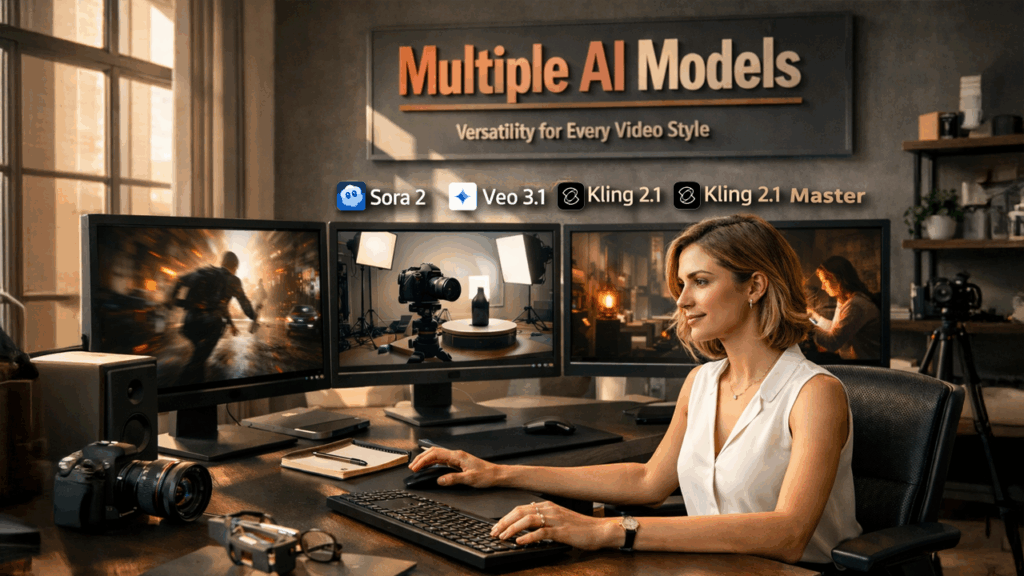
A notable feature of some AI video platforms is multi-model support. Distinct models ensure diverse strengths in realism, motion quality, and artistic style. For example, prominent models involve Veo 3.1, Sora 2, and Kling 2.1 Master, which can create cinematic visuals, creative storytelling, and realistic product presentations.
Having different models in their arsenal helps the teams to experiment with distinct visual approaches without requiring in-depth technical skills of each model, ensuring flexibility for a wide range of content requirements.
Supported Text-to-Video and Image-to-Video
Modern AI video platforms generally support both Image-to-Video or Text-to-Video workflows:
- text-to-Video: Transform written text, clearly expressed ideas, marketing copy, or CRM scripts into dynamic visual sequences.
- Image-to-Video: Convert static images in motion-driven visual content.
This dual capability allows teams to create a broad range of visual assets without depending on conventional resources of video production.
ROI Potential and Cost Considerations
Conventional production of videos is generally costly. You would have to hire videographers, rent equipment, secure different locations, and dedicate hours in post-production editing. For businesses who create content regularly, such expenses can combine and can even overload your marketing budgets.
AI video generation ensures a distinct economic model. By removing a lot of these overhead expenses, businesses can focus their budget on content strategy, distribution, and performance optimization. The cost per video significantly decreases, making it possible to create customized content for distinct customer segments, experiment with different creative approaches, or ensure consistent output across diverse channels.
Specifically, for CRM teams, this can create opportunities to improve various customer touchpoints with video content now more accessible. You can create product tutorials, welcome sequences, and upsell campaigns, offering visual elements without even needing dedicated resources for production in any of the initiatives. The ROI naturally becomes better and more measurable when teams have the ability to create large volumes of content while tracking engagement metrics across diverse campaigns.
Ensuring Brand Consistency Across Various Video Content
One of the core challenges that marketing teams often deal with when scaling content production is ensuring consistent messaging and visual identity. AI video platforms resolve this through features aligned with brand standardization.
Teams can create prompt templates that prefer visual styles, brand guidelines, and messaging frameworks. Such templates help in generating videos that comply with defined brand standards, even when different team members create content. Pacing preferences, color schemes, and tonal qualities can be given in the prompt to ensure cohesion across different video assets.
In addition, the capability to create diverse variations from similar prompts enables teams to perform A/B testing of their creative approaches while ensuring that their brand elements remain consistent. It is a systematic approach for content creators that support both control and creativity, allowing teams to experiment within defined brand parameters.
Simplified Workflow
The usual workflow for AI video creation is very simple:
- Choose a visual style or model.
- Provide a text prompt or upload an image
- Configure parameters like video ratio and duration.
- Create the video
This simplified process minimizes dependence on complex editing software, enabling teams to emphasize on content strategy instead of technical implementation.
Practical Applications for CRM and Marketing
AI video generation can render support to diverse applications in CRM and marketing contexts:
- Converting sales scripts into explainer videos
- Creating videos for campaigns in email or social media
- Improving product education and customer onboarding
- Improving engagement with short-from storytelling videos.
By minimizing production complexity, such tools allow teams to pay more attention to strategic planning and customer engagement. For teams that look to further simplify their workflow, integrating CRM with marketing automation can improve efficiency and enhance client outcomes across diverse channels.
Conclusion
As video continues to dominate online communication, AI video creation tools provide an effective way to create content at a large scale. Key characteristics like rapid creation, free trial credits, quick creation, and dual Text-to-Video/Image-to-Video make it easy for teams to grow their video output without greatly incurring costs or technical demands.
Platforms like AI Ease demonstrate how AI video generation can integrate into modern marketing and CRM workflows, providing a flexible and scalable approach to visual content creation.
%201.png)

%201.png)

%201.png)