





Healthcare is changing fast, and one of the biggest changes is how clinics manage patient records. The traditional Electronic Health Record system helps clinics get away from using paper. They still have a lot of work to do by hand.
Now, Electronic Health Record systems that use Artificial Intelligence are changing how clinics handle their paperwork, daily tasks, and patient care. These Electronic Health Record systems are made to save time, reduce stress, and make things work overall.
For clinics, the small ones choosing between Artificial Intelligence and traditional Electronic Health Record systems is not just about the software. It is about how the whole clinic will work in the future.
What Is a Traditional EHR System?
A traditional Electronic Health Record system is used to store records on a computer. It gets rid of paper files. Doctors and staff still have to type in a lot of information by hand.
In a lot of clinics, doctors and staff spend time typing up notes and updating patient records. They also have to select templates and fill out paperwork. Even though everything is on the computer, the Electronic Health Record system is still a lot of work. Clinics that want more control over these processes often turn to Custom EHR Software to better match their specific workflows.
Traditional Electronic Health Record systems do not do everything together. They separate things like getting information, writing down what happened during a visit, and sending bills. This means that staff have to enter the information multiple times, which makes things slower. The Electronic Health Record system is supposed to help. It can still be pretty slow.
What Is an AI-Powered EHR System?
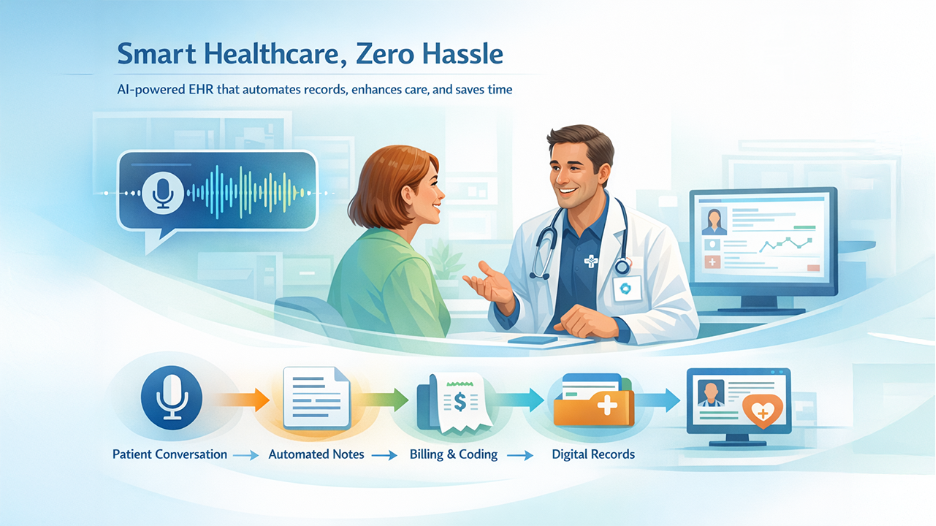
An electronic health record system that uses intelligence is made to do more than just hold information. It helps offices do daily tasks automatically and cuts down on the amount of work that people have to do by hand.
For example, in a system that handles records for functional medicine, EMR can listen to what patients say, make notes that are easy to understand, and connect that information right to the billing and patient records. This is really helpful for offices that give patients very detailed and personalized care.
By using strict forms, doctors can pay attention to patients while the system takes care of the paperwork in the background. This makes everything run smoothly and quickly for the electronic health record system and the doctors who use it.
AI vs Traditional EHR: Key Differences
Documentation Process
Traditional EHR systems make doctors type or dictate notes and then format them on their own. This usually takes time after seeing a patient.
AI EHR systems can turn conversations into notes right away. These notes can be edited if necessary.
Some key benefits are:
- Doctors do manual typing
- Notes are ready sooner
- There is charting to do after hours
Workflow Integration
In the way of doing things, people had to deal with patient intake, notes, and billing separately. The staff had to jump forth between these tasks and do the same work over again.
AI systems make this a lot easier, by putting everything in one simple process. This means that information gets passed from one step to the next automatically so people do not have to enter it than once. For clinics looking to go further, CRM Automation in Healthcare can connect these workflows with patient management and billing systems seamlessly.
Important points:
- Patient intake gets put into the system and updates the patient charts
- Billing is connected to the notes
- This way, there are fewer mistakes and less work that has to be done twice with patient intake, billing, clinical notes, and patient charts, and all that.
Time Efficiency
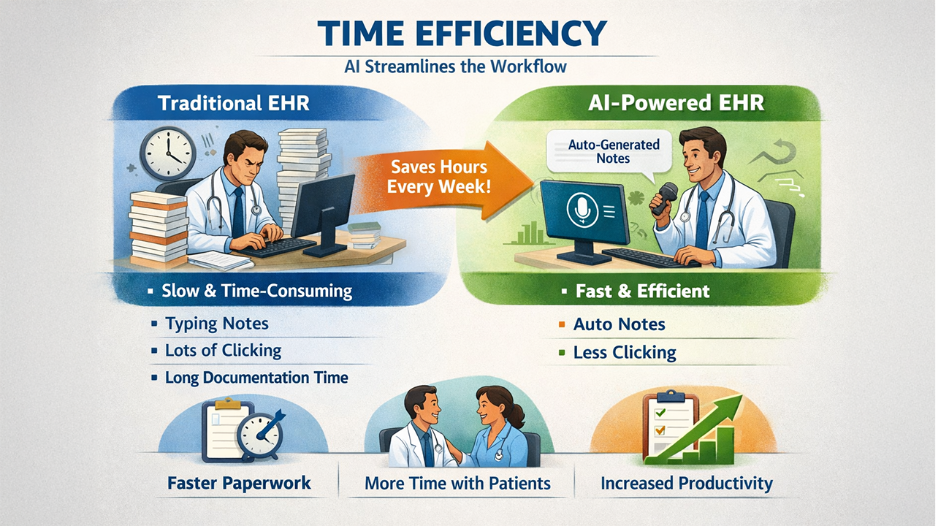
Traditional Electronic Health Records take a lot of time for each patient. This is because doctors have to write down a lot of information by hand and click around the system a lot. It can really slow down the clinic.
AI systems help save time. They do this by creating notes and making it so doctors don't have to click as much. Some clinics say they save a few hours every week.
The benefits are:
- Faster paperwork
- More time to take care of patients
- More work gets done every day
Provider Workload
Traditional electronic health record systems make things harder for doctors because they have to take care of patients and do paperwork at the same time. This can be really tough. Lead to doctors feeling stressed out and exhausted.
AI electronic health record systems help with this problem by doing tasks that need to be done over and putting information in order all by themselves.
- Lower administrative burden
- Less mental fatigue
- work-life balance for doctors who use electronic health record systems, like these AI electronic health record systems.
Scalability
As clinics get bigger, the old way of doing things needs a lot of work from people, which can make things slower and more expensive.
The clinic can handle patients, and this is because AI systems do a lot of the work for them.
This means the clinic does not have to hire a lot of people to get the work done.
- The clinic can handle patients.
- The clinic does not need to hire staff.
- The clinic works well even when it gets bigger.
AI vs Traditional EHR: Quick Comparison Table
| Feature | Traditional EHR | AI EHR |
| Documentation | Manual and time-consuming | Automated and fast |
| Workflow | Separate processes | Fully connected |
| Time per patient | Higher | Lower |
| Workload | High | Reduced |
| Accuracy | Depends on user | AI-assisted accuracy |
| Growth handling | Limited | Scalable |
Benefits of AI EHR for Clinics
Artificial intelligence electronic health record systems are really good for clinics that want to get things done faster and take care of patients. This is especially true for clinics that do not have a lot of staff.
Artificial intelligence helps doctors by reducing the time they spend writing things down, so they can spend time with patients and less time looking at screens. It also makes sure the information is correct by putting it in order and reducing mistakes that people make.
Another big advantage is that clinics can send out bills faster. Since artificial intelligence connects the notes that doctors take with the bills, clinics can get paid faster. There will be fewer mistakes.
Overall, artificial intelligence systems help clinics work better, save time, and make things less stressful for the people who work there and the doctors who provide care.
Challenges of Traditional EHR Systems
- Traditional EHR systems still work, but have limitations, especially as clinics grow
- Data entry is time-consuming and takes away time from patient care
- Workflows are not fully connected, causing repeated tasks
- Inefficiencies lead to delays and a higher chance of errors
- Providers often experience burnout due to after-hours documentation
How Artificial Intelligence Is Changing Clinic Operations
Artificial Intelligence is not just making Electronic Health Record systems better. It is changing the way clinics work every day. This means clinics can work efficiently because Artificial Intelligence reduces the need for people to do tasks by hand.
Artificial Intelligence can do things like schedule appointments. Talking to patients helps the people at the front desk. It also makes sure that everything is written down by listening to conversations and turning them into notes that make sense.
Also, Artificial Intelligence helps doctors make decisions by looking at patient information and pointing out important things. This means patients get care and their health gets better.
Future of Electronic Health Record Systems
Healthcare technology is moving towards systems that use Artificial Intelligence. More clinics are using Artificial Intelligence to work and have less work to do.
In the years to come we can expect to see things like talking to computers to write down information, using numbers to predict what might happen, and having computers do all the work automatically become normal.
Clinics that start using Artificial Intelligence soon will be better at getting things done, making patients happy, and doing a good job overall because they are using Artificial Intelligence.
Conclusion
The AI vs traditional EHR systems are not just about technology; it is about how a clinic runs daily. Traditional EHRs helped move healthcare to digital, but they still depend a lot on manual work and time-consuming tasks.
AI EHR systems improve this by automating documentation, connecting workflows, and reducing admin work. This helps clinics save time, lower stress, and focus more on patient care, making AI a smarter choice for growing clinics.
%201.png)

%201.png)

%201.png)