




Small businesses rely on video more than ever to explain products, educate customers, and drive conversions. For years, platforms like Vimeo and Wistia have been the default choice for hosting and publishing those videos. However, as video becomes more central to marketing, product, and customer success workflows, many teams are starting to feel constrained by tools that were built for a very different stage of growth.
What often begins as a simple hosting decision turn into a broader operational challenge. Rising costs, limited control over playback environments, basic analytics, and weak security options make it harder for small businesses to treat videos as a measurable, high-impact business asset. Teams want faster playback, better branding control, stronger protection for gated content, and clearer insight into how videos influence sign-ups, demos, or revenue. Vimeo and Wistia can cover some of these needs, but rarely all of them in a way that scales cleanly.
That shift has led many small businesses to actively seek alternatives beyond basic video hosting. The best Vimeo and Wistia alternatives today focus on performance, ownership, security, and analytics, without adding unnecessary complexity or enterprise-level overhead. In the sections that follow, we break down five of the most practical alternatives for small businesses, starting with the option that offers the most complete balance of speed, control, and business-ready video infrastructure.
How We Evaluated Vimeo and Wistia Alternatives
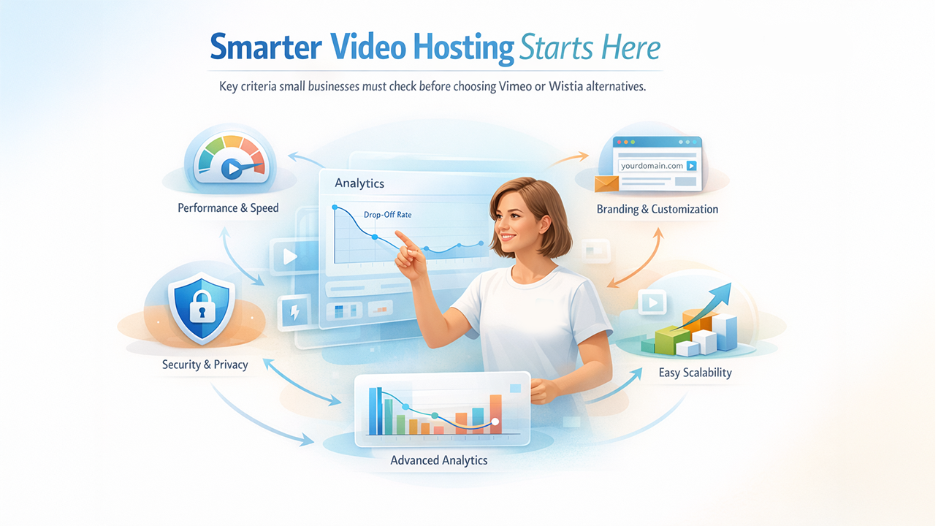
Not every video platform is built with small businesses in mind. Some prioritize developers, others cater to media publishers, while many focus narrowly on marketing teams. To identify alternatives that genuinely replace Vimeo and Wistia for small businesses, the evaluation needed to go beyond feature lists and pricing pages.
The first factor was video performance and reliability. Slow startup times, buffering, or inconsistent playback directly impact viewer engagement and conversion rates. Platforms were assessed on how well they deliver video across regions, devices, and bandwidth conditions, especially during traffic spikes.
Next was control over branding and distribution. Small businesses increasingly want their videos to live on branded domains, inside their own products, or across landing pages without third-party logos or distractions. Ownership of the player experience and flexibility in embeds mattered more than surface-level customization.
Security and access control also have an important role to play. Even those businesses that just started now deal with gated demos, paid content, internal training, or proprietary product videos. The criteria to evaluate platforms was whether they support secure delivery without complex setup, prevent unauthorized sharing, and enable access restrictions.
Analytics and business visibility are another key criterion. Keeping a basic view count alone is not enough. The strongest alternatives offer meaningful insights into viewers' behavior such as how they interact with videos, where they drop off, and whether engaging with videos drives connections to downstream actions like sign-ups or submissions.
Lastly, easy adoption and scalability are also considered. Using videos is essential for marketing, product, and customer success. That’s why small teams require more advanced tools to work which do not feel limiting. Elements such as clear pricing structure, lower operational overhead, and the ability to scale without replatforming are essential.
Small businesses are increasingly using video animations to market their business from product demos and explainer videos to brand storytelling which makes finding a hosting platform that can reliably deliver all of that content even more critical.
Using these criteria, the following platforms stood out as the most practical and future-ready Vimeo and Wistia alternatives for small businesses.
1. Gumlet: The Most Complete Vimeo and Wistia Alternative for Growing Businesses
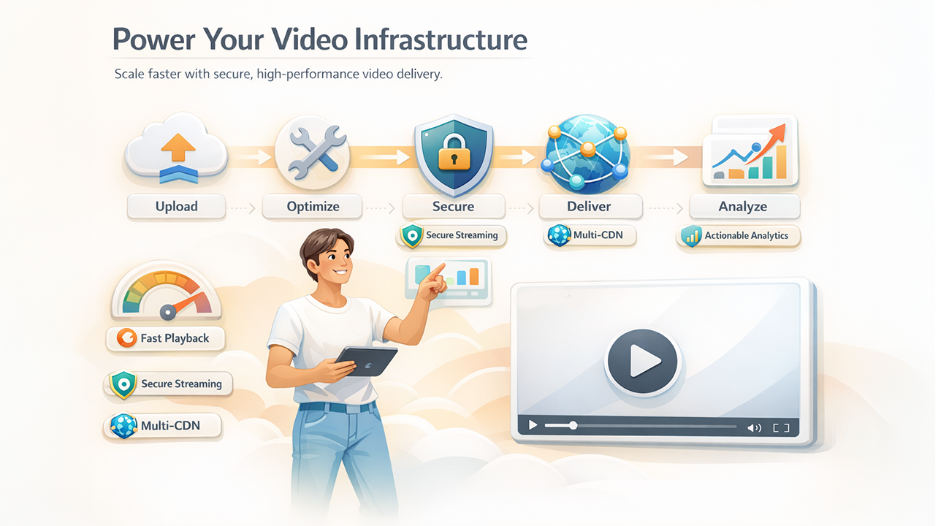
Gumlet stands out as the most well-rounded alternative to Vimeo and Wistia for small businesses that want more control over how video is delivered, protected, and measured. Rather than positioning video as a standalone marketing asset, Gumlet treats it as core infrastructure that supports marketing, product, education, and customer engagement use cases from a single platform.
Gumlet is an end-to-end video hosting platform for businesses that need speed, control, security, and measurable outcomes from video.
One of the primary reasons businesses move away from Vimeo or Wistia is performance inconsistency as video usage grows. Gumlet offers fast, reliable playback with adaptive bitrate streaming and a multi-CDN setup. This allows videos to load faster and play smoothly across geographies and devices. This reliability becomes a measurable advantage for small businesses that serve global users or run high-traffic campaigns.
Gumlet stands out from its competitors as it provides control over the viewing experience. With this, videos can be embedded on branded domains with a clean and distraction free player. This gives businesses the full ownership of how their content is displayed across landing pages, websites, help centers, and in-product surfaces. For companies that are dependent upon product demos, onboarding videos, or gated educational; this level of control is important.
Many small teams consider security an afterthought. Until their content starts leaking or being shared beyond its intended audience, teams do not think about security. However, Gumlet provides built-in protections along with tokenized URLs, domain and IP restrictions, and advanced access controls. With these high-end capabilities, businesses can confidently and securely host paid courses, internal videos, or customer-only resources without having to rely on complex configurations or third-party plugins.
Analytics and business visibility are where Gumlet actually differentiates itself consistently. The platform offers more than just limiting insights into basic engagement metrics. It provides in-depth visibility into how viewers usually interact with videos, including where they drop off and their browsing behavior. This helps teams understand which videos are driving conversions, supporting onboarding success, or contributing to customer retention. These videos then are treated as a measurable part of the funnel rather than an isolated content format.
As teams increasingly use AI video generation to scale marketing content from product explainers to onboarding sequences; Gumlet provides the infrastructure to host and deliver that growing volume without compromising performance or control.
To start simple and scale without encountering major problems is significantly important for small businesses. Gumlet is easy to adopt even by non-technical teams as it has ready-to-use embeds and dashboards. It also offers APIs and automation for product and engineering teams as their needs evolve with time. This balance makes it particularly suitable for growing companies that want a long-term Vimeo or Wistia replacement rather than a short-term workaround.
Small businesses that are looking for a platform that blends security, performance, branding, control, and actionable analytics in a unified system, Gumlet emerge as the most comprehensive alternative to both Vimeo and Wistia.
2. Mux: A Strong Vimeo and Wistia Alternative for Developer-Led Teams
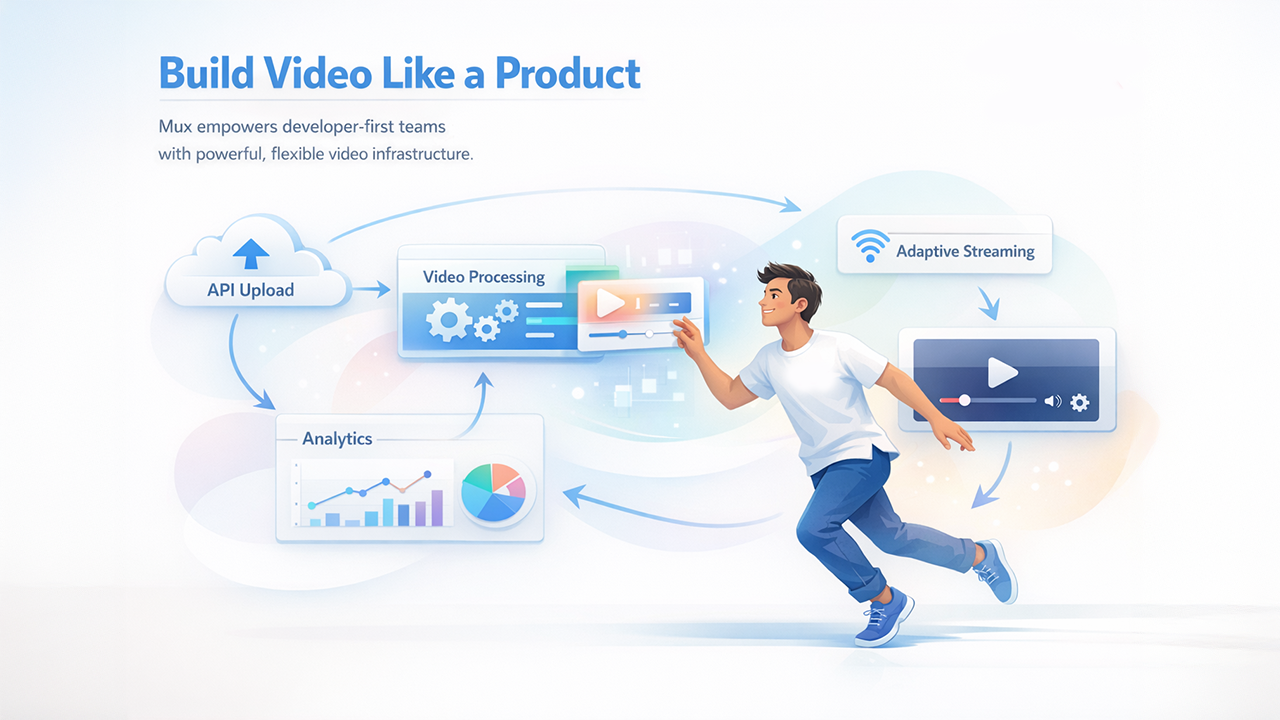
Mux works best for those businesses that view video as a major part of their product experience instead of only considering marketing channels. Vimeo or Wistia focuses heavily on publishing and presentation that are out-of-the-box while Mux positions itself as a developer-first video infrastructure platform that is designed to be embedded in applications and workflows.
This platform has features or capabilities such as programmatic video management, API-driven uploads, and fine-grained control over playback with custom applications. This level of flexibility can be beneficial for small businesses with in-house engineering resources, especially when they build video-heavy products, internal tools, or customized user experience that goes beyond standard embeds.
Performance-wise, Mux provides stable streaming and adaptive playback that are expected in modern web and mobile applications. Video quality and playback are relatively stable, making it a good alternative for teams that have outgrown Vimeo or Wistia in terms of technical capabilities.
However, Mux may not always be the most convenient choice for teams that are not technical. Marketing and growth teams may find the lack of publishing features, branding, and analytics to be limited without additional engineering resources. While Mux provides raw data and monitoring, deriving meaningful marketing or conversion insights can be a custom engineering task.
Mux can be a good alternative for product-led and engineering-driven small businesses looking to replace Vimeo or Wistia. For teams looking for a more balanced platform that serves both technical and go-to-market needs without heavy development overhead, it may introduce more complexity than necessary.
3. Cloudflare Stream: A Lightweight Alternative Focused on Global Performance
Cloudflare Stream appeals to small businesses that prioritize fast, globally distributed video delivery and predictable pricing. Built directly on top of Cloudflare’s infrastructure, it offers reliable playback with minimal setup, making it an attractive option for teams that want to move away from Vimeo or Wistia without introducing operational complexity.
The most significant strength of Cloudflare Stream is its ability to perform well no matter which region it is used in. Videos are also aided by the presence of the Cloudflare network around the globe, which can help minimize latency and loading times for viewers. This can make a significant difference for businesses that have viewers from all over the world.
Cost-wise, Cloudflare Stream is often viewed as transparent and simple. The pricing is usage-based and easy to understand, which may be attractive to small teams working with tight budgets or unpredictable traffic patterns. This is in contrast to the tiered pricing models that tend to migrate businesses to higher tiers as video usage increases.
However, Cloudflare Stream is designed to be quite bare-bones in terms of functionality. The ability to customize branding, player functionality, and publishing tools is limited compared to more robust video platforms. Analytics tools are available but very basic, focusing on delivery and engagement rather than viewer behavior or conversion data. For marketing teams using video to generate leads, demos, or onboarding, these limitations may become apparent over time.
Cloudflare Stream is best suited for small businesses that require fast and secure video delivery and are comfortable with video as an infrastructure component rather than a growth driver. Additional tools may be needed for teams requiring more advanced engagement analytics or marketing-oriented workflows.
4. JW Player: A Familiar Option for Content and Media-Driven Businesses

JW Player is a well-established video platform that many companies will recognize as having been widely used on media and publishing sites. As a competitor to Vimeo and Wistia, it is likely to appeal to small businesses that create a regular stream of content and are looking for a tried-and-tested way to host and monetize their videos.
The service provides a robust video player, dynamic streaming, and functionality tailored to content-driven workflows, such as playlists and ad support. For companies that function more like digital media publishers, these features alone could make JW Player a viable option, particularly if video views and content distribution are the top objectives.
Where JW Player is showing its age is in terms of flexibility and ease of use for smaller teams. The setup process can be a bit more complex than some of the newer platforms, and the overall experience may take longer to customize to suit the needs of the business. Although it has analytics, these are typically more focused on media than on business results.
Branding and control are an option but usually require extra setup, and more advanced security options may not be as easily accessible to small businesses as they are to larger companies. This means that JW Player may be a good option for teams that are already thinking about media operations, but it may feel like overkill for businesses that are simply looking for a new, all-in-one Vimeo or Wistia solution.
For small businesses that have a strong publishing focus, JW Player is still a viable alternative. For those that value simplicity, stronger business analytics, and quicker time-to-value, other options may be more suitable.
5. Bunny Stream: A Budget-Friendly Alternative for Simple Video Hosting
Bunny Stream is often considered by small businesses that are primarily motivated by cost efficiency and straightforward video delivery. As a viable alternative to Vimeo and Wistia, it is more concerned with offering the bare essentials of video hosting without the overhead and pricing complexity that comes with more feature-rich services.
The service offers good streaming performance and is tightly integrated with Bunny.net’s CDN, which helps to ensure smooth playback around the world. For teams that need to host a library of videos for websites, documentation, or basic educational content, this level of performance is typically adequate.
The simplicity of Bunny Stream is both its benefits and drawbacks. Although it provides basic hosting requirements, it provides less functionality in terms of branding, analytics, and marketing. The analytics information for viewers is more about usage than behavior, making it difficult to analyze the contribution of video towards conversions or engagement in the funnel.
Security options are provided, but they are less advanced compared to those offered by platforms that are designed with gated or high-value content in mind. For businesses that rely on video for internal training, customer onboarding, or paid access, these constraints can become more apparent as usage grows.
Bunny Stream is well-suited for small businesses looking for a low-cost alternative to Vimeo or Wistia and are comfortable trading advanced functionality for affordability. For teams that expect video to play a more strategic role in growth or customer experience, it may serve as a short-term solution rather than a long-term platform.
Quick Comparison: Vimeo and Wistia Alternatives at a Glance

While all five platforms can replace Vimeo or Wistia in specific scenarios, they are built for very different priorities. Some are centered around infrastructure and developer control, while others are centered around cost efficiency, and a few seek to optimize for performance, security, and business insights.
In the case of small businesses, the main point of differentiation will be the importance of video to the business. Organizations that view video as a strategic business resource will find value in solutions that provide excellent playback experience, full branding capabilities, security features, and analytics that link viewing behavior to business outcomes. Solutions that are more infrastructure- or media publishing-focused may be suitable for more limited use cases but may require additional software or development work to provide the same level of business insights.
It is this point of differentiation that distinguishes lightweight hosting solutions from solutions that enable marketing, product, and customer success workflows in a single platform.
Vimeo and Wistia Alternatives Compared
| Platform | Best For | Branding Control | Security & Access Control | Analytics Depth | Setup Effort | Key Trade-Off |
| Gumlet | Small businesses using video for marketing, product, onboarding, and education | Branded player, custom domains, clean embeds | Tokenized links, domain and IP restrictions, DRM, dynamic watermarking | Viewer heatmaps, engagement analytics, event tracking, attribution-ready | Low to Medium | More capability than basic hosts, requires minimal initial setup |
| Mux | Engineering-led teams building video deeply into products | Fully custom via APIs | Secure delivery through programmatic controls | Raw playback and performance data requires custom analytics layer | High | Powerful, but depends heavily on engineering resources |
| Cloudflare Stream | Teams prioritizing fast global delivery and simple pricing | Limited player customization | Basic access control tied to Cloudflare infrastructure | Delivery-focused metrics, limited viewer behavior insight | Low | Lacks marketing and conversion-focused analytics |
| JW Player | Content-heavy or media-style businesses | Configurable player with legacy workflows | Available but often enterprise-oriented | Media performance and monetization analytics | Medium to High | Heavier platform for small teams |
| Bunny Stream | Cost-conscious teams needing basic video hosting | Basic branding options | Basic security features | Usage-level metrics only | Low | Limited insights and growth-oriented features |
Pick the Right Platform in 60 Seconds
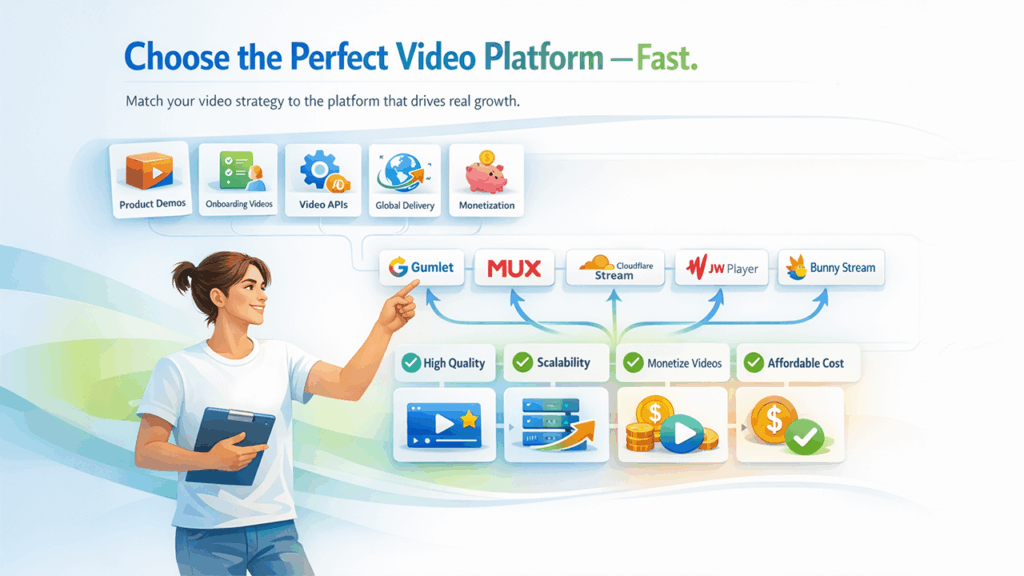
If you are looking for Vimeo and Wistia alternatives, the quickest way to begin to shortlist your choices is to think about how your business uses video. Every option on this list is designed for a different core purpose.
- If your videos are used across product demos, onboarding, help centers, landing pages, or gated customer content, and you need fast playback, branded embeds, strong access control, and analytics that show how video impacts sign-ups or conversions, Gumlet is the most practical choice. It is designed for businesses that want to treat video as part of their growth and product stack, not just a hosting layer.
- If your team is engineering-led and video needs to be deeply embedded inside a custom application using APIs, with full control over workflows and playback logic, Mux is a strong fit. It works best when you are comfortable building your own publishing, analytics, and user-facing experiences on top of raw video infrastructure.
- If your primary requirement is globally fast video delivery with simple, usage-based pricing and minimal configuration, Cloudflare Stream is a sensible option. It is well-suited for teams that care more about delivery performance than branding, marketing workflows, or detailed viewer behavior.
- If your business operates more like a digital publisher and you focus on distributing a large volume of video content with advertising or media-style monetization, JW Player remains a capable solution. It is best for content-heavy teams that prioritize reach and playback at scale over simplicity and business attribution.
- If your goal is to replace Vimeo or Wistia at the lowest possible cost and you only need basic video hosting without advanced analytics, security, or personalization, Bunny Stream can work as a budget-friendly alternative. It is most effective when video plays a supporting role rather than a strategic one.
For most small businesses that rely on video for growth, education, and customer experience but do not want to manage multiple tools or complex setups, Gumlet offers the most balanced combination of performance, control, security, and measurable outcomes, and is the best alternative to Vimeo and Wistia out there.
Which Vimeo or Wistia Alternative Is Right for Your Business?
Choosing the right alternative depends less on feature volume and more on how your business uses video today and plans to use it in the future.
If your team is product-driven and engineering-intensive, a developer-first platform may provide strong customization capabilities if you are willing to build internal workflows around it. For teams that value performance and cost predictability above all else, infrastructure-optimized solutions will address those requirements with minimal overhead.
The reality is that most small businesses will fall somewhere in between. They will use video for product demos, onboarding, educational content, and marketing, but they won’t want to have to deal with multiple tools. In those cases, platforms that combine fast delivery, strong security, branded publishing, and actionable analytics tend to offer the most long-term value.
For businesses in this category, Gumlet consistently emerges as the most complete Vimeo and Wistia alternative. It delivers the performance and reliability expected from modern video infrastructure while giving non-technical teams the tools they need to measure impact, protect content, and maintain full ownership of the video experience.
Final Thoughts
Vimeo and Wistia helped define how small businesses adopted video, but the expectations around video have changed. Today, video is no longer just about hosting or playback. It plays a direct role in conversion, retention, education, and brand perception.
The strongest alternatives understand this paradigm shift and position video as an integral part of the business stack, rather than a separate add-on. By considering platforms from the perspective of performance, control, security, and results, small businesses can make an informed decision that meets their needs today and tomorrow.
As video continues to influencex the way customers discover, assess, and trust software products, making the right platform choice becomes a sound business decision. The platforms listed above provide a solid roadmap ahead, with Gumlet being the most well-rounded option for small businesses seeking to outgrow the limitations of Vimeo and Wistia.
%201.png)

%201.png)

%201.png)