


The typical "best image CDN" roundup is written for a SaaS product team managing a few hundred UI assets and a couple of marketing hero images.
It benchmarks free tier limits, compares the quality of JavaScript SDKs, and usually lands on the cheapest option because nothing in the evaluation puts any real pressure on the infrastructure.
If you run technology for a news organization, a travel magazine, or a hotel brand, that list is close to useless.
Your image library operates differently. Thousands of high-resolution photographs move through your pipeline every week, uploaded by editorial photographers working under deadline pressure with files that often exceed 5 MB each. A breaking news story can send traffic through the roof in under ten minutes. Your readership is distributed across time zones, devices, and connection qualities that vary from fiber in Seoul to mobile data in Lagos.
And on top of all of that, many publishing teams are already running Imgix and starting to feel the friction of a credit-based pricing model that makes sense at a smaller scale but compounds unpredictably as volume grows.
According to HTTP Archive's Web Almanac, images remain the single largest contributor to page weight on both desktop and mobile sites. That makes your image delivery layer a direct input into Core Web Vitals, search visibility, and the ad impressions your pages generate per session. Choosing the right image CDN for a media property is not a background infrastructure call. It is a revenue decision.
For publishers thinking through this at a foundational level, understanding the full scope of image optimization for mobile UX, from format conversion and adaptive compression to edge delivery architecture, is the right starting point before any vendor comparison.
The platforms covered below are the ones that show up in real publishing and hospitality technology stacks. The criteria are the ones media engineering teams actually use to make the final call.
The Short Version
For news sites, travel publishers, and hotel brands, the image CDN decision comes down to three variables that generic comparison guides ignore: how your CDN behaves under traffic spikes, whether it delivers AVIF and WebP at acceptable compression quality on large editorial files, and whether it supports custom domain delivery without an enterprise contract. Of the platforms compared here, Gumlet and Fastly are the strongest fits for media-scale operations, with Gumlet offering the more accessible entry point for mid-market publishers.
Key Takeaways
- News sites, travel publishers, and hotel brands face image delivery pressures that generic CDN comparison guides are not designed to address: traffic spikes that can exceed several hundred percent in minutes, high-resolution editorial photography that punishes poor compression algorithms, and global audiences concentrated in regions where many CDN networks are thin on edge coverage.
- Brand integrity requirements make a vendor-branded delivery URL a non-starter for most media properties. Custom domain (CNAME) support is a baseline expectation, not a premium feature.
- This comparison evaluates six platforms: Imgix, Gumlet, Cloudinary, ImageKit, Cloudflare Images, and Fastly Image Optimizer against four criteria that actually move the needle for publishing operations: global PoP distribution, compression quality on large-format originals, custom domain support, and pricing predictability at high volume.
Why Media Publishers Have Different Image CDN Requirements

Most image delivery platform comparisons treat a travel magazine and a SaaS onboarding flow as identical consumers of CDN infrastructure. They are not, and the gap matters enough to separate the right choice from a very expensive mistake.
Media publishers face a specific combination of pressures: burst traffic behavior tied to news cycles and content virality, very large original files from professional photography pipelines, audiences spread across geographies where CDN coverage varies dramatically, and brand consistency requirements that extend all the way to the delivery URL.
The four criteria that separate a meaningful evaluation from a generic feature checklist for this audience are global PoP (Point of Presence) distribution, compression quality on high-resolution originals, CNAME (Canonical Name record) support for custom delivery domains, and pricing structure at publishing-scale bandwidth volumes. Each one is worth examining before the comparison table makes them concrete.
Volume, Velocity, and the Breaking News Problem
There is a fundamental asymmetry between how media sites experience traffic and how most CDN infrastructure is benchmarked.
Standard CDN performance metrics are built around consistent, predictable load. Media properties do not have consistent, predictable load. They have a baseline that holds steady for most of the day, and then a breaking story drops and the traffic curve goes nearly vertical.
News sites and large digital publishers can see traffic surge by several hundred percent within minutes of a major event, as documented across election night coverages and major breaking news cycles tracked by infrastructure providers. Every one of those requests hits your image layer before anything else reaches the user.
An edge delivery network that handles steady-state traffic cleanly but cannot absorb sharp regional spikes without degraded cache hit rates is a liability during the moments your audience is largest.
Multi-CDN failover behavior, intelligent load balancing across regional clusters, and published 99.9-plus percent uptime SLAs all belong in the evaluation alongside the headline performance numbers.
Web.dev data published from HTTP Archive findings shows that 73% of mobile LCP (Largest Contentful Paint) elements are images, which means CDN behavior under load has a direct, measurable effect on your Core Web Vitals score precisely when traffic, and therefore advertiser scrutiny, peaks.
Edge Caching Architecture and Request Optimization Under Traffic Spikes

The effectiveness of an image CDM heavily depends on cache architecture and request routing strategy under spike conditions. Various modern CDNs rely on multi-layer caching hierarchies, which generally combine edge caches, regional mid-tier cache, and origin shielding. These reduce the origin of fetch amplification during the traffic surges.
A poorly optimized setup can also result in cache fragmentation, in which a small variation in the query parameter can generate separate cache keys, lowering the hit ratios of caches. An advanced platform mitigates this issue through normalized cache keys and stale-while-revalidate strategies that continue serving cached assets while refreshing them asynchronously.
Additionally, HTTP/2 and HTTP/3 multiplexing and TLS session reuse also play a non-trivial role in reducing the connection overhead for image-heavy pages. These lower-level delivery mechanics directly influence tail latency (p95/p99) during peak traffic for the media publisher. This often acts as a more accurate indicator of real-world performance than average response times.
The Travel and Hotel Photography Use Case
Travel and hospitality publishers face a different version of the same challenge, and the pressure point shifts from traffic velocity to image size and geographic distribution.
A luxury hotel brand or destination travel site typically serves high-resolution photography with original file sizes ranging from 2 MB to 8 MB per image. That content is delivered to a globally distributed audience that skews heavily toward mobile devices, and the browsing intent is commercial: a prospective guest is deciding whether a property is worth booking based largely on what the photographs look like and how fast they load.
Real-time image transformation on-the-fly, serving appropriately sized and format-converted variants to each device and browser, is not an optimization for these sites. It is a conversion requirement.
The CDN criteria that matter most here are PoP density in Asia-Pacific and EMEA (regions that generic North America-anchored networks underserve), the quality of adaptive image compression on large originals at moderate quality settings, and the availability of custom domain delivery.
Whether a platform converts accurately to next-generation formats matters enormously at this image size: AVIF browser support exceeded 96% globally by 2026 according to caniuse.com (Based on March 2026 data), making automatic format conversion to AVIF a baseline expectation, and the difference in file size versus JPEG on large editorial photographs is not marginal.
What travel and hotel photography sites should evaluate in an image CDN
- APAC and EMEA PoP density: not just headline global coverage, but edge node presence in the specific regions where your booking audience concentrates.
- AVIF output quality on large-format originals above 4 MB: compression ratios can degrade significantly at this file size on platforms optimized for smaller assets.
- Custom domain (CNAME) support on paid plans, not gated to enterprise tiers.
- Migration path from existing stack: specifically whether the platform maintains API compatibility with Cloudinary or Imgix to avoid a codebase rewrite.
- Pricing behavior during seasonal traffic spikes: transformation-credit models compound faster than bandwidth-based models during peak booking seasons.
Custom Domain Support and Why it is Not Optional for Media Brands

For a travel magazine or a flagship news property, the delivery URL is a brand asset.
Custom domain support means images served from images.yourbrand.com rather than something like abc.cdn.vendor.io, and for media organizations it has three compounding benefits beyond aesthetics.
- First, brand integrity: premium editorial properties with significant advertising inventory cannot present a third-party vendor domain in every network request.
- Second, SEO: Google Image Search indexes image URLs, and branded delivery domains carry domain authority that generic CDN subdomains do not accumulate.
- Third, migration flexibility: publishers who configure a CNAME in front of their image delivery layer can switch CDN vendors with a DNS update rather than a full URL rewrite across their CMS, transforming a multi-month engineering project into a manageable afternoon task.
Some platforms on this list restrict CNAME support to higher pricing tiers or Enterprise contracts. That constraint is captured in the comparison table below.
Pricing Predictability at Publishing Volume
The structural shift in Imgix's pricing model deserves careful attention from any publisher currently running it or seriously evaluating it.
As of 2025-2026, Imgix has transitioned all customers to a unified credit model where capacity is consumed across three separate buckets simultaneously: media management (covering storage and cache), delivery (CDN bandwidth), and transformations (resizing, format conversion, cropping).
For a news site serving responsive image variants across desktop, tablet, and mobile breakpoints, a single editorial photograph can draw from all three buckets on every request.
- Transformation credits fire when the image is resized for each device.
- Delivery credits accumulate with every CDN request from a reader.
- Management credits apply against cached storage.
At publishing volume, those costs compound in ways that a bandwidth-based pricing model does not, and they compound unpredictably during traffic spikes when all three categories accelerate together.
Platforms that price image delivery primarily against bandwidth consumed in GB, rather than per-transformation operation, tend to produce more linear, forecastable cost curves for editorial operations running between 500 GB and 5 TB of monthly CDN traffic. This distinction has become one of the primary triggers for publisher CDN re-evaluations over the past year.
Image CDN Platforms Compared for Media and Publishing Teams
The columns below reflect the criteria established above. Subjective ratings have been excluded. All values should be verified against current vendor documentation before procurement decisions, as CDN pricing and infrastructure are updated frequently.
| Platform | Global PoPs | Custom Domain (CNAME) | WebP/AVIF Auto-Conversion | Pricing Model | Best For |
| Imgix | Global (exact count not published) | Yes (Enterprise tier) | Yes (both) | Credit-based: management + delivery + transformations | Developer-heavy teams needing granular URL-parameter transformation control |
| Gumlet | 700+ (multi-CDN) | Yes (all paid plans) | Yes (both) | Bandwidth-based, transparent | Media publishers, travel and hotel sites, high-resolution editorial photography at scale |
| Cloudinary | Global | Yes (paid plans) | Yes (both) | Transformation credits + storage + bandwidth | Enterprises needing digital asset management and image CDN in one platform |
| ImageKit | 700+ PoPs | Yes (paid plans) | Yes (both) | Bandwidth-based | Developer teams with React, Vue, or Next.js stacks |
| Cloudflare Images | 310+ PoPs (120+ countries) | Requires paid Cloudflare plan | Yes (both) | Per-transform ($0.50 per 1,000 transforms) | Publishers already on Cloudflare infrastructure |
| Fastly Image Optimizer | Enterprise PoP network | Yes | Yes (AVIF, WebP, JPEG XL) | Pay-as-you-go (self-serve since September 2025) | High-traffic news publishers at the scale of The New York Times and BuzzFeed |
Which Image Delivery Platform Fits Your Media Use Case
Feature parity across these platforms has narrowed significantly in recent years. Every option on this list handles the fundamentals:
- On-the-fly image resizing
- WebP and AVIF delivery
- Global edge caching
- Integration with S3-compatible origins
The real differentiators for media teams are pricing structure at publishing scale, CDN geographic footprint relative to where your audience actually sits, and the operational weight of onboarding and day-to-day management. Here is how each platform stacks up when those variables are the lens.
1. Gumlet: Best for Media Publishers, Travel Sites, and High-Resolution Editorial Photography
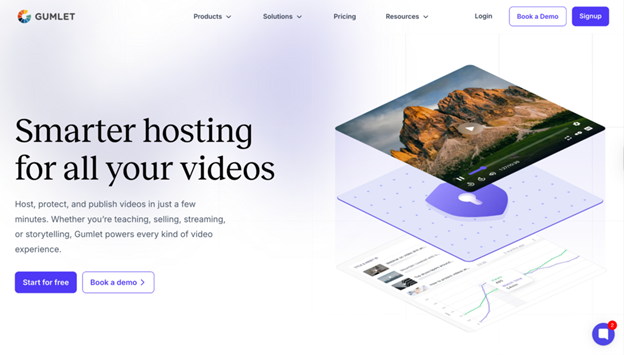
Gumlet is built for the publishing and media use case in a way that is apparent in both its pricing structure and its infrastructure choices.
Its multi-CDN routing across 700-plus globally distributed PoPs is specifically designed to handle the kind of geographic breadth that travel publishers and internationally distributed news properties require.
Custom domain support (CNAME) is available across all paid plans rather than gated behind an enterprise contract, which matters for mid-market editorial brands that need branded delivery without enterprise pricing commitments.
Simplotel, a hospitality-technology company that manages websites and booking engines for more than 3,000 hotels across 26 countries, including Altamont Hotels in Jamaica and Casa Solana in Mexico, migrated its image delivery stack to Gumlet from Cloudinary. The results across 15 million monthly image transformations:
- a 97% reduction in image size compared to original files,
- 36% better compression than Cloudinary at equivalent quality settings,
- 37% reduction in bandwidth consumption,
- and a 61% drop in operational spend. Simplotel's CEO noted a 16% average increase in client website traffic within the first 60 days.
The migration itself took two days with zero downtime.
The full breakdown of the Simplotel migration illustrates precisely why hospitality technology teams managing large photography libraries at scale evaluate Gumlet differently from a typical SaaS buyer.
For teams migrating from Imgix specifically, Gumlet maintains full Imgix API compatibility, which reduces the migration to a hostname swap rather than a codebase rewrite.
2. Imgix: Best for Engineering-Led Teams Requiring Granular Transformation Control
Imgix remains the most powerful option for engineering-led teams that want granular, URL-parameter-based control over every transformation operation. Its API flexibility is genuinely best-in-class for teams building custom media pipelines where precise transformation control at the URL level is a product requirement rather than a convenience.
The credit model is workable for stable, predictable workloads and teams with lower image volume. It becomes a friction point at high-variance publishing traffic volumes, particularly for news organizations where a single breaking story can spike transformation and delivery credit consumption simultaneously within a short window.
3. Cloudinary: Best for Enterprises Combining Image Delivery with Digital Asset Management
Cloudinary is the right call when image delivery is one capability within a broader digital asset management requirement. Enterprises managing large content teams, distributed publishing workflows, and complex media libraries across multiple properties will find Cloudinary's DAM (Digital Asset Management) layer difficult to replicate elsewhere.
The trade-off is cost structure. Cloudinary's pricing reflects the full platform weight of its DAM offering, and for publishers whose primary need is delivery optimization rather than enterprise-wide asset governance, that pricing premium is hard to justify. Teams that need both capabilities in one system, however, will find the integration depth difficult to match.
4. ImageKit: Best for Developer Teams on Modern Front-end Architectures

ImageKit competes directly on bandwidth-based pricing and PoP footprint, and it holds its own on both. Its framework-native integrations for React, Vue, and Next.js make it a natural fit for developer teams building on modern front-end architectures where the JavaScript SDK takes priority over infrastructure configuration.
For publishing operations with a strong engineering culture and a tech stack built around component-driven frameworks, ImageKit's developer experience is one of the cleaner ones on this list. Bandwidth-based pricing also means cost behavior is predictable as the audience grows, which aligns well with editorially-driven growth trajectories.
5. Cloudflare Images: Best for Publishers Already Running on Cloudflare Infrastructure

Cloudflare Images is the logical default for publishers already running on Cloudflare infrastructure, and for good reason: the integration is native, the network spans 310-plus PoPs across more than 120 countries, and the per-transform pricing model is transparent.
The practical constraint is that Cloudflare Images does not work as a drop-in image CDN the way Gumlet or ImageKit do. Images either need to be stored in Cloudflare's system or delivered through Cloudflare's Image Resizing product on a paid plan, which requires more setup than pointing a CNAME at an existing S3-compatible origin.
For high-volume properties generating significant responsive image variants across multiple breakpoints, per-transform costs also warrant close monitoring at scale.
Fastly Image Optimizer: Best for High-Traffic News Publishers at Enterprise Scale
Fastly Image Optimizer targets the high-end of the publishing spectrum and makes no apology for it. The infrastructure supporting major news publishers and large-scale media brands is enterprise-grade in the truest sense, and Fastly's Image Optimizer supports automatic conversion to AVIF, WebP, and JPEG XL based on browser capabilities, plus a format analytics layer added in early 2026 for tracking format distribution across live traffic.
The September 2025 launch of self-serve pricing removed the previous requirement for a sales-led onboarding process, making it accessible to a wider range of organizations than before.
That said, it remains the most infrastructure-heavy option on this list, best suited for organizations where raw delivery performance and format analytics at extreme scale are the primary evaluation criteria rather than ease of setup or cost efficiency at moderate volume.
One Thing Most Image CDN Comparisons Miss: The Editorial Workflow

Almost every image CDN comparison treats delivery performance as the complete picture. For media publishers, delivery is the downstream output of an upstream workflow problem that the CDN vendor either helps with or silently complicates.
Editorial teams at news organizations, travel publishers, and hotel brands do not manage image libraries the way SaaS product teams do.
Photographers upload dozens of high-resolution files per day, organized by story, shoot date, campaign, or geographic region. Non-technical editors need to locate, tag, and publish assets without filing an engineering ticket. Photo editors need to replace a published image after it goes live without breaking the URL that is already embedded across CMS pages, social posts, and newsletter sends.
A platform's bulk upload behavior, folder-based media organization, and asset replacement workflow affect daily content operations, not just infrastructure performance. Several practical questions rarely appear in generic platform comparison guides but belong in any publisher's evaluation:
- Can editorial staff organize and publish large image batches through the platform UI without API access?
- Does the CDN serve optimized variants while preserving the original file untouched, which matters for editorial integrity and source archive requirements?
- When an image is replaced after publication, does the delivery URL remain stable?
These are not secondary concerns for a daily publishing operation. For a news desk processing hundreds of images per week, or a travel site maintaining thousands of destination pages, they are as operationally critical as edge latency.
Frequently Asked Questions
1. What is the best image CDN for a news website?
There is no single best image delivery platform for all news sites. The right choice depends on your global traffic distribution, daily image volume, and whether your current infrastructure can absorb traffic spikes without degrading cache hit rates.
For high-traffic publishers with globally distributed audiences, platforms like Gumlet that offer multi-CDN failover, 700-plus PoPs, and bandwidth-based pricing tend to produce more predictable costs and more resilient delivery under the spike conditions that define news traffic patterns.
2. Does Imgix support custom domains for media publishers?
Imgix supports custom domain delivery, but CNAME access is tied to Enterprise-tier plans. Publishers evaluating Imgix should confirm current custom domain requirements directly with the vendor, as plan structures have evolved with the transition to the credit-based pricing model. Teams on lower tiers may find CNAME support unavailable without a tier upgrade.
3. Which image CDN is best for hotel and travel photography websites?
Travel and hotel photography sites should prioritize platforms with strong APAC and EMEA PoP coverage, high-quality AVIF and WebP conversion that preserves detail in large-format originals, and custom domain support for brand-consistent delivery URLs.
Platforms using multi-CDN routing with intelligent load balancing across geographic regions reduce delivery latency to international audiences most effectively, which is the variable most directly tied to engagement and booking conversion for this sub-vertical.
4. What is the difference between WebP and AVIF for editorial photography?
Both are next-generation image formats like HEIC and AVIF, that deliver smaller file sizes than JPEG at equivalent visual quality. AVIF typically produces output 15 to 30 percent smaller than WebP at comparable quality settings, which compounds into meaningful bandwidth savings across a high-volume editorial photography library.
Most modern image CDNs handle format negotiation automatically, serving AVIF to browsers that support it and WebP as the fallback, with no changes required in the CMS or publishing workflow.
5. How do image CDN costs scale for large publishers?
The two dominant pricing structures, bandwidth-based and per-transformation credit-based, behave very differently at publishing scale. Bandwidth-based pricing scales linearly with CDN delivery traffic in GB, producing invoices that move predictably with audience growth.
Credit-based models can compound costs when a single asset draws simultaneously from storage, delivery, and transformation credit buckets, a behavior that becomes most pronounced at high-traffic, high-variance media properties serving responsive image variants across multiple device breakpoints.
For publishers operating above 500 GB of monthly CDN traffic, this structural difference is usually the first variable worth modeling before renewing or switching contracts.
%201.png)

%201.png)

%201.png)