



A black box AI can be defined as an AI system where the user does not know about its internal workings. Users can observe the inputs and outputs of the system, but they cannot see what is actually happening inside the AI system that creates the desired results. Consider a black box model that assesses the resumes of the job candidates. In such a system, users can view the inputs they provide to the system, including their resumes. And then users can also see the results, i.e., the assessments the model gives for these resumes. However, the users do not get any information regarding how the model arrives at its conclusions. This means that users will not know what factors it will consider when evaluating a resume, how it measures those factors, and so on.
Most of the sophisticated machine learning models that are available today, including LLM (Large Language Model) models such as Meta’s Llama and OpenAI’s ChatGPT, are black box AI. Such AI models are trained on large data sets through complex processes of deep learning. It will be tricky for the average user to understand how they work, and they create a few problems. Let us understand the problems with black box AI models with the help of the following points-
- There is no doubt that these complex black boxes can deliver stunning results. However, the overall lack of transparency can make it tough to rely on their outputs.
- Users will not be able to fully validate the outputs of the model if they do not know what factors play in the background.
- Furthermore, this opaqueness of the black box model obscures biases, cybersecurity issues, privacy violations, and other problems.
In order to address these issues, AI researchers are now working on explainable AI tools that balance the performance of advanced models with better transparency into AI outcomes.
What is the need for Black Box AI Platforms?

Black box models are created based on two of the following reasons:
- The AI developers create black boxes to meet an objective.
- Their training ultimately turns a model into a black box.
AI programmers and developers hide the inner workings of the AI tools before they release it to the public. This tactic is generally deployed to secure intellectual property. The developers know precisely how everything works, but they hide the decision-making process and source from the public. Numerous rule-driven and conventional AI algorithms turn out to be black boxes for this reason.
Organic Black Boxes
A wide range of modern AI technologies includes generative AI systems, which can be termed “organic black box.” The creators of such tools do not hide their inner workings on purpose. Instead, the deep learning technologies that drive these systems are so obscure that even creators are not quite clear about what is happening inside these systems.
Deep Neural Networks
Deep neural networks can consume and assess raw data, i.e., unstructured large data sets with little to zero human intervention. Users feed large volumes of data in these networks to make them capable of identifying these patterns, learning from these patterns, and applying their learning to create new outputs such as videos, images, and text. This capability for large-scale learning with no supervision allows AI platforms to perform actions such as advanced language processing, original content creation, and other feats that can emulate human intelligence.
However, it is important to keep in mind that these deep neural networks are naturally opaque. Users, who include AI developers, can actually see what happens at the output and input layers, also known as the “visible layers.” They can observe the data that goes inside these systems, or the classifications, predictions, or other types of content that comes out. Users do not get any information about what happens inside the network layers in between, which are nothing but “hidden layers.”
What Do AI Developers Actually Know About These Black Boxes?
Broadly, AI developers are clear on how this data moves through each network layer, and they have a rough idea of what models do with the data they consume. But they have no idea about the specifics. For instance, they will be knowledgeable about what happens when a certain number of neurons activate, or exactly how these models search for vector embeddings and combine to create a response for a prompt. Even AI models that are open source are essentially black boxes because users, including developers, cannot figure out precisely what happens at each layer of the model when it is active.
What Are the Problems Associated with Black Box AI?
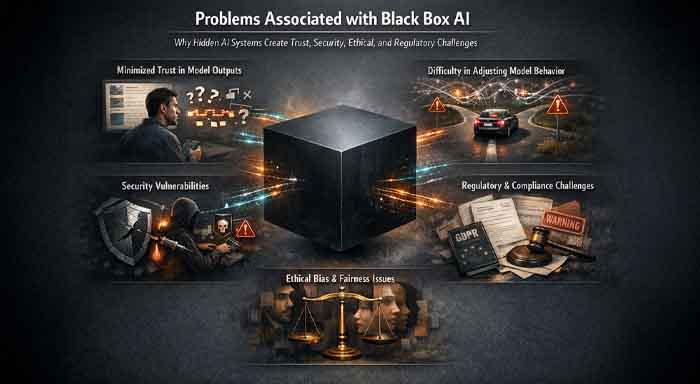
The most sophisticated Machine Learning and Artificial Intelligence models that are available today are extremely capable and smart. However, this advanced capability comes at the cost of hidden internal workings.
Generative AI models depend on complex neural networks to respond to prompts written in natural language, solve reasoning problems, and generate original content. However, it is not easy to accurately interpret what is actually happening inside those networks. You will find AI models that are simpler and rule-driven, but they are not as flexible or powerful as generative AI models.
So, AI developers cannot solve the black box problem by introducing more conventional or explainable AI systems. Sure, they can perform numerous functions, but there are a few operations that only an advanced model can perform.
While these black box AI models are in full use throughout the world and across industries, the obscurity of their inner workings and lack of transparency can be a hindrance in deriving the complete value out of these advanced models.
Minimized Trust in Model Outputs
Users do not have a clear idea of how a black box makes the decision that it does. They can determine the factors that these models have considered and the correlations that they have drawn. Even if the outputs of models like ChatGPT and Claude are accurate, users cannot understand the backend processes that actually create these outputs.
Unknown to the users, there are instances when black box models arrive at the right conclusion due to wrong reasons. In AI industries, this behavior is known as “Clever Hans Effect.” In sensitive fields like healthcare, this effect can have dangerous consequences. For instance, AI models that are trained to diagnose COVID 19 based on X-ray data can perform well with training data, but they are not effective in real-world situations.
This performance gap generally emerges because the models are learning to recognize COVID-19 based on incorrect data. There was one experimental model that was diagnosing COVID-19 based on the annotations present on the X-rays instead of the X-rays themselves. This happened because the X-rays were often annotated in the training data of the model. Physicians use annotations for research and teaching purposes, which black box models incorporate in their diagnosis.
Difficulty in Adjusting the Operations of the Model
If a black box makes incorrect decisions or creates incorrect or harmful outputs consistently, it can be difficult to adjust the model to fix this behavior. Without having a clear idea about what exactly is happening inside these models, users cannot find out exactly where things are going wrong.
This problem can be a major challenge in the area of autonomous vehicles, where developers train advanced AI systems to make driving decisions in real-time. If an autonomous vehicle makes an incorrect decision, the consequences can be detrimental. However, since the models driving these vehicles are so complex, understanding why these models make bad decisions and how you fix them can be quite difficult.
To fix this problem, numerous autonomous vehicle engineers complement their AI platforms with explainable and simple systems, like radar and lidar sensors. While these platforms do not explain the inner workings of these models, they do deliver insights into the situations and environments that propel AI to make bad decisions.
Security Problems
Since organizations cannot see what is going on inside these black box models, they cannot identify the vulnerabilities existing inside. Generative AI models are also vulnerable to prompt injection or data poisoning attacks, which can change the behavior of the model secretly without knowledge of the user. If users cannot look into the processes of the model, they will not have a clear idea about when those processes have been changed.
Ethical Concerns
Now, it is an undeniable truth that AI models, especially black box models, are susceptible to truth. If the training data contains biases, then these black box models are likely to carry forward these biases and create biased output. Now, since in black box models, the internal working is unknown; it can be difficult to identify where exactly the bias is and its causes. Unwanted bias can lead to illegal, harmful, or suboptimal responses. For example, a black box AI model can reject qualified female candidates if the training data is male-dominated.
Modern criminal justice systems leverage advanced AI models to assess the possibilities of re-offence by a person. These models are generally black boxes, at least for the public, who will not have any knowledge regarding the factors that the model will consider. If the algorithm is not transparent, it can be difficult to have confidence in its predictions or identify when they are wrong.
Regulatory Non-compliance
Specific regulations such as the CCPA (California Consumer Privacy Act) or the European Union AI Act have established rules on how businesses can use your confidential data during AI-driven decision making. If organizations are using black box models, it can be difficult for them to know whether they are compliant or prove compliance during audits.
White Box AI vs Black Box AI
White box AI is also referred to as explainable AI (XAI) or glass box AI, and it is the exact opposite of black box AI. It is an AI platform whose inner workings are quite transparent. Users can clearly see and understand how the platform consumes data, processes it, and reaches a conclusion.
White box AI models make it easy for users to validate the outcomes and trust them. Furthermore, they also have the option to tweak the models in order to improve accuracy and performance. However, it is not so easy to convert every AI into a black box.
Conventional AI models can often be more transparent if their source code is shared publicly. However, advanced machine learning models can create their own parameters through deep learning models. Even if you publicly share the architecture, users will not understand what they are doing.
Having said that, you should know that research is being done currently to find a way to make modern AI models more transparent and explainable. For instance, Anthropic researchers are deploying what is known as autoencoders to Claude Sonnet 3 or higher versions. It is a type of neural network that can help in understanding which neurons combine to create a response for which concepts.
How to Deal with the Challenges of Black Box AI?
Businesses can choose white box models wherever they need, but there are some workflows that need advanced black box AI tools. Having said that, there are always techniques to make black box models more reliable and reduce some of the risks-
Open-source Models-
Open-source models can provide users greater transparency into their operations and development than closed-source AI platforms that make model architecture private.
An open-source generative AI model might turn out to be a black box because of its complex neural network. However, it can provide users with much better insights than a closed-source model.
AI Governance-
AI governance, i.e., the standards, the processes, and the guardrails that aid in ascertaining AI tools and systems are ethical and safe allows businesses to maintain robust control structures for AI executions.
Governance tools can provide a greater insight into model operations via tracking automation, health scores, performance alerts, and audit trails. Now, it is important to keep in mind that AI governance might not make a black box transparent, but it can aid in detecting anomalies and preventing inadequate use.
AI Security-
AI security tools and processes can aid in identifying and resolving vulnerabilities in AI models, applications, and associated data sets that security and IT teams might not discover on their own. AI security platforms can also provide deep insights into data of each AI deployment, model, and application usage, as well as applications that access the capabilities of AI.
Responsible AI-
A responsible AI framework provides an organization with a fixed set of practices and principles that make AI more reliable. For instance, IBM’s trust and transparency principles of AI involve transparency, explainability, and fairness. Where black box models are required, complying to the framework can help a business utilize those models better.
Conclusion
Black box AI platforms showcase a fundamental trade-off between transparency and capability. While such sophisticated models ensure tremendous results across various industries, their black box nature creates major concerns related to bias, trust, security, and regulatory compliance. Businesses cannot simply abandon black box AI, as certain critical tasks require advanced processing power. Instead, it is important for businesses to execute complete strategies integrating security frameworks, AI governance, and responsible AI practices. By utilizing open-source wherever possible and setting up powerful oversight mechanisms, businesses can leverage the power of black boxes while reducing the intrinsic risks and ensuring accountability.
FAQs About Black Box AI
Q. Is ChatGPT a black box?
A- Yes, ChatGPT is considered a “black box AI” because of its deep neural network architecture and large training data. Its internal decision-making process is incredibly complex and opaque.
Q. What are the Black Box AI problems?
A- Since the inner workings of a Black Box AI is not revealed, its biases, security vulnerabilities, and decision-making processes remain hidden.
Q. What is the white box AI?
A- Quite opposite to black box AI, white box AI can be defined as interpretable and transparent AI models where humans can understand the decision-making process and internal logic.
Q. Why do AI developers create black box models?
A- AI developers generate black box models either intentionally to secure intellectual property or unintentionally because deep learning neural networks become opaque and complex, even to the developers.
Q. How can businesses minimize risks related to black box AI?
A- Businesses can reduce black AI risks by executing AI governance frameworks, leveraging open-source models wherever possible, implementing AI security platforms, and deploying responsible AI practices with powerful oversight mechanisms.
%201.png)

%201.png)

%201.png)