





You can utilize business process services like outsourcing bookkeeping to reduce your administrative burden and enhance financial accuracy while defining scope, controls and service levels upfront. By using a structured approach, you can effectively estimate the real costs, carry out objective evaluation of vendors, and design an operating model that gives you controls. Whether you run a growing software-as-a-service (SaaS) company, an e-commerce brand, or a professional services firm, the principles here apply across contexts.
Expect clear definitions of what bookkeeping virtual assistant services and bookkeeping outsourcing includes, a readiness diagnostic to test your preparedness, security requirements aligned with recognized frameworks, cost modeling based on current U.S. labor data, and a phased implementation plan with measurable checkpoints. The goal is a confident, numbers-backed decision followed by disciplined execution.
Outsourcing is rarely all-or-nothing. Several teams that succeed usually start with a limited scope and proven value. They expand once trust, data quality and controls achieve stability.
Define Outsourced Bookkeeping Scope Precisely to Avoid Confusion

Clear scope prevents misunderstandings that cost revenue loss and scope creep. Bookkeeping is the accurate, timely recording, and reconciliation of financial transactions plus the preparation of basic management reports. It is not a tax strategy, audit work, or chief financial officer (CFO)-level advisory unless you contract those separately.
In-Scope Activities
- Accounts payable (AP): vendor onboarding with W-9 collection, three-way matching for purchase orders, coding, approval routing, and payment file preparation with dual approvals.
- Accounts receivable (AR): invoice creation triggered by your customer relationship management (CRM) system or sales orders, cash application, unapplied cash research, and dunning cadence setup.
- Bank and credit card reconciliations: daily bank feed monitoring, next-day cash reconciliations, weekly card reconciliations, exception tracking, and variance explanations.
- Expense management: receipt capture enforcement, policy checks, general ledger coding, and exception escalation.
- Management reporting: statements for profit and loss, balance sheets, snapshots of cash flow, and variance analysis with commentary.
- General ledger maintenance: posting recurring journals, reclassifying miscoded entries, and maintaining supporting schedules for key balances.
Out-of-Scope Without Separate Agreement
Income tax preparation, assurance services, or attest work requires a licensed certified public accountant (CPA) with independence. Complicated revenue recognition policy design and high-judgment accounting estimates belong with a controllership service or internal team. Implementations such as IT administration and finance systems fall outside standard bookkeeping contracts and should be treated as separate projects.
Evaluate Your Process Maturity Before Deciding to Outsource Bookkeeping
Outsourcing performs well when you can articulate systems, inputs, approval paths, and outputs for your major financial processes. Stabilize your internal processes if they are undocumented or if your master data is not organized properly.
Data Hygiene and Systems
- Make a list of your accounting system, CRM, AP, AR, and payroll tools along with their versions, owners, and primary use cases.
- Confirm your chart of accounts following naming conventions and get rid of all duplicate or inactive accounts that create reporting noise.
- Verify that automatic bank feeds are enabled with tracked error rates and a clear mapped out process for resolving feed failures.
- Standardize document naming and storage locations to allow external teams to retrieve support quickly during reviews or audits.
Operational Workload Indicators
If your internal admin or founder spends more than eight to ten hours weekly on bookkeeping, hiring a bookkeeping virtual assistant becomes attractive. QuickBooks reveals that growing U.S. businesses spend roughly twenty-five hours weekly on doing data entry manually and reconciliations on average. Count your unreconciled transactions that are older than thirty days, monthly invoice and bill volumes, and actual versus target close dates to accurately measure the real workload.
Security Posture
Multi-factor authentication (MFA) should be enforced across finance systems. Keep documented records of your approval matrix revealing who approves vendor creation, invoices, and payments at each threshold. Flag any card payment data, protected health information under HIPAA, or personally identifiable information (PII) considerations in early stages, so that vendor controls align with your requirements.
Sequence Bookkeeping Tasks So Low-Judgment Work Moves Out First
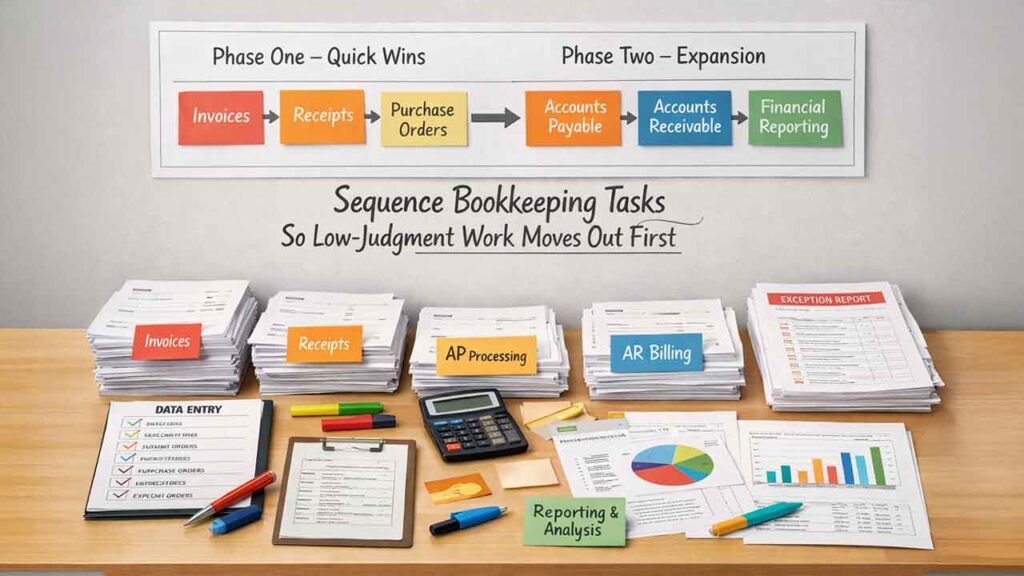
Rather than speed, sequencing matters more. First, begin with low-judgment, high-repeatability tasks and gradually expand as confidence starts building.
Phase One Quick Wins
- Daily bank and weekly card reconciliations with exception logs and documented resolution steps.
- Receipt capture and expense coding using policy-based rules that reference your chart of accounts.
- Invoice posting from CRM with standardized item mapping and required supporting documentation.
Before carrying out the handoff to your bookkeeping virtual assistant, make sure to document straightforward playbooks for every outsourced task. To make it clearer, add screenshots, field-level instructions, and examples of edge cases. This helps the provider to act consistently without looking for constant clarification.
Phase Two Expansion
After ensuring the consistent quality of evidence, integrate AP scheduling and payment run preparation with dual approvals. Introduce audits of expenses along with policy compliance sampling. Enable AR cash application automation plus first-level collections of scripts coordinated from CRM tasks.
Retain Internally or With CPA
Important elements such as policy decisions regarding revenue, complicated deferrals, pricing regulations and strategies for tax must stay within an internal team or a licensed CPA. Outsourcing these prematurely can increase the risk without any proportional benefit. These areas depend on business strategy and risk appetite, which third-party can’t understand better than your leadership team.
Choose an Outsourcing Model That Matches Your Risk and Complexity Profile
Independent Freelancer
Freelancers are flexible to work with. They offer transactional work but there is a risk of single-point failure. Coverage typically spans business hours in one time zone. This approach is ideal for stable and low-volume small businesses who are willing to handle process, manage documentation and security directly.
Bookkeeping Virtual Assistant Service
A coordinator-led bookkeeping virtual assistant service (for Bookkeeping and Outsourcing Customer Service) executes tasks across AP, AR, and reconciliations with potential after-hours coverage. Make sure to confirm that the provider enforces MFA, keeps audit logging, and follows documented playbooks. This model works best for small to medium size businesses (SMBs) because they usually want a managed option with weekly bank reconciliations and proactive AR follow-ups without any need to hire in-house staff.
Managed Bookkeeping Provider
Team-based delivery with standard operating procedures, assurance of quality, and redundancy are fit for those businesses that are growing with integration-heavy stacks. Long hours and formal levels of service address segregation-of-duties and audit-friendly documentation requirements. Expect onboarding that is more structured along with clearer escalation paths than with ad hoc freelancers.
CPA or Accounting Firm
A CPA firm offers stronger assurance artifacts in case lenders or investors expect documents that are attest-ready or when revenue recognition policies are material. Costs increases and you must maintain a balance and independence between bookkeeping and attest services. This model works well when you anticipate due diligence, financing, or frequent external audits.
Taken together, these models show that you can match delivery structure to your risk appetite, internal process maturity, and coverage needs without defaulting to a full-time employee. For U.S. SMBs that want a managed option with weekly bank reconciliations, proactive A/R follow-ups, after‑hours coverage, and a single coordinator instead of hiring in‑house, a bookkeeping virtual assistant can provide a balanced mix of flexibility and control.
Calculate Total Cost of Ownership to Compare In-House and Outsourced Bookkeeping
Comparing internal hiring to outsourcing requires honest accounting for wages, benefits, software, supervision, and risk.
Building the Cost Model
The U.S. Bureau of Labor Statistics reports the median annual wage for bookkeeping, accounting, and auditing clerks was $49,210 as of May 2024. Employer benefits average roughly 29.7 percent of total compensation for private-industry workers. Fully loaded internal labor therefore runs approximately $63,800 per year or $5,316 monthly.
Add software costs of $150 to $300 monthly depending on your finance stack. Manager oversight at four hours weekly times a $60 fully loaded rate adds roughly $1,039 monthly. Amortize hiring and backfill costs at about $250 monthly. Include a risk contingency reflecting expected-value fraud exposure. IBM reports the global average data breach cost reached $4.88 million in 2024, with U.S. averages near $9.36 million.
Combine these elements together into a single total cost of ownership (TCO) figure for internal delivery. To operate in cities that are expensive or require industry specialization, adjust wage and benefits assumptions upward. There might be lower cash compensation for roles that are fully remote. However, they may require more investment in appropriate tools and management time.
Worked Example
Internal monthly TCO: $5,316 labor plus $200 software plus $1,039 oversight plus $250 hiring plus $100 risk contingency equals approximately $6,905. Vendor monthly TCO: $2,500 fee plus $200 software plus $520 reduced oversight plus $125 amortized implementation equals approximately $3,345. Monthly savings run around $3,560, yielding annualized savings near $42,720, and breakeven on a $1,500 implementation occurs in the first month.
Cash-Flow Upside
Reducing days sales outstanding (DSO) by five to seven days on $250,000 monthly credit sales frees $41,096 to $57,534 in working capital. Apply that freed cash to inventory, paid acquisition, or interest savings. Even on lower volumes, a modest DSO improvement can fund better reporting tools or part-time controllership support.
Set Security and Compliance Guardrails Before Granting Any Vendor Access
Security failures dwarf any cost savings from outsourcing. To avoid negotiating controls under time pressure, establish non-negotiable baselines even before onboarding any vendor.
Requirements for Baselines
- Multi-factor authentication on banking portals, expense tools, accounting, and password managers. Microsoft estimates MFA blocks over 99.9 percent of account-compromise attempts.
- Least-privilege access is enforced through role-based permissions and quarterly access audits.
- Review assessments retained for one to three years and evaluate on a monthly basis.
- Combined password control with a shared storage system instead of exchanging credentials through chat, spreadsheets, or email.
Fraud Detection
Business email compromise (BEC) continues to be a significant threat. The FBI cites $55.5 billion in global BEC losses between October 2013 and December 2023.
Establish independent callbacks to validate phone numbers when vendor bank credentials change. Enforce duty segregations: one function creates vendors; another authorizes; third executes payments. Consider any urgent or confidential payment change request as a potential red flag.
Compliance Frameworks
Obtain SOC 2 Type II reports, including relevant trust policies; these service organizations manage reports that demonstrate how security and availability measures operate day to day. ISO/IEC 27001 certification represents an advanced data security management system. When cardholder information exists, document Payment Card Industry Data Security Standard (PCI DSS) v4.0 scope determinations and validate authentication needs.
The Role of Structured Scorecard to Evaluate Bookkeeping Vendors Impartially
Implementing a weighted scoring model avoids bias in selection and preserves the rationale behind decisions. Bring two or three finalists through the same scoring process so you can explain the choice to auditors, investors, or a board.
Scoring Standards
- Commercials (15%): Cost visibility, deployment costs, termination guidelines.
- Process Maturity (20%): Well-defined formal operating procedures (SOPs), quality assessment, reconciliation documents, and error handling.
- Technical Integration (20%): Smart integration of CRM and accounting platforms, exception handling, and logging transparency.
- Security and Compliance (30%): Multi-Factor Authentication (MFA) requirements, least-privilege principles, certifications, and incident handling procedures.
- Staffing and Coverage (15%): Operating times, 24/7 support services, backup systems, business resilience planning.
Essential Evaluation Questions
Request vendors to provide a complete, comprehensive payment authorization segregation. Obtain sample reconciliation files with reviewer approval and timestamp records. Check breach alert timelines, store retention duration, CRM integration workflow (including linking failure handling) and engage with a minimum of two reference clients of comparable organizational size and systems.
Roll Out Outsourced Bookkeeping in Measured 30-60-90 Day Phases
A phased rollout with well-defined milestones lowers the risk of likelihood while strengthening confidence gradually.
Initial 30 Days
Finalize scope and assign clear accountability. Set up least-privilege accessibility with read-only bank connections for security. Bring it on your chart of accounts and vendor master, confirming W-9 and TIN (Taxpayer Identification Number) status.
Implement simultaneous reconciliations and set up key performance indicator (KPI) benchmarks for cycle times and error rates. Hold weekly standups and a retrospective at day thirty.
From Day 31 to 60
Enable AP scheduling and AR cash application under dual approvals. Introduce CRM-triggered invoicing. Track KPIs on a weekly basis with targeting next-day cash reconciliations and sub-one-percent error rates, while enabling event logs and alerts for integration failures.
From Day 61 to 90
Complete service-level agreements and tailored to DSO targets. Streamline variance notifications, discrepancy reports, reference pack aggregation, and conduct scheduled quarterly access audits with control verification. Run a dynamic operation manual that records all processes and is revised after an event or material adjustment.
Link SLAs and KPIs Directly to Business Results that Actually Matters
Sync vendor responsibility with quantifiable business results beyond activity tracking.
- Reconciliation timeliness: cash next day, cards weekly.
- Error rate: below 0.5 percent of transactions on monthly sampling.
- AP cycle time: invoice moves from receipt to approval within a median of 3 business days.
- AR DSO: cohort-based targets with five to seven day reduction over baseline within ninety days.
- Support response: acknowledgment within four business hours, resolution within one business day for minor tickets.
Define data sources for each KPI and automate extraction. Use a shared dashboard and weekly fifteen-minute reviews. Designate responsible owners for items exceeding thresholds and monitor corrective actions until completed.
Prevent Common Outsourcing Challenges by Safeguarding Scope, Access, and Ownership
The common reasons why most outsourcing fails lie beneath poorly defined scope, inadequate access management, or missed internal administration.
An incomplete statement of work with vague deliverables leads to rework and conflicts. Excessive access permissions, such as complete bank access instead of read-only---significantly increase fraud vulnerability. When no single internal owner is assigned to make decisions and remove blockers, meetings often result in non-stop discussions without progress.
Write a precise statement of work (SOW) with acceptance criteria and evidence requirements for each process. Implement least-privilege access and enforce MFA across all systems. Designate a business owner who operates weekly workflow reviews with clear, well-structured decisions.
Maintain an exit plan starting day one, including how you will transition books and revoke access if performance slips.
Candid feedback loops matter as much as contracts. Schedule periodic retrospectives with your vendor, surface issues early, and decide whether problems stem from process design, training, or individual performance before reacting.
Maintain Tight Governance so Outsourced Bookkeeping Continues to Deliver ROI
Working with a bookkeeping virtual assistant to outsource bookkeeping tasks can unlock material time savings and cash-flow improvements while strengthening controls. You can start with disciplined scoping, precise service stages, and robust security measures right from day one.
Leverage the diagnostic and price model to confirm your decision, the scorecard to choose the right vendor, and the phased plan to execute with confidence. Conduct quarterly reviews and prepare a defined exit strategy to keep things in control as your business expands.
When managed correctly, outsourced bookkeeping integrates seamlessly within your control environment instead of bypassing it. Think of the relationship as a lasting operating capability rather than just a quick fix, and keep adjusting scope, controls, and metrics as your business continues to scale.
%201.png)

%201.png)

%201.png)