
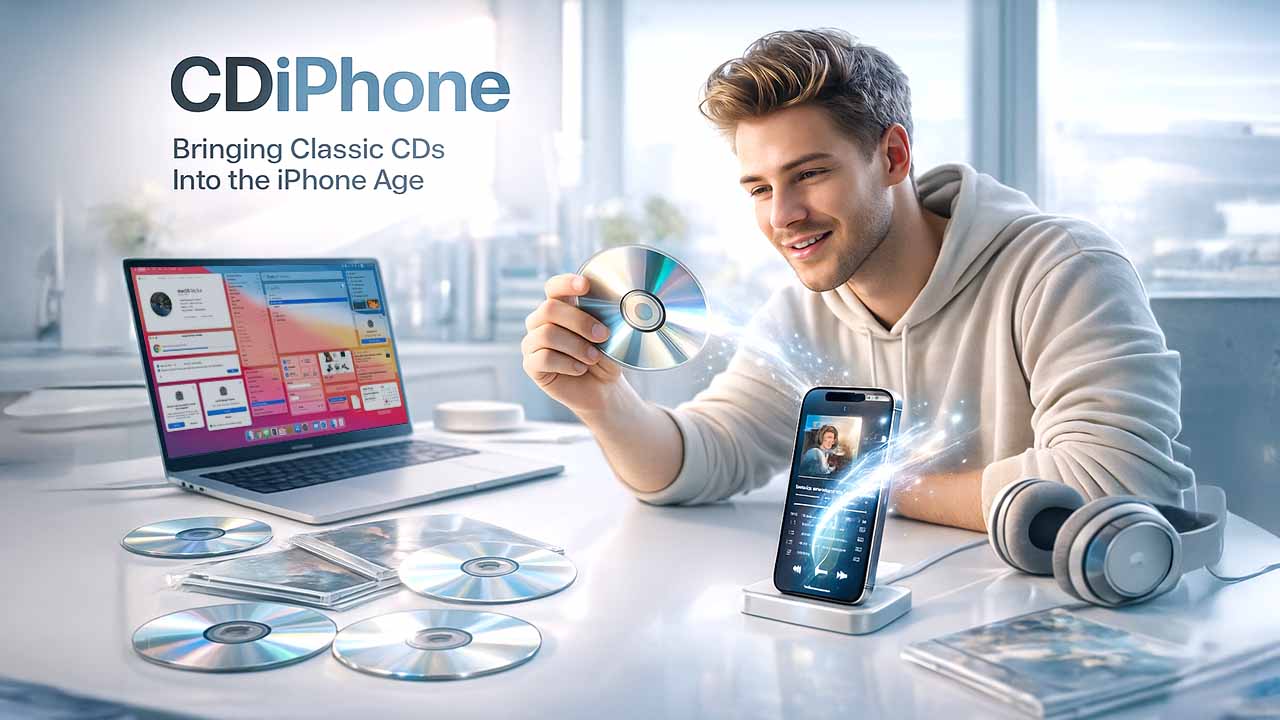

First of all, let us be clear with the fact that CDiPhone is not an actual Apple product. It is just a fun idea explored within Apple communities. It toys with a hypothetical concept of integrating CDs (Compact Disk) with an iPhone. Many users have recently wondered about a way to make their iPhones play CD music. However, according to Apple experts, there is simply no way to add a CD drive to the iPhone.
This simply rejects the idea of plugging a CD player into your iPhone like a USB drive. This term “CDiPhone” became popular when music lovers started asking whether there was a way to enjoy old CD music on their iPhone devices. If you are curious about exactly where the term “CDiPhone” emerged from, are CDs still relevant in 2026? Can you actually transfer the music stored on your CDs to your iPhone? and future innovations we can expect.
The Importance of CDs in the Music Industry
The history of CDs can be traced back to the early 1980s. The first commercial CD was introduced by Philips in 1982. This completely transformed the way people listened to songs back then. CDs started to dominate the market, quickly replacing LPs and tapes. This was simply because CDs stored more songs, offered a higher song quality, and were more durable.
Throughout the 1980s and 1990s, CDs dominated the music industry and emerged as a global phenomenon. Most people had a vast collection of CDs at their home, stored a few in their cars, and some even used portable Walkman devices. Even the popularity of Blu-ray discs and DVDs could not impact the popularity of CDs.
The Gradual Decline of CDs
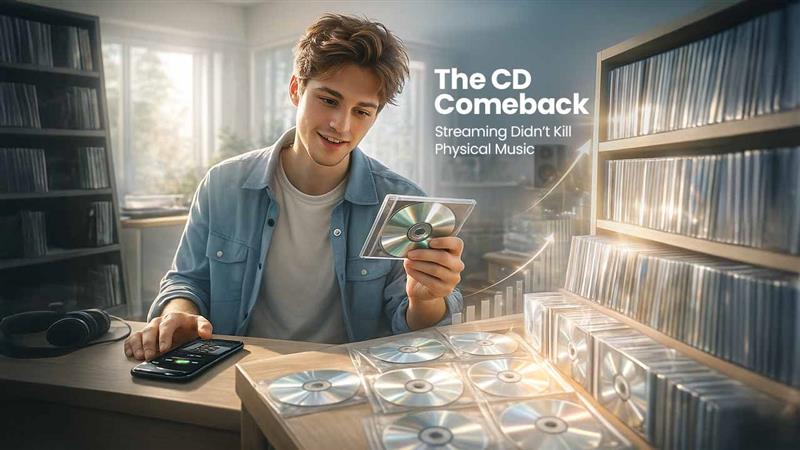
In early 2000, CD sales reached their upper threshold. They were used all around the world in cars, home music systems, personal computers, etc. However, soon the world experienced the rise of the internet, MP3 files, and digital downloads. Gradually, music streaming platforms also became popular, and CD sales started to drop.
Slowly, the physical stores of music started shutting down. It marked a major shift in how people listened to music. Streaming services offered great convenience, and naturally, people were inclined toward them. However, contrary to popular belief, the CD industry did not completely die down.
In fact, as per the RIAA report, the CD industry grew by 11% in 2023, its overall value touching $537 million. What is astonishing about this is the fact that approximately 43% of CD buyers are under the age of 35. This points to the fact that younger audiences are rediscovering CDs and are liking them.
Read Also:
- How To Convert A Picture To PDF On An iPhone
- How to Free Up Space on iPhone When You’re Out of Storage
- How to Clear App Cache on iPhone: A Simple Guide for a Faster, Cleaner Device
So, Why CDs in 2026?
We live in the era of streaming services. However, CDs are making an unexpected comeback, as it is evident from trending terms like “CDiPhone.” Let us list the factors that influence users to purchase and even talk about CDs.
- The Nostalgia Factor: For Gen X and millennials, CDs are a major part of their favorite music year that they have a lot of affinity toward. At the same time, Gen Z has also found CDs to be “vintage cool”—a unique experience that the digital world, ruled by streaming services, has denied them.
- True Ownership: When you purchase a CD, you gain lifelong rights. You will never have to face modern issues like monthly subscriptions, songs missing from your platforms, the need for internet, etc. CDs are a one-time purchase that provides lifetime value.
- Superior Sound Quality: CDs provide uncompressed audio at 16-bit/44.1KHz— no compression, no buffering, and no dependency on internet connection. Audiophiles understand the difference.
- Directly Supporting Artists: Selling a single CD compensates artists a lot more than publishing it on thousands of streams. Fans wish to support their musicians genuinely and notice CDs as direct financial support.
- The Tangibility Factor: We live in a world that is increasingly digital. Having physical media gives you something that streaming cannot. A tangible album art, liner notes you can include, and a collection of CDs you can use to display in your home.
- Affordability: Utilized CDs cost approximately $1-5 at thrift stores, less expensive than yearly streaming subscriptions for collectors who are budget-conscious.
The "CDiPhone" has become a popular term on the internet because it resonates with people’s desire to bridge modern devices with physical collections.
The History of iPhone
Apple revealed the iPhone on 9th January 2007 when Steve Jobs announced it as a phone, internet communicator, and an iPod all rolled in one. The world of technology changed forever after that. Over the years, the iPhone has become better with faster processors, more advanced cameras, and huge storage capacity. By the end of 2025, billions of units will have been sold all around the world. The emergence of smartphones like the iPhone has accelerated the rise of streaming services, making CDs seem like an outdated technology. People prefer apps such as Spotify, Apple Music, and YouTube to store as well as play music online.
After 2008, Apple began to remove CD drives from its computers. Thus, it is obvious that we never had an iPhone with a CD drive support. Modern iPhone comes with a USB-C or Lightning Port, which is a great option for charging and accessories, but not for using a CD.
A Practical Way to Get CD Music on Your iPhone
While you cannot directly play CDs on your iPhone, you can easily transfer CD music to your iPhone directly. The best ways to do that are described as follows:
1. Through the Music App or iTunes:
- Choose a computer that has a CD drive.
- Insert your CD in the CD drive.
- Open your music app (Mac) or iTunes (Windows).
- After that, you can connect your iPhone and synchronize your library.
This is the most common and easiest way to move the songs from your CD to your iPhone.
2. Through Apple Music or iCloud:
You can import the CD songs on your computer and then enable Sync Library. This allows you to upload your songs to iCloud. You will then have all your songs accessible on your iPhone.
3. Utilizing a USB Drive:
Convert your CD songs to MP3 files, save them on a USB drive, and then move them to your iPhone via the Files app.
4. Utilizing Third-Party Apps:
Applications such as iMazing make it quite simple to transfer the music from your computer directly to your iPhone.
Why can't you connect a CD Drive to an iPhone?
The thought of plugging a CD drive directly into your iPhone sounds very cool, but it is not quite possible. Let us understand why:
1. No Space:
CD drives are quite mechanical and large. On the other hand, iPhones are designed to be compact and slim. There is no room for a CD mechanism.
2. Connection and Power Limits:
A CD player generally requires a lot more power than an iPhone can supply via USB-C or Lightning ports. Furthermore, iOS does not support CD drive communication.
3. Missing Software:
CD drivers require particular drivers to work. On the other hand, iOS does not have these built-in drivers. Thus, even if you manage to connect one, it will not work.
4. Outdated Technology:
Apple has ceased building its external SuperDrive CD readers since 2024. As far as Apple is concerned, the company is quite sure that CDs have now become a thing of the past.
5. Battery and Physical Concerns:
An in-built CD slot makes the iPhone extremely bulky, quite vulnerable to dust, and more power-consuming. It is quite contrary to the sleek design goals of Apple.
So, if there is one takeaway from this section, it is just this: CDiPhone is a good food for thought. However, the thought for converting into an actual device is quite impractical.
Future Possibilities
It is true in technology as it is true in any field: never say never. In this section, let us explore some futuristic ideas that can bring phones and CDs closer.
- Wireless CD Player: Wi-Fi CD players or small Bluetooth speakers that directly stream music on your iPhone.
- Sophisticated Connectivity: Advanced phones in the future can support more external devices, including drives.
- Mini CD Drives: As components become smaller, portable CD attachments are also a possibility.
- Smart Applications: Applications that link phones to computers or simulate CD playback for listening in real-time.
- Digital Album Apps: Interactive applications that recreate the look and feel of owning a CD collection.
Currently, they are just random ideas, but they can become a reality in the future, reviving the significance of CDs in the music and technological landscape.
Conclusion
As the blog makes it clear, CDiPhone is not an actual product but a symbol of nostalgia. It showcases the bridge between modern iPhones and classic CDs. Even though you cannot directly play a CD on an iPhone, you can still make the most of your CD collection by importing as well as synchronizing your music. Though the process can take a few steps, it is the only way of reliving your favorite albums on your iPhone device. Perhaps someday, technology will find a way to merge the two worlds together. For now, you will have to manually synchronize your music if you want to play old-school albums on modern devices.
%201.png)

%201.png)

%201.png)